
A 10kW Solar-Storage System in Nigeria: Built Around a Non-Stop Freezer
Site record of a frozen wholesale outlet in Ogun State, Nigeria: 12 × 630W modules, 1 × 10kW three-phase hybrid inverter, 1 × 15kWh low-voltage battery cabinet

It is two o’clock in the afternoon in August, Ogun State. Beside the highway from Ifo to Lagos sits a store with an iron-sheet roof. Foam boxes are stacked at the entrance, beads of water still clinging to them. Six refrigeration units stand side by side inside, compressors humming, and the room feels even hotter than outdoors.
Instead of showing us the rooftop first, the shop owner led us straight to the distribution board. It was a three-phase four-wire unit replaced just last year. He told us power cuts occur four to five times a day — some last 10 to 20 minutes, others half a day. Occasionally the voltage drops to barely over 180V, and the compressors cut out with a click, requiring manual restart. If an outage hits overnight, he opens up the next morning to find a whole cabinet of thawed fish.
That statement became the starting point for the whole solution. What he really needed was not just “a solar installation”, but “these cabinets must never stop”.
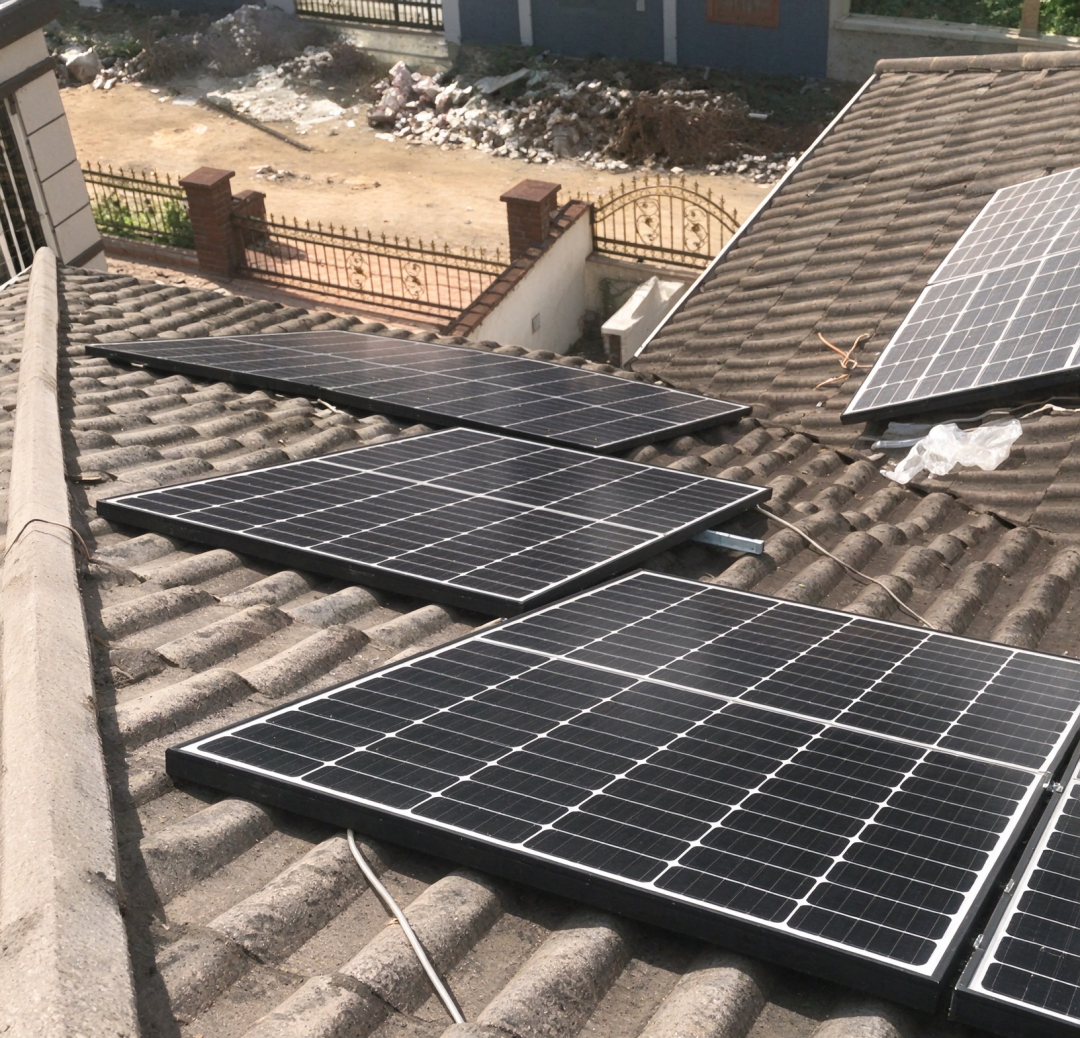
Solar panel installation pictures
Requirements Gathered On-Site
Before drafting the proposal, we spent most of the day at the store and noted down the following:
- Quantity and rated power of each appliance, and which ones require uninterrupted power overnight
- Operating schedule and duration of the water pump
- Nighttime loads: cash register, fans, lighting, router
- Highest-priority load during outages (not the lights, but the compressors)
- Available location for the battery: the store is humid, prone to rats, and there had been thefts at the entrance
- Three-phase supply available (yet several single-phase loads were all connected to the same phase)
Every subsequent calculation grew from these notes. Standard templates cannot bridge the gap between engineering drawings and real site conditions.
Balance the Energy Budget First, Then Select Equipment
Based on the store’s operating routine, daily energy consumption is around 20kWh:
| Load | Daily Consumption | Description |
|---|---|---|
| Refrigeration & freezing (4 chest freezers + 1 display cabinet + small cold room) | ~10kWh | 24-hour continuous operation, no overnight shutdown |
| 1.1kW well water pump | ~3kWh | Runs once in early morning and once in evening, roughly 1 hour each time |
| Lighting, fans, cash register, router | ~4kWh | Mainly active 18:00–23:00 |
| Ice maker and spare display cabinet | ~3kWh | Interruptible, the first loads to be shed in an emergency |
The peak load does not fall at noon, but in the evening, when compressors, pumps, lights and fans run together, reaching an estimated 4.5–5kW. One easily overlooked detail: when power resumes after an outage, multiple compressors start simultaneously with an inrush current 3–4 times the rated value. The 10kW inverter was selected not as vague “extra margin”, but to withstand this transient surge. Its continuous backup rating is 10kW, with a 2× overload capacity for 10 seconds — perfectly matching this scenario.
The average overnight load is only 0.5–0.6kW, consuming roughly 7kWh over 13 hours. This justifies the 15kWh battery: around 1.5 times the night load, enough to sustain operation through two consecutive cloudy days with reserve remaining.
How the Three Key Figures Interlock
7.56kWp, 10kW and 15kWh are not random approximate values grouped together; they are tightly coordinated parameters. 12 pieces of 630W modules give a DC capacity of 7.56kWp, paired with a 10kW AC inverter, for a DC-to-AC ratio of 0.76. On sunny dry-season days, generation hits 22–24kWh, enough to cover the 20kWh daily load and charge the battery. In the rainy season with heavy cloud cover, output can drop to 9–12kWh, and the shortfall is supplemented by the grid. The local grid is unstable, yet it is still present.
The battery is 51.2V, 15.36kWh. Its maximum charging current is 100A, equivalent to approximately 5.1kW. This means when solar output peaks at 7kW around midday, battery charging is capped at 5.1kW. Excess power first feeds the loads, and any surplus beyond that is clipped. Some see this as wasteful, but this clipping point is intentional: the battery avoids sustained full-power charging, runs cooler, and cycles more gently. The 5000-cycle rating for lithium iron phosphate (tested at 25°C, six-month storage baseline) can only be achieved under mild operating conditions.
Its discharge current reaches 200A. 200A × 51.2V ≈ 10.2kW, matching the 10kW inverter perfectly, eliminating the risk of the inverter demanding power that the battery cannot supply.
String Configuration: A Detail That Makes or Breaks the System
The layout of the 12 modules is the single point where poor design leads to persistent faults.
First, the inverter constraints: two independent MPPT channels, each accepting only one string. Max input current per channel: 20A; max short-circuit current per channel: 25A. MPPT operating window: 150–850V; startup voltage: 180V; absolute max input voltage: 1000V.
We settled on 2 strings × 6 modules:
- Operating voltage: 6 × 41.82V ≈ 251V, sitting comfortably in the middle of the 150–850V MPPT range
- Open-circuit voltage: 6 × 49.34V ≈ 296V. At low morning temperatures, Voc rises at -0.25%/°C, reaching roughly 303V at 10+°C, still far below the upper 850V limit
- String current: Imp = 15.07A, Isc = 16.27A, well under the 20A / 25A per-channel limits. One string per MPPT channel, no parallel current stacking
- Identical module count on both channels, preventing mismatch drag
We also evaluated an alternative: 3 strings × 4 modules, still totalling 12 panels. That layout yielded Voc of only 197V, barely enough for startup, and Vmp of just 167V. When temperatures rise, voltage sags close to the 150V lower threshold and can drop out of MPPT tracking. Worse still, combining two strings in parallel on one MPPT channel would push current to 30A and Isc to 33.5A, exceeding both limits. This configuration was rejected immediately.
Equal module count is superficial; validity depends on electrical parameters. It sounds simple, but on-site rework teaches you the cost of cutting corners.
Final string design: MPPT Channel 1: 1 string of 6 modules; MPPT Channel 2: 1 string of 6 modules, total DC capacity 7.56kWp.
System operation principle video
Equipment Specifications
Inverter

10kW hybrid inverter Weight: 43kg; Dimensions: 475×698×240mm. Wall-mounted, manageable by one person. Max efficiency: 97.6%; European efficiency: 97.0%; MPPT tracking efficiency: 99.9%. Three-phase output 220/380V or 230/400V, 50/60Hz. AC input tolerance: -15% ~ +10%, 45–55Hz auto-sensing. This feature is especially valuable in Nigeria: when grid voltage falls below 187V, the inverter disconnects from the grid and switches to battery power, shielding compressors from low-voltage stress. Transfer time between grid-tied and off-grid mode: 10ms. Cash registers and lights do not flicker. IP66 protection rating, intelligent air cooling, 100% support for three-phase unbalanced loads — ideal for this store, where single-phase loads cluster on one phase. Built-in Type II/III DC surge protection, plus full protection suite: reverse polarity, insulation monitoring, earth leakage, anti-islanding, and optional AFCI arc fault protection. 10-year warranty. OLED display and mobile APP monitoring; LAN connection enables remote generation and consumption monitoring.
Battery

15kWh energy storage battery 51.2V vertical cabinet, lithium iron phosphate, 15.36kWh (300Ah). Charge current: 100A; discharge current: 200A; pulse discharge: 300A for 15 seconds. CAN / RS485 communication with the inverter. BMS manages overcharge, overdischarge, overcurrent, overtemperature and short-circuit protection. Operating temperature: -10~50℃; Humidity: 0–95% non-condensing; Altitude: ≤1500m. UN38.3 and MSDS certified. Critical installation note: IP20 rating, for indoor installation only. It cannot be mounted outdoors alongside the inverter under direct sunlight. Modular design: individual modules are around 5kWh, paralleled inside the cabinet to reach 15kWh. Expansion is possible with identical modules in parallel. Do not mix modules of different batches or capacities, as conflicting BMS units will cause faults.
Daily Operating Logic
- During daytime: solar power supplies loads first. Excess generation charges the battery. Export to grid is disabled. Net metering is unavailable locally; grid export offers no revenue and creates unnecessary risks.
- Around 18:30, once irradiance drops below the threshold, 10ms seamless transfer to battery power — lights stay on and cash registers do not reboot.
- Overnight: battery maintains a 20% SOC minimum while freezers keep running.
- 06:00: the water pump starts on a timer. It prioritises solar power, drawing battery power only when necessary. Scheduling the pump for early morning is the most energy-efficient tactic, as solar irradiance is already rising while the freezer compressors are in a low-load cycle.
- When grid supply restores: the inverter first verifies acceptable voltage before reconnecting. The grid then charges the battery, with charging current limited to ~60A for slower, cooler charging.
- Extended cloudy weather load shedding sequence: ice maker first, then spare display cabinet. Freezers are the last loads to be disconnected.
Commissioned in August, monitored through November for three months:
- Sunny dry days: 22–24kWh daily generation
- Worst rainy stretch: three consecutive cloudy days, 9–11kWh daily generation
- Average overnight battery discharge: 6.8kWh; lowest SOC recorded: 23% on the third cloudy day
- Grid outages: 20–30 per week. Zero load outages, except two planned shutdowns for wiring inspection
- Three-phase imbalance peaked at ~40%, no inverter alarms triggered
The figures are neither exceptional nor poor — just realistic. The shortfall during those rainy days was covered by the grid. If this location had no grid access, the 15kWh battery bank would need an upgrade.

Indoor installation drawing of key photovoltaic equipment
System Boundaries
Suitable Application Scenarios
Daily consumption around 20kWh, peak load near 5kW, three-phase supply available, and uninterrupted power is mandatory.
Not Suitable For
Cold room expansion to three units, ice production lines, or welding equipment. These needs cannot be solved simply by adding battery capacity; inverter paralleling or larger hardware is required.
The 15kWh cabinet sets the practical overnight limit. 7kWh night consumption is well matched. To ride out two cloudy days in sequence, additional identical battery cabinets must be added, with matching capacity, batch and BMS firmware.
Do not oversize modules unnecessarily. While the inverter’s DC input recommendation can go up to 16kW, battery charging is capped at 5.1kW, so midday surplus will be clipped. If extra budget is available, upgrading battery capacity delivers more value than adding solar panels.
Closing Notes
The shop owner told us later: now when the power fails, the only clue is a brief flicker of the lights. For a frozen food trader, that says everything.
This configuration is nothing extraordinary. It is just 12 panels, one battery cabinet and one inverter, every parameter calibrated precisely to the routine of this corrugated-iron store. Ultimately, our work was translating the requirement “must not stop” into voltages, currents, module counts and operating timetables.


