
Indonesia Kitchen Waste Workshop 210kW/512kWh Off-Grid Solar Energy Storage System Project Report
1. Project Overview
This project is a standalone off-grid power supply system with no grid access. It serves a kitchen waste treatment workshop in Indonesia, with the core load being a three-phase 380V kitchen waste shredder. The workshop operates continuously day and night and requires high power supply reliability. Power is fully supplied by the independent solar and energy storage system. The local average daily effective sunshine duration is approximately 4 hours, offering abundant solar resources suitable for deploying an off-grid solar-storage system. This solution adopts an off-grid architecture consisting of solar modules + MPPT charge controllers + lithium iron phosphate energy storage cabinets + off-grid power frequency inverters. During daytime, solar power directly supplies the load, surplus electricity is stored, and batteries fully power the load at night and under low-light conditions. The system runs independently without grid support to ensure stable production.

PV module installation photos
2. Overall System Composition
The complete off-grid system comprises a solar power generation subsystem, MPPT charging subsystem, energy storage battery subsystem, off-grid inverter subsystem, along with mounting brackets, DC cables and connection components. There is no grid connection loop for fully autonomous operation.
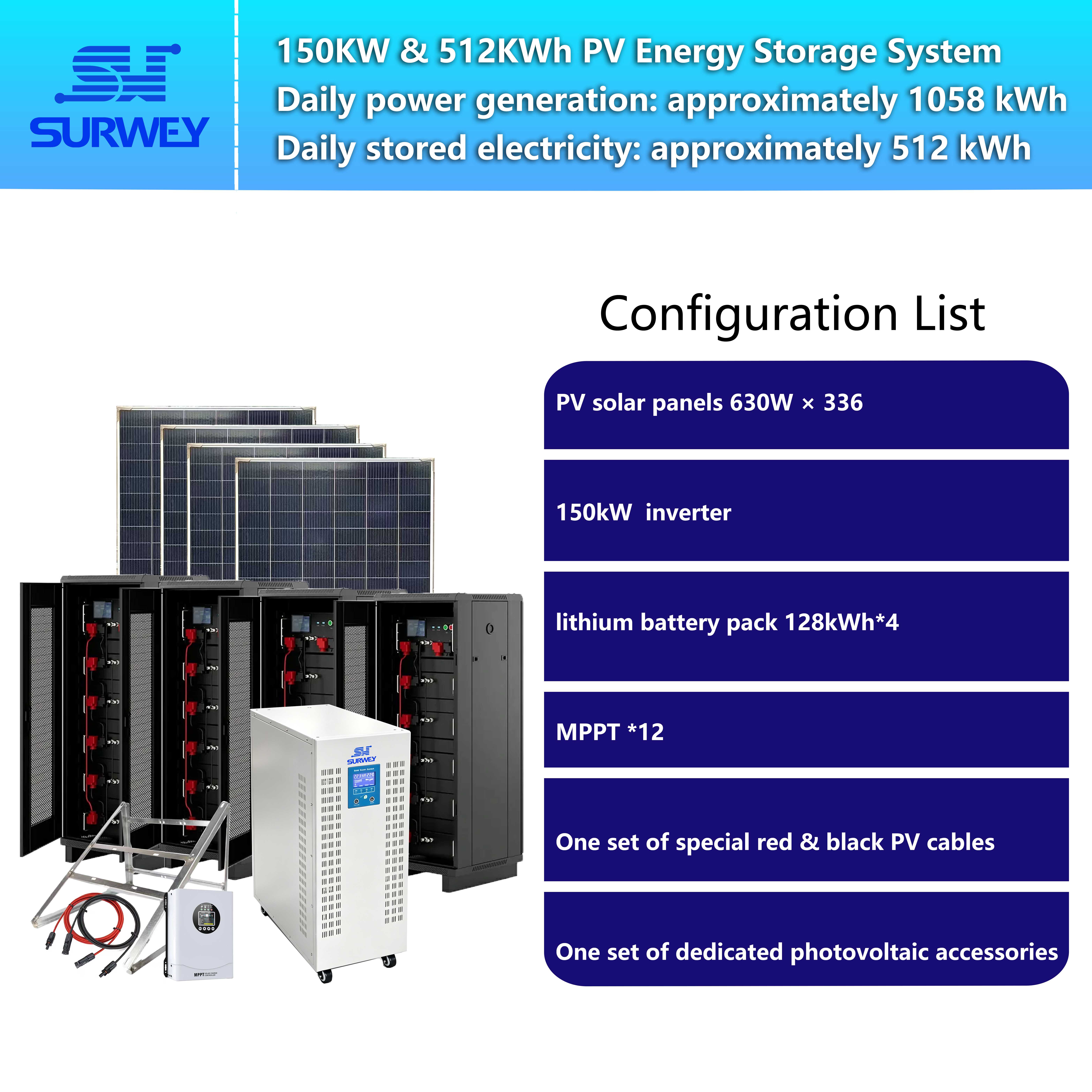
- Solar section: 336 pieces of 630W monocrystalline solar modules, total installed capacity 211.68kW
- Energy storage section: 4 units of 128kWh high-voltage lithium iron phosphate energy storage cabinets connected in parallel, total capacity 512kWh
- Inverter core: 1 set of 150kW three-phase off-grid power frequency inverter compatible with a 384V battery platform
- Charging unit: 12 sets of 384V/100A MPPT solar controllers for maximum power point tracking and battery charging management
Based on the local average 4-hour effective sunshine, the theoretical daily solar generation is around 847kWh. After deducting losses from wiring, MPPT conversion and battery charge-discharge cycles, the generated power can cover all daytime loads and charge the batteries with surplus energy to support continuous power supply at night and under low-light conditions, achieving in-situ daily energy self-sufficiency.
3. Solar String Design
String voltage verification is carried out based on the specifications of the 384V/100A MPPT solar controller used in this system. For this voltage class, the maximum allowable open-circuit PV input voltage of the controller is 800V, and the valid MPPT tracking voltage range is 480V–640V. Each controller has 2 independent MPPT channels; each channel can connect a maximum 11.2kW PV array, and the two channels work independently without mutual interference.
String Configuration & Channel Matching
Twelve MPPT controllers are deployed, providing 24 independent MPPT channels in total, with one PV string connected to each channel. To unify the number of modules per string and consume all 336 pieces of 630W modules without leftovers, the final configuration is 14 modules per string, forming 24 strings in total (24 × 14 = 336 modules), matching the full bill of materials.
Voltage Parameter Verification
Under Standard Test Conditions (STC), each 630W monocrystalline module has an open-circuit voltage of 49.34V and an operating voltage of 41.82V.
- 14 modules in series: string open-circuit voltage = 690.76V, lower than the 800V maximum DC input limit of the controller with sufficient safety margin.
- String operating voltage = 585.48V, fully within the MPPT tracking window of 480V–640V. Stable maximum power tracking can be maintained under normal operating conditions to avoid generation interruption caused by out-of-limit voltage.
Adaptation to Tropical Environment
Indonesia features a tropical climate with year-round high temperature and humidity. The actual operating temperature of modules is much higher than STC. Both open-circuit voltage and operating voltage of PV modules decrease as temperature rises. Therefore, the actual on-site string open-circuit voltage will be lower than the theoretical value of 690.76V, further reducing overvoltage risk. Meanwhile, the operating voltage remains steadily within the valid MPPT range and will not drop out of the tracking window under high temperature to guarantee generation efficiency.
Power Matching Check
The rated power of one string is 8.82kW, below the 11.2kW maximum power limit of a single MPPT channel. The combined power of two channels on one controller is 17.64kW, within the reasonable load capacity of the equipment. The total power of the 24-string array is 211.68kW. The DC side is reasonably oversized when matched with the 150kW inverter, which accommodates high-temperature power derating of modules in tropical regions and improves the inverter’s daily utilization rate.
4. Core Equipment Parameters
150kW Three-Phase Power Frequency Off-Grid Inverter

150kW three-phase power frequency off-grid inverter
Three-phase 3/N/PE configuration. DC side compatible with 384V battery system; battery operating voltage: 336V–480V. Standard AC output: 380VAC; 400VAC / 415VAC customized output available, frequency adjustable at 50Hz/60Hz. Pure sine wave output, suitable for inductive motor loads. Built-in protections for undervoltage, overvoltage, overload, short circuit and overtemperature. Equipped with LCD panel and RS485 communication; wireless remote monitoring is optional. Intelligent air cooling, IP20 protection rating, full power output up to 2000m altitude. The 150kW capacity can withstand the inrush current during shredder startup, reserves capacity for load expansion, and supports battery priority mode.
High-Voltage Lithium Iron Phosphate Energy Storage Cabinet (128kWh)

128kWh high-voltage lithium iron phosphate energy storage cabinet
Single cabinet rated capacity: 128kWh, lithium iron phosphate cells. Rated voltage: 409.6V, capacity: 314Ah, operating voltage: 332.8V–467.2V, matching the inverter voltage range. Single cabinet rated charge/discharge power: 60kW, recommended charge/discharge current: 100A, maximum current: 150A. Peak discharge of 350A is sustainable for 2 minutes at 25°C to handle load startup inrush. Charging temperature range: 0°C–55°C; discharging temperature range: -20°C–55°C. CAN & RS485 communication supported, IP20 protection rating. Cycle life ≥6000 times under standard conditions. Four cabinets connected in parallel deliver a total capacity of 512kWh. At 90% depth of discharge, the usable capacity is approximately 460kWh, supporting roughly 13 hours of shredder operation powered solely by batteries.
384V/100A MPPT Controller
Rated DC voltage: 384V, rated current: 100A. Maximum PV open-circuit input voltage: 800V, MPPT tracking range: 480V–640V, perfectly matched with the 14-module string design. Each unit has 2 independent MPPT channels; each channel accepts up to 11.2kW PV input. MPPT conversion efficiency >99%. Compatible with lead-acid batteries, lithium batteries and other battery types. Built-in floating charge, equalizing charge and overcharge protection, plus multi-level protection against overvoltage, undervoltage, overtemperature and reverse connection. RS485 communication supported, wireless monitoring module optional. Intelligent forced air cooling, operating temperature range: -15°C ~ 50°C. Twelve controllers are deployed for 24 MPPT channels, each connected to one 14-module string. During wiring, strings on the same MPPT channel shall have identical orientation and tilt angle to minimize mismatch losses.
5. System Operation Logic
System operation principle video
The system has no grid connection and is powered by coordinated solar and energy storage. It automatically switches operating states according to solar irradiance for uninterrupted power supply.
- Sufficient sunlight: Solar DC power flows through MPPT controllers to the DC bus, prioritizing the off-grid inverter to drive the shredder. When instantaneous solar output exceeds load consumption, surplus power charges the battery until the full-charge threshold is reached to prevent overcharge damage.
- Low light & night: Solar output declines with irradiance. The system smoothly switches to battery discharge mode. Energy storage cabinets continuously supply power to the inverter, which converts DC to three-phase 380V AC to maintain load operation. Voltage and frequency remain stable during switching without impact on the shredder.
- Prolonged low irradiance / continuous rainy weather: Solar generation drops sharply and battery SOC keeps decreasing. When SOC falls below the preset lower limit, the system triggers a low-battery alarm to notify on-site maintenance personnel. Non-critical auxiliary loads can be shut down to prioritize power supply for the shredder core process, extend battery runtime and avoid production shutdown.
6. Solution Conclusion
Verified by voltage boundary check, power matching and energy balance calculation, this solution meets all technical requirements for standalone off-grid operation: the open-circuit voltage and operating voltage of PV strings stay within the MPPT working window of controllers, energy storage capacity matches the power deficit during non-sunlight hours, and inverter capacity covers motor startup inrush current. Safety margins are reserved for high-temperature derating and continuous rainy extreme conditions. The hierarchical load strategy further improves power supply reliability under adverse scenarios.


