
Cost Reduction & Efficiency Improvement | Technical Solution of PV-Storage-Diesel Hybrid Microgrid for Temporary Construction Camp in Saudi Desert
— Maximize Solar Energy Consumption and Reduce Fuel Consumption of Diesel Generators
Abstract: Targeting the 7,300 m² temporary construction plot of the Saudi project, this solution takes into account the available photovoltaic roof and canopy area as well as the camp power load characteristics. A 60kW three-phase high-voltage hybrid inverter, high-voltage lithium battery energy storage, 650W high-efficiency PV modules and diesel generator sets ≥100kVA are adopted to build an integrated PV-storage-diesel microgrid system.
With PV as the main power supply in daytime, the energy storage system undertakes six core objectives: smoothing PV output fluctuations, absorbing surplus noon power, compensating power peaks in morning and evening, supporting the startup of inductive air-conditioning loads, supplying power to critical nighttime loads, and improving the low-load operation condition of diesel generator sets. Under insufficient solar irradiance on cloudy days, the system automatically switches to diesel power generation, balancing power supply reliability and fuel economy. The following paper conducts a comprehensive discussion from site overview, load analysis, equipment configuration, operation strategy, return on investment, risks and operation & maintenance.
1. Project Site Overview and Construction Conditions
The total plot area of the project is 7,300 m². Most of the site is open space planned for vehicle parking lots and material yards. The maximum usable area for PV installation is 500 m², leaving no conditions for large-area ground-mounted PV. All PV modules are installed on the top of temporary buildings and newly built canopies.

Roof PV Module Installation Diagram
Details of available PV deployment locations: ① 3 container offices, each sized 12m×3.6m. Modules on container tops can extend outward by overhang to realize both power generation and sunshade; ② 1 restroom container sized 10m×3.6m, with overhanging PV modules installed on its top; ③ Open washing & water storage area with a newly built 10m×6m PV canopy; ④ 10 parking spaces in the parking area with an available area of 150 m² for PV carport construction; ⑤ Canopy of the diesel generator area covering approximately 30 m². All PV mounting positions are temporary carriers for temporary works. Quick-install detachable brackets are fully adopted so that all equipment can be wholly relocated and reused after project completion.
The camp serves as a temporary construction site, only for office work and workers’ noon rest without overnight accommodation or kitchen stoves. Working hours are concentrated from 7:00 to 19:00 daily. No construction work is carried out at night; only minimal loads such as refrigerators, monitoring devices and partial lighting remain. Saudi Arabia enjoys abundant solar resources with peak sunshine hours of 5.5–6 h, yet it features large diurnal temperature differences and extremely high summer temperatures. PV modules, energy storage batteries and inverters must be adapted to high-temperature environments. High diesel fuel cost constitutes the major operational expenditure of the project. Therefore, the core demand of this system is to reduce diesel consumption via PV and energy storage while guaranteeing stable and reliable power supply.
2. Power Load Sorting and System Design Objectives
2.1 Details of Camp Electrical Loads
- Workers’ rest tents: 6 sets of 3HP vertical air conditioners;
- Office containers: 6 sets of 2.5HP air conditioners;
- Restroom area: 1 set of 3HP air conditioner;
- Equipment loads: 2kW refrigerated water dispenser, 2kW refrigerator, 2kW ice maker, 1kW water pump;
- Other loads: low-power loads including lighting, monitoring, office computers and equipment charging.
From 7:00 to 19:00 in daytime, air conditioners, water pumps, ice makers and water dispensers are all put into operation. Air conditioners are inductive loads with large inrush current at startup. Construction stops at night with all air conditioners shut down; only refrigerators, monitoring and basic lighting remain, resulting in low nighttime loads. The owner requires the backup diesel generator capacity to be ≥100kVA.
2.2 Six Design Objectives of the Energy Storage System
- Smooth PV output fluctuations: Clouds in daytime Saudi Arabia may cause instantaneous drops in PV power. The energy storage system compensates power gaps through rapid charge and discharge to avoid voltage fluctuations on the load side.
- Absorb surplus noon PV power: During periods of strongest midday irradiance, PV power generation exceeds the instant power consumption of the camp. Excess electricity is stored in batteries to avoid energy waste.
- Compensate insufficient PV output in morning and evening: In early morning before work and late afternoon near knock-off time, low solar elevation reduces PV output. The energy storage releases power to fill power gaps and cut the startup frequency of diesel generators.
- Support high-power startup impact of air conditioners: The startup of air conditioner compressors generates inrush power several times the rated value. The short-time overload capability of energy storage absorbs the impact and prevents system tripping.
- Supply critical nighttime loads: No diesel generators are activated at night; energy storage supplies power for refrigerators and monitoring equipment to eliminate idle diesel fuel consumption overnight.
- Optimize operating conditions of diesel generator sets: Prevent long-term low-load idling of diesel generators. Low-load operation leads to poor fuel efficiency and accelerated carbon deposition and wear of engines. Energy storage undertakes peak shaving to keep diesel generators operating within high-efficiency load ranges.
When irradiance is extremely poor on cloudy days and PV power generation is nearly invalid, the system switches to diesel generator power supply mode to guarantee full power consumption of the camp.
3. System Hardware Configuration
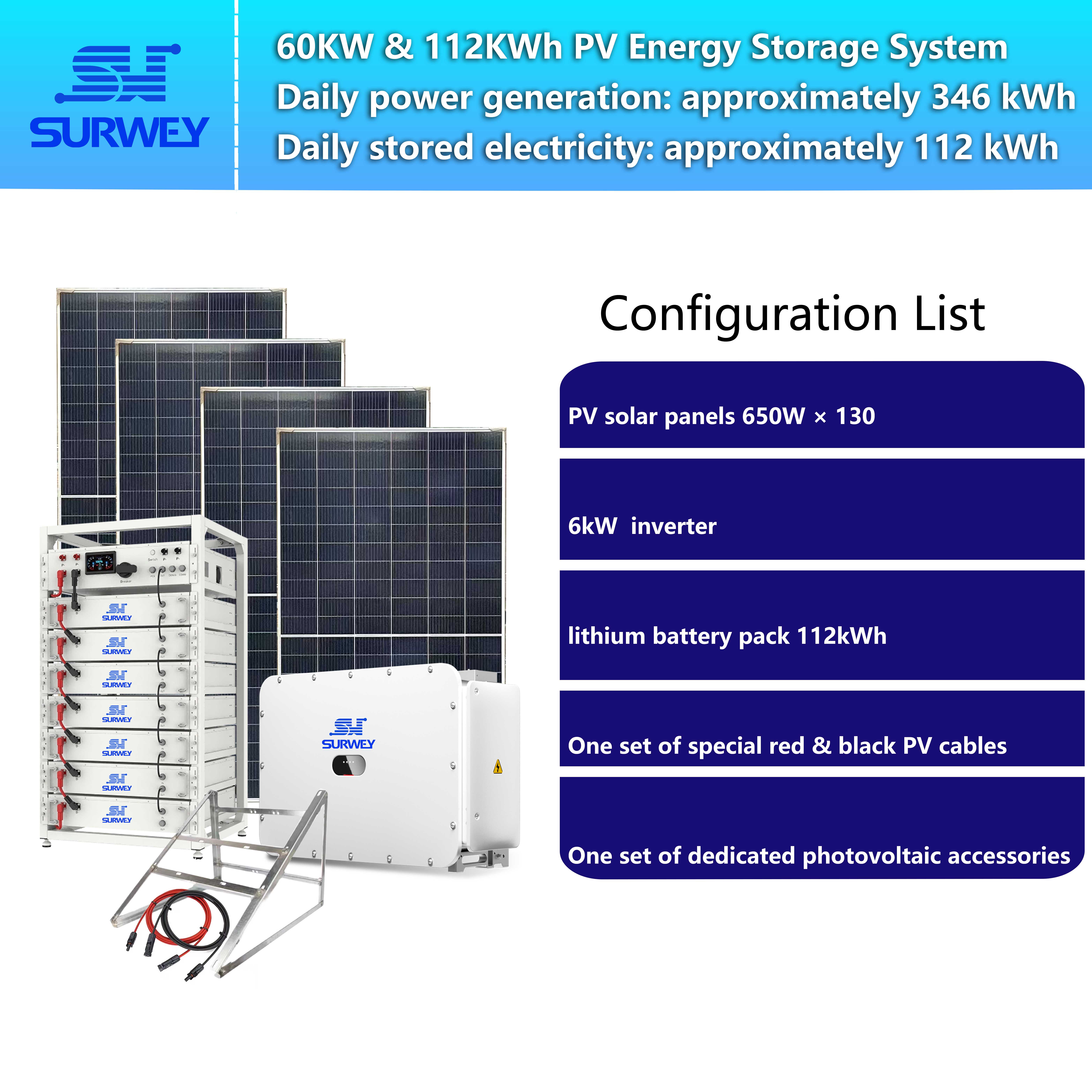
This microgrid system consists of an 84kWp PV array, a 60kW three-phase high-voltage hybrid inverter, a 112kWh high-voltage lithium battery energy storage system, diesel generator sets above 100kVA, EMS energy management system, power distribution cabinets and bracket auxiliary materials. Equipment selection strictly matches site working conditions and product parameters.
3.1 650W PV Array Configuration
650W high-efficiency monocrystalline silicon PV modules are selected, totaling 130 pieces.
String scheme: 13 modules connected in series per string, with 10 strings in total connected to the 10 MPPT ports of the inverter. The total installed PV capacity is 84.5kWp.
This inverter supports PV oversizing up to 2 times its rated power. The 60kW inverter connects to 84.5kWp PV with an oversizing ratio of approximately 1.41, which falls within the allowable product range. It maximizes the utilization of the 500 m² available installation area and fully taps the noon power generation potential under Saudi sunlight. The maximum string current of the modules is 21A, fully matching the maximum 21A string input current parameter of the inverter MPPT ports with no hardware compatibility risks.
Modules are all arranged on container tops, wash area canopies, diesel generator shed roofs and PV carports. The overhang and carport structures deliver power generation and heat insulation & sunshade simultaneously, reducing the cooling load of air conditioners inside containers and achieving dual benefits of “power generation + heat insulation”. Considering high temperatures in Saudi Arabia, temperature derating is reserved for modules. Brackets feature quick disassembly to meet the relocation and reuse requirements of temporary construction projects.
3.2 Energy Storage Inverter: 60kW Three-phase High-voltage Hybrid Inverter

This model is a commercial high-voltage energy storage hybrid inverter adapted to the PV-storage-diesel hybrid microgrid scenario of this project, with core adaptation advantages as follows:
- Dual independent high-voltage battery ports supporting large-capacity battery pack access with a maximum charging current of 200A, compatible with high-voltage lithium batteries;
- 200% overload output for 200ms in off-grid mode, perfectly absorbing the startup impact of air conditioner compressors and solving the startup challenge of massive inductive air-conditioning loads in temporary construction camps;
- Built-in generator hybrid mode interface supporting coordinated operation of PV, energy storage and diesel generators. Mature control strategies for weak grid and diesel-storage hybrid working conditions reduce diesel investment and O&M costs;
- Grid-tied/off-grid switching time less than 10ms for seamless load transfer, avoiding power-off restart of air conditioners and computers;
- Supports dynamic reactive power compensation to improve the power factor of the camp system and reduce reactive power loss; equipped with mains bypass function;
- Matched cloud platform for remote monitoring of power generation, battery SOC and diesel generator startup & shutdown status, realizing fault alarms and AI optimized dispatching;
- Patented heat dissipation structure adapted to high-temperature desert environments in Saudi Arabia to ensure continuous stable equipment operation under high temperatures;
- Supports DC coupling with expansion potential in later stages.
3.3 112kWh Energy Storage Battery Configuration

High-voltage lithium iron phosphate batteries with a total capacity of 112kWh are configured, composed of 7 sets of 16kWh high-voltage lithium modules plus 1 high-voltage battery management box. The high-voltage batteries directly connect to the dual battery ports of the inverter without extra PCS, lowering system link losses.
Rationale for the 112kWh battery capacity design: on one hand, to accommodate excess noon PV power generation; on the other hand, to satisfy overnight power supply for small nighttime loads including refrigerators and monitoring devices. Meanwhile, it releases power in morning and evening periods with insufficient PV output and mitigates cloud disturbance. SOC protection thresholds are set in the system to reserve battery protection capacity and extend the cycle life of batteries.
3.4 Diesel Generator and Supporting Facilities
A three-phase diesel generator set ≥100kVA is selected per the owner’s requirement and connected to the diesel hybrid interface of the inverter. Unified dispatching is performed by the EMS energy management system of the system instead of simple hard switching. The system strategy tries to avoid light-load idling of diesel generators. Diesel generators are only started when PV output is insufficient and battery SOC drops to the preset lower limit. When diesel generators run, PV supplies loads preferentially, and surplus power charges batteries, maintaining diesel generators within high-efficiency load ranges. It addresses pain points of carbon deposition and deteriorated fuel consumption caused by long-term low-load operation of traditional construction-site diesel generators. ATS switch cabinets, heat dissipation & ventilation and noise reduction protection are also configured to adapt to desert construction site environments.
4. System Operation & Control Strategy (PV-Storage-Diesel Coordination)
Relying on the built-in EMS energy management logic of the inverter, the system automatically runs under four typical working conditions:
System Operating Principle Video
Sufficient sunlight in daytime (7:00–12:00, 13:00–17:00 on sunny days) PV serves as the primary power supply, prioritizing powering all on-site loads such as camp air conditioners, water pumps and ice makers. When PV power generation exceeds instant power consumption, surplus power charges the high-voltage lithium batteries. The energy storage system responds in real time to rapidly smooth instantaneous PV fluctuations caused by passing clouds and guarantee stable load voltage. The diesel generator remains on standby without startup.
Peak strong sunlight at noon PV output reaches its peak with limited load consumption. A large amount of surplus electric energy is stored in the 112kWh battery, converting noon “curtailment risk” into stored electricity for use in morning and evening periods with insufficient PV output.
Insufficient irradiance: early morning, evening or cloudy days During early working hours (7:00–9:00) and late afternoon near knock-off time (17:00–19:00), low solar elevation leads to insufficient PV output, and energy storage batteries release power to fill power gaps. In case of consecutive cloudy days, once battery SOC falls to the preset lower limit, the system automatically starts the 100kVA diesel generator for load operation. PV still outputs power preferentially to reduce diesel output, and surplus power from diesel operation charges batteries to keep diesel generators running in high-efficiency load ranges and eliminate no-load or ultra-low-load idling.
Nighttime working condition (19:00–7:00 next day) Construction is finished and all air conditioners shut down. Only small loads including refrigerators, monitoring and lighting remain in the camp. PV input is disabled and diesel generators are shut down. Nighttime loads are fully powered by lithium battery energy storage. At 7:00 the next morning when work starts, the system gradually switches back to PV-priority mode after PV power rises.
Key protection logic: Minimum SOC protection is set for energy storage to prevent battery over-discharge. When energy storage reaches the lower protection limit, the diesel generator will automatically start day or night to guarantee uninterrupted power supply for critical loads.
5. Economic Calculation and Payback Period Analysis
Calculation premise: This is a temporary construction site project. All system equipment can be disassembled and relocated to the next project after completion. This static rough estimation is for decision-making reference. Diesel price is high locally. For traditional construction-site diesel power generation, industry experience shows diesel consumption is approximately 0.28–0.32 L per kWh.
With an installed PV capacity of 84.5kWp, considering high-temperature attenuation and dust shading in Saudi Arabia, the equivalent peak sunshine duration is calculated as 5h and the comprehensive system efficiency is 0.82. The daily power generation is around 346kWh. Based on 300 effective power generation days per year, the annual PV power generation reaches approximately 103,800kWh. After introducing the PV and energy storage system, about 45%–55% of diesel-generated power of the camp can be replaced, directly saving expenses on diesel procurement, transportation, genset maintenance, oil and filter replacement. In the traditional diesel-only mode, generators often operate under low loads with high fuel consumption and rapid mechanical wear. The PV-storage-diesel system optimizes operating conditions and reduces the frequency of major overhaul of diesel generators, generating indirect savings on maintenance costs.
Static payback period explanation: This system includes 84.5kW PV modules and brackets, a 60kW three-phase high-voltage hybrid inverter, 112kWh high-voltage lithium batteries, power distribution cabinets, installation auxiliary materials and commissioning. Equipment of temporary construction projects has reuse value for secondary relocation. If the project lasts 3–4 years, substantial fuel can be saved within this project cycle, and the dismantled equipment can continue serving subsequent engineering projects. If only calculating internal revenue within this project, the static investment payback period is roughly 5–7 years. If considering multi-project turnover and reuse of equipment, the comprehensive equivalent payback period can be shortened to the range of 3–4 years.
Note: The actual payback period is directly affected by project duration, actual annual working days of the construction site, on-site module cleaning frequency, proportion of cloudy days and fluctuations in diesel market price. Refined calculation can be performed later based on real on-site operation data.
6. Risk Points and O&M Recommendations for Desert Temporary Construction Projects
- Dust and sand: Severe sand and dust exist in Saudi deserts. Dust accumulation on PV module surfaces will greatly reduce power generation. It is recommended to clean modules at least 1–2 times per month to boost power generation.
- High-temperature protection: Ensure good ventilation and heat dissipation for inverters and battery compartments. Avoid direct sunlight on battery packs and elevate equipment bases to prevent sand accumulation on the ground.
- Battery management: Strictly implement SOC strategies and avoid deep over-discharge to extend the cycle life of lithium batteries. Use the cloud platform to remotely check battery status and inverter alarms.
- Diesel generator maintenance: Although the startup frequency decreases, regular maintenance of oil and filters is still required. The EMS system log records each startup duration to facilitate system operation analysis.
- Temporary construction safety: Reinforce wind resistance for overhanging PV structures on container tops. Lightning protection and earthing shall be implemented for all electrical equipment to comply with electrical specifications for Middle East construction sites.
7. Solution Summary
This project fully utilizes the limited 500 m² temporary roof and canopy resources of the camp. It is equipped with 84.5kW PV modules, a 60kW three-phase high-voltage hybrid inverter, 112kWh high-voltage energy storage batteries and diesel generator sets ≥100kVA to build a PV-storage-diesel complementary microgrid system.
The system perfectly matches the power consumption habit of the construction site with concentrated power use in daytime and only a small number of critical loads at night. The energy storage system fulfills six objectives: smoothing fluctuations, storing noon power, supplementing power in morning and evening, supporting air-conditioning impact loads, supplying nighttime power and optimizing diesel generator operating conditions. Free solar energy is maximized on sunny days while diesel generators serve as backup guarantee on cloudy days, balancing power supply reliability and cost reduction demands. As a temporary construction project, all equipment can be disassembled, relocated and reused to further average down overall investment cost. This solution is highly suitable for promotion in temporary construction camps of infrastructure projects in desert regions.


