
Off-Grid Solar Power and Energy Storage Solution for Farms in Tanzania
Preface
Tanzania is located in tropical East Africa with abundant solar irradiation and high annual average solar radiation. However, rural farm areas suffer from weak public power grid infrastructure, severe grid voltage fluctuations, frequent blackouts and even complete power outages during certain periods, which seriously restricts farm production and daily management.
The local climate features persistently high ambient temperatures, intense ultraviolet radiation, high humidity in rainy seasons, heavy dust and sandstorms in dry seasons, plus salt spray corrosion in some regions. These conditions impose stringent requirements on outdoor PV power equipment in terms of weather resistance, anti-ageing performance and durability.

1. Project Overview
Electric loads on this farm include field lighting, security surveillance, irrigation water pumps, small feed processing machinery and other equipment. A hybrid grid-tied & off-grid integrated system is adopted. It operates in grid-tied mode with complementary power supply when mains electricity is available, and automatically switches to island off-grid mode during grid outages to guarantee uninterrupted power supply for critical farm loads.
The system consists of 40 pieces of 630W double-glass bifacial TOPCon PV modules, 2 sets of 12kW hybrid grid-tied/off-grid inverter-charger all-in-one machines, and 3 units of 16kWh energy storage batteries. The total installed PV capacity reaches 25.2kWp with a designed daily power generation of 126kWh, and the total energy storage capacity is 48kWh.
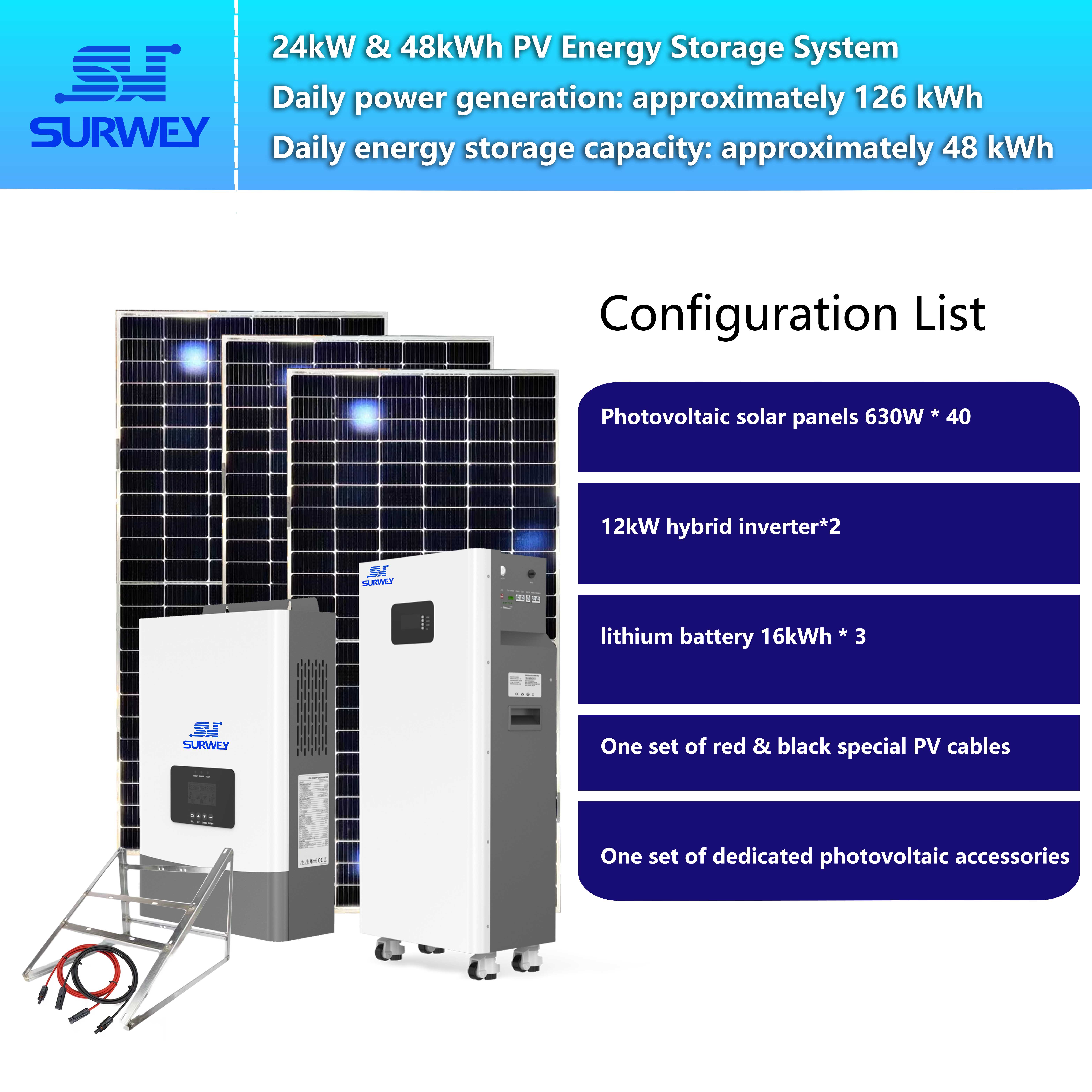
System Configuration List (Diagram Attached)
Operation strategy: PV power supplies on-site loads directly during daytime first; excess electricity is stored in batteries. When mains power is available, the PV system works in coordination with the grid. During nighttime, low-irradiance cloudy weather or grid failures, energy stored in batteries is discharged to maintain continuous power supply for all-day farm operation.
2. PV Array Voltage Verification & Array Design
Double-glass bifacial TOPCon PV modules are selected, with open-circuit voltage Voc = 48.8V under Standard Test Conditions (STC).

PV Module Installation Layout (Diagram Attached)
Array configuration: 40 modules are divided into 4 strings, with 10 modules connected in series per string. Open-circuit voltage per string = 10 × 48.8V = 488V.
Two 12kW hybrid inverter-charger units are deployed; each unit connects to 2 PV strings. The MPPT voltage operating range of the inverters covers 60–550V DC, and the maximum allowable PV open-circuit voltage is 550V. The module maximum power voltage Vmp is 41.5V, so the string operating voltage reaches 415V after 10 modules in series. This value falls fully within the inverter MPPT tracking window to enable stable maximum power point captureSolarEdge.
The 4 PV strings are grouped into two pairs; every two strings connect to one hybrid inverter’s PV input terminal. All 40 PV modules are fully utilized without idle standby capacity, maximizing the installed power output.
The double-glass encapsulation delivers bifacial power generation, bringing an extra 5–25% power gain from the rear side. The modules feature excellent resistance to micro-cracks, acid & alkali salt spray, water vapor penetration and PID power attenuation, perfectly matching Tanzania’s harsh outdoor conditions of strong UV, high humidity, dust and salt mist晋能清洁能....
TOPCon cells are characterized by low power degradation and superior low-light performance. They can still generate effective power in early morning, late evening and cloudy weather, boosting overall system power yield and adapting to the alternating cloudy and sunny climate locally.
3. Energy Storage & Inverter Wiring Scheme
Key Equipment Parameters

Supports hardware parallel connection, with automatic switching between grid-tied and island off-grid modes. MPPT voltage range: 60–550V DC. It integrates PV charging, inversion and grid-tied functions, and can drive inductive loads such as water pumps, matching the unstable grid conditions on Tanzanian farms.

Built-in BMS (Battery Management System) with full protection against over-charging, over-discharging, over-temperature and short circuits. Multiple units can be paralleled for capacity expansion. Three 16kWh units are connected in parallel to form a total 48kWh energy storage bank.
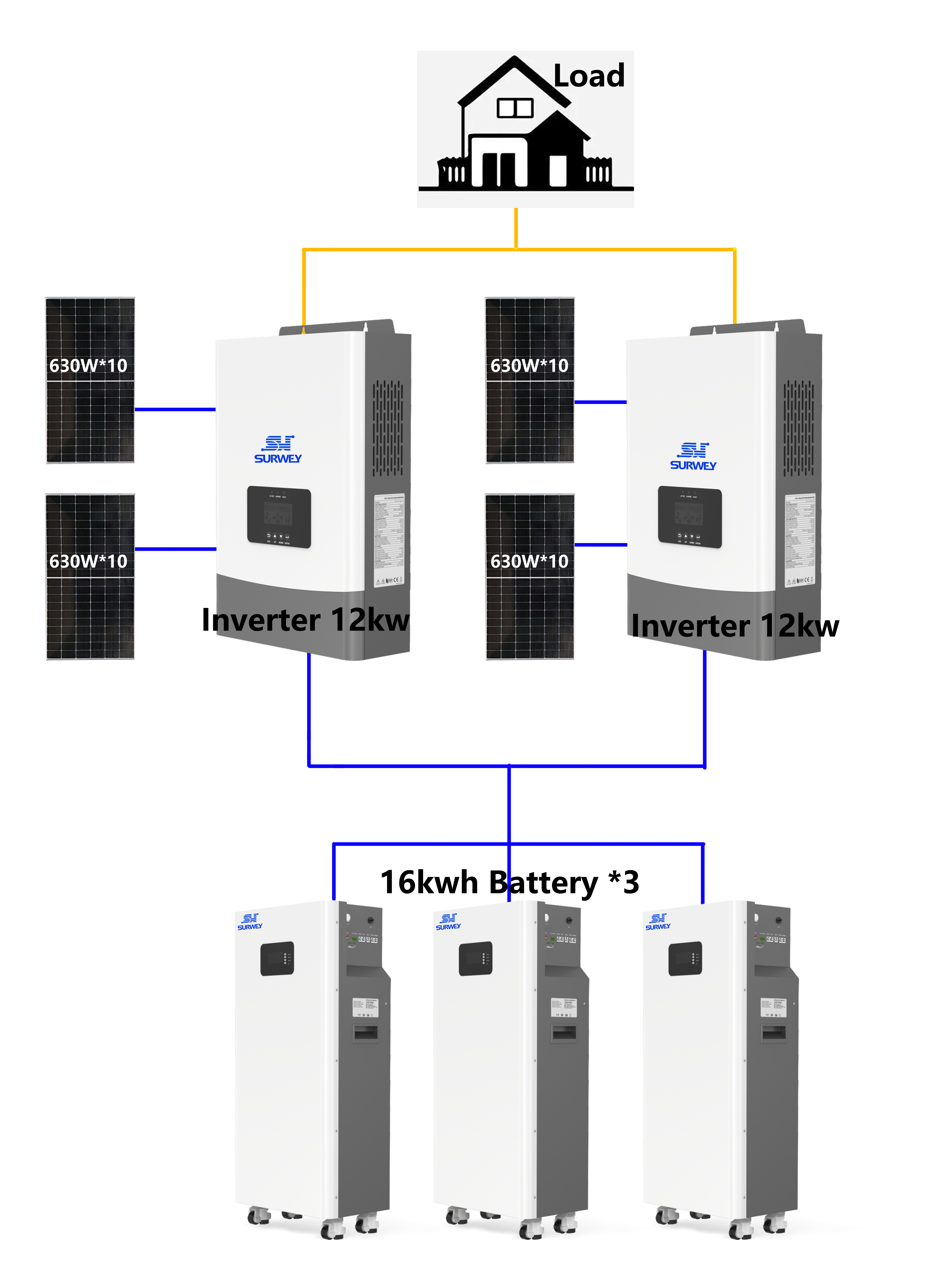
Wiring Topology (System Schematic Attached)
This system is equipped with 2 hybrid inverter-chargers (12kW each) and 3 LiFePO4 batteries (16kWh each). All devices support parallel operation; batteries are of the same model and batch.
DC Side Battery Connection
The three batteries are connected in parallel (never in series) and converged onto a common DC copper busbar. Each battery is fitted with an independent DC fuse and circuit breaker to isolate single-unit faults. Cables from each battery to the busbar are identical in length and cross-section to ensure balanced current sharing. The voltage difference between individual batteries shall be kept ≤0.05V before parallel connection to avoid circulating current. BMS parallel communication cables are wired between batteries, and only the host battery’s communication port is connected to the main hybrid inverter.
4. Farm Load Analysis & Power Matching
| Load Type | Rated Power | Quantity | Total Power | Daily Operation Hours | Operation Description |
|---|---|---|---|---|---|
| Field Lighting & Security Monitoring | 120W | 4 sets | 480W | 24h | Continuous base load running all day |
| Irrigation Water Pump | 1,500W | 2 units | 3,000W | 10h | Intermittent pumping; high-power operation is recommended during daytime with direct PV supply |
| Small Feed Processing Machine | 2,200W | 1 unit | 2,200W | 14h | Production scheduled mainly in sunny daytime to reduce battery consumption |
| Mixed Combined Load | 8,500W | — | 8,500W | 4.1h | Peak simultaneous operation; not recommended for long-term continuous running |
The two 12kW hybrid inverters provide a total continuous AC output power of 24kW, with strong tolerance to motor starting inrush current, suitable for inductive water pump loads.
Operation Mode
- Grid-Tied Mode (Mains Available) Loads are jointly supplied by PV generation, battery storage and utility grid.
- Island Off-Grid Mode (Grid Failure) The system automatically disconnects from the grid and switches to island operation.
In actual farm operation, high-power water pumps and processing equipment should run primarily in bright daylight, powered directly by PV output to minimize battery discharge, reduce battery cycling and extend storage service life. Only low-power base loads (lighting, surveillance) remain active during off-grid nighttime operation.
5. System Operation Logic
(Video: Current flow diagram of system operation)
① Grid-Tied Mode (Mains Power Available)
Under good solar irradiance, the PV array generates electricity, and the inverter’s MPPT module continuously tracks the maximum power point. PV power is prioritized to supply on-site loads directly. Surplus PV power charges the energy storage batteries; when PV output is insufficient, the shortfall is supplemented by the utility grid. This realizes coordinated power dispatch among PV, battery storage and mains electricitySolarEdge.
② Island Off-Grid Mode (Grid Blackout)
The system automatically cuts off grid connection and enters island operation. Daytime: Power is supplied jointly by PV generation and battery discharge. Nighttime: With no PV input, batteries discharge and invert AC power to supply lighting and monitoring base loads.
③ Low-Irradiance Cloudy & Rainy Conditions
When PV output drops on cloudy or rainy days:
- Grid-tied mode: The utility grid makes up the power deficit.
- Off-grid island mode: Batteries automatically supplement power to maintain uninterrupted supply. If prolonged continuous overcast weather occurs, the system will automatically cut off non-essential high-power loads once the battery reaches the low-voltage protection threshold, only retaining lighting and monitoring to prevent deep battery discharge and cell damage.
Equipment Coordination & Protection Logic
Built-in BMS on each battery communicates with the hybrid inverters to implement full protection against over-charging, over-discharging, over-current, over-temperature and short-circuit faults. Anti-island protection is fully configured. The whole system supports operational data collection, recording key parameters including daily PV generation, battery SOC, load power and grid status, allowing farm managers to monitor real-time system performance.
6. On-site Installation & O&M Adaptation to Local Environmental Conditions
Tanzania’s farm sites feature harsh outdoor climates, so installation and daily maintenance must fully adapt to local weather conditions.
PV Array Installation Modules face the equator with an inclination angle set according to local latitude. The mounting bracket is elevated to ensure good rear-side ventilation, maximizing the bifacial rear power gain. Installation avoids shading from trees and buildings to prevent partial shadow power loss. All PV cable connectors are fully sealed for waterproofing and dustproofing against high humidity in rainy seasons and sand erosion in dry seasons.
Inverter & Battery Housing Hybrid inverters and energy storage batteries shall be placed inside a well-ventilated, rainproof equipment room, never exposed to direct sunlight. In tropical high-temperature environments, equipment heat dissipation directly determines service life; the equipment room must be designed with adequate natural ventilation to control indoor temperature.

Grid Access & Lightning Protection The mains incoming circuit is equipped with reliable AC circuit breakers and surge protection devices to cope with severe voltage fluctuations of the local power grid.
Regular Maintenance Dust accumulates heavily on PV module surfaces during dry sandstorm seasons, drastically reducing power generation. Periodic surface cleaning is required. All cable terminals shall be inspected and tightened quarterly to prevent loose connections caused by thermal expansion and contraction under high temperatures.
The system reserves sufficient expansion margin. If the farm expands breeding and processing capacity in the future, the PV array and battery storage capacity can be extended to raise the overall power supply capacity.
7. Solution Summary
This hybrid grid-tied & off-grid PV energy storage system is fully tailored to Tanzania’s tropical high temperature, intense UV radiation, dust, salt spray and unstable local power grid conditions. Weather-resistant double-glass bifacial TOPCon PV modules are selected. All 40 modules are fully deployed, and the string open-circuit and operating voltages perfectly match the MPPT operating window of the hybrid inverters, enabling stable PV power captureTrina Sola....
The total installed PV capacity is 25.2kWp with a daily generation of 126kWh. The system works in grid complementary mode when mains power is available; during grid outages, the 48kWh battery storage guarantees basic electricity supply at night and in cloudy weather.
Optimized load management — running high-power production equipment on direct daytime PV power and avoiding deep battery discharge — effectively slows down battery degradation and prolongs the whole system’s service life.
Integrating both grid-tied complementary power and off-grid island backup functions, the system delivers stable, low-cost electricity supply and solves the power shortage problem for agricultural production under unreliable rural grid conditions in Tanzania.


