
Technical Scheme of Wind-Solar & Grid Complementary Backup Power Supply for Outpost Guardhouses on the Periphery of Populus euphratica Forest Scenic Area, Eastern Xinjiang
Preface
This project involves the construction of a wind-solar hybrid + grid complementary backup power supply system for outpost guardhouses on the periphery of the Populus euphratica Forest Scenic Area in eastern Xinjiang. The guardhouses serve the functions of scenic area patrol, security and on-duty monitoring. Located in the Gobi desert, the site boasts excellent solar and wind energy resources. However, the public power grid suffers limited supply stability with risks of power outages.
1. Project Overview
The system adopts solar photovoltaic power generation and wind power generation as dual primary energy sources. Energy storage batteries store electric energy, and the utility grid acts as backup supplementary power. It ensures uninterrupted and stable power supply for security equipment, lighting, communication terminals and monitoring devices in the guardhouse, and resolves the power supply guarantee challenge for remote field duty points.

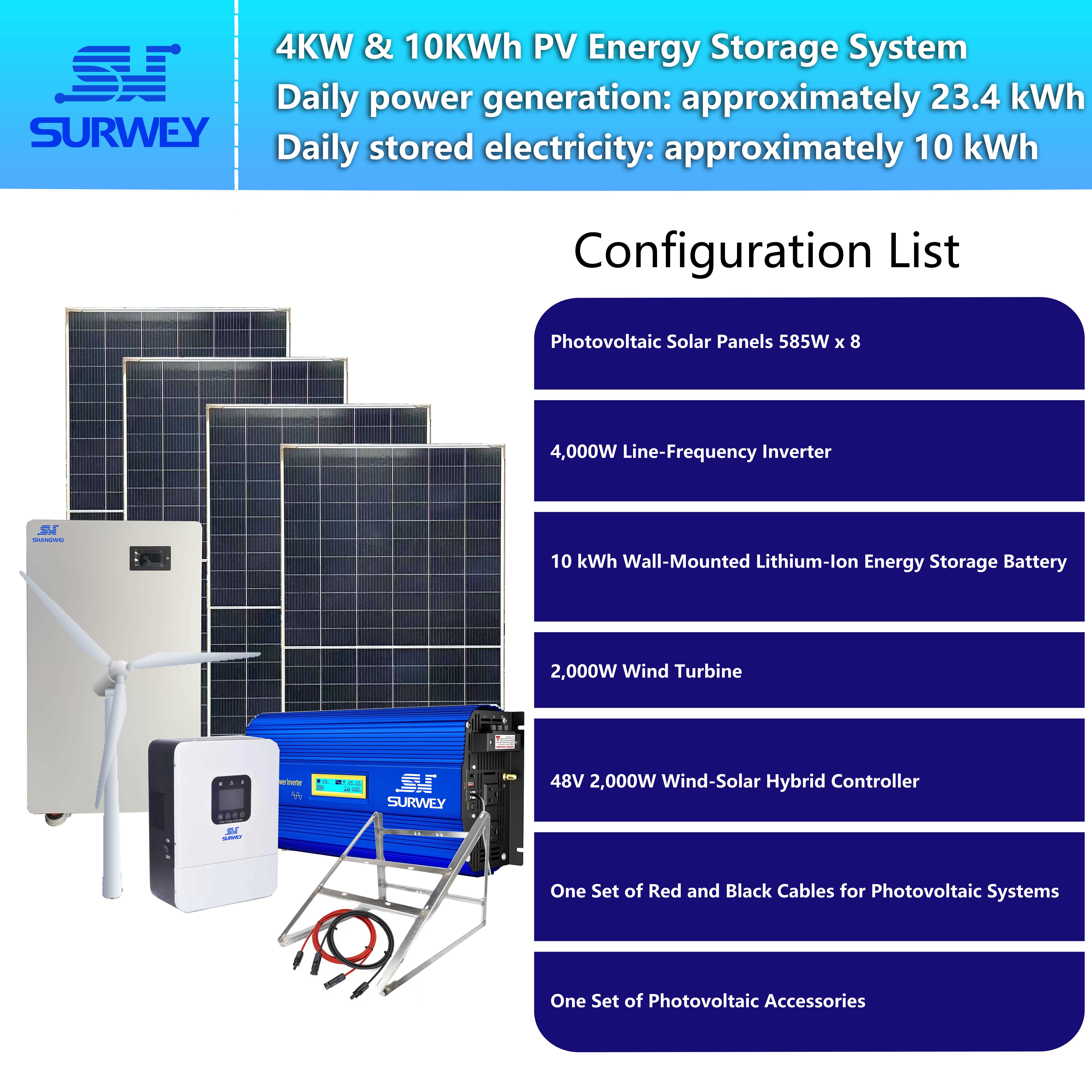
(Photo of the wind-solar hybrid photovoltaic energy storage system)
Core system configuration: 8 pieces of 585W photovoltaic modules; 4 modules connected in series form one string, with 2 strings connected in parallel; 2000W wind-solar hybrid wind turbine controller; rated battery voltage 48V, rated wind turbine power 2000W; 4kW off-grid power frequency inverter SW‑40; 10kWh wall-mounted vertical lithium iron phosphate energy storage battery; supporting power distribution auxiliary materials. The system is designed with a daily photovoltaic power generation capacity of 23.4kWh and an effective daily energy storage capacity of 10kWh.
(System configuration diagram)
2. Key Electrical Verification Calculations
(1) Photovoltaic Modules
Model SW10T‑144HBD 585W photovoltaic modules are selected. Under STC conditions, the open-circuit voltage Voc of a single module is 51.85V. Module arrangement: 4 modules in series per string, 2 strings in parallel. Open-circuit voltage of one string: 4 × 51.85V = 207.4V.
Low temperatures in winter in eastern Xinjiang raise the open-circuit voltage of modules. Calculation is performed under the extreme condition of -40℃. The module temperature coefficient is -0.34%/℃ with a 25℃ reference baseline, resulting in a temperature difference of -65℃. Voltage rise = 51.85 × 4 × 0.0034 × 65 = 45.4V Extreme maximum open-circuit voltage ≈ 252.8V.
The maximum PV access voltage of the controller is 350V; 252.8V is lower than the limit and meets the access requirement. The MPPT input voltage range of the SW‑40 inverter is 165‑260V. The DC side of the photovoltaic array is connected to the MPPT working interval of the inverter. Both the normal-temperature open-circuit voltage (207.4V) and the extreme low-temperature open-circuit voltage (252.8V) fall within the allowable MPPT input range of 165‑260V of the inverter. The voltage matching satisfies the safe operation requirements of the system and prevents equipment damage caused by overvoltage. Total power of two parallel strings: 8 × 585W = 4680W.
(2) Wind Turbine and Wind-Solar Hybrid Controller
A wind-solar hybrid controller is configured, with a rated battery voltage of 48V, matching a wind turbine rated power of 2000W and supporting a maximum photovoltaic rated power of 5000W.

(Photo of wind-solar hybrid controller)
The wind turbine charging of the controller supports optional MPPT boost, buck, combined boost-buck and PWM modes; photovoltaic charging adopts PWM mode. It is equipped with a built-in resistor unloading device. The unloading control logic includes rotational speed limiting, voltage limiting, current limiting and PWM pulse width modulation.
Protection functions: overvoltage, undervoltage, reverse connection prevention and external switch protection on the battery side; overspeed, overvoltage and overcurrent protection on the wind turbine side.
An LCD screen is equipped to display battery voltage, charging current, state of charge; wind turbine voltage, charging current, rotational speed, output current and output power; solar charging current; system status, power generation and fault codes.
Operating temperature and humidity: -20℃ ~ +55℃, 35‑85% RH (no condensation); static power consumption ≤ 3W. Optional extended functions include RS232, RS485, USB, GPRS remote communication and anemometer interface, adapting to operation and maintenance monitoring for field guardhouses.

(Installation photo of wind-solar hybrid controller)
Electrical verification: For the 2000W rated wind turbine in the 48V system, the operating current of the wind turbine is approximately 41.7A, complying with the ≤60A current limit on the wind turbine side. The total rated photovoltaic power is 4680W; the photovoltaic operating current in the 48V system is approximately 97.5A, satisfying the ≤100A total current constraint on the photovoltaic side. The maximum access voltage of the wind turbine is 350V, and the power generation voltage of the wind turbine fully meets the access requirements.
(3) Energy Storage Battery
The energy storage battery has a nominal voltage of 48V and usable capacity of 10kWh, supporting parallel expansion of multiple units. Its built-in BMS provides overcharge, overdischarge, overcurrent and temperature protection. It supports communication linkage with the inverter of this project. The recommended depth of discharge is 90%, the battery cycle life ≥ 8000 cycles, with a 5-year warranty.

(10kWh energy storage battery)
The effective daily energy storage capacity of the system is 10kWh, which meets the daily basic power reserve for loads in the guardhouse. Protection thresholds of the controller for the 48V system: undervoltage protection at 40.8V, undervoltage recovery at 46.5V; overvoltage protection at 58.8V, overvoltage recovery at 52.8V; float charging voltage 54.0V.
(4) Inverter Parameters

(4000W power frequency inverter)
The SW‑40 power frequency inverter has a rated power of 4kW and pure sine wave output. The output voltage is selectable as 220VAC, with transfer time <3ms. It features grid complementary function: when the utility grid is normal, power is supplied preferentially by the grid while charging the battery. When grid power fails, it switches seamlessly to energy storage inversion power supply instantly. It integrates complete protection against overload, short circuit, overvoltage and overdischarge. The charging current can be customized, matching the 48V energy storage battery of this project.
(5) Table of Available Load Power and Endurance Duration of the Whole System
| Electrical Equipment | Single Unit Power | Quantity | Total Load Power | Theoretical Battery Endurance (9kWh usable battery energy) | Remarks |
|---|---|---|---|---|---|
| Security Monitoring Camera | 15W | 4 pcs | 60W | 150h | 24h uninterrupted operation |
| Indoor LED Lighting | 18W | 3 lamps | 54W | 166h | Nighttime use |
| Communication Transmission Terminal | 40W | 1 set | 40W | 225h | 24h uninterrupted operation |
| Office Laptop | 60W | 1 set | 60W | 150h | Intermittent use |
| Small Combined Load (All devices running simultaneously) | - | - | 214W | ≈42h | Endurance extends with ongoing wind-solar power generation |
| Maximum Allowable Load Power | - | - | ≤3200W | - | Inverter rated 4kW; recommended load rate ≤80% |
Note: The endurance duration is a theoretical value calculated under full battery state and without wind-solar power input. Endurance will increase significantly with wind-solar power input. The battery depth of discharge is controlled at 90%, giving an actual usable capacity of 9kWh.
3. General Working Principle of the System
This system is a hybrid wind-solar-grid backup power supply system, consisting of photovoltaic power generation unit, wind power generation unit, wind-solar hybrid controller, energy storage battery, power frequency inverter, grid bypass unit and power distribution protection devices.
Direct current generated by photovoltaic panels and the wind turbine is fed uniformly into the wind-solar hybrid controller, which completes power regulation, charging management and power dissipation. Electric energy is prioritized to the rear-end inverter and converted into 220V AC power for the guardhouse loads. Excess electric energy is stored in the energy storage battery. When the battery is fully charged, the controller activates its built-in resistor unloading function to consume surplus power generated by the wind turbine and photovoltaic array, protecting the battery and wind turbine.
The inverter is equipped with a grid bypass function: the utility grid supplies loads directly when available. In the event of grid power loss, it switches to energy storage inversion output within milliseconds to guarantee uninterrupted operation of equipment in the guardhouse.
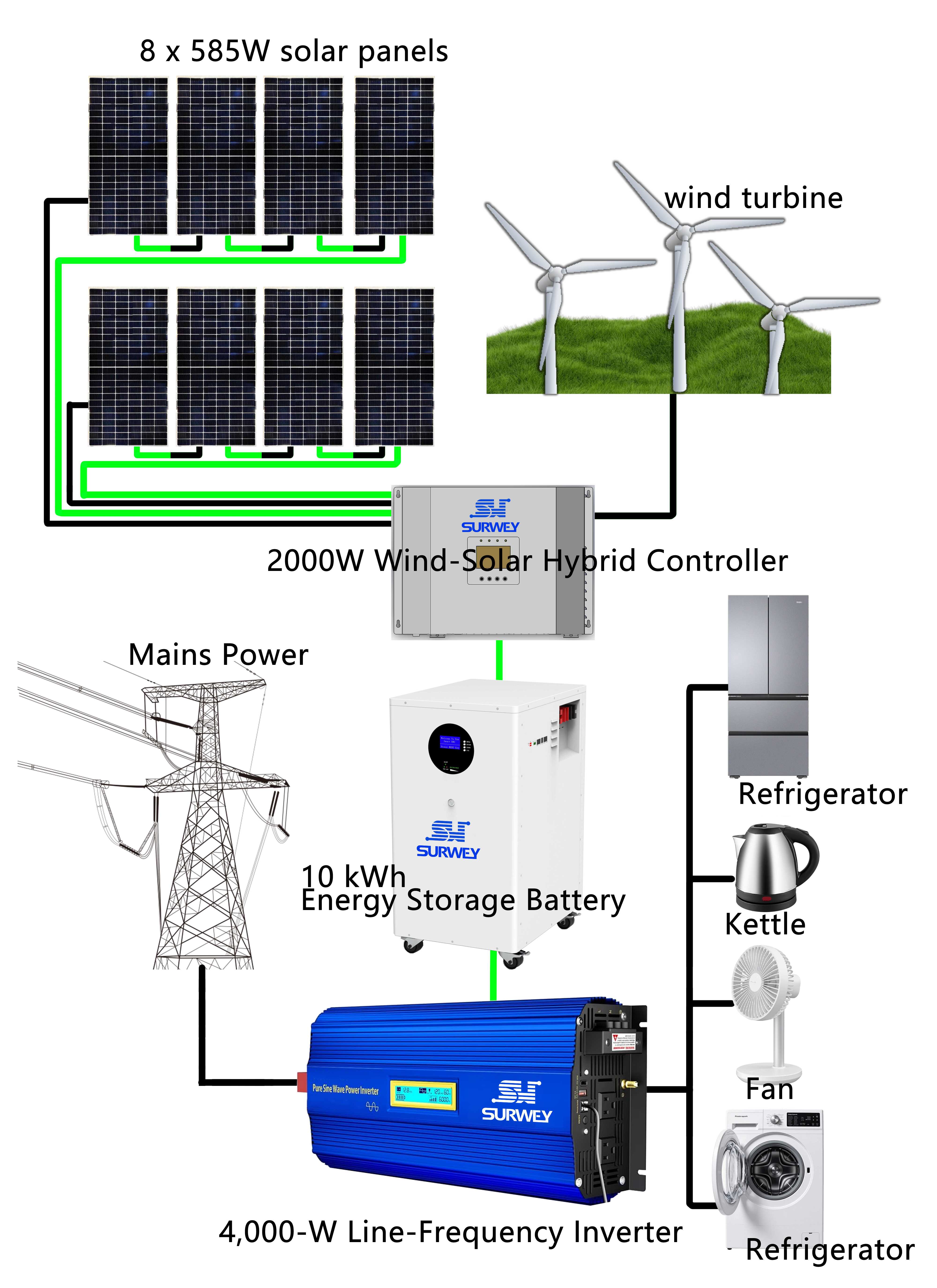
(Wind-solar hybrid system topology diagram)
4. System Operating Conditions and Power Generation Analysis
The project site is located in the Populus euphratica Forest Scenic Area of eastern Xinjiang, featuring abundant solar irradiation and favorable day-night wind conditions. The installed photovoltaic capacity is 4680W and the wind turbine installed capacity is 2000W, with a designed daily photovoltaic power generation of 23.4kWh.
Wind turbine power output fluctuates with wind speed and serves as an effective supplement to photovoltaic power, offsetting insufficient photovoltaic output at night and on cloudy days. The daily comprehensive load of the guardhouse is approximately 214W, with a 24-hour power consumption of about 5.1kWh. The system is designed with an effective daily energy storage capacity of 10kWh, covering the daily power consumption of loads while reserving energy storage margin for severe weather.
🎬 Video: Working Principle of Wind-Solar Hybrid System
⛅ Sunny & Windy Condition Photovoltaic panels generate power as the main source in daytime, with the wind turbine providing auxiliary output. After meeting real-time load consumption, surplus power charges the battery, which can be fully charged to store 10kWh of electricity for nighttime and subsequent cloudy days.
🌧 Consecutive Cloudy & Calm Condition Photovoltaic output is nearly zero and wind turbine output is minimal. The system consumes power from the energy storage battery to sustain loads. When the battery voltage drops to the undervoltage protection threshold, the inverter automatically switches to the utility grid to prevent irreversible damage to the battery caused by deep overdischarge.
⚡ Grid Complementary Mode When the utility grid is functional, grid power supplies loads preferentially and can recharge the battery. Once grid power is interrupted, the system switches to energy storage inversion output within milliseconds to ensure security monitoring and communication equipment remain powered on, satisfying the uninterrupted power supply requirement of the guardhouse.
In the case of complete public grid failure, the system operates independently relying on wind-solar generation and energy storage. Combined with real-time wind-solar power generation and stored energy, it maintains continuous operation of key security equipment.
5. Installation and Environmental Adaptability Design
Environmental characteristics of the periphery of the Populus euphratica Forest in eastern Xinjiang: extreme day-night temperature difference, low winter temperatures, heavy wind-blown sand and strong ultraviolet radiation.
Photovoltaic array: Tilted brackets are adopted to match the local optimal installation angle. Module wiring and connectors are treated with waterproof and dustproof protection, and cables are equipped with UV-resistant shielding.

Wind turbine: The wind turbine tower is installed firmly with vibration reduction and lightning protection measures, kept away from building shading.
Equipment cabin: The wind-solar controller, inverter and energy storage battery are installed indoors in the guardhouse to avoid direct sunlight, ensuring the equipment operating temperature range of -20℃~+55℃ and adapting to local low-temperature winters.
Earthing and lightning protection: Lightning protection devices are configured on both DC and AC sides of the whole system. Photovoltaic brackets, wind turbine towers and equipment enclosures are reliably earthed for lightning protection in the Gobi region.
Operation, maintenance and monitoring: The LCD screen of the wind-solar hybrid controller displays operating data and fault codes of the wind turbine, photovoltaic array and battery. A remote communication module such as RS485 can be optionally configured to facilitate inspection by scenic area operation and maintenance staff.
6. Protection Functions and Safety Design
Photovoltaic side: DC circuit breaker + lightning protection. The open-circuit voltage of each PV string has passed verification and meets the controller access voltage requirement with no overvoltage risk.
Wind turbine side: The built-in resistor unloading protection of the wind-solar hybrid controller provides rotational speed limiting, overspeed, overvoltage and overcurrent protection. It automatically unloads power under strong wind conditions to protect the wind turbine.
Battery side: The BMS integrates overcharge, overdischarge, overcurrent and temperature protection. The controller is equipped with battery overvoltage, undervoltage and reverse connection prevention protection, linked with the inverter via communication to restrict charging and discharging under abnormal conditions. The 48V system protection parameters of the controller match the battery specifications.
Inverter side: Complete protection against overload, short circuit, overvoltage and grid abnormality. Seamless switching upon grid failure prevents power loss of monitoring and communication equipment.
Earthing protection: All metal equipment enclosures are uniformly earthed to mitigate risks of static electricity and lightning strikes in the Gobi environment.
7. Summary
This wind-solar and grid complementary backup power supply system is customized to address the remote power supply pain point of guardhouses in the Populus euphratica Forest Scenic Area. It adopts 8 pieces of 585W photovoltaic modules arranged as 4 in series per string and 2 strings in parallel, paired with a 2000W wind turbine and a 48V wind-solar hybrid controller. Electrical verification confirms that the power, current and voltage of the wind turbine and photovoltaic array are all within the allowable range of the controller. The normal-temperature and extreme low-temperature open-circuit voltages of PV strings fall within the MPPT voltage range of the 4kW inverter, delivering safe and reasonable electrical matching.
The system achieves a daily photovoltaic power generation of 23.4kWh and a daily energy storage capacity of 10kWh, matched with a 10kWh long-cycle lithium iron phosphate energy storage battery and a 4kW grid-complementary power frequency inverter. With photovoltaic and wind power as primary energy sources, energy storage for electricity accumulation and the utility grid as the final backup guarantee, the system realizes uninterrupted power supply for security, monitoring and communication equipment of the guardhouse. It adapts to the Gobi environment in Xinjiang featuring large temperature differences and wind-blown sand, and meets the long-term stable operation requirements of scenic area duty points.


