
4 inverters and 4 energy storage cabinets form nearly 1 MWh of energy storage for a PET plant in Brazil.

Polypropylene (PET) Plant
This polypropylene (PET) plant installs PV panels on its land area with energy storage cabinets placed alongside. This is how the system operates on a daily basis.
For this Brazilian factory owner, the biggest headache over the past two years has not been order volume, but electricity bills.
Our project is located in Brazil, with a polypropylene (PET) plant as the client. Looking at their electricity invoices from April to August this year: the bill stood at USD 18,700 in April and rose to USD 47,700 in August, more than doubling within half a year. Converted to electricity tariffs, the rate was USD 0.176 per kWh in April and climbed to USD 0.361 per kWh by August. The local currency kept depreciating while power tariffs continued to rise, pushing monthly bills to new highs.
The client reached out with one straightforward request: provide a quotation for photovoltaic installation as soon as possible. His core hesitation regarding the solution was simple: should he opt for a grid-tied-only system, or a hybrid grid solution with energy storage?
This article fully breaks down how this project was negotiated, configured, and financially evaluated.
01 Determine Capacity Based on Electricity Bills
PV capacity is not arbitrarily decided; it is calculated using electricity bills and production records. The data provided by the client from April to August is as follows:
- April: 106,000 kWh consumption, 650 tons output, electricity bill USD 18,700
- May: 104,000 kWh consumption, 660 tons output, electricity bill USD 22,400
- June: 127,000 kWh consumption, 860 tons output, electricity bill USD 25,700
- July: 141,000 kWh consumption, 950 tons output, electricity bill USD 36,500
- August: 132,000 kWh consumption, 880 tons output, electricity bill USD 47,700
Monthly average: 122,000 kWh consumption, 800 tons output, electricity bill USD 28,300
Three key takeaways. First, the average monthly power consumption is 122,000 kWh. While the load scale is moderate, electricity expenditure remains high, averaging USD 28,300 per month, equivalent to approximately USD 0.23 per kWh. The actual tariff hit USD 0.36 per kWh in August. Second, power consumption correlates with production volume. July recorded the highest output of 950 tons together with peak electricity use of 141,000 kWh, representing a typical production-type load. Third, the plant does not operate 24/7. Loads are concentrated in daytime with low night-time demand — a critical factor for the energy storage solution.
Analyzing a single month is insufficient. The five-month dataset reveals a clear pattern: power use rises alongside production, while electricity bills increase even faster. For plants facing rising energy consumption and escalating tariffs, PV installation delivers consistent returns, since every unit of self-generated power offsets increasingly expensive grid electricity.
Site conditions are favorable: the transformer capacity is 1200 kVA. The factory has 3 hectares of land available for ground-mounted PV plus an additional 2,000 square meters of rooftop space.
The 400 kWp capacity was finalized by comprehensively evaluating load profiles, transformer rating and usable land area. It avoids overcapacity, fully utilizes available land and reserves room for future expansion.
For reference, the client’s invoices show the April electricity cost was 28.97 million reais, which surged to 73.86 million reais in August, a 2.5x increase. In USD terms, the bill rose from 18,700 to 47,700. The combined pressure of currency depreciation and tariff hikes is the real driver behind the client’s urgency to deploy PV. Delaying the project by another year will only lead to far higher energy costs.
02 System Configuration: 4 × 100 kW Parallel Inverters + 4 × 241 kWh Energy Storage
Three core equipment categories.
This configuration was not decided unilaterally. We went through three rounds of alignment with the client: first define PV capacity based on electricity bills and production data, then size energy storage against load curves, and finally validate against transformer and site constraints. This step must be thoroughly completed for overseas projects, as retrofits incur substantial costs later.
- PV Modules: 400 kWp, mainly ground-mounted with supplementary rooftop arrays
- Hybrid Grid Inverters: SW-0100, 100 kW × 4 units in parallel, total 400 kW
- Energy Storage Cabinets: SW-E240 air-cooled storage cabinets, 241 kWh × 4 units, total 964 kWh (~1 MWh)
An illustrative topology diagram visualizes the energy flow within the whole system.
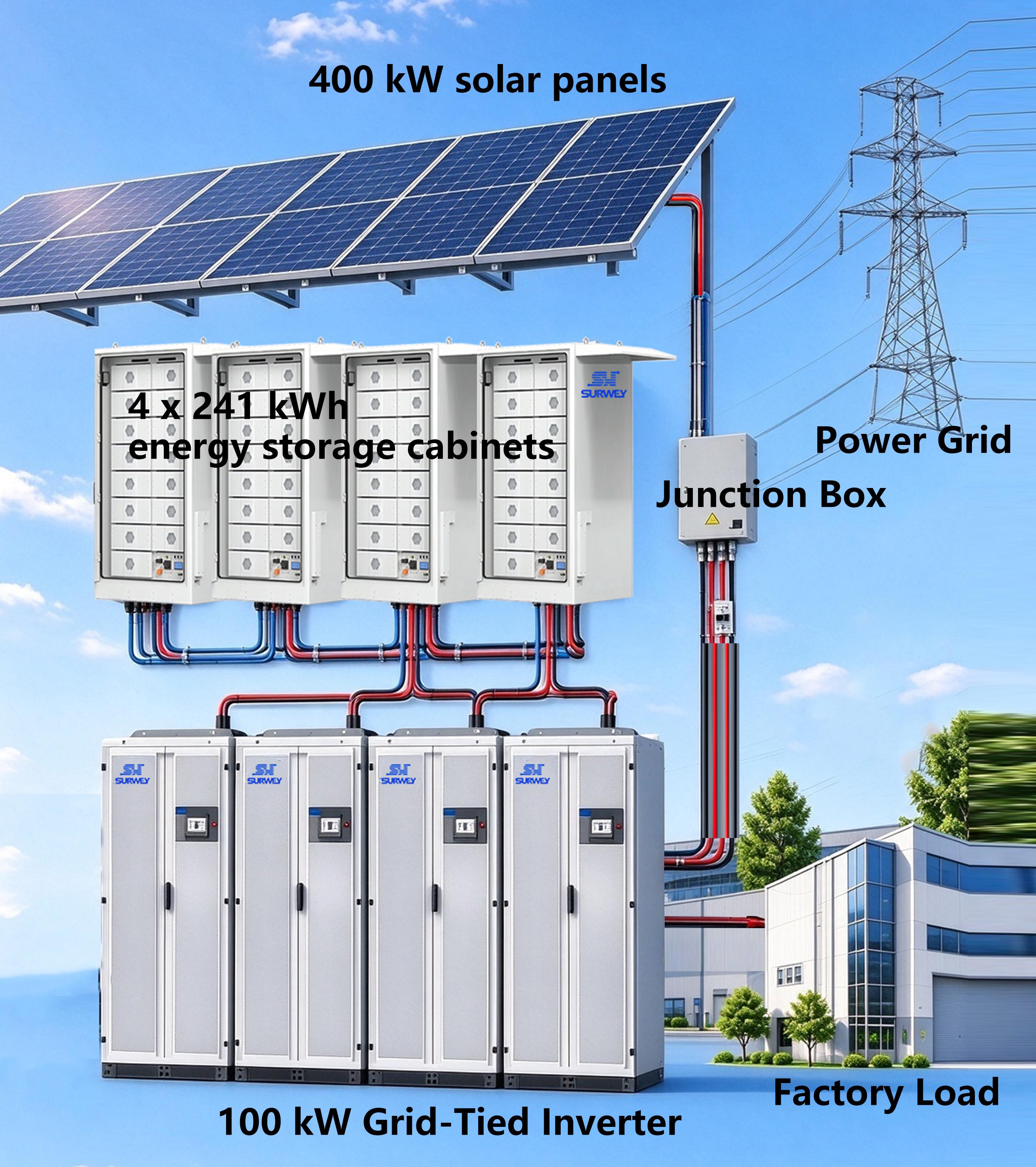
System Topology Diagram
Four reasons for selecting the SW-0100 inverter:
- Hybrid grid architecture: MPPT, transformer, STS grid-tie/off-grid switch and maintenance bypass are integrated into one unit. PV, energy storage, loads and grid are switched internally, drastically reducing field wiring work.
- Supports 100% unbalanced loads. Factories contain abundant single-phase equipment, making three-phase imbalance commonplace. Many purely grid-tied inverters are sensitive to unbalanced loads, so this capability is a hard requirement for hybrid inverters.
- Multi-unit parallel operation. Four paralleled units deliver 400 kW total capacity. Further expansion can be achieved by simply adding extra inverters without modifying existing hardware.
- Battery voltage range of 420~950 V, perfectly matching the 672~864 V operating window of the storage cabinets. Direct DC connection eliminates intermediate equipment and cuts one stage of power loss. The maximum charging power per unit reaches 110 kW; the four units combined provide 440 kW, able to fully charge the 964 kWh battery bank in roughly two hours.
The 964 kWh storage capacity is also engineered rather than arbitrary. The plant is not in 24-hour operation. Nighttime loads mainly consist of lighting and auxiliary equipment with low power demand. Excess PV power generated during daytime charges the battery, and stored energy discharges at night to nearly eliminate grid electricity consumption after sunset. At 964 kWh, the storage is well-sized for this load profile, neither undersized nor over-engineered.

SW-E240 Energy Storage Cabinet
Each SW-0100 unit is rated at 100 kW, with a maximum PV access capacity up to 165 kW (dual MPPT). We allocate only about 100 kWp PV per inverter, retaining sufficient margin for module oversizing and future retrofits.
In addition, the SW-0100 achieves off-grid voltage THD below 1% under linear loads, ensuring stable power supply for precision machinery. Certain equipment in the polypropylene plant is sensitive to voltage quality, which served as an important advantage during evaluation.
Key parameters for the SW-E240 energy storage cabinet (241 kWh per unit):
- LFP cells: 314 Ah, system voltage 768 V (15 modules in series)
- 6,000 cycles at 90% SOC, basically covering the full service life of the power station without mid-life cell replacement
- IP54 protection grade, operating temperature: -20~50 °C, suitable for local climate
- Air cooling design: simpler structure and fewer failure points than liquid cooling, facilitating maintenance for overseas projects
- Integrated PDU real-time monitoring and fire suppression system; RS485/CAN communication, compatible with BMS interfaces of MPS0100 inverters
Cabinet dimension: 1300 × 1260 × 2375 mm. Each unit occupies less than 2 m². Four cabinets plus installation access fit within the footprint of a standard parking space, offering flexible site arrangement.
The four cabinets deliver nearly 1 MWh capacity. Excess daytime PV power is stored in energy storage for discharge during night and cloudy periods, lifting the self-consumption ratio for this medium-sized factory.
Video on How the System Works
03 Why Hybrid Grid Instead of Pure Grid-Tied
This is the most frequent question raised by the client and a critical consideration for overseas projects.
Pure grid-tied systems are cheaper and simpler. PV power supplies onsite loads first, and surplus power is exported to the grid. However, Brazil presents several unavoidable challenges:
Grid stability. Voltage fluctuations and power outages are not rare in many industrial zones across Brazil. A power cut halts production lines, and losses go far beyond the cost of electricity itself. Hybrid systems with off-grid capability activate STS switching upon grid failure, where PV plus storage continue to supply critical loads without shutdown.
Load profile. The polypropylene plant does not run round-the-clock. PV output peaks coincide with daytime production. Surplus power charges the battery for use during high-cost evening and night hours. Pure grid-tied systems cannot achieve this time-shifting; full grid purchases remain unavoidable after dark.
Simply put, hybrid grid systems shift surplus midday PV power to nighttime consumption, which is exactly the high-cost period the factory cannot avoid. The economics strongly favor this approach.
Unbalanced loads. As mentioned earlier, hybrid inverters support 100% unbalanced loads, delivering better stability for facilities with many single-phase devices.
The conclusion is straightforward: in markets with unstable grids and rising tariffs, the extra investment for hybrid systems buys uninterrupted production during outages and higher self-consumption — two priorities for manufacturing plants.
Hybrid solutions are not universally applicable. The selection criterion is simple: if local grids are reliable with rare blackouts and the factory consumes power only in daytime with negligible night loads, a pure grid-tied system suffices and saves the substantial capital cost of energy storage. Clarify these two conditions before equipment selection.
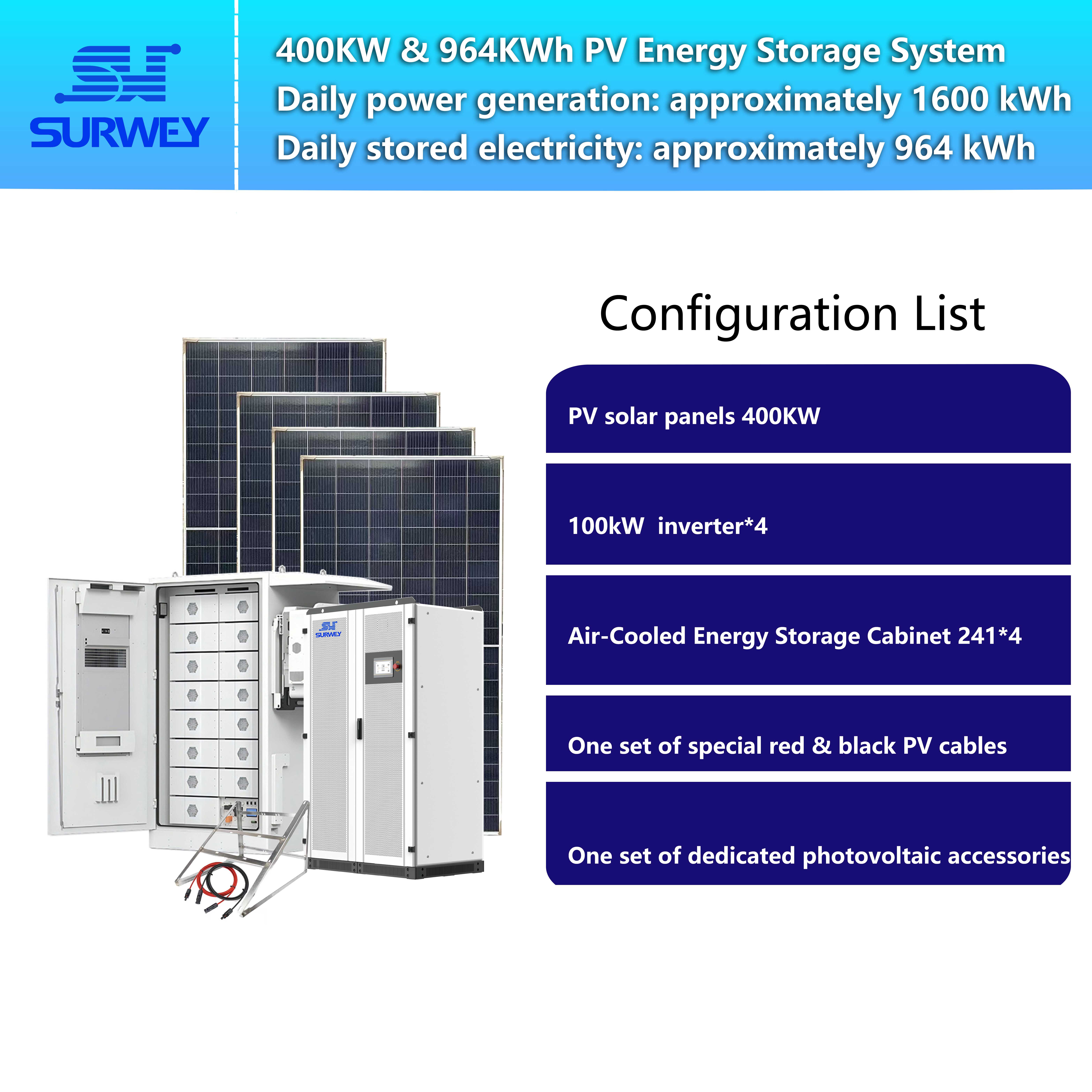
System Configuration Diagram
04 Financial Calculation Overview
Based on data provided by the client: Monthly power consumption: 122,000 kWh; monthly electricity bill: USD 28,300, ~USD 0.23/kWh. The actual tariff reached USD 0.36/kWh in August and keeps rising.
Breaking down April to August, tariffs climbed from USD 0.176 to USD 0.361 per kWh, more than doubling. Total electricity bills jumped from USD 18,700 to USD 47,700, a 2.5x increase. Following this trend, annual savings from the same system will grow further if deployment is delayed.
Power generation estimate: Located in central-northern Brazil, the site has an annual equivalent sunshine duration of roughly 1,500–1,700 hours. The 400 kWp PV array generates about 600,000–680,000 kWh per year. With an estimated self-consumption ratio of 60%–70%, annual on-site consumption of PV power reaches 360,000–480,000 kWh.
Note: This is a preliminary estimate. Prior to formal quotation, we run power generation simulation software incorporating tilt angle, azimuth, shading and module degradation to acquire realistic annual yield and refine return calculation and storage charge-discharge strategies.
At USD 0.23/kWh, annual electricity savings are approximately USD 83,000–110,000. Using the latest August tariff of USD 0.36/kWh, savings reach USD 130,000–170,000 per year.
The rough payback period stands at 2–3 years. This calculation mainly accounts for self-consumption and excludes revenue from surplus power export. Net metering policies differ across Brazilian states; returns can increase further if local export incentives apply.
Energy storage cabinets represent the largest single line item in the quotation, accounting for nearly 40% of total investment. This is the primary cost gap separating hybrid grid solutions from pure grid-tied alternatives.
Disclaimer: Power output and self-consumption ratios are estimates. Formal proposals include detailed simulation reports and data alignment with the client. Still, the core logic holds: higher local tariffs shorten the payback timeline.
05 Practical Details for Delivery & Commissioning
Finally, several construction and delivery considerations to mitigate common pitfalls for overseas projects.
Mounting structure: Ground arrays use Q235B U-channel steel 41×41×2.0 plus 40×40 aluminum rails. Rooftop arrays adopt PV concrete footings. Civil works and mounting installation are covered under the turnkey price.
The 400 kWp PV modules are matched accordingly. Cable and mounting quantities are calculated primarily for ground arrays. Separate detail drawings are prepared for rooftop sections, keeping the two designs independent and simplifying later O&M.
Cabling: DC side PV-F-DC1000V 1×4 mm² cables. AC side includes grid connection cabinets, distribution equipment and monitoring. Hot-dip galvanized flat steel 40×4 is used for lightning protection and earthing.
Storage cabinet delivery: Each cabinet weighs about 2.5 tons (excluding PCS). Site load capacity and hoisting access must be verified in advance, with delivery routes reserved for the four cabinets.
Permits and monitoring: Grid interconnection procedures and monitoring systems are delivered as a package. Permit lead times for overseas projects are longer than expected, so initiation should start as early as possible.
One equipment compatibility note: MPS0100 inverters communicate via RS485/CAN, matching the communication protocol of storage cabinets. A single monitoring platform manages all devices and reduces interface troubleshooting during site commissioning.
The Brazilian client finally selected the hybrid grid solution. The reasoning is simple: his concerns are not only tariff hikes, but also power outages and spiraling energy bills. The 400 kWp PV plus nearly 1 MWh energy storage marks the first step for this factory to turn electricity cost from a passive expense into a controllable variable.
There is no universal answer for system design, yet the methodology applies broadly: analyze load profiles first, assess grid conditions second, and perform financial evaluation last. These three pillars guide sound decision-making for overseas PV and energy storage projects.


