
Photovoltaic and Energy Storage System of the Factory in Turkmenistan
A factory in Turkmenistan has installed a 36 kW PV system paired with an 80 kWh energy storage unit.
In May in Turkmenistan, afternoon temperatures regularly climb above 40°C. The factory’s injection moulding machines run nonstop on a three-shift schedule, and electricity bills keep rising year after year. To make matters worse, occasional grid outages force production lines to shut down. A two-hour stoppage disrupts far more than power costs — it derails production schedules and triggers urgent calls from downstream customers.
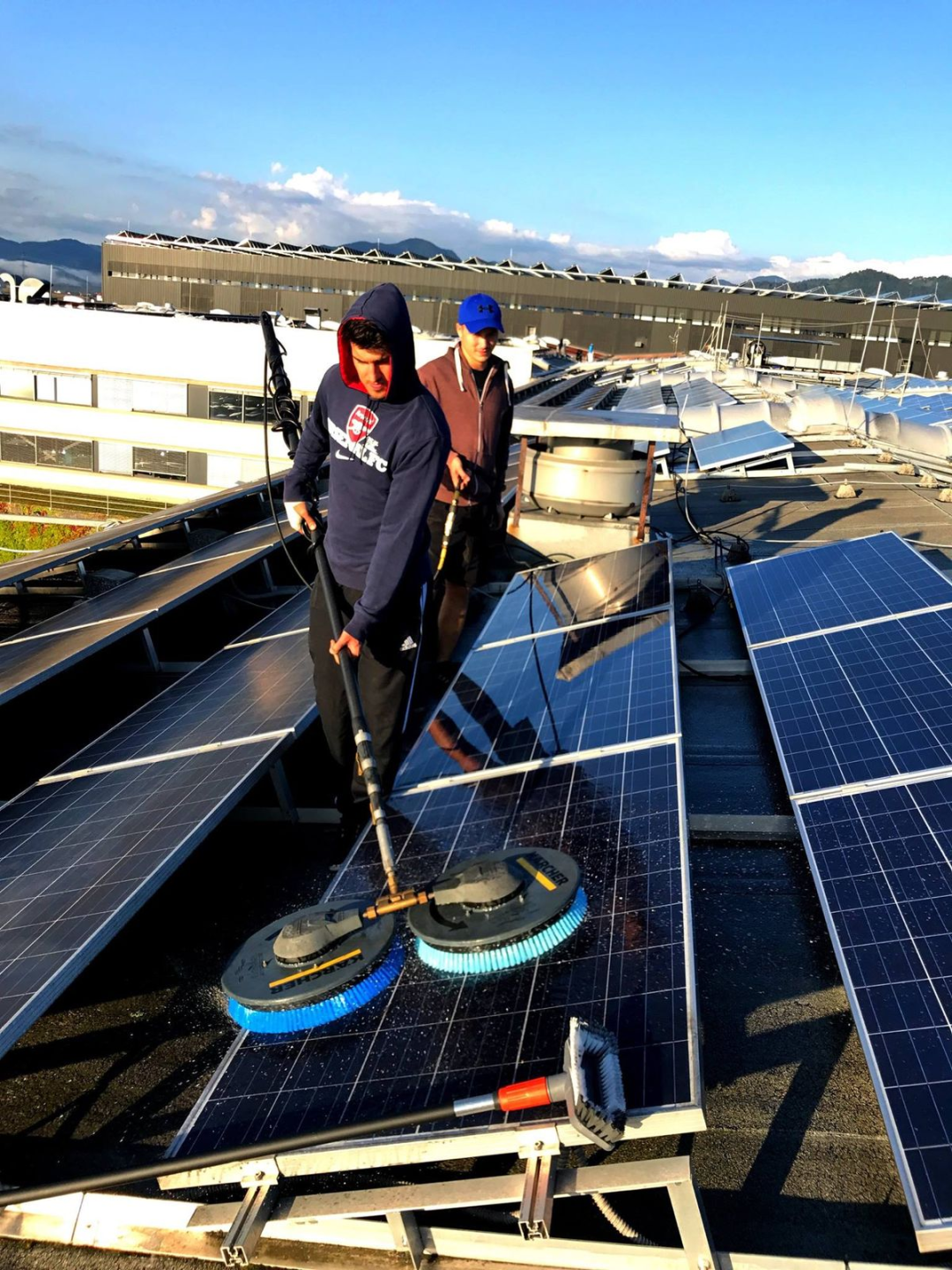
Rooftop PV Array Diagram
This May, a new array of modules was mounted on the factory roof, while a three-phase inverter and a high-voltage energy storage cabinet were installed inside the power distribution room. Fundamentally, the system relies on three core functions: solar power generation, battery energy storage, and power dispatching via the inverter. Simple as it sounds, the engineering work is sophisticated. Sizing calculations, module stringing configuration and dispatching logic all require detailed on-site analysis.
This article explains how this system was configured for the specific site in Turkmenistan, what it can deliver and what its limitations are.
What factories lack is not electricity, but controllable power
Turkmenistan is a major natural gas producer with abundant energy resources. Yet power challenges are never merely about whether electricity is available.
Many local factories face moderate electricity tariffs, but three pain points persist: they cannot capitalise on time-of-use price differences; unplanned grid cuts halt production lines instantly; many sites maintain diesel generators for backup, with fuel costs soaring annually. For textile plants, agricultural processors and building material factories, electricity expenses can be optimised, but power outages cannot be tolerated. Once production stops, raw materials, labour costs and delivery deadlines all suffer.
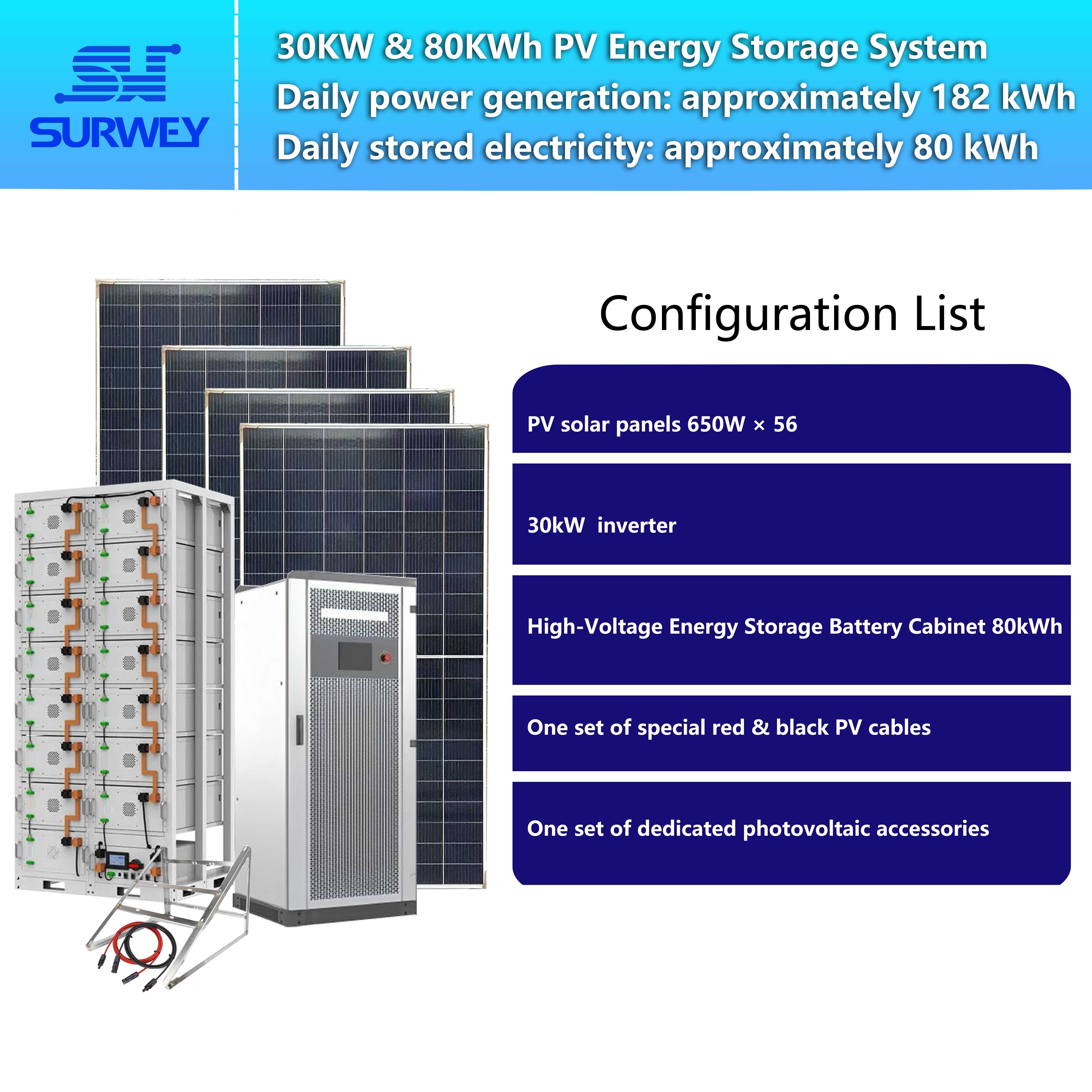
System Configuration Diagram
Main equipment specifications of the system:
- PV Modules 56 pieces × 650W N-type modules = 36.4 kW. Average daily generation: 182 kWh (based on local irradiance of approximately 5 kWh per kW per day). MPPT operating window: 250~1000 V, with string margin fully verified.
- Energy Storage 80 kWh high-voltage LFP cabinet. Rated voltage: 819.2 V (operating range: 672~928 V). Directly compatible with the inverter’s DC side of 250~850 V. Usable capacity: around 74 kWh at 90% depth of discharge; cycle life: 6,000 cycles.
- Inverter Three-phase 30 kW (peak 33 kW). Supports grid-tied/off-grid switching, 100% unbalanced load operation, diesel generator coordination for fuel saving and multi-unit parallel connection. Verified with comprehensive field data.
The objective of this system is not the unrealistic promise of zero electricity bills. It targets three practical outcomes: store surplus daytime solar power for use during peak hours or at night; sustain production during short grid outages; reduce diesel generator runtime to cut fuel expenditure. In short, the factory does not simply want cheaper electricity — it wants controllable power.
Precise engineering for the 56 PV modules
Given sufficient rooftop space, the layout was planned based on available installation area. Fifty-six 650W N-type modules deliver a total capacity of 36.4 kW. Turkmenistan enjoys strong solar irradiance, averaging roughly 5 kWh generation per kW daily. This yields 182 kWh per day, a figure derived from local irradiation data rather than rough estimates. Annual output reaches approximately 60,000 to 70,000 kWh, covering a substantial portion of daily consumption for this medium-small factory.
While the total module quantity is fixed, string configuration requires careful design. Each module has an open-circuit voltage of 49.73 V. The number of modules per string must keep the total string voltage within the inverter’s MPPT window of 250~1000 V, with extra margin reserved for temperature variation. Too few modules per string results in insufficient power output under weak morning and evening light; too many causes excessive voltage spikes in cold winter conditions, risking overvoltage trips. This parameter was validated repeatedly on site before finalisation.
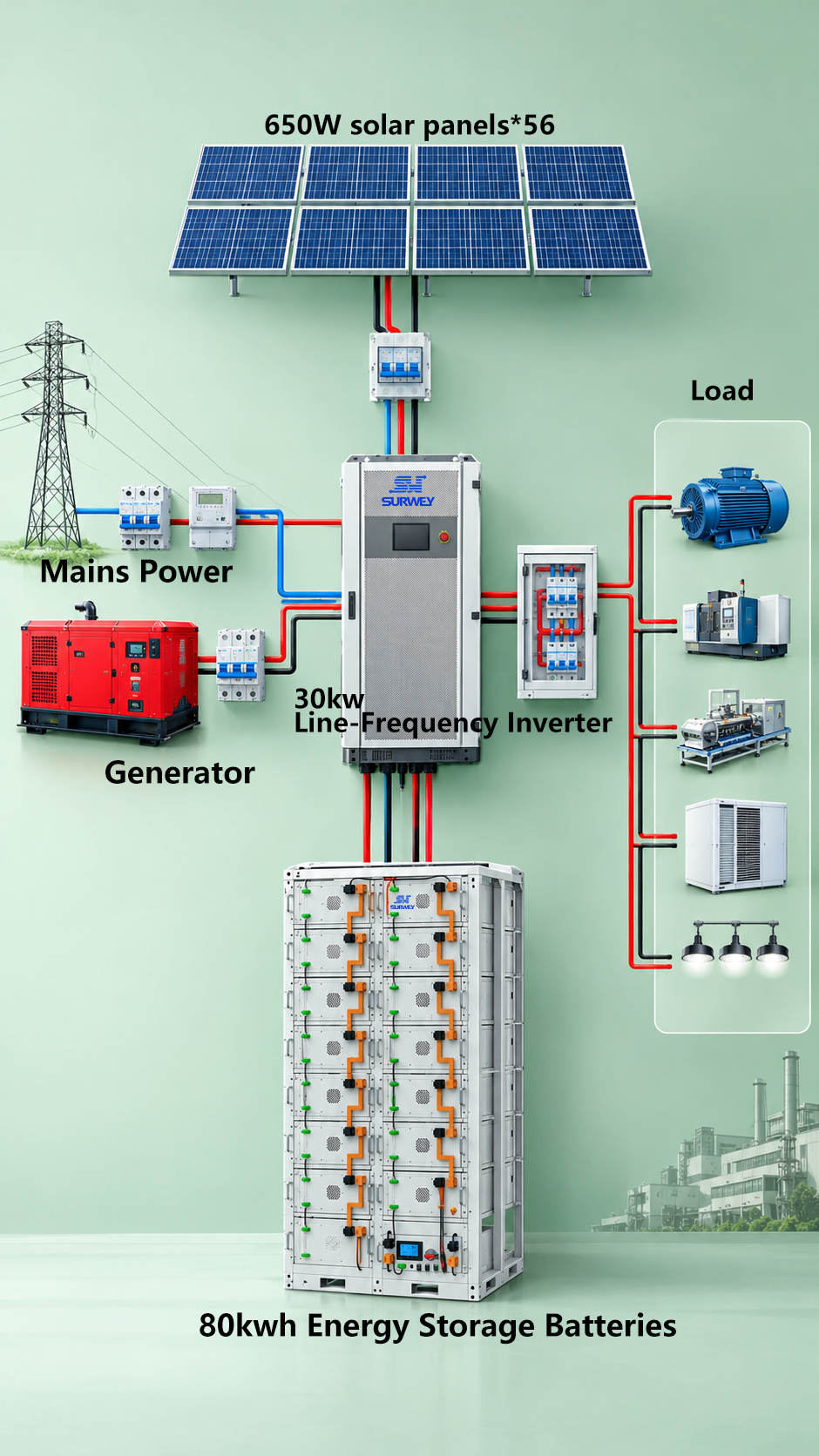
System Topology Diagram
With 182 kWh daily PV output and an 80 kWh battery, the storage system can capture roughly half of the daytime power surplus. This ratio is not arbitrarily maximised. Oversized storage remains idle for much of the time and fails to deliver economic returns; undersized storage cannot meet evening demand. The balance is optimised according to the factory’s actual load profile and tariff structure.
Dust is another key consideration in Turkmenistan. Clear skies and strong irradiance are offset by heavy dust in spring, which coats module surfaces and reduces power output. Therefore, the modules adopt semi-tempered glass and IP68 junction boxes, paired with scheduled cleaning routines to minimise generation losses. Critically, peak production hours align perfectly with peak solar output. Most generated power is consumed directly by production equipment, with only excess energy charging the battery, delivering high utilisation — the core economic advantage of this configuration. These N-type monocrystalline modules contain 132 cells each and achieve a conversion efficiency of 24.1%. For the same 650W power rating, higher efficiency reduces rooftop footprint and eases structural load and construction work.
The 80 kWh high-voltage cabinet: the backbone of the whole system
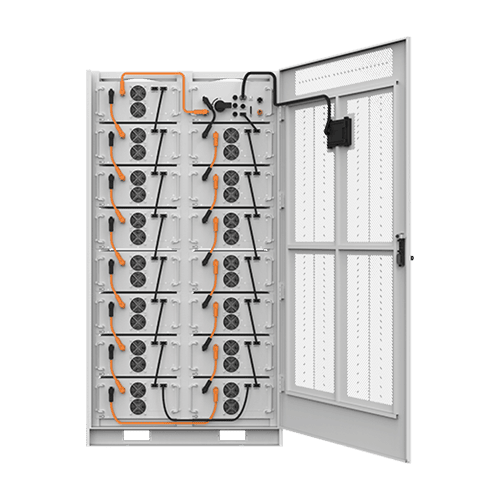
80 kWh High-Voltage Lithium Energy Storage Cabinet
The storage unit uses lithium iron phosphate chemistry with a nominal capacity of 80 kWh, rated voltage of 819.2 V and operating voltage range of 672~928 V. The high-voltage design delivers tangible benefits: lower operating current, thinner cabling and reduced losses. It directly matches the inverter DC side (250~850 V) without an additional converter, eliminating extra efficiency losses.
What does an 80 kWh battery mean in practice? It can store a portion of surplus daytime PV generation for discharge in peak periods and at night. LFP chemistry supports deep cycling. At 90% depth of discharge, it still offers 6,000 cycles. With one full charge-discharge cycle daily, the service life can reach around 10 years. Its wide operating temperature range — charging: 0~55°C, discharging: -20~55°C — withstands scorching Turkmen summers and cold winters. The nominal 80 kWh is a nameplate value. Design calculations use the usable capacity of about 74 kWh at 90% DOD for accurate load matching.
The cabinet is assembled from modular packs, with 16 modules connected in series per string and support for capacity expansion. If production expands later, additional modules can be added without full system replacement. An integrated BMS continuously monitors charging/discharging current, temperature and state of charge. The system reduces power for protection under abnormal conditions instead of immediate shutdown. The battery pack holds CE and IEC62619 certifications and complies with UN38.3 requirements for sea transport and installation, simplifying customs clearance and acceptance for overseas factory deployment.
The 30 kW three-phase inverter: the core operational unit
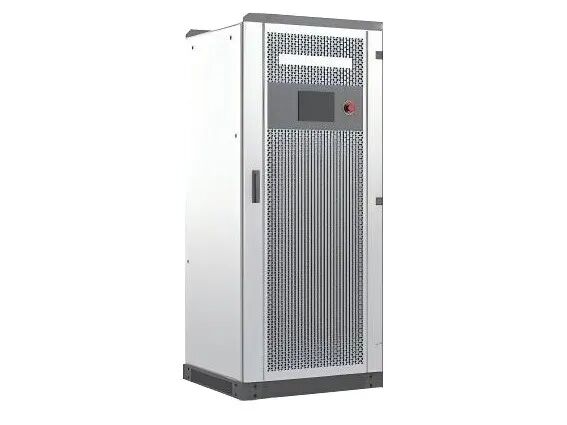
30 kW Three-phase Inverter
This unit integrates MPPT, transformer, STS transfer switch and maintenance bypass, functioning as both the brain and main switchgear of the whole system. In grid-tied mode, solar power supplies production loads first, with surplus energy charging the battery. When grid power fails, it switches to off-grid mode within milliseconds, and the battery takes over to keep production running. It has a nominal rating of 30 kW with a 33 kW peak capacity. Both grid-tied and off-grid modes are supported, and output harmonic distortion is controlled below 3%, which is friendly to factory motors and frequency converters. Its operating temperature spans -30°C to 55°C, so overheating trips are avoided even under the extreme summer heat around Ashgabat. It supports 100% unbalanced load operation, allowing independent loads on each of the three phases.
Two features are especially valuable for factories in Turkmenistan. First, it can coordinate with diesel generators, adjusting generator output according to real-time load. When solar generation is high, the diesel engine reduces fuel consumption; after sunset, the generator supplements power. For plants already relying on diesel backup, this creates meaningful fuel savings. Second, multi-unit parallel operation is supported. If the factory expands in the future, additional inverters can be paralleled without tearing down the existing setup.
Dispatching parameters can be set directly via the touchscreen. The BMS communicates with the inverter through CAN and RS485, while the EMS enables remote monitoring over TCP/IP. Operators can view daily generation, stored energy and battery state of charge from the office or remotely. This is far more convenient than manual meter checks in the power room overnight.
Daily operation on site
Video of System Operating Principle
When sunlight is strong in daytime, the PV array generates at full capacity, feeding production loads first and charging the battery with excess power. As irradiance drops in the afternoon, the battery discharges to fill the power gap. At night, the grid supplies power while the battery remains on standby. In case of grid failure, off-grid switching completes within tens of milliseconds to maintain continuous production for several hours.
After one month of operation, the improvements are measurable: electricity bills are much less burdensome, and diesel purchase orders are reduced. On-site operation profile: production starts at 8 a.m., when PV output already reaches 80% of capacity. At noon, when temperatures peak, PV and battery supply the full production load, drawing almost no power from the grid. By 5 p.m. when production finishes, the battery is nearly fully charged. The system runs autonomously overnight, discharging on demand when loads exist and idling otherwise. During weekends or low-order off-seasons, surplus solar power stored in the battery extends available backup hours for more flexible power dispatching.
Limitations: this is not a universal fix
This system cannot sustain multi-day total grid blackouts. With only 80 kWh storage, diesel generators must take over once backup duration is exceeded. Neither can it resolve inherent inefficiencies within production lines. Its value is limited to three use cases: capturing time-of-use price benefits, sustaining short-duration power outages and cutting diesel consumption. Economic feasibility must be verified individually using the factory’s load curve and local tariff policies; configurations cannot be copied blindly from other projects.
Solar generation in desert regions remains weather-dependent. Output drops noticeably during prolonged cloudy or dusty periods, where storage acts as a backup rather than an extra benefit. This factor must be included in financial modelling. Maintenance also matters: PV modules need regular dust cleaning and cable joint inspections. The energy storage cabinet in the power room requires good ventilation and dry conditions, and BMS alarm logs should be reviewed periodically. These tasks are simple, yet many systems are neglected after commissioning. Long-term stable operation for a decade relies equally on quality hardware and routine maintenance.
Closing remarks
PV modules, storage cabinets and inverters are passive hardware. What brings the system to life is rigorous calculation tailored to site-specific conditions. The optimised configuration delivering tangible benefits for this Turkmen factory cannot be copied directly elsewhere. Different rooftop orientations, load structures and tariff policies demand revised designs for every new site. This is the plain reality of commercial and industrial energy storage: not mystical, but calculation-driven.


