
Hybrid PV-ESS Project for a Mid-Scale Hotel in Ghana, Africa/Bid Farewell to Frequent Power Cuts, Unlock a New Energy Solution for Hotel Operations
Introduction
In Ghana, West Africa, the biggest headache for most hotel operators is not low occupancy, but unpredictable blackouts. Unstable grid power and soaring diesel costs keep eating into hotel profit margins. An 80kW commercial hybrid PV-storage system has been deployed for a local mid-sized hotel. This PV-plus-storage hybrid model tackles the most pressing energy challenges facing West African commercial businesses.
Anyone who has travelled for business or tourism in Ghana has experienced the poor power supply firsthand. As one of West Africa’s most economically active nations, tourism stands as a pillar industry. Numerous mid-tier business and vacation hotels host travellers worldwide, yet weak power infrastructure remains an unavoidable operational pain point.
Many operators have tried installing standalone solar PV systems. However, solar alone cannot meet the hotel’s 24-hour power demand. Solar power generation peaks in daylight but drops to zero at dusk, overnight and on rainy cloudy days, forcing hotels to revert to utility power or fire up diesel generators. To achieve reliable power alongside cost reduction, standalone solar is far from sufficient. A hybrid grid-tied PV-storage microgrid is the ideal fit for commercial properties such as Ghanaian hotelsCat.
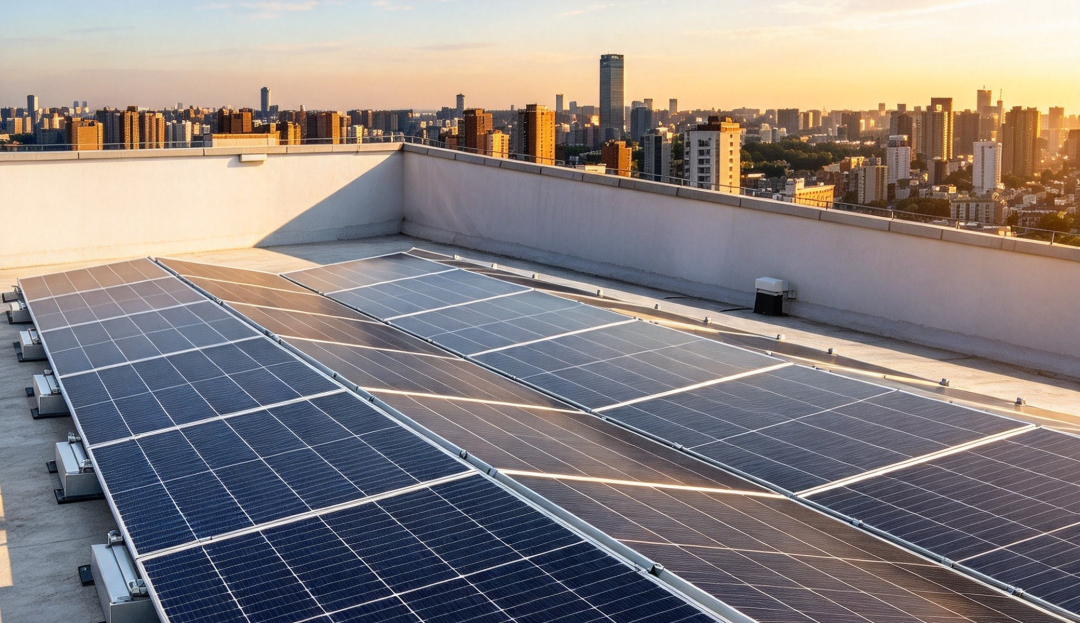
This mid-scale hotel project in Ghana adopts a custom commercial hybrid PV-ESS solution tailored to local load profiles and solar irradiance. The system forms an intelligent microgrid integrating four power sources: solar PV, battery energy storage, utility grid and diesel generator, delivering round-the-clock power security for hotel operations.
Full Equipment Bill of Materials
Core Project Parameters
Total PV installed capacity: 80kW Average daily power output: 256kWh Effective local sunshine hours: ~4 hours Usable battery discharge capacity: 160kWh
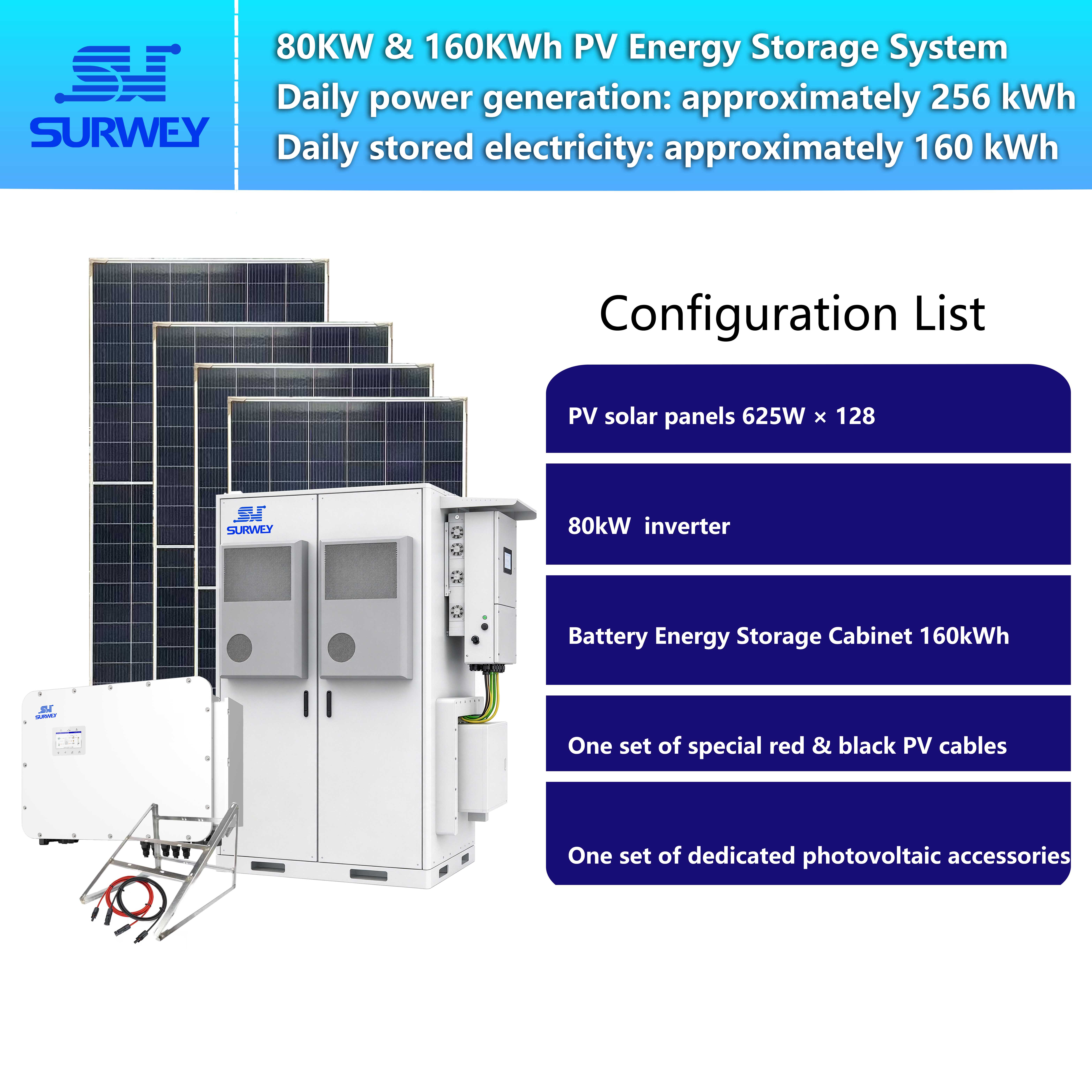
(System Configuration Diagram)
| No. | Equipment Name | Specification | Qty |
|---|---|---|---|
| 1 | High-efficiency PV Modules | 625W N-type monocrystalline modules | 128 pcs |
| 2 | PV Mounting Structure | Custom-made on-site | 1 set |
| 3 | Outdoor Integrated ESS Cabinet | 160kWh, air-cooled, built-in aerosol fire suppression | 1 set |
| 4 | Three-phase Hybrid Storage Inverter | 80kW, with grid-tie/off-grid switching & anti-backflow function | 1 set |
| 5 | Diesel Generator Set | 75kW, fitted with ATS automatic transfer switch | 1 set |
| 6 | DC PV Cables | 4mm² PV-specialized cables | 600m |
| 7 | AC Power Cables | 3×50+1×35mm² | 20m |
| 8 | Auxiliary Material Kit | Earthing components, cable trays, conduits, etc. | 1 set |
System Operating Principle
(System Working Principle Video)
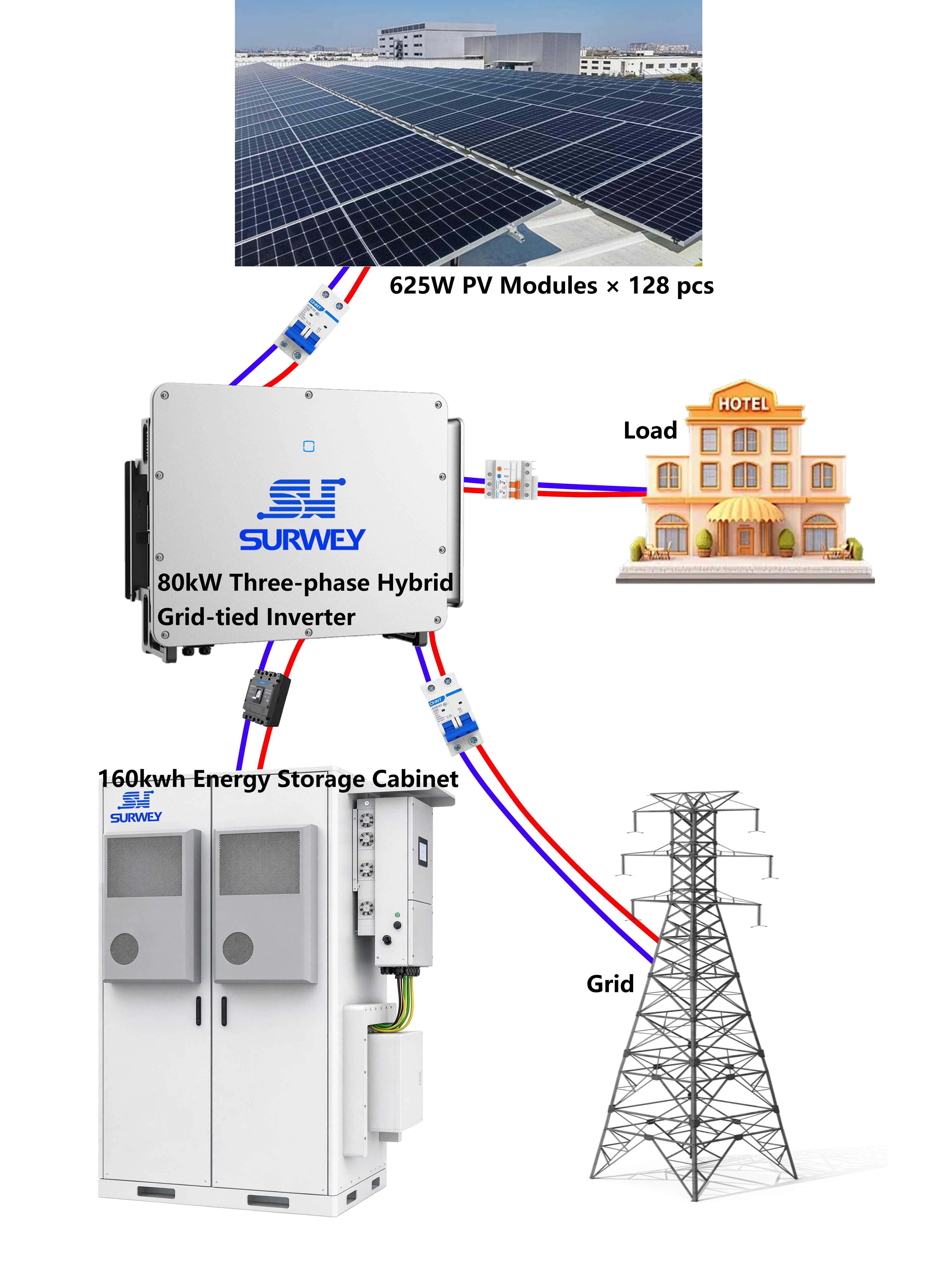
The hybrid inverter acts as the core dispatching unit, connecting four energy sources: PV array, battery storage, utility grid and diesel generator. When sunlight is strong, solar power first supplies hotel loads; excess electricity charges the battery cabinet. If load demand exceeds PV output, the battery or utility grid supplements the shortfall.
When the grid is live, the system runs in grid-tied mode. The system switches seamlessly to islanded backup mode within 10ms once the grid fails, with the battery supplying power immediately. When the battery state of charge falls below the preset threshold, the system automatically starts the diesel generator as the final backup. All switching logic runs fully automatically without manual intervention.
Climate-Adapted Design Tailored to Ghana’s Conditions
Ghana lies in the tropical belt with abundant annual solar resources and roughly 4 effective sunshine hours per day, making it ideal for PV development. Meanwhile, systems must withstand high temperatures, high humidity and heavy dust during rainy seasons. The design avoids copying domestic or European project standards; all equipment is selected for outdoor tropical operating conditions.
PV DC Side
The complete PV array consists of 128 pieces of 625W high-efficiency N-type monocrystalline PV modules. The array is divided into 10 strings to match the inverter’s 10 MPPT channels: 9 strings with 13 modules per string and 1 string with 11 modules per string.
Each module has an open-circuit voltage of 48.6V and a maximum power point voltage of 41.4V. Under high-temperature operating conditions, the operating voltage of the 13-module string is 538.2V and that of the 11-module string is 455.4V. At the low-temperature extreme, the open-circuit voltage of the 13-module string reaches 631.8V, and the open-circuit voltage of the 11-module string reaches 534.6V. All string voltages fall within the inverter’s MPPT range of 150–950V, with no risk of low-temperature overvoltage, enabling reliable power tracking and generation. Compared with conventional modules, N-type modules exhibit lower power degradation under high temperatures, making them better suited for Ghana’s year-round hot climate. Each module is rated at 625W with a module conversion efficiency of 23.14%.
The total installed PV capacity of the system is 80kW. Under ideal solar irradiance, the project achieves an average daily power generation of 256 kWh. During daytime, most hotel loads including air conditioning, lighting, kitchen and laundry facilities are preferentially powered by green electricity generated on-site, directly reducing power purchased from the utility grid. Custom-designed PV mounting structures are engineered to meet the structural load and roof orientation of the hotel rooftop, making full use of idle roof space without occupying valuable land area.
Inverter
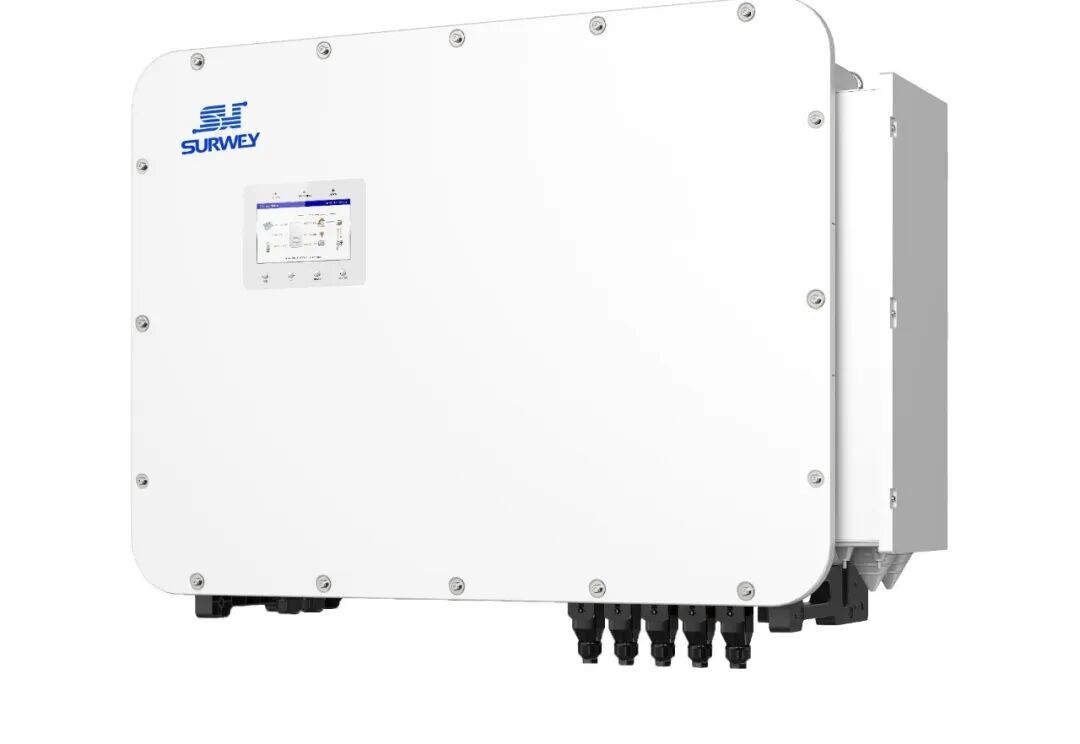
80kW Three-phase Hybrid Storage Inverter
As the "brain" of the whole system, the 80kW three-phase hybrid inverter undertakes the core task of energy dispatching. The inverter has a rated AC output power of 80kW and supports 160% overload for 200 milliseconds in off-grid mode, capable of handling the inrush load during startup of hotel equipment such as elevators and compressors. With 160kWh usable capacity on the ESS side, continuous runtime is approximately 4 hours when supplying the hotel’s critical load of 40kW. If only supporting 20kW basic critical loads such as lighting, monitoring and fire protection, the runtime can exceed 8 hours, sufficient to cope with most short-duration power outages locally.
The inverter supports high-power PV input and accepts a maximum 160kW PV array, reserving space for future capacity expansion. It also supports operation on weak grids, adapting to severe voltage fluctuations of Ghana’s local grid and avoiding frequent equipment shutdown and protection triggered by grid instability. It comes with an anti-backflow function to prevent PV power from feeding back into the public grid. Dynamic reactive power compensation is also available to optimise grid power factor and reduce reactive power charges. The equipment reaches IP66 protection rating to withstand dusty and humid outdoor environments. Equipped with intelligent redundant fan cooling, it ensures stable operation even under high ambient temperatures. Remote cloud platform monitoring is supported, allowing users based in China to remotely view data on power generation, battery charge and discharge, facilitating remote O&M of the power station.
Energy Storage Side
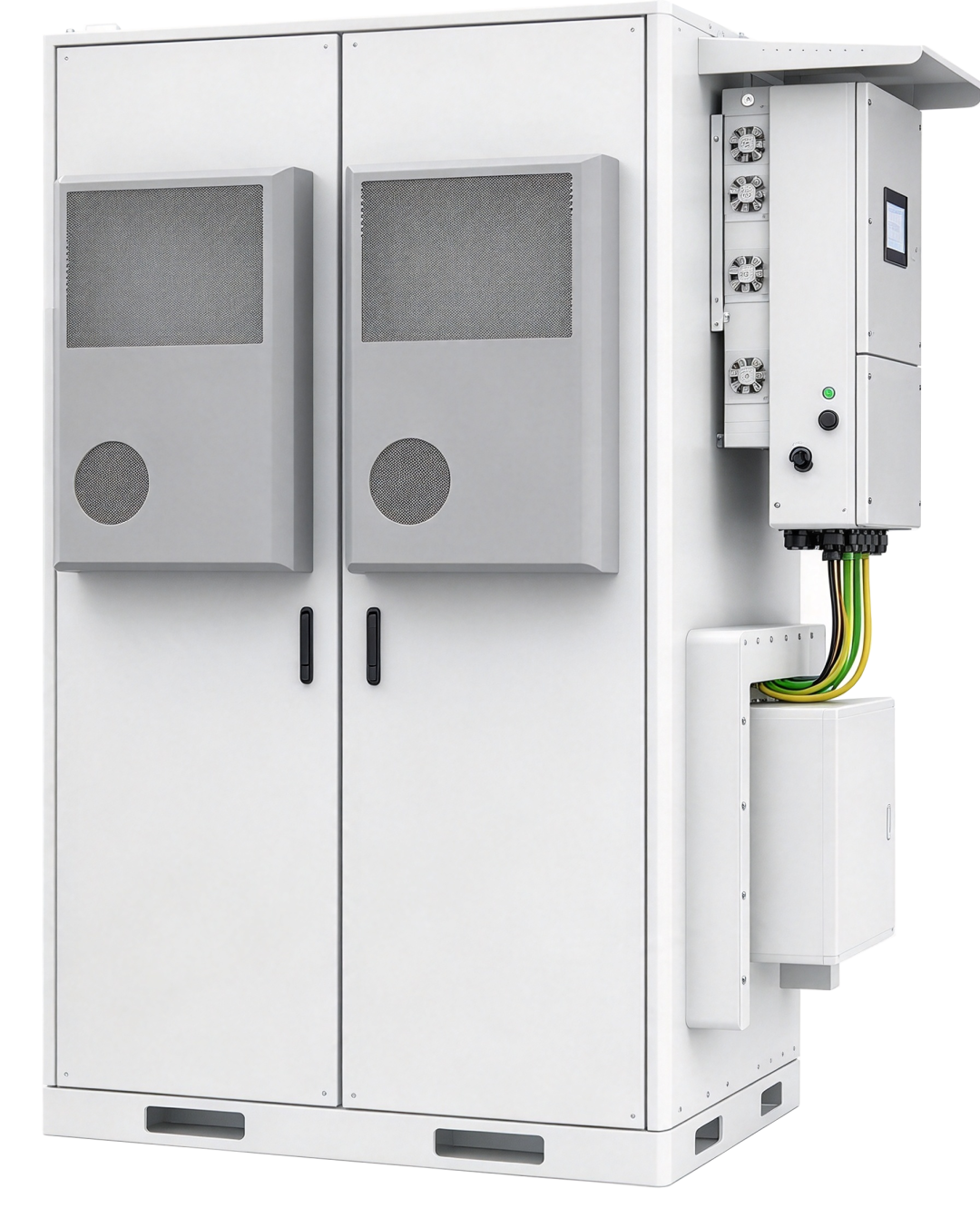
160kWh ESS Cabinet
A 160kWh outdoor integrated energy storage cabinet is deployed on the ESS side. It adopts air cooling and carries IP54 protection rating. It is a fully integrated outdoor cabinet with batteries, fire protection and BMS integrated inside one unit. No dedicated battery room is required, lowering civil engineering investment and simplifying on-site installation and commissioning. An integrated aerosol fire suppression module is embedded inside the energy storage cabinet to fully safeguard battery system safety. The battery boasts a cycle life exceeding 6,000 times, meeting the requirements of frequent charge and discharge cycles for commercial and industrial applications.
This system does not completely discard the existing diesel generator; instead, it incorporates the 75kW diesel generator into the whole energy dispatching system. Only under extreme conditions of prolonged rainy weather and fully depleted energy storage, will the system automatically start the diesel generator as backup power. This greatly shortens generator operating hours, removes diesel from the role of daily primary power supply and cuts fuel consumption fundamentally.
In addition, the full project is equipped with complete auxiliary materials including cables, earthing components and cable trays. It is worth noting that the quantities of DC and AC cables are preliminary estimates. On overseas project sites, building layout and equipment placement affect the actual cable length required. During project execution, re-verification and adjustment will be performed according to actual on-site hotel conditions to ensure construction matches real site requirements.
Payment, manufacturing and ocean shipping of the whole project also need to align with international trade cycles. From order placement in China, through equipment production and ocean freight to delivery to the Ghana site, the overall lead time exceeds three months. This is a realistic factor for African overseas PV-ESS projects. With domestic production plus long-distance ocean shipping, project preparation must be planned well in advance. If the hotel has a scheduled commissioning date, the power supply system shall be constructed in parallel with other hotel civil works. This avoids idle hotel facilities and delayed full opening caused by power equipment still in transit after the main hotel building is completed.
Core Business Benefits for Hotel Operators
Most project owners only focus on electricity bill savings, yet the value of PV-storage systems for overseas hotels extends far beyond cost reduction. We break down the benefits into three dimensions: operational security, cost optimization and long-term asset value.
1. Secure Business Operations and Mitigate Blackout Risks
Uninterrupted power is the lifeblood of hospitality. Guest rooms require continuous power for air conditioning, hot water and lighting; elevators, fire and security systems must stay online 24/7; power outages in kitchens and cold storage lead to massive food spoilage. Traditional diesel generators suffer from start-up delays and frequent breakdowns.
This hybrid system switches to island mode within milliseconds during grid outages, with batteries instantly taking over critical loads. It drastically cuts guest complaints, booking cancellations and material losses, protecting core hotel revenue.
2. Cut Energy OPEX, Reduce Diesel Consumption and Extend Generator Lifespan
Grid electricity tariffs in Ghana are already high, and diesel power is even more costly. The hotel prioritizes self-generated solar power in the daytime and stores surplus energy in batteries for evening and night use. This minimizes grid electricity purchases and drastically reduces generator runtime. The diesel set only kicks in during extreme outages, slashing fuel expenditure alongside maintenance and repair costs. Overall energy expenses drop significantly.
It should be noted that PV-storage is a capital-intensive upfront investment with no immediate payback upon commissioning. Overseas projects face extra costs from ocean freight, customs duties and field installation, pushing up initial CAPEX. However, PV modules, ESS cabinets and inverters all come with multi-year warranties as long-term fixed assets. Cumulative savings on electricity and fuel will gradually offset the initial investment and generate steady long-term returns.
3. Intelligent Multi-source Coordination for Weak Grids, with Built-in Expansion Capacity
Local grid voltage and frequency fluctuate constantly. This hybrid inverter is engineered for weak grid conditions and can tolerate unstable utility power. The four power sources (PV, storage, grid, diesel) are automatically scheduled by the control system without manual switching, lowering operational skill requirements for on-site staff. The hardware is reserved for future expansion. If the hotel adds more guest rooms, restaurants and banquet halls later, owners can add extra PV modules or battery capacity without replacing the core system.
4. Enhance Green Brand Image
An increasing number of international business travellers prioritise eco-friendly accommodation. An on-site PV-storage clean energy system serves as a powerful marketing highlight, creating a competitive edge on booking platforms and for corporate client receptions.
Common Pitfalls to Avoid for African PV-ESS Projects
African hybrid power projects cannot simply replicate domestic designs. Project teams must mitigate multiple key risks:
- Reserve sufficient lead time for manufacturing, ocean shipping and customs clearance; align power system design with building civil works.
- Select equipment rated for tropical high-temperature and dusty environments; complete string voltage simulation verification in the design phase.
- Cable and auxiliary material quantities are only preliminary estimates; final sizing must rely on on-site survey data.
- Adopt highly integrated all-in-one units with remote monitoring functions to offset the shortage of local professional maintenance technicians.
- Complete joint commissioning between the PV-storage system and existing diesel generators, and set reasonable start-stop thresholds to avoid coordination faults and minimise rework after installation.
Closing Remarks: New Energy Reshapes West Africa’s Commercial Energy Landscape
For decades, business owners across Ghana and West Africa have treated diesel generators as mandatory infrastructure, forced to bear sky-high fuel costs and accept constant power cuts. The widespread adoption of PV-storage hybrid microgrids is breaking this long-standing paradigmCat.
We must stay realistic: hybrid PV-ESS is not a universal fix. Upfront capital expenditure remains a barrier, and zero-cost power is impossible. Nevertheless, for hotels running 24/7 with strict reliability requirements, the hybrid solution breaks the cycle of expensive grid power and diesel fuel. A one-time equipment investment locks in long-term controllable energy costs while eliminating the existential risk of sudden blackouts.
This 80kW PV + 160kWh ESS hybrid project for a Ghanaian mid-scale hotel is just one representative case among countless West African commercial PV-storage deployments. As tourism and trade keep expanding across Africa, more hotels, factories and commercial buildings will adopt hybrid solar-plus-storage microgrids. The most practical approach for African commercial renewable projects is to avoid overambitious full off-grid designs and oversized battery capacity. Instead, design a pragmatic, cost-effective hybrid system with grid and diesel backup, fully matched to local solar resources and grid conditions — a solution that is reliable, right-sized and financially viable.


