
Three-Phase PV-ESS Practical Case for Self-Built House in Hebei Province, China|Complete Implementation Scheme for Power Load Shifting to Support High-Power Three-Phase Air Conditioners During Daytime
Introduction
Many rural self-built houses are equipped with 380V three-phase grid access. In summer, high-power three-phase air conditioners run continuously for 8–9 hours during daytime, resulting in high daytime electricity consumption, while the load drops sharply after dark. For conventional grid-tied PV systems, surplus power generated in daytime can only be sold to the grid at a low price. Households still need to purchase grid power for night use, which greatly reduces the self-consumption rate of PV power.
A "PV + Energy Storage" three-phase hybrid grid system stores surplus electricity generated by solar panels in the daytime, addressing the pain point of day-night power mismatch.
Based on real household power consumption profiles, this article fully dissects a practical three-phase residential PV-ESS solution, covering power consumption analysis, PV string design, core equipment selection, power generation estimation, operating logic and on-site construction pitfalls. It delivers actionable guidance for households with three-phase grid access and heavy daytime loads.
1. Real Household Power Consumption Profile — Design Equipment Based on Actual Demand
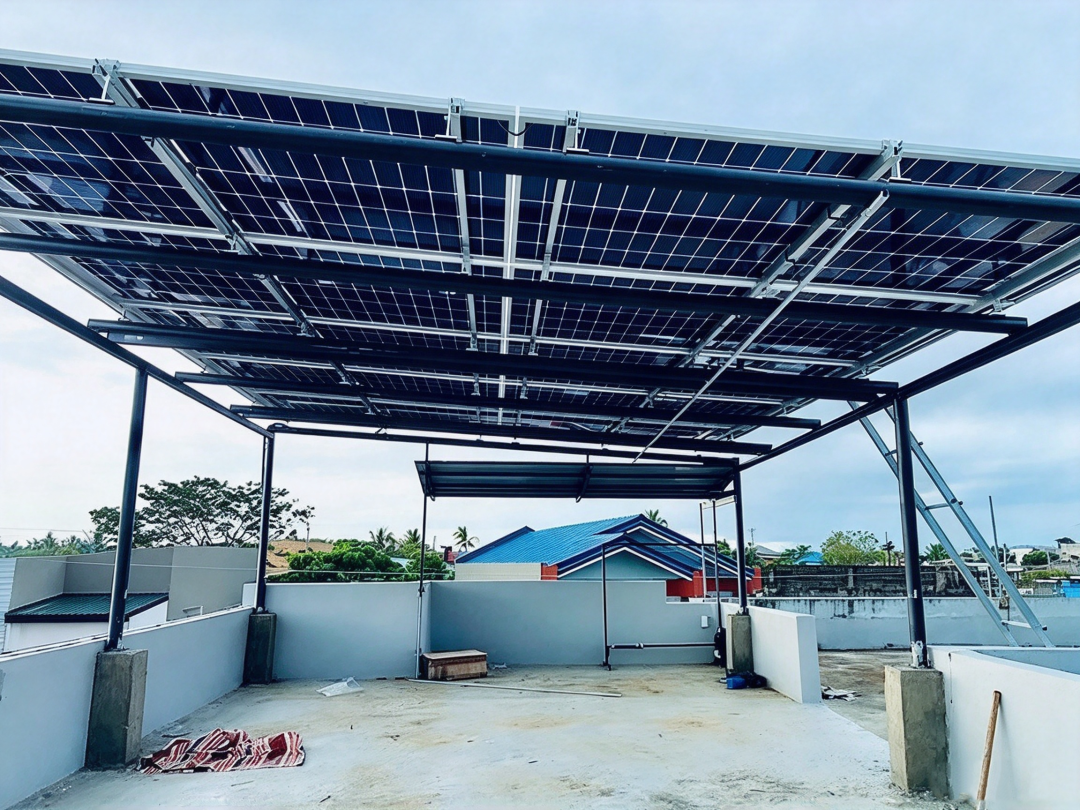 PV Array Installation Diagram
The project site is located in Hebei Province, China. The roof has an available area of approximately 100 m², with standard 380V three-phase grid connection. Its power consumption characteristics are typical for rural households in North China.
- Average daily overall power consumption: 14 kWh
- During hot summer periods, with three-phase air conditioners running for long hours, the maximum daily consumption reaches 25 kWh.
- Power use is heavily concentrated in daytime. The three-phase air conditioner operates for 8–9 hours only on summer days and remains idle in winter.
- Nighttime load is low: only small air conditioners, lighting, TV, routers and other ordinary appliances run, consuming merely 3–5 kWh overnight.
Four core pain points of this household:
- Significant day-night power mismatch. PV output peaks at noon, coinciding with heavy power draw of three-phase air conditioners. PV generation stops after sunset, yet power is still required at night. Ordinary grid-tied PV exports excess daytime power to the grid and imports power at night, leading to low self-consumption.
- Three-phase heavy loads exist; single-phase ESS inverters are not applicable. Installing a single-phase energy storage inverter for a household with three-phase air conditioners will cause overload, frequent protective shutdowns, and even compressor damage — one of the most common mistakes for self-built house PV-ESS projects.
- Large seasonal difference in power demand. Summer has high peak loads; when three-phase air conditioners are turned off in winter, overall load drops drastically. Solar irradiation hours shrink in North China winters, lowering PV output. System design must accommodate both summer and winter conditions instead of over-sizing equipment solely for summer peak demand.
- Sufficient roof resources. The usable roof area is around 100 m². After deducting parapets and maintenance access, there is ample space for PV arrays, allowing reasonable DC oversizing to boost power output under low-light conditions in morning and evening.
Many homeowners ask for panel and equipment quotations directly without analyzing their own power usage schedule, load types and seasonal variations. Two undesirable outcomes often follow: undersized equipment triggers system shutdowns when air conditioners start in summer; blindly oversized battery banks push up budgets while batteries stay idle most of the time. This solution is customized for the actual profile: heavy daytime loads, light nighttime loads and large seasonal load variance.
2. System Hardware Configuration & String Electrical Design
Based on household load profile, roof conditions and inverter datasheet parameters, the full configuration of this three-phase hybrid PV-ESS system is defined:
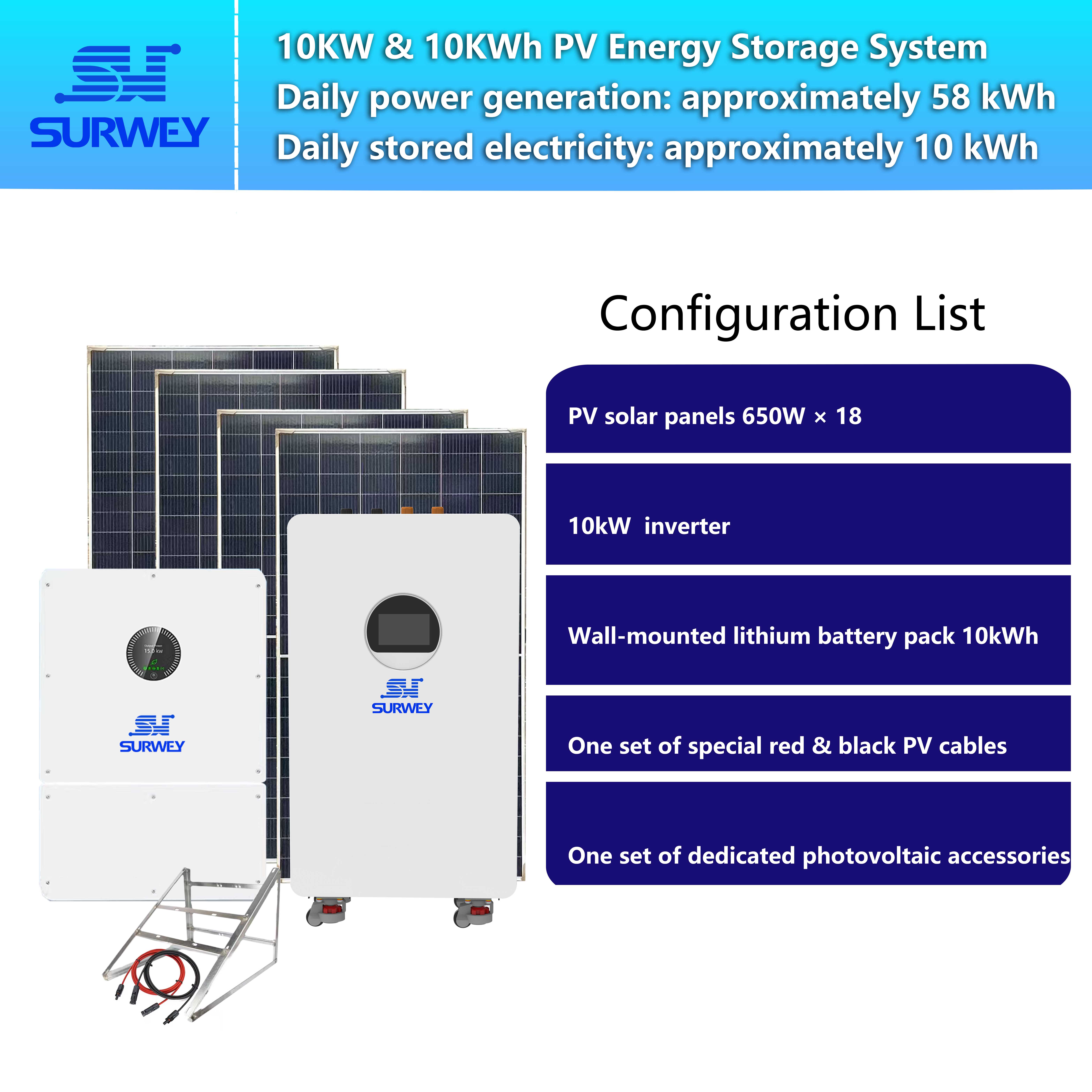
- PV Modules: 18 pieces of 650W high-power monocrystalline modules, total installed capacity 11.7kWp
- String Wiring Scheme: 9 modules in series per string, 2 strings in total. The two strings connect separately to the two independent MPPT ports of SW10K-HU inverter. String 1 connects to MPPT1 and String 2 to MPPT2. Dual MPPT independent tracking minimizes generation loss caused by partial shading.
- Hybrid Inverter: SW10K-HU, 10kW three-phase hybrid (grid-tied/off-grid) energy storage inverter. Maximum recommended PV power: 16000W; 2 MPPT channels; max charge/discharge current: 220A. Supports 100% three-phase unbalanced output, each phase can bear up to 50% of rated power. Features 200% overload capacity for 10 seconds to handle the inrush current during three-phase air conditioner compressor startup. Up to 6 units can be paralleled for future expansion. Integrated generator input and intelligent load control enable seamless off-grid backup during power outages.
- Energy Storage Battery: 51.2V 200Ah lithium iron phosphate battery, nominal capacity 10.24kWh. Adopts household ESS-specific LFP cells with integrated BMS (Battery Management System), supporting CAN/RS485 communication with the inverter. Recommended Depth of Discharge (DOD) ≤80%, available usable capacity approx. 8.19kWh to extend cycle life; 6000 cycles @80% DOD.
- Auxiliary Materials: Hot-dip galvanized PV roof brackets, PV-specified DC cables, DC combiner box, AC/DC distribution cabinet, surge protection devices, circuit breakers, fuses, communication harnesses and cloud monitoring module.
Key String Design Logic
18 pieces of 650W modules are divided into 2 strings with 9 modules in series each, feeding two separate MPPT channels rather than paralleling strings to one MPPT. The MPPT voltage window of SW10K-HU is 150–850V. For 9 × 650W modules in series, the operating voltage at ambient temperature falls within the optimal MPPT tracking range, and cold-state open-circuit voltage will not exceed the inverter’s maximum DC withstand voltage, complying with electrical safety requirements.
Benefits of dual-MPPT separate string connection: if one side of the roof is partially shaded by trees or parapets, only one string is affected while the other continues normal generation. This configuration yields higher energy production than combining both strings on a single MPPT, which is highly recommended for residential PV-ESS.
Each 650W module occupies around 2.55 m². 18 modules take up roughly 45.9 m² of roof space. With a total available roof area of 100 m², spare space is reserved for future PV array expansion for EV chargers or additional high-power appliances.
Inverter Parameter Matching Notes
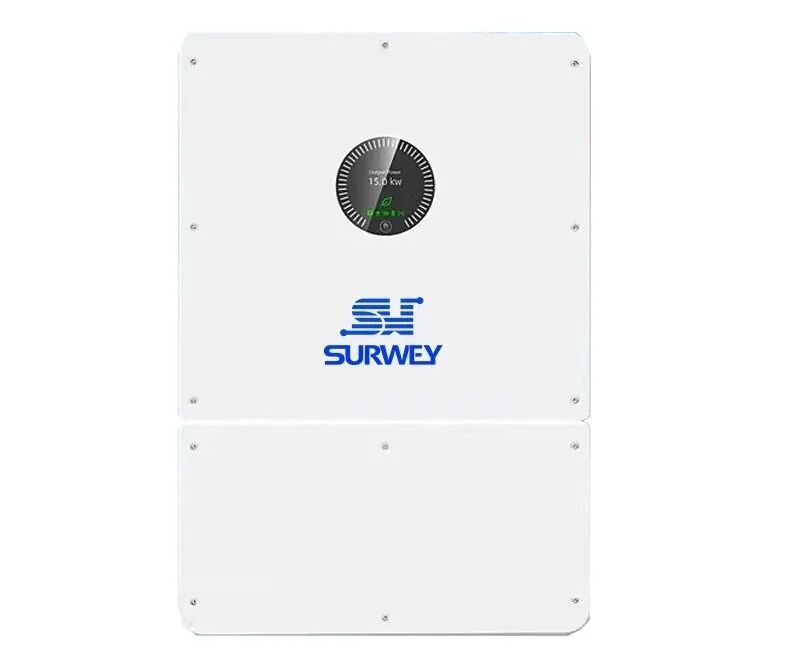
10 kW Three-Phase Grid-Tied Inverter
The maximum allowable PV input power of SW10K-HU is 16000W, while the actual DC installation capacity is 11700W, giving a DC oversizing ratio of 1.17, within a safe and reasonable range. Moderate oversizing improves output under weak light in morning and evening. At peak irradiance, the inverter automatically limits AC output without hardware damage. Its maximum charge/discharge current 220A perfectly matches the 51.2V 200Ah battery, avoiding current limitation and hardware waste.
Battery Parameter Interpretation

10kWh Lithium Battery Energy Storage Pack
51.2V 200Ah LFP battery has total energy of 10.24 kWh. With daily operation limited to 80% DOD, usable capacity reaches 8.19 kWh, which adequately covers 3–5 kWh of nighttime household consumption. The battery will not be deeply discharged, ensuring long service life. Equipped with full BMS protection including overcharge, overdischarge, overcurrent, high and low temperature protection, suitable for indoor household installation.
3. Theoretical Power Generation Estimation for Different Scenarios
Location: Hebei Province, China.
- Annual peak sun hours: ~4.2 h
- Summer peak sun hours: ~5.0 h
- Winter peak sun hours: ~3.2 h
- System overall efficiency: 0.85, accounting for module degradation, cable loss, inverter conversion loss, dust and temperature derating.
Summer Condition (Maximum daily consumption: 25 kWh)
Theoretical daily generation = 11.7kWp ×5.0h ×0.85≈49.7kWh. In summer, PV power directly supplies three-phase air conditioners running for 8–9 hours in daytime. Total daily generation reaches nearly 50 kWh, exceeding the household’s maximum daily consumption of 25 kWh. Part of the PV output directly feeds air conditioners and other loads; surplus power charges the 51.2V 200Ah battery. Once the battery is fully charged, the hybrid system automatically exports remaining power to the grid for feed-in revenue.
After sunset when PV output stops, the system switches to battery discharge mode to power low-load devices such as small air conditioners and lighting at night. Night consumption is 3–5 kWh, less than half of the battery’s usable 8.19 kWh capacity, avoiding deep discharge and protecting battery life. When SOC drops to the preset protection threshold, the system automatically switches back to grid power to prevent overdischarge damage.
Average Annual Condition (Average daily consumption:14 kWh)
Average daily generation =11.7 ×4.2 ×0.85≈41.8kWh. Daily PV generation averages ~41.8 kWh while household consumption is only 14 kWh. Most solar power is self-consumed; excess energy charges the battery or exports to the grid, effectively cutting electricity bills.
Winter Condition (Three-phase air conditioner shut down)
Theoretical daily generation =11.7 ×3.2 ×0.85≈31.8kWh. Shorter sunshine hours reduce PV output in winter, yet high-power three-phase air conditioners are off, and total load returns to 14 kWh per day. Daytime PV directly supplies household loads, and surplus power is stored in the battery for night use, fully meeting daily power needs.
⚠️ Note: All values above are theoretical generation figures. Actual yield is affected by roof orientation, installation tilt, shading, dust accumulation and ambient temperature. The optimal installation tilt angle is 35–38°, facing true south. Minimize shading from trees and parapets to maximize energy output.
4. Complete Operating Logic of SW10K-HU Three-phase Hybrid System
Many homeowners confuse grid-tied, off-grid and hybrid systems. A hybrid (grid-tied/off-grid all-in-one) inverter supports both grid-connected power generation and off-grid emergency backup. The system has four operating states.
System Working Principle Video
State 1: Grid normal, sufficient daylight, PV power > household load DC power from PV modules enters the inverter via two independent MPPT channels and is converted into 380V three-phase AC to supply household loads directly; three-phase air conditioners consume solar power first. Surplus power charges the 51.2V 200Ah battery. Once fully charged, excess power is automatically exported to the utility grid for feed-in income. Dual MPPT tracks independently; partial shading on one string does not affect the other string’s generation.
State 2: Grid normal, dusk/night with zero PV output The inverter switches to battery discharge mode. The energy storage battery supplies power for night appliances. When battery SOC reaches the protection threshold, discharge stops immediately and the system seamlessly switches to grid supply to guarantee uninterrupted power.
State 3: Grid normal, insufficient sunlight on cloudy days PV output is insufficient to support household loads. PV feeds loads first. When battery energy is low, the system supplements power from the utility grid. PV and grid work in tandem; household appliances are unaffected by cloudy weather.
State 4: Utility power outage — off-grid backup mode At the moment of grid failure, SW10K-HU switches in milliseconds to disconnect from the utility grid and enter off-grid microgrid mode. PV and battery jointly output 380V three-phase power for household loads. During daytime outages, PV can drive three-phase air conditioners while charging the battery. At night, stored battery power supports essential loads.
Important Reminder: Under off-grid mode, total load shall not exceed the inverter’s continuous output rating of 10kW. Avoid turning on multiple high-power appliances simultaneously to prevent overload shutdown. Thanks to the 200% short-time overload capability, the unit easily handles the startup inrush of three-phase air conditioner compressors.
Overall operation: On sunny days, PV power supplies local loads first; surplus energy charges the battery, and excess power after full battery is exported to grid. At night, battery discharges; grid takes over when battery energy is low. Automatic emergency switchover during blackouts. This perfectly matches the usage pattern: heavy daytime loads and light nighttime loads.
5. Five Critical Pitfalls to Avoid for Residential PV-ESS Implementation
Even premium hardware will suffer failures without proper policy review and construction quality control. Below are key practical tips summarized from distributed PV project experience:
- Confirm local grid policy for energy storage with power supply bureau in advance Grid policies for hybrid PV with energy storage vary across cities and counties. Some regions allow ESS grid connection and normal settlement for exported surplus power; others restrict ESS solely for outage backup and prohibit reverse power feed to the grid. Consult and complete filing with the power bureau before equipment procurement and construction, confirm whether ESS grid connection and feed-in are permitted, to avoid huge losses after installation.
- Check roof load bearing capacity; reinforce aged roofs if needed Total weight of 18 ×650W PV modules is about 360 kg, plus brackets and clamping components. For old flat roofs and aged color steel roofs, load bearing must be verified. Reinforcement is required for insufficient bearing capacity. Safety always comes first.
- Check nameplate power of high-power appliances and verify inverter load margin This scheme adopts SW10K-HU 10kW three-phase hybrid inverter with 2× short-time overload capacity for motor startup inrush. Before installation, check nameplate rated and maximum input power of three-phase air conditioners, three-phase water pumps and other equipment. If the rated load power approaches 7kW, recheck inverter load margin.
Key concept: kW stands for power, determining the maximum appliances the system can drive; kWh stands for battery capacity, determining how long appliances can run. Many homeowners blindly pursue large-capacity batteries while ignoring inverter output power, resulting in protective tripping once air conditioners start despite sufficient battery energy — essentially insufficient output power.
- Follow specifications strictly for string design, cables and protection devices This project uses 9 modules per string with two strings connected to separate MPPT channels. Do not arbitrarily change series-parallel configuration during construction to avoid MPPT voltage out-of-limit. DC side uses flame-retardant PV dedicated cables, DC voltage drop controlled below 2%. 51.2V 200Ah is a high-current ESS system; battery cables, breakers and fuses must match maximum charge/discharge current. Ordinary wires cannot be substituted. Complete surge protection and earthing are required for both AC and DC sides. Many self-built houses have poor inherent earthing; inadequate grounding poses safety risks in thunderstorms.
- Do not overlook battery installation environment 51.2V 200Ah LFP batteries are recommended to be placed indoors in well-ventilated and dry locations, never exposed under direct sunlight. The optimal operating temperature for lithium batteries is 10–30°C. Long-term high-temperature exposure accelerates degradation. If placed outdoors without thermal insulation in cold winter nights, low temperature limits battery charge/discharge performance and shortens service life.
6. Supported Appliances & Theoretical Runtime
Note: Under off-grid condition, the inverter continuous output power is 10kW and usable battery capacity is 8.19kWh. The table below shows theoretical runtime relying purely on battery with no PV supplement. Runtime will be significantly extended when PV is available during daytime. Actual runtime is subject to real appliance power, start-stop cycles, ambient temperature and battery degradation, for reference only.
| Appliance | Rated Power | Theoretical Runtime on Single Unit | Combined Load Example | Total Combined Power | Theoretical Runtime |
|---|---|---|---|---|---|
| 5HP three-phase floor-standing AC | 3.8kW | ~2.1h | 5HP three-phase AC + lighting + router | 4.2kW | ~1.9h |
| 3HP single-phase household AC | 2.2kW | ~3.7h | 3HP AC + TV + lighting | 2.6kW | ~3.1h |
| 1.5HP small AC | 1.1kW | ~7.4h | 1.5HP AC + lighting + TV + router | 1.5kW | ~5.4h |
| Full set of household lighting | 300W | ~27.3h | Whole-house lighting + router + TV | 600W | ~13.6h |
| TV + Router | 250W | ~32.7h | TV + Router + Refrigerator | 550W | ~14.9h |
| Refrigerator (average operating power) | 120W | ~68.3h | Refrigerator + lighting + router | 420W | ~19.5h |
| Three-phase water pump | 4.5kW | ~1.8h | Three-phase water pump + basic lighting | 4.8kW | ~1.7h |
Important Remarks: Calculation above uses 8.19 kWh usable battery capacity without PV input. If PV is available during daytime power outages, appliances can run longer. Motor loads (air conditioners, water pumps) generate inrush starting current. The system supports 200% overload for 10 seconds to handle startup, but cannot operate continuously under overload conditions. Total load under off-grid mode must not exceed 10kW continuous rating. Stagger operation of multiple high-power devices to prevent inverter overload shutdown.
7. Residential PV-ESS: The Best Solution Is the One Matching Your Actual Needs
Two extreme views exist among homeowners regarding PV-ESS: some believe PV-ESS can fully disconnect from the grid to achieve zero electricity bills; others argue energy storage has no value and selling all generated power to grid is better.
As demonstrated in this real household case, the core value of three-phase hybrid PV-ESS is mitigating day-night power mismatch, raising PV self-consumption rate and providing emergency backup power instead of complete grid independence.
This configuration — 18 ×650W modules (11.7kWp) + SW10K-HU 10kW three-phase hybrid inverter + 51.2V 200Ah battery — is balanced and customized for the scenario with heavy three-phase AC load in daytime and light night load. It avoids overspending on oversized battery banks while fully utilizing summer solar irradiation to meet peak demand. In winter when high-power loads are off, there will be no redundant idle capacity.
Roof orientation, shading, household power habits and local grid policies differ from house to house. Conduct on-site roof survey, record nameplate parameters of high-power appliances and confirm local grid policy before finalizing your scheme. Do not copy online configurations directly.
If your home has three-phase grid access, heavy daytime loads and sufficient roof space, this string-designed three-phase PV-ESS solution can serve as a valuable reference. Feel free to leave comments for PV-ESS discussion.


