
Overseas Office PV-ESS Microgrid Implementation|Complete Solution Analysis of PV-ESS Hybrid Grid System for Three Airport Office Buildings in Tonga
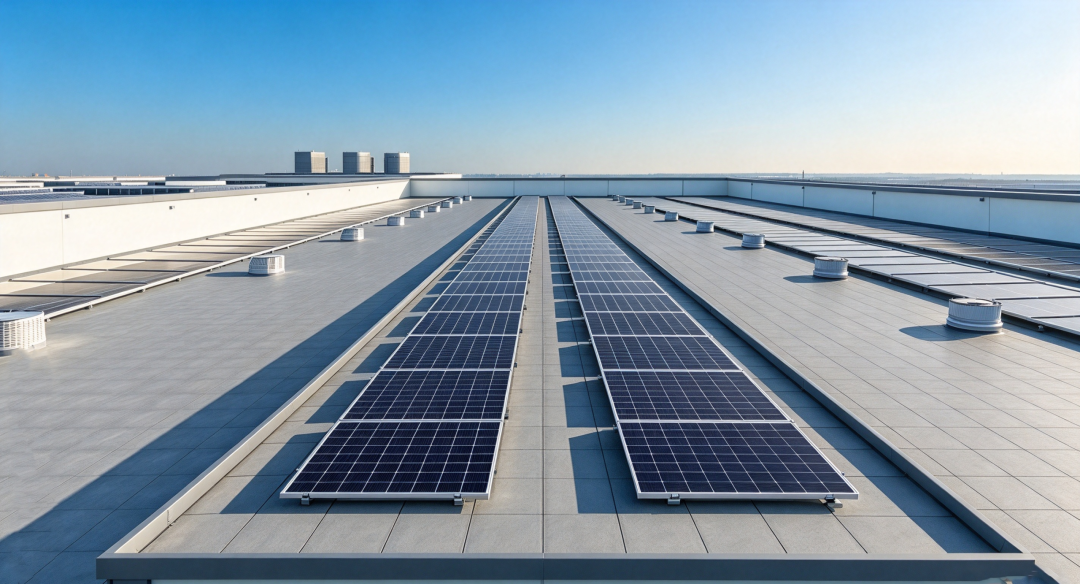 Roof PV Array Diagram
 Roof PV Array Diagram
Introduction: Driven by the rising commercial and industrial electricity tariffs in Tonga, many overseas airports and transportation-supporting buildings have begun exploring PV-energy storage microgrid solutions. Without feeding power back to the utility grid, these systems maximize self-consumption and reduce reliance on mains power. This project covers three airport office buildings in Tonga. Based on the actual power consumption characteristics of the buildings, it adopts a hybrid inverter + energy storage + PV array configuration. Mains power only serves as backup supply, balancing economic benefits and power supply reliability. It provides a replicable design reference for similar overseas office buildings.
I. Project Overview: Practical Power Consumption Pain Points of Airport Office Scenarios
Located in Tonga, this project serves three airport supporting office buildings, all with three-phase power supply. Airport buildings require basic power supply stability. Meanwhile, high local commercial and industrial electricity tariffs are the core driver for the deployment of the PV-ESS system.
The three office buildings feature significantly different power consumption scales yet highly unified power consumption schedules: office loads dominate during working hours on weekdays, while night-time loads remain very low. Staff finish work at around 17:00 (5 PM). Major power consumption periods occur in the morning and after 15:00 in the afternoon. The rooftops offer ample space for PV installation. The client explicitly requested no grid interconnection (no reverse power delivery to the public utility grid). Mains power acts only as backup supply, paired with energy storage to achieve on-site consumption of daytime PV generation and cut procurement of expensive grid electricity.
Baseline power consumption of the three buildings:
- Office Building 1: The highest-load main airport office building, with monthly power consumption of approximately 18,000 kWh.
- Office Building 2 & 3: Smaller auxiliary office buildings, each with monthly power consumption of roughly 1,500 kWh.
Key constraints of the scenario, which form the starting point of solution design:
- Reverse power delivery to the grid is prohibited. The whole system operates in hybrid backup mode. PV power supplies building loads first; excess power charges the energy storage system. Once the battery is fully charged, the system automatically curtails PV output to prevent reverse power flow.
- Mains power serves as a "backup supplement" rather than the primary power source. Grid power is drawn automatically only when PV output is insufficient and energy storage is depleted, to minimize electricity bills.
- The energy storage system does not require large-capacity long-duration backup. It mainly covers office power demand before work ends in the morning and afternoon. Night-time loads are inherently low and do not require all-night energy storage support.
- A full three-phase architecture is adopted. Hybrid inverters are equipped with CT current transformers and smart meters to realize real-time power monitoring, energy dispatch and anti-reverse-power-flow control, ensuring safe operation of the entire microgrid.
- Fast grid-tie/off-grid switching capability is required. When mains power fluctuates abnormally, the system smoothly switches to PV-ESS off-grid microgrid mode to guarantee uninterrupted power supply for office equipment, monitoring systems and network infrastructure and other critical loads.
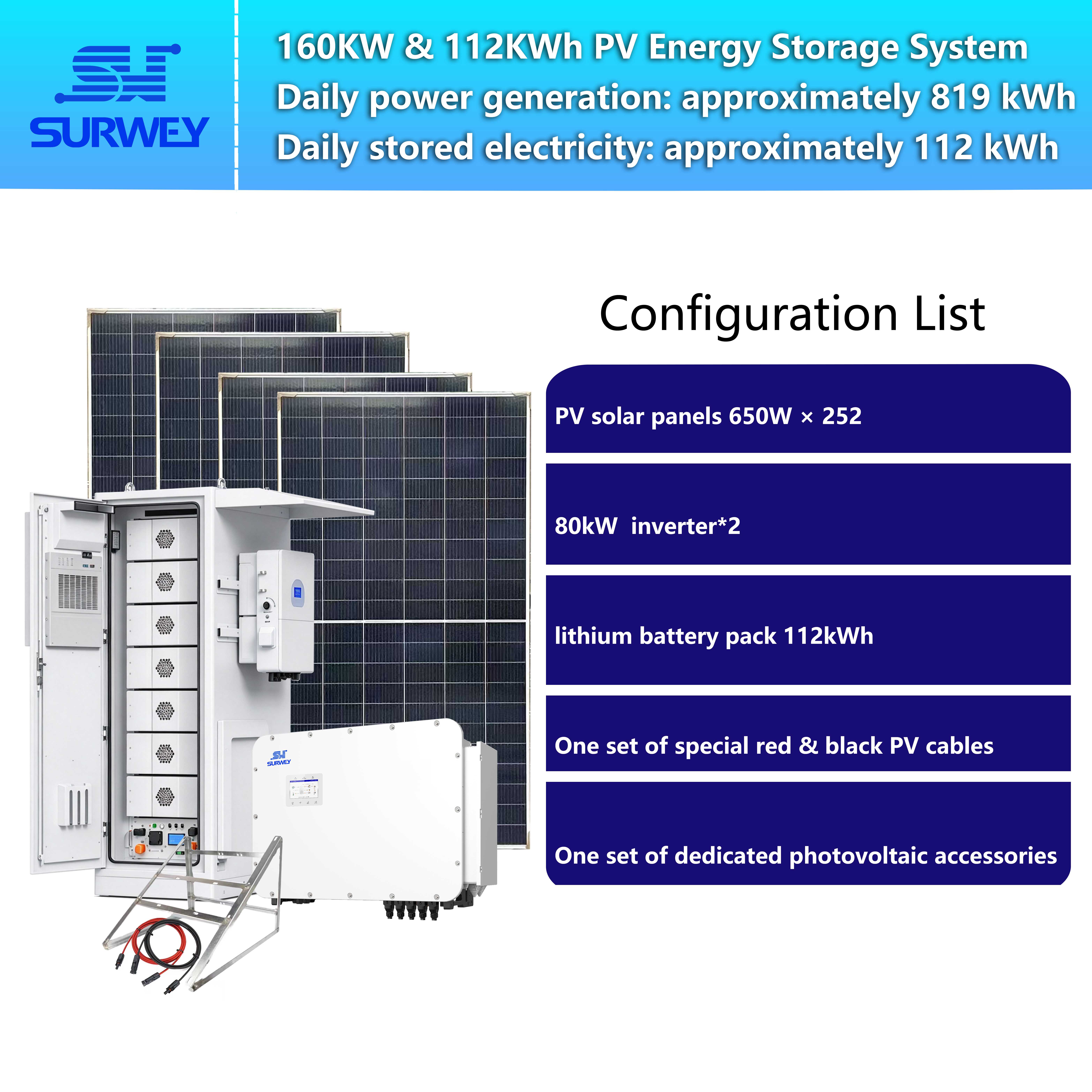
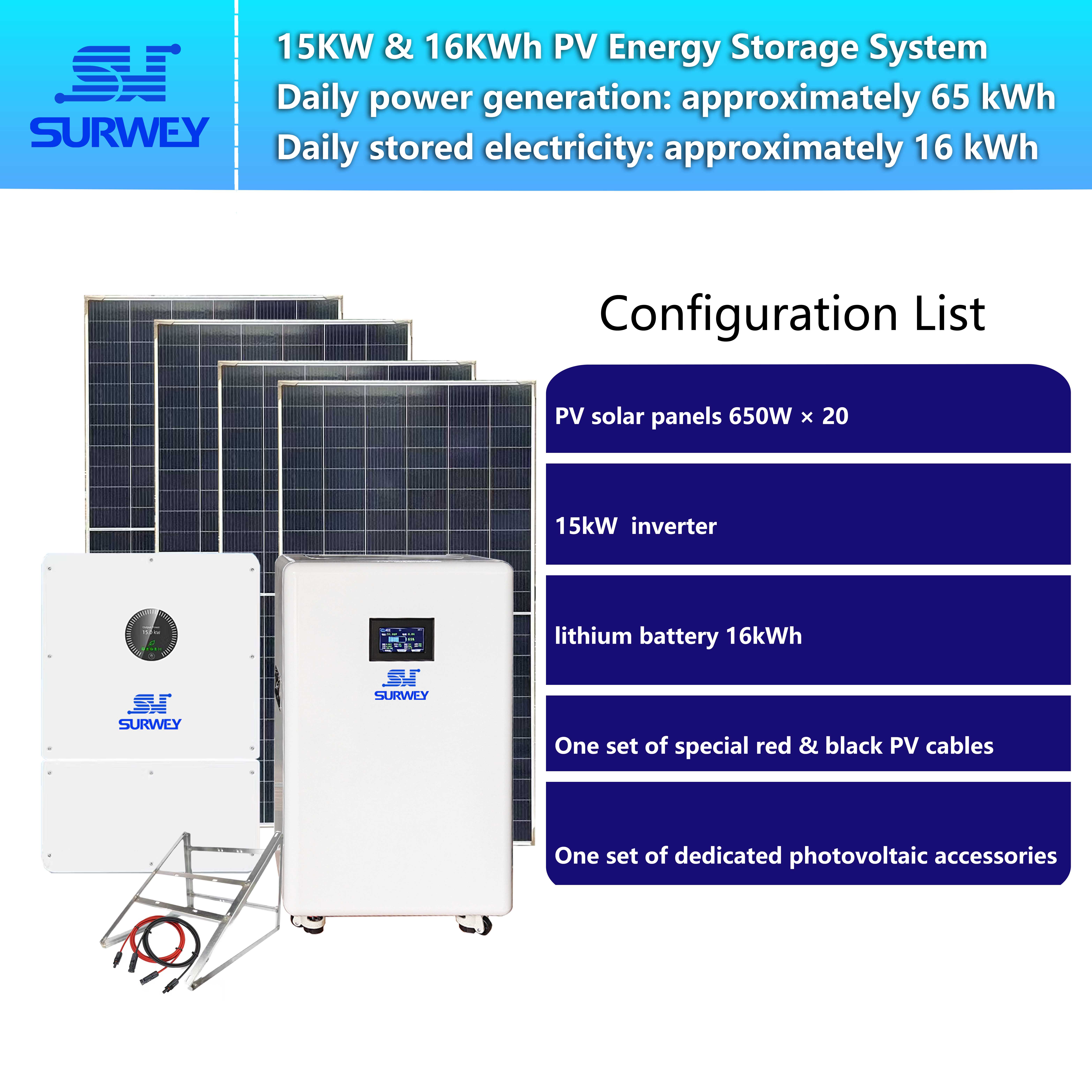
Combining load breakdown, power consumption schedules and rooftop resources, the final overall equipment configuration of the project is as follows: All PV modules are 650W panels, totaling 292 pieces. The hybrid inverter setup includes 2 units of high-power 80kW models and 2 units of medium-and-small 15kW models. Energy storage consists of 1 unit of 112kWh energy storage cabinet and 2 units of 16kWh energy storage batteries.
- Building 1: Two 80kW inverters running in parallel + 112kWh energy storage cabinet + 252 pieces of 650W PV panels.
- Building 2 & 3 (two small buildings): Identical configuration for each: 1 unit of 15kW inverter + 1 unit of 16kWh energy storage battery + 20 pieces of 650W PV panels.
II. Solution Design Logic: Why This Capacity Matching?
Many overseas PV-ESS projects fall into two common pitfalls: over-sizing PV and energy storage, leading to idle equipment and higher upfront investment; or insufficient capacity, which fails to cover core working hours with PV generation and greatly weakens cost-saving effects. This project starts from real load curves, sorts out load time-series data, then matches the scale of PV, inverters and energy storage to achieve "adequate capacity without over-investment".
2.1 PV Array Capacity Matching Logic
Building 1 (main building) is equipped with 252 pieces of 650W PV panels, with a total PV installed capacity of 163.8kW. Two 80kW inverters run in parallel, with a total rated inverter power of 160kW. Tonga boasts excellent solar irradiance. The solar angle in the morning and afternoon better fits the rooftops of airport buildings. During peak noon irradiance, the inverter performs power limiting, reserving more generation margin for office power demand after 15:00 in the afternoon. This well matches the building’s power consumption peaks and improves the utilization rate of effective power generation, instead of simply pursuing peak power.
For auxiliary Buildings 2 and 3, each is fitted with 20 pieces of 650W PV panels, with a single-building PV installed capacity of 13kW, paired with a 15kW hybrid inverter. The small buildings have low monthly electricity consumption of only 1,500 kWh. Under local irradiance conditions, the 13kW PV array can directly cover basic loads such as lighting, office computers, network and monitoring for most working hours on weekdays. Since staff finish work at 17:00, power generated in the late afternoon can be stored in the 16kWh battery to cope with low-irradiance cloudy days.
In total, 292 pieces of 650W PV panels are deployed, with a total installed capacity of 189.8kW. The design principle of the whole system: PV generation targets daytime on-site self-consumption plus battery charging, rather than full self-sufficiency around the clock. A small amount of mains power is used for low night loads to control energy storage investment.
2.2 Inverter Selection: Parallel Hybrid Grid Architecture for Buildings of Different Scales
The project fully adopts three-phase hybrid inverters supporting both grid-tied and off-grid modes and multi-unit parallel operation. CT transformers and bidirectional smart meters are the core hardware to realize "mains power as backup and no reverse power flow".
The main Building 1 with heavy loads adopts two 80kW inverters in parallel.

A single 80kW three-phase hybrid inverter supports high-power PV access and bidirectional battery charging and discharging. After parallel connection of two units, the overall load capacity of the system rises, and dual-port energy storage access is supported for the 112kWh cabinet connected to the parallel system.
The parallel scheme brings two practical benefits:
- During load peaks, both units output power together to handle surge loads from simultaneous activation of air conditioners and office equipment in the office building.
- Redundancy capability: if one inverter fails, the other can carry partial critical loads, improving power supply fault tolerance for airport buildings. Synchronous control is implemented inside the parallel system. Switching from grid-tied mode to off-grid microgrid mode takes only tens of milliseconds, so office equipment will not reboot due to power cut, meeting the uninterrupted power requirement for critical airport office loads.
Each small auxiliary Building 2 and 3 is equipped with one 15kW three-phase hybrid inverter.

The small buildings have low loads, and a single inverter can cover all loads, featuring compact equipment and simple on-site installation and commissioning. Despite the small building size, three-phase models are still selected to match the original three-phase power distribution of the buildings, avoid three-phase imbalance and ensure stable operation of office air conditioners and power equipment.
CT transformers and smart meters act as the "sensing nerves" of the whole system. Installed at the mains incoming side, they collect real-time power and current direction data of the grid side. The system implements zero reverse power flow logic: once a trend of power backfeeding to the public grid is detected, the inverter immediately adjusts PV output or prioritizes sending surplus power into energy storage, strictly ensuring no power flows back to the grid to satisfy local non-grid-connection mandatory requirements.
2.3 Energy Storage Capacity Trade-off: Avoid Blind Oversizing, Match Real Power Consumption Timing
Many clients for overseas PV-ESS projects tend to specify oversized energy storage in pursuit of complete off-grid operation. However, airport office buildings have minimal night power consumption, with power demand concentrated on weekdays in daytime. Energy storage mainly compensates for irradiance fluctuations, such as reduced PV output on cloudy or overcast days, or supplements power supply when solar irradiance fades near the end of work in the afternoon. It does not need to supply power overnight, so oversized energy storage is unnecessary. This is the key point to control the project payback period.
The main Building 1 is configured with a 112kWh energy storage cabinet.

The main building consumes about 600 kWh daily out of its 18,000 kWh monthly consumption, most of which is used during working hours from 08:00 to 17:00. PV power directly supplies loads in daytime, and surplus power charges the 112kWh cabinet. On cloudy days with insufficient PV output, the battery discharges to fill the power gap. After 15:00 when solar irradiance gradually drops, energy storage discharge takes over office power demand and reduces grid power draw in this period.
Battery protection thresholds are set inside the system to retain certain battery margin. This extends battery cycle life. In case of extreme consecutive rainy days, once battery state of charge drops to the preset lower limit, the system automatically switches to mains power backup to prevent battery damage from over-discharge.
Buildings 2 and 3 are each equipped with a 16kWh energy storage battery.

The small buildings have a daily load of merely 50 kWh. PV power supplies loads directly in daytime, and surplus power charges the 16kWh battery. For small buildings, this capacity is sufficient to support half-day office loads and stably sustain power supply until off-work on cloudy days. Night-time power consumption is extremely low. Even if energy storage is depleted, a small amount of mains power suffices, so there is no need to expand energy storage capacity.
Lithium battery systems are adopted for all energy storage units, compatible with the high-voltage battery interface of hybrid inverters. They deliver high charge-discharge efficiency and adapt to high-temperature, wide-temperature-range outdoor installation environments. A complete BMS battery management system is equipped to provide overcharge, over-discharge, overcurrent and temperature protection.
III. System Operation Logic Breakdown: Complete Workflow of the Hybrid Microgrid
The core logic of the whole system: PV priority, energy storage buffering, mains backup, no reverse power flow. The daily operation process can be broken down as follows for easier understanding of actual operating status.
160kW 112kWh Parallel System Working Principle Video
Weekday daytime with sufficient irradiance (morning work start to noon): DC power generated by the PV array flows into the hybrid inverter, which converts it into three-phase AC power to supply all loads of the office building first. When PV generation exceeds the real-time building load, excess energy charges the energy storage system. The CT and smart meter continuously monitor the mains incoming line, with mains power draw close to zero and almost no grid electricity purchased. Charging continues if the battery is not full. Once fully charged, the inverter actively reduces PV output to avoid surplus power backfeeding the grid, realizing zero reverse power flow operation.
Afternoon period (15:00 to 17:00 off-work): The solar elevation angle decreases and PV output gradually declines. When PV generation falls below real-time building load, the energy storage system discharges first to fill the power gap and continue supplying office loads, postponing mains power draw as much as possible. Mains power is only drawn after the battery SOC hits the protection lower limit or when the sun sets and PV output nearly disappears. Since staff finish work at 17:00, building loads drop sharply after work. Even if mains power is needed, power consumption remains very limited.
Cloudy and overcast conditions: PV output drops greatly and cannot fully support all loads. PV still generates power to the maximum possible extent, and the gap is supplemented by battery discharge. If battery SOC decreases rapidly and reaches the preset lower limit, the system switches smoothly and mains power automatically intervenes as a supplement to guarantee uninterrupted office power supply.
Abnormal mains power (grid fluctuation or power outage): The system detects mains status via CT and smart meters. Once mains abnormality is identified, the inverter rapidly switches to off-grid grid-forming mode. The entire PV-ESS system forms an independent microgrid, with PV and energy storage jointly supplying power for critical building loads. Switching takes milliseconds, so computers, monitoring and network equipment will not shut down. When mains power recovers and stabilizes, the system synchronizes phase automatically and seamlessly switches back to hybrid grid mode.
After off-work at night: The building has minimal night loads and no PV output. The battery retains partial reserve capacity according to settings. Small night base loads (security monitoring, etc.) are directly powered by mains power instead of consuming battery capacity, reducing battery cycles and extending service life.
Special note: This project is not a fully off-grid system in the traditional sense. Fully off-grid systems require much larger PV and energy storage capacity to cope with consecutive rainy weather, resulting in high investment costs. This project is a PV-ESS hybrid microgrid with mains as backup. The grid remains in the system acting as a "safety buffer". It cuts consumption of expensive grid power for most working hours without incurring the high equipment cost of fully off-grid projects, making it a highly cost-effective solution for overseas commercial and industrial office buildings.
Meanwhile, the system supports load priority management. Under extreme conditions where total PV-ESS power is insufficient, the system can automatically cut non-critical loads and prioritize power supply for security systems, servers and core office equipment to further improve reliability.
IV. Hardware Supporting, Installation and Compliance Key Points for Overseas Projects
For overseas projects, especially island regions, besides equipment capacity matching, electrical architecture, protection rating, communication monitoring and local standard compliance are critical for smooth project delivery. Many domestic schemes exported overseas often overlook these details.
In terms of electrical topology, the two 80kW inverters for the main Building 1 adopt a parallel architecture. Multi-unit parallel operation requires proper synchronous control. Distribution cabinets, circuit breakers and cables are selected according to the maximum output current of parallel units with margin reserved. DC-side protection is implemented between energy storage and inverters. On the AC output side, backup critical load circuits are separated from ordinary circuits. In off-grid mode during mains failure, power supply for critical circuits is prioritized.
The installation position of CT transformers and bidirectional meters is particularly critical. Transformers must be clamped on the total mains incoming side instead of the load side. Only in this way can the power flow direction between the grid and building be accurately detected to realize zero reverse power flow control. Incorrect transformer installation will disable the anti-reverse-power-flow function and cause power backfeeding, violating local grid requirements and bringing compliance risks.
Environmental adaptability: Tonga has high summer temperatures. Outdoor equipment requires a wide operating temperature range. Inverters feature high protection ratings to adapt to open-air or outdoor cabinet installation. Energy storage cabinets are equipped with temperature control and heat dissipation to guarantee lithium battery service life and safety under high-temperature conditions. The whole system supports local display and remote cloud platform monitoring. Operation and maintenance personnel can remotely view PV generation, battery SOC, building load consumption and mains power draw data of each building; alarms can be read remotely for pre-fault troubleshooting. The three office buildings can be monitored independently or managed centrally, facilitating airport operation and maintenance teams.
Regarding local compliance certification: For commercial and industrial PV-ESS projects in Tonga, inverters, energy storage and PV modules must meet local safety, EMC and grid standards. Even though this project is non-grid-tied, equipment must satisfy corresponding safety specifications, which is a mandatory requirement for site acceptance of overseas projects. During on-site construction, grounding protection is implemented for the three-phase power distribution system. PV-specific switches are fitted on the DC side, protective devices are installed for battery circuits, and complete insulation monitoring and leakage protection are deployed to protect personnel and equipment safety.
V. Project Benefit Analysis: Additional Value Beyond Electricity Cost Savings
Direct Electricity Bill Savings
Time-of-use electricity tariffs apply for commercial and industrial users in Tonga, with high rates during daytime working hours and further price hikes in peak periods. The core benefit of the project comes from replacing expensive grid power with PV generation and battery discharge on weekdays in daytime. Most of the 18,000 kWh monthly power consumption of the main Building 1 occurs in daytime working hours. The PV-ESS system covers a large share of this consumption and significantly reduces grid power purchase volume. Although Buildings 2 and 3 have small loads, their low monthly power consumption base means PV can cover most daytime power use, delivering a higher percentage reduction in electricity bills.
It should be objectively stated: since mains backup is retained, 100% full self-sufficiency cannot be achieved. A certain amount of mains power will still be consumed during consecutive rainy days. Nevertheless, overall electricity bills are greatly optimized compared with the original state without PV-ESS. Meanwhile, the enormous upfront investment of fully off-grid schemes is avoided, delivering a more reasonable payback period.
Improved Power Supply Resilience
As airport supporting buildings, the office premises house security monitoring, network communication and administrative office equipment. In case of mains power disturbance or short outages, the system switches to PV-ESS microgrid mode within milliseconds to keep critical loads powered, enhancing power supply resilience of airport supporting buildings. This added value cannot be delivered by mains power supply alone.
Operation and Maintenance
High standardization of equipment across the three buildings: large buildings adopt 80kW parallel inverters while small buildings use unified 15kW models, with only two specifications for energy storage. Fewer spare part types reduce later operation and maintenance pressure. The remote monitoring platform collects operating data of the three buildings centrally, eliminating frequent on-site meter reading by O&M staff. Active push of fault alarms cuts on-site O&M costs for overseas projects.
VI. Design Insights for Similar Overseas Office Projects
This project for Tonga airport office buildings is a typical overseas small-and-medium commercial and industrial PV-ESS microgrid case. Many domestic EPC teams undertaking overseas projects often encounter similar scenarios: high local electricity prices, good rooftop PV conditions, but grid interconnection for power sales is prohibited. Clients want energy storage while working within limited budgets and do not require full off-grid operation. Combined with this project, several replicable design experiences are summarized:
- Analyze real load time-series data instead of only monthly total electricity consumption. For the same monthly power consumption, PV and energy storage deliver high value if loads concentrate in daytime; value drops sharply if loads occur mainly at night. In this office building case, power consumption concentrates in working hours in daytime, maximizing PV utilization, and energy storage does not need oversized capacity. Do not blindly scale up PV and energy storage at the beginning, resulting in investment waste.
- Distinguish between "fully off-grid" and "hybrid microgrid with mains backup". Many clients want off-grid systems without realizing that fully off-grid solutions require much larger PV and energy storage capacity to cope with consecutive rainy weather, driving up costs sharply. For many overseas commercial buildings where mains infrastructure remains available but grid power is expensive, hybrid microgrid with mains as backup is a higher cost-performance route.
- Non-grid-tied does not mean arbitrary wiring. Configuration and installation location of CT transformers and bidirectional meters are critical. Zero reverse power flow fully relies on power collection at the incoming side. Errors in hardware installation will make the whole scheme fail to meet local grid requirements. Electrical details must be prioritized for overseas projects.
- Deploy equipment by building classification. Use high-power parallel inverters for heavy-load buildings and small independent inverters for low-load buildings, instead of simply adopting uniform equipment for all. In this project, two 80kW inverters in parallel for Building 1 and single 15kW inverters for small buildings match equipment scale to respective loads, balancing performance and investment.
- Moderate energy storage capacity: sufficient capacity is enough. Energy storage accounts for a large share of total system investment and must match application scenarios. In this case, energy storage is used to fill gaps caused by fading afternoon irradiance and cloudy days, rather than all-night power supply. Therefore, oversized energy storage cabinets are not deployed, and investment is prioritized for frequently used PV and inverters.
- Confirm equipment certification, protection rating and temperature operating range in advance for overseas projects. Overseas environments and safety regulations are stringent. Even for non-grid-tied systems, equipment must comply with local standards to avoid acceptance risks in advance.
VII. Conclusion
A growing number of overseas transportation-supporting and office buildings worldwide adopt hybrid microgrid solutions featuring "PV + energy storage, mains backup, no grid interconnection". Different from conventional grid-tied PV systems and fully off-grid systems isolated from the utility grid, such solutions well balance electricity cost savings, power supply reliability and upfront investment in high-tariff regions.
For this project covering three airport office buildings in Tonga, differentiated configurations are adopted according to varying power consumption conditions of 1 heavy-load main building and 2 small auxiliary buildings: 2 units of 80kW hybrid inverters running in parallel, 2 units of 15kW hybrid inverters, paired with 1 unit of 112kWh energy storage cabinet and 2 units of 16kWh energy storage batteries, plus a total of 292 pieces of 650W PV panels. Supported by CT and smart meters for power sensing, the whole system implements PV priority, energy storage peak-shaving buffering, mains backup supplement and zero reverse power flow to fit the actual operating conditions of airport office buildings: daytime concentrated power consumption, off-work at 17:00 and low night loads.
For overseas EPC engineers and solution designers, overseas PV-ESS solution design cannot copy the mindset of domestic grid-tied projects. It is necessary to fully understand local grid rules and building load curves, avoid blind pursuit of "100% self-sufficiency", and find the balance between economic efficiency and power supply capacity within constraint conditions. This is what makes a truly implementable solution.


