
Photovoltaic and Energy Storage Integrated Technical Solution for Small and Medium-sized Building Materials Processing Plant in Colombia
Preface
This project designs a 160kW / 522kWh PV-ESS integrated system for the power consumption of a small and medium-sized building materials processing plant in Colombia. The local power grid suffers from voltage fluctuations and short-duration power outages. The factory includes 24/7 continuously operating wind pumps and water machinery, while other production equipment has variable start-stop schedules. The total installed power of loads is 130 kW, the normal operating power is 40 kW, and peak load can reach 122 kW. Continuous production places high requirements on power supply reliability. The system achieves an average daily power generation of 1170 kWh and daily energy storage capacity of 522 kWh. It reduces electricity expenses and guarantees production during grid faults, realizing self-consumption of PV power, storage of surplus electricity, and emergency backup power supply during grid outages.
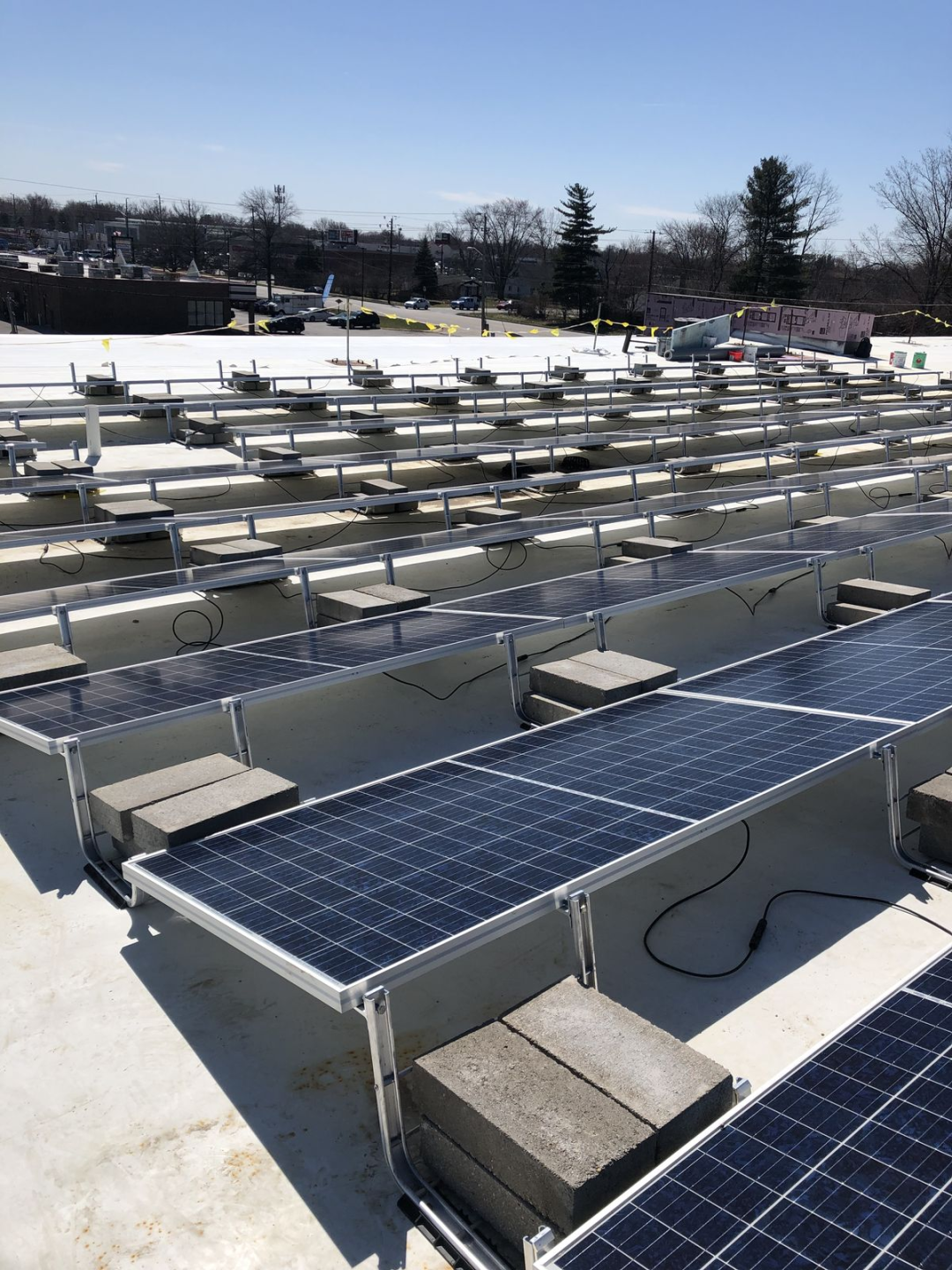 PV Module Roof Layout Drawing
The solution fully accounts for the starting impact of motor-type loads. Power margin is selected at 3–4 times the load rating to support startup and continuous operation of various factory equipment. The design also complies with local climate conditions and electrical standards to ensure long-term stable system operation. The following sections elaborate on equipment parameters, string verification, load backup duration, operating principles, and conclusions.
1. Main System Equipment Parameters
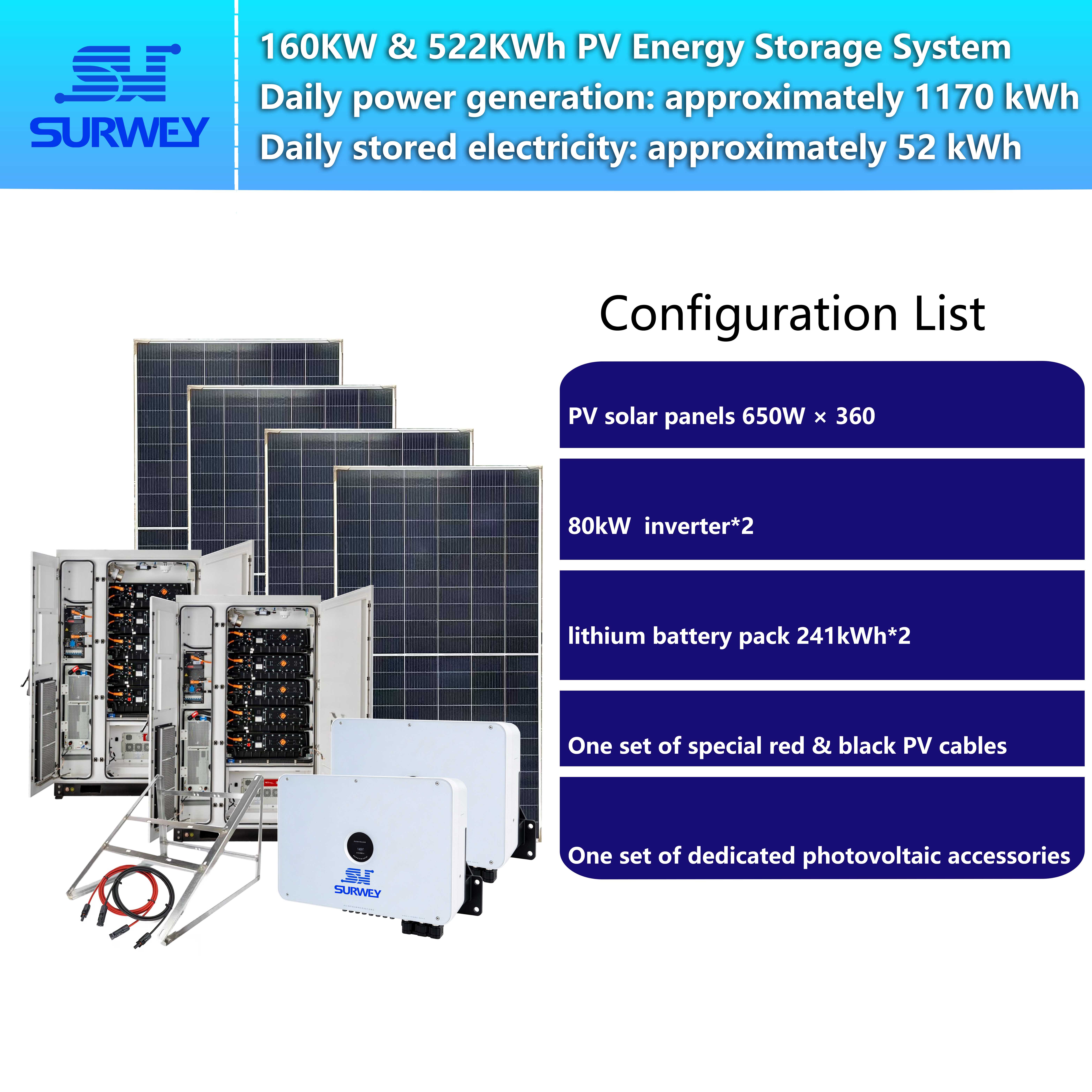
System Configuration Diagram
The overall configuration of this PV-ESS system: 360 pieces of 650 W PV modules, connected in series with 18 modules per string for a total of 20 strings. Two units of 80 kW three-phase hybrid grid inverter/controller. Each unit connects to 10 PV strings and matches the device’s 10 MPPT channels. Two units of 241 kWh outdoor energy storage cabinets are deployed to form a complete grid-tied/off-grid commercial and industrial PV-ESS system, delivering functions including PV power generation, bidirectional energy storage charging and discharging, grid complementation, and seamless backup power supply upon grid faults.
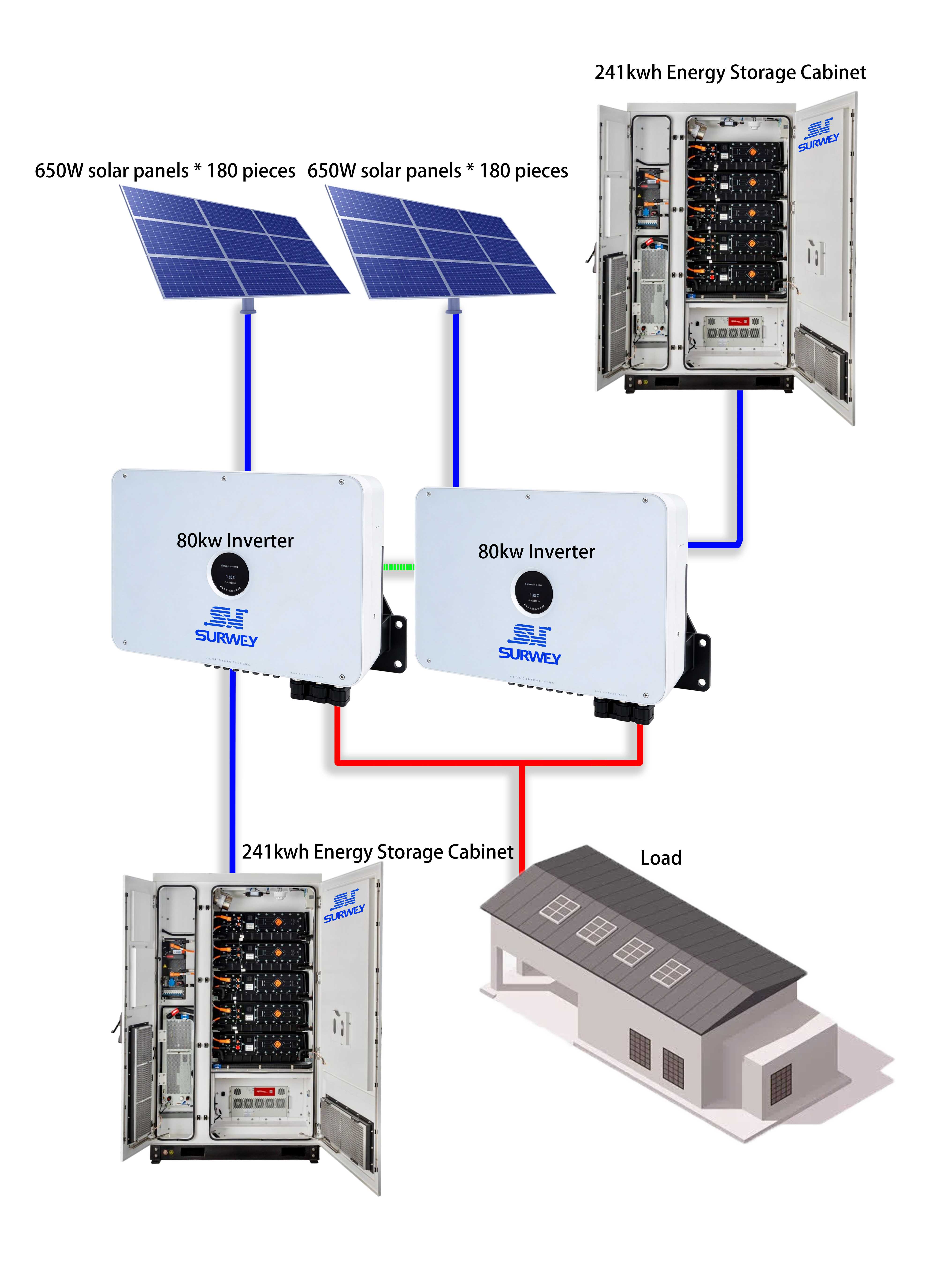
System Topology Schematic
High-power monocrystalline PV modules suitable for rooftop or ground mounting in commercial and industrial scenarios. The modules feature excellent high-temperature adaptability, matching Colombia’s high-temperature and high-irradiance climate. They offer strong wind and hail resistance with stable output. Single module power: 650W; total installed capacity of 360 modules: 234 kWp. Module electrical parameters match the inverter MPPT voltage window. String output current complies with the inverter’s per-channel input limit, supporting high-current module access to boost overall power generation and supply clean DC power to the factory.
80 kW Three-phase Hybrid Grid Inverter & Controller

Three-phase high-voltage grid-tied/off-grid hybrid equipment, supporting grid-connected power generation, bidirectional charge and discharge of energy storage, and fast switching to backup power mode during grid faults with switching time less than 10ms to ensure uninterrupted power to loads. The unit is equipped with 10 MPPT channels. Each unit connects to 10 PV strings and features dual battery ports for independent connection to energy storage cabinets, facilitating capacity expansion. It supports weak grid operation and diesel generator integration, with functions of dynamic reactive power compensation, anti-reflux control and demand management. It provides short-time overload output capability to handle large inrush current during startup of fans and water pump motors. Integrated comprehensive AC and DC protection, IP66 protection rating for harsh outdoor environments. Equipped with cloud platform remote monitoring and fault alarm for intelligent scheduling.
241 kWh Outdoor Energy Storage Cabinet

Outdoor integrated lithium iron phosphate energy storage cabinet. Usable capacity per unit: 241kWh. Cell specification: 51.2V‑314Ah, cycle life ≥8000 times. Long cycle life adapts to daily charge-discharge cycles of commercial and industrial applications. The cabinet is designed for outdoor installation and integrated with BMS (Battery Management System), which monitors cell voltage and temperature in real time with protection functions against overcharge, overdischarge, overcurrent and abnormal temperature. It can be directly connected to the battery port of the hybrid inverter & controller. Parallel connection of two storage cabinets increases total energy storage capacity to store surplus PV power and supply factory loads under low irradiance or grid anomalies, fulfilling peak shaving and emergency backup functions.
2. PV String Voltage & Current Matching Verification
PV wiring scheme of this project: 18 pieces of 650 W modules connected in series to form one string, with 20 strings in total. Strings are evenly allocated to two 80 kW hybrid inverter & controller units, with 10 strings for each unit corresponding to 10 independent MPPT channels. The inverter MPPT operating voltage range is 150‑950V, maximum DC input voltage 1000V, maximum DC input current per channel 42A. Operating current of one string is approximately 13.9A. Under standard test conditions, the string operating voltage of 18 series-connected modules is around 612V, falling within the optimal MPPT operating range of the inverter.
Under low-temperature conditions, module open-circuit voltage rises. After correction with temperature coefficients, the maximum open-circuit voltage of 18 series modules does not exceed 930V, lower than the inverter maximum DC input limit of 1000V, avoiding overvoltage protection trigger. Under high-temperature conditions, string operating voltage drops, and the minimum operating voltage remains higher than the MPPT lower limit of 150V to prevent MPPT loss of lock and power generation failure.
For current: operating current of one string is approximately 13.9A. Only one string is connected to each MPPT channel. The per-channel current is far below the 42A per-channel maximum limit, so DC overcurrent will not occur.
Each inverter connects to 10 strings. Under the 117 kW PV allocation for each unit (total PV capacity 234kWp), the 80kW inverter model supports up to 160kW PV input with 2x rated PV oversizing. 117kW is within the allowable oversizing range, fully utilizing solar irradiance resources in Colombia to improve power generation revenue. All string voltage and current parameters are within the inverter’s allowable electrical range. The electrical design is safe and compliant.
3. System Available Power and Backup Duration Calculation
Factory loads are divided into two categories: wind pumps and water machinery running continuously 24/7 with power of 8 kW; other production equipment with total power of 122 kW and variable start-stop schedules. Total load power of the factory: 130 kW; average normal operating power: 40 kW.
System power margin is reserved at 3–4 times peak load. Two 80 kW hybrid inverter & controller units provide combined AC rated output of 160 kW. Short-time overload capability handles startup inrush current of inductive loads such as water pumps and fans.
Total energy storage capacity: two 241 kWh cabinets, total 482 kWh. Depth of discharge (DOD) of lithium iron phosphate ESS is set at 90%, and overall system conversion efficiency at 97% for calculation.
- Backup for essential continuous loads only (wind pumps + water machinery, 8 kW): Available usable energy = 482 × 0.9 × 0.97 ≈ 420 kWh. Theoretical backup duration: approx. 52.5 hours. It guarantees long-time uninterrupted operation of 24/7 water machinery and wind pumps during grid outages.
- Backup for factory average daily operating load of 40 kW: Available usable energy 420 kWh, continuous operation duration approx. 10.5 hours.
- Full load operation at rated 130 kW: Limited by total inverter rated output of 160kW, the system can support full-load operation of all equipment for approx. 3.2 hours, covering short-term peak production scenarios.
In actual operation, PV generates power simultaneously during daytime. PV power can supply loads together with energy storage to further extend backup duration. The EMS (Energy Management System) supports load priority configuration. During grid faults, priority power supply is assigned to wind pumps and water machinery, while non-critical loads can be selectively disconnected to guarantee core process equipment of the building materials plant and avoid raw material loss and production interruption caused by power outages.
4. System Operating Principle
This PV-ESS system is a hybrid grid-tied/off-grid solution, composed of PV array, 80 kW hybrid inverter & controller, 241 kWh energy storage cabinets, EMS, public power grid and factory loads. It has two main operating modes: grid-tied operation and off-grid backup, with EMS coordinating and scheduling all equipment status.
Animation Video of System Operating Principle & Current Flow
Grid-tied Normal Mode (Grid Available)
Under sufficient solar irradiance, DC power from PV modules passes through the hybrid inverter & controller. MPPT maximizes power extraction and converts DC to AC power, which supplies factory production loads preferentially. When PV output exceeds real-time factory power consumption, surplus power charges the energy storage cabinets via bidirectional rectification of the inverter to achieve the target daily stored energy of 522 kWh. If PV output cannot meet factory demand, the energy storage discharges to supplement loads and reduce power purchase from the grid. When PV plus ESS output is still insufficient, the public grid automatically compensates the power gap. Anti-reflux function can be enabled to prevent PV power from feeding back to the grid. Dynamic reactive power compensation improves power factor at the plant site and reduces reactive power charges.
Grid Fault Off-grid Backup Mode
When the public grid experiences power outage or voltage abnormality, the system completes grid-tied/off-grid switching within milliseconds and disconnects from the grid to enter independent backup mode, with switching time less than 10ms so factory loads do not perceive power interruption. At this stage, PV and energy storage jointly supply plant loads. In daytime, PV power supplies loads directly first and surplus energy is stored. At night with zero PV output, energy storage cabinets discharge to maintain equipment operation. EMS intelligently identifies loads, assigns the highest power supply priority to wind pumps and water machinery, and switches non-critical loads on or off according to remaining SOC to prevent system overload shutdown. After grid recovery and verification of qualified grid parameters, the system automatically switches back to grid-tied mode seamlessly.
Generator Integration Capability
The hybrid inverter & controller supports connection of diesel generators. Under extreme conditions when stored energy is depleted, diesel generators can be deployed as a tertiary backup power source. AC output from generators connects to the AC input port of the inverter & controller, supplying factory loads directly or charging energy storage cabinets to further improve power supply reliability for Colombia’s unstable grid conditions.
The cloud monitoring platform of the whole system collects real-time data including PV generation, ESS SOC, factory power consumption and grid parameters. Charge and discharge strategies can be configured remotely, and fault alerts are pushed automatically to help operation and maintenance personnel monitor system status.
5. Conclusion
This solution designs a PV and energy storage system matching the power consumption characteristics of the small and medium-sized building materials processing plant in Colombia. Total PV installed capacity: 234kWp, equipped with two 80kW hybrid inverter & controller units and two 241kWh outdoor energy storage cabinets. PV strings have passed voltage and current verification, and all equipment electrical parameters are matched to meet safe operation requirements. The system achieves average daily power generation of 1170 kWh and daily stored energy of 522 kWh. It realizes self-consumption of PV power to reduce factory electricity purchase cost, and delivers strong emergency backup capability. It can support long-time uninterrupted operation of 8kW water machinery and wind pumps, and provide around 10.5 hours of backup power for the factory’s normal 40kW load to mitigate production losses caused by grid outages.
Equipment selection fully considers starting impact of inductive motor loads with sufficient power margin. Energy storage cabinets feature ≥8000 charge-discharge cycles suitable for daily commercial and industrial cycling. Outdoor protection ratings adapt to local high-temperature and rainy climate. The system supports grid-tied, off-grid and hybrid generator operating modes with intelligent scheduling via EMS. The system effectively improves power quality of the factory, reduces dependence on the public grid, and balances economic benefits and power supply security. Inverter and energy storage cabinets can be directly connected in parallel for future capacity expansion as factory production capacity grows, offering good scalability.


