
Technical Solution for PV-ESS System of Wood Processing Factory in Indonesia
Preface
With the sustained growth of Indonesia’s industrial economy, power demand of small and medium-sized manufacturing factories has kept rising. However, industrial parks across the country are plagued by prominent pain points including unstable grid power supply, high commercial and industrial electricity tariffs, lack of sound peak-valley electricity price adjustment mechanisms, and fines incurred by exceeding instantaneous power demand, which greatly push up production power costs and operational risks for small and medium industrial enterprises.
In response to the above conditions, Shangwei Technology has customized and delivered a three-parallel commercial and industrial PV-ESS system for a wood processing factory in Indonesia to meet its power consumption demands. Located near the equator, Indonesia boasts abundant solar irradiance, creating ideal natural conditions for distributed PV system deployment.
1. Project Overview
This project is built on the premises of a wood processing factory in Indonesia, featuring a grid-connected PV energy storage system. PV arrays are installed on idle factory rooftops and open ground, paired with high-voltage outdoor energy storage cabinets to form an integrated "PV + Energy Storage" energy supply system.

Installation site of PV panels on factory rooftop
Wood processing plants feature concentrated production loads and obvious power consumption gaps between peak and off-peak hours. The coordinated operation of PV and energy storage enables self-consumption of on-site generated power and storage of surplus electricity, cutting power purchase expenses during grid peak periods, optimizing the factory’s power consumption curve, enhancing power supply reliability, and mitigating equipment shutdown risks caused by grid fluctuations for wood processing machinery.
Video of System Working Principle
System Configuration
- 468 pieces of 650W PV modules
- 3 sets of 125kW three-phase high-voltage hybrid inverter & control integrated machines
- 3 outdoor energy storage cabinets (single cabinet rated capacity: 241.15kWh, rated charge/discharge power: 125kW)
- Theoretical average daily PV power generation: 1,521kWh
- Average daily electricity stored by energy storage system: 723kWh
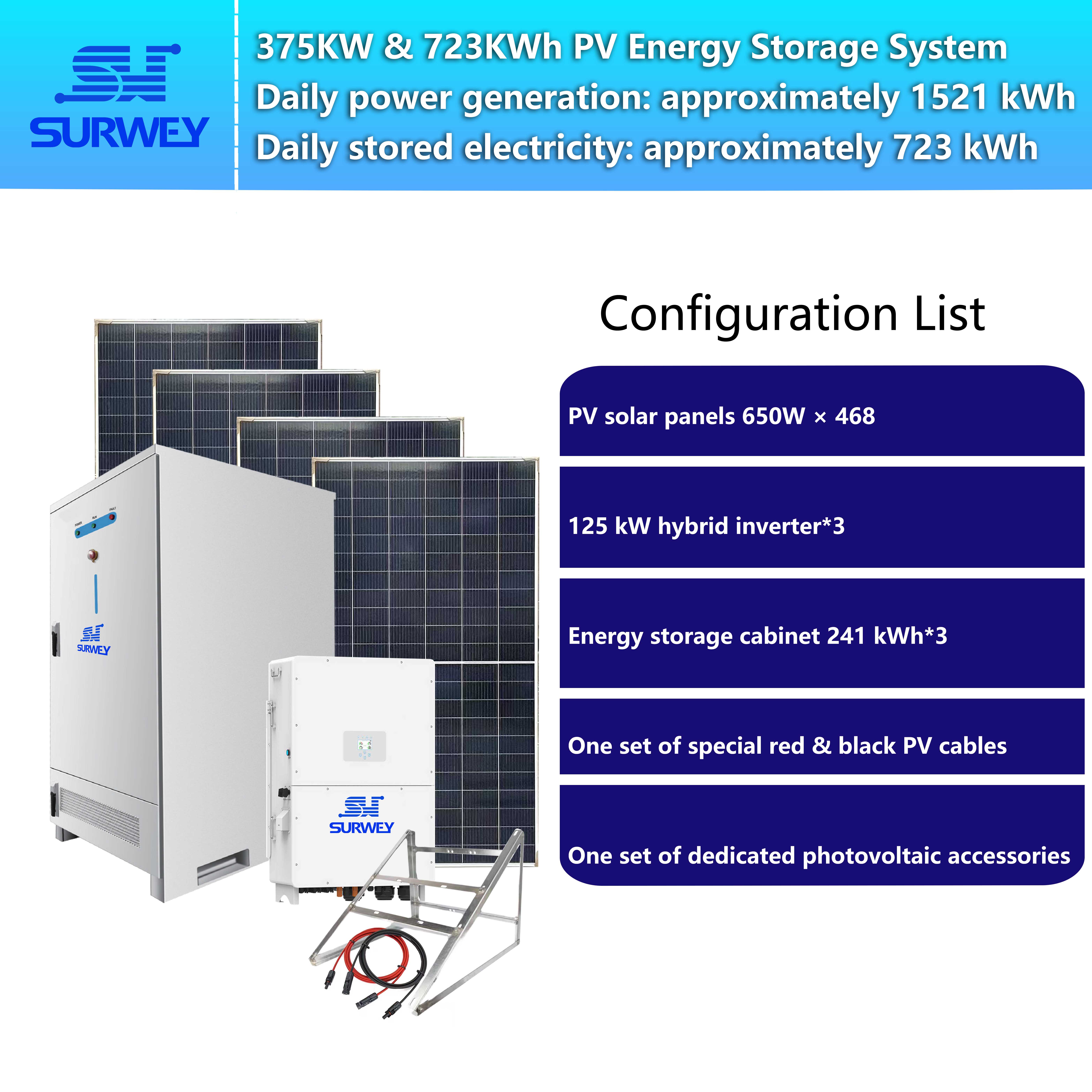
System Configuration Diagram
2. Core Equipment Parameters
(1) 650W PV Module
Electrical parameters under Standard Test Conditions (STC):
- Maximum Power (Pmax): 650W
- Open-circuit Voltage (Voc): 57.52V
- Maximum Power Point Voltage (Vmp): 48.70V
- Short-circuit Current (Isc): 14.12A
- Maximum Power Point Current (Imp): 13.39A
- Maximum System Voltage: 1,500V

PV Array Diagram on Factory Rooftop
The double-sided double-glass modules feature PID resistance, perfectly adapting to Indonesia’s high-temperature and high-humidity climate. The power attenuation rate stands at 1% in the first year, followed by a linear attenuation of 0.4% annually afterwards. The modules come with a 12-year material warranty and a 30-year linear power output warranty, delivering outstanding long-term operational stability.
(2) 125kW Three-Phase High-Voltage Hybrid Inverter & Control Integrated Machine

125kW Three-phase Hybrid Grid Inverter
- Maximum PV DC withstand voltage: 1,000V
- MPPT operating voltage range: 150V ~ 850V
- Equipped with 10 independent MPPT channels; up to 2 strings of PV modules can be connected in parallel per single MPPT channel, supporting a maximum of 20 PV strings for the whole unit
- Maximum input current per MPPT channel: 42A
- Maximum accessible PV power of the whole unit: 250kW
- Compatible with high-voltage energy storage batteries with a battery voltage range of 600~850V, perfectly matching the voltage window of the project’s energy storage cabinets.
The device integrates comprehensive electrical protection functions including islanding protection, insulation monitoring, AC/DC lightning protection, overvoltage and overcurrent protection, complying with grid connection standards for commercial and industrial plants.
(3) Outdoor Commercial & Industrial Energy Storage Cabinet

241kWh Outdoor Energy Storage Cabinet
- Single cabinet rated capacity: 241.15kWh; rated charge/discharge power: 125kW; total capacity of 3 cabinets: 723.45kWh
- Rated battery system voltage: 768V; operating voltage range: 672V ~ 864V
- Air cooling design, IP54 outdoor protection rating, operating temperature range: -20℃ ~ 50℃, suitable for Indonesia’s tropical climate
- Supports RS485/CAN communication and can be connected to the Energy Management System (EMS) for unified dispatching
3. PV Array String and Parallel Connection Design (Voltage Verification)
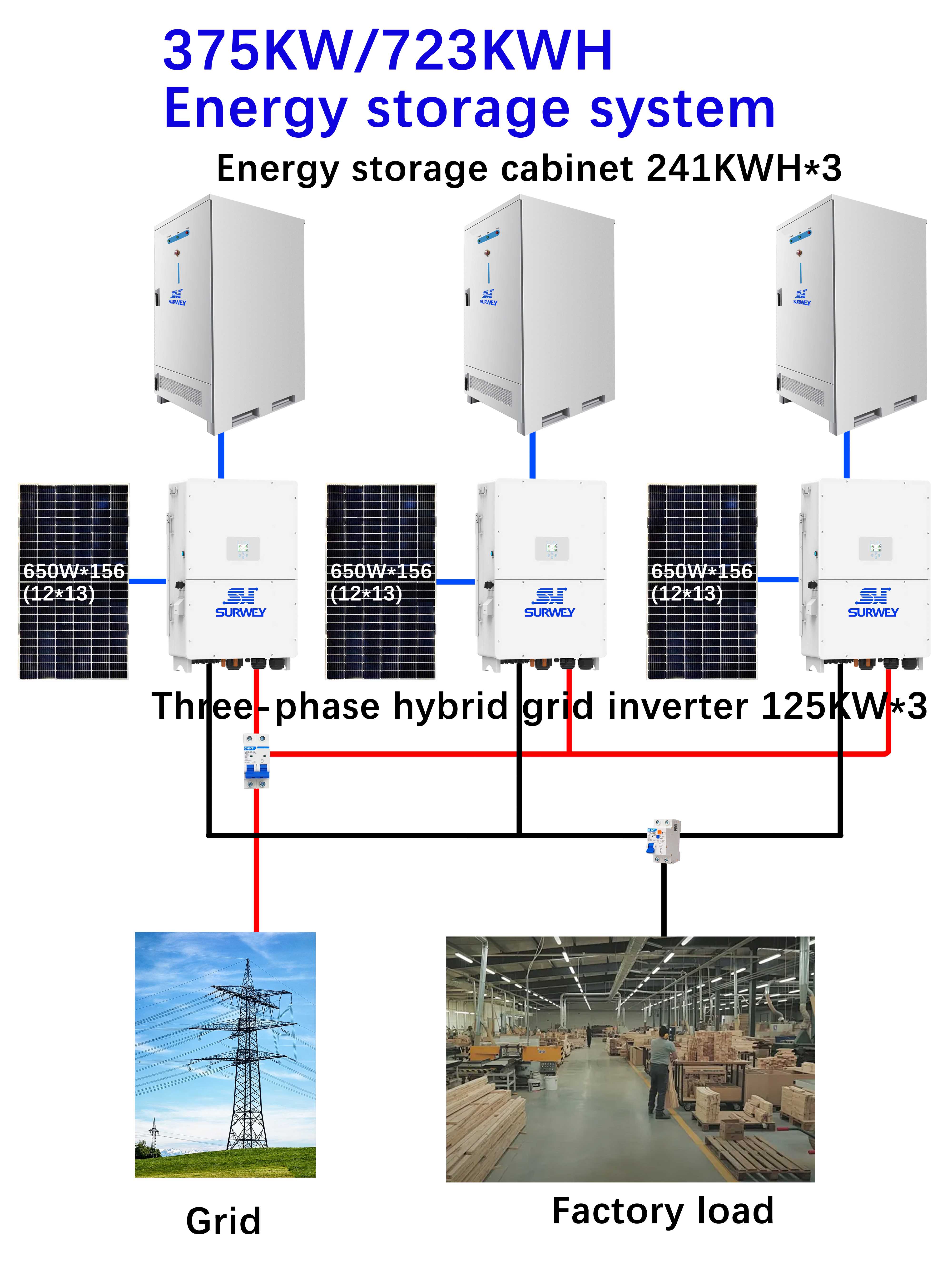
System Topology Diagram
(1) Number of Modules per Series String
Indonesia lies in the tropical zone with rarely encountered extreme low temperatures. The design complies with two mandatory constraints: ① The open-circuit voltage of series-connected modules shall not exceed the inverter’s maximum DC withstand voltage of 1,000V;
② The maximum power operating voltage of modules shall fall within the inverter’s effective MPPT range of 150V~850V.
Final design: 13 pieces of 650W modules per string
- Single-string open-circuit voltage: 13 × 57.52 = 747.76V < 1,000V
- Single-string maximum power voltage: 13 × 48.70 = 633.1V, within the optimal MPPT operating range
If 14 modules are connected in series, the open-circuit voltage will reach 805.28V with insufficient voltage safety margin. Considering the continuous production demand of the wood processing plant and long-term stable system operation, the scheme of 13 modules per string is adopted.
(2) Total Number of Strings and Inverter Allocation
- Total PV modules: 468 pieces
- Total PV strings = 468 ÷ 13 = 36 strings The system is equipped with 3 sets of 125kW inverter & control integrated machines, evenly allocated with 12 PV strings per unit. Upper limit verification: Each unit allows a maximum of 20 PV strings, and 12 strings are fully compatible with hardware interfaces.
(3) MPPT Channel Allocation per Unit
Each unit is configured with 10 independent MPPT channels, supporting up to 2 parallel strings per channel. The allocation scheme for 12 strings is as follows:
- 2 MPPT channels: 2 parallel strings each (4 strings in total)
- 8 MPPT channels: 1 string each (8 strings in total) Total accessible strings: 12
⚠️ Mandatory design requirement: PV modules connected to the same MPPT channel must feature identical model, series quantity, installation orientation and tilt angle to avoid internal circulating current and reduce power generation loss. 4.0mm² special PV cables are adopted for DC wiring, and all modules are fitted with MC4 connectors uniformly.
(4) Power Verification
- Power per single string: 13 × 650W = 8,450W = 8.45kW
- PV access power per inverter unit: 12 × 8.45kW = 101.4kW
- Total installed PV power of three units: 304.2kWp The theoretical average daily power generation is 1,521kWh, corresponding to an equivalent sunshine duration of approximately 5 hours, consistent with the effective horizontal solar irradiance level in Indonesia.
4. Energy Storage System Configuration Scheme
The project deploys 3 outdoor energy storage cabinets with a single cabinet capacity of 241.15kWh and a total energy storage capacity of 723.45kWh, matching the daily energy storage demand of 723kWh on site.
The energy storage cabinet features a rated voltage of 768V and an operating voltage range of 672~864V, which is fully compatible with the battery voltage window of the 125kW high-voltage hybrid inverter & control integrated machine.
A one-to-one wiring scheme is adopted for the system: each inverter unit is independently connected to one energy storage cabinet, facilitating later operation and maintenance, fault isolation and independent energy dispatching.
Operation Strategy
- Power generated by PV panels is prioritized to supply production loads of the wood processing factory during daytime. When PV output exceeds real-time factory power consumption, surplus electricity charges the energy storage system until the battery reaches the upper SOC limit.
- During evening peak power hours when PV output declines, the energy storage system initiates discharge to power factory loads, cutting electricity purchased from the grid during peak periods.
- When PV output is insufficient and energy storage power is exhausted, factory loads are supplemented by power from the public grid.
5. System Operation Logic
- Daytime with sufficient sunlight: PV arrays generate electricity to supply production equipment including log saws, planers and drying units on priority. If power generation surpasses factory load consumption, excess power charges the energy storage system.
- Peak power consumption hours: PV output drops and the energy storage system discharges continuously to supply factory loads, reducing peak electricity bills and smoothing load impact.
- Nighttime without solar irradiance: After energy storage power is fully released, factory loads are powered by the public grid.
The whole system supports grid-connected operation and short-term off-grid backup power supply, alleviating equipment shutdown losses caused by grid voltage fluctuations for wood processing production.
A supporting Energy Management System (EMS) collects data including PV output, energy storage status, grid electricity quantity and factory load data uniformly, automatically optimizing charge and discharge strategies to minimize the factory’s power consumption cost to the maximum extent.
6. Rated Power and Continuous Discharge Duration for Core Equipment of the Wood Processing Factory Supported by the System
| Equipment Name | Rated Power per Unit | Supported Quantity | Continuous Discharge Duration (SOC 20%~90% usable range) |
|---|---|---|---|
| Large Multi-blade Log Saw | 120kW | 1 set | Approx. 4.2h |
| Four-sided Wood Planer | 75kW | 1 set | Approx. 6.7h |
| Wood Drying Fan Unit | 55kW | 2 sets | Approx. 4.6h |
| Sanding Machine | 40kW | 2 sets | Approx. 6.3h |
| Central Dust Removal Fan | 30kW | 3 sets | Approx. 5.6h |
| Small Sliding Table Saw | 15kW | 6 sets | Approx. 5.6h |
Note: The duration values are theoretical calculations based on the usable energy storage capacity of 506.4kWh (total capacity: 723.45kWh, SOC operating range: 20%~90%), excluding AC-DC conversion losses. Actual operating duration will fluctuate slightly subject to equipment efficiency and ambient temperature.
7. Scheme Summary
This project features a total installed PV capacity of 304.2kWp paired with a 723.45kWh high-voltage energy storage system. PV arrays adopt a series connection scheme of 13 modules per string with 36 strings in total. Each of the 3 sets of 125kW inverter & control integrated machines connects 12 PV strings, with all operating voltages falling within the effective MPPT working range of the equipment, ensuring a safe and compliant electrical architecture.
Customized for the production characteristics of wood processing factories in Indonesia, the coordinated PV and energy storage system realizes peak shaving and valley filling, effectively reducing the factory’s power purchase cost, buffering grid fluctuations and lowering production shutdown risks. All equipment selected for the system is mature and reliable, adapted to the local tropical high-temperature and high-humidity climate, delivering excellent long-term operational stability and sound project economic benefits.


