
Technical Solution for Mobile Skid-Mounted 12kW/32kWh PV Energy Storage Gas Station in Yaoundé, Cameroon
Preface
This project is implemented in Yaoundé, the capital of Cameroon. The local municipal power grid suffers unstable power supply and frequent blackouts. Leveraging abundant local solar resources, a 40,000L mobile skid-mounted gasoline filling station is constructed, equipped with a single 3kW dual-nozzle fuel dispenser operating from 8:30 to 24:00 every day. The station adopts an off-grid independent power supply system solely supported by photovoltaic energy storage, without any grid connection.
Video of the working principle of the PV energy storage system
1. Project Overview
The scheme is equipped with an SW12000 ES hybrid PV inverter-charger, 18 pieces of 650W PV modules, and a parallel energy storage system consisting of two 16kWh lithium batteries. The system generates an average daily power output of 58kWh with a maximum daily energy storage capacity of 32kWh.

Schematic Diagram of PV Energy Storage System
✅Three core design objectives of the solution:
The series voltage of photovoltaic arrays is strictly kept within the MPPT operating range of the inverter to guarantee power generation conversion efficiency. All electrical devices and skid-mounted oil storage facilities of the entire station comply with explosion-proof safety codes for fuel stations.
The cycle life of lithium batteries is prolonged via refined control of charge-discharge strategies, ambient temperature regulation and BMS parameters.
The system is designed merely to satisfy daily load requirements, without reserved energy storage redundancy for successive rainy days.
2. Basic Working Conditions and Load Calculation
2.1 Climate and Environmental Conditions of Yaoundé, Cameroon
Yaoundé features a transitional tropical rainforest climate divided into dry and rainy seasons. The annual sunshine duration averages about 2,400 hours. Sufficient solar irradiance is available in dry seasons while effective daily power generation hours shrink on cloudy and rainy days in wet seasons. The annual average temperature ranges from 22℃ to 30℃ with high air humidity and frequent dew formation in rainy seasons, so equipment must be protected against moisture, heat and poor ventilation.
The 40,000L gasoline storage tank belongs to Zone 1 explosive hazardous area. Energy storage cabins and inverter power distribution equipment are physically separated from oil storage tanks. The entire electrical system adopts sealed explosion-proof wiring to eliminate risks of electric leakage and electrostatic fire in high-humidity environments.
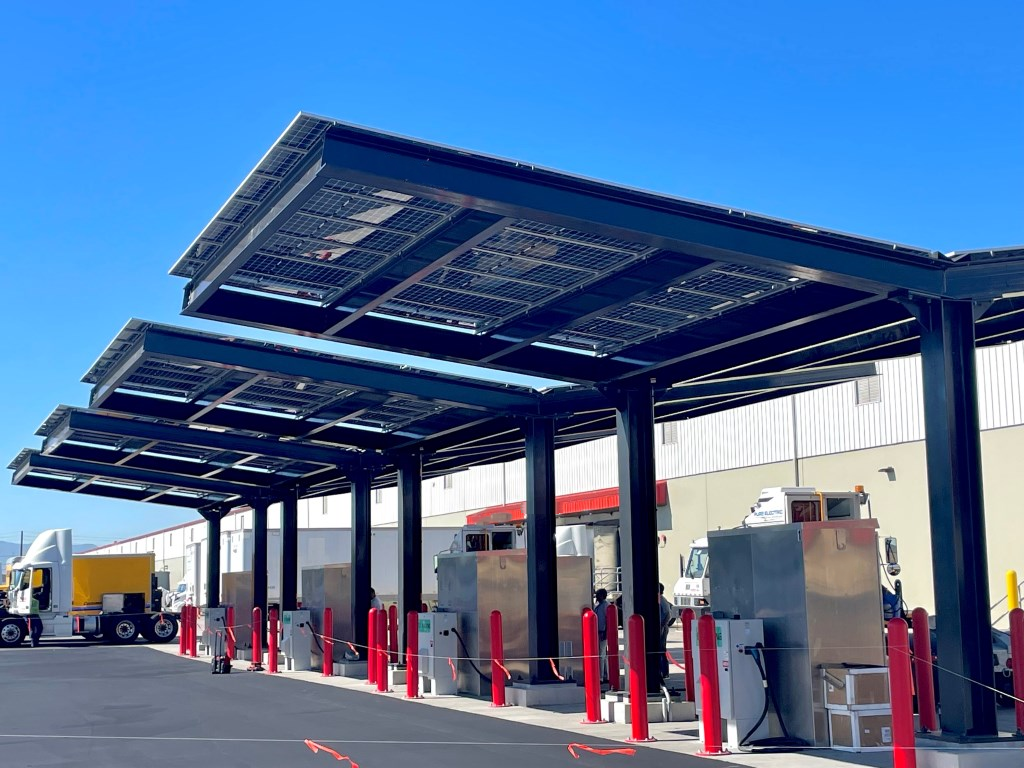
Photovoltaic Gas Station in Yaoundé, Cameroon
2.2 Load Parameter Calculation
3. PV Array Configuration and Voltage Verification
3.1 Series Allocation of PV Modules

3.2 Series Voltage Calculation and Verification
Parameters of one string with 9 modules connected in series:
- Standard open-circuit voltage: 9 × 54.34 = 489.06VDC
- MPPT operating voltage: 9 × 45.22 = 406.98VDC
The MPPT effective operating range of the inverter is 60~480V, and 406.98V fully fits this interval. The normal-temperature open-circuit voltage of 489.06V is lower than the 550V maximum withstand voltage of the inverter. In hot daytime conditions of the dry season, the open-circuit voltage of PV modules drops with rising temperature without overvoltage risks. The open-circuit voltage peaks on cool early mornings in rainy seasons but still stays below the equipment voltage threshold. The PV array voltage perfectly matches the inverter with no hidden faults of under-voltage or overvoltage.
3.3 Matching of PV Installed Capacity
4. Configuration and Life Extension Design of Lithium Battery Energy Storage System
4.1 Hardware Configuration of Energy Storage

4.2 Longevity Control Strategy for Lithium Batteries
Lithium battery aging and capacity attenuation are mainly caused by deep charge-discharge, unbalanced temperature and humidity, long-term full-charge standing and high-rate charge-discharge. Combined with Yaoundé’s climate featuring high humidity and obvious temperature difference, the scheme sets multi-layer control mechanisms to extend battery service life:
- Shallow charge & discharge with locked SOC thresholds: Hard parameters are set via the BMS backend supporting the inverter: upper charging SOC limit 80%, lower discharging SOC limit 25%, controlling the daily effective battery discharge depth within 55%. Avoid long-term full-pressure standing and complete emptying of batteries. Under identical service conditions, the cycle life at 55% discharge depth is over 40% longer than that at 80% discharge depth. During daytime, the fuel dispenser load is preferentially powered by PV generation, and energy storage only supplements power shortages in low-irradiance periods to further cut daily battery cycle depth.
- Special moisture-proof and heat-insulated energy storage cabin adapted to local climate: Lithium batteries and the inverter-charger are separately placed in independent sealed explosion-proof cabins with a safe distance of no less than 5m from the 40,000L skid-mounted oil tank. Thermal insulation boards are attached to the outer cabin walls, while dehumidifying and forced cooling fans are installed inside to stabilize the battery operating environment within the optimal range of 15~35℃, solving accelerated cell aging caused by dew in rainy seasons and high temperature in dry seasons. Moisture-absorbing silica gel desiccants are equipped inside the cabin and replaced regularly to prevent rust and short circuits of wiring terminals.
- Mild low-rate charge-discharge operation: The daily energy storage charging volume is 32kWh with a 6~8-hour daytime PV charging period, limiting the charging rate within 0.2C. Discharging at a rate of only 0.1C to supply the 3kW fuel dispenser load drastically reduces cell heat generation and internal loss to slow down capacity attenuation.
- Active equalization management for parallel batteries: Batteries of the same model and batch are used in parallel, each built with an active equalization BMS. The system automatically launches a full-cell equalization program once a month to eliminate voltage differences between parallel batteries, prevent overcharging and overdischarging of single cells and ensure synchronous attenuation of the whole battery pack.
5. Functional Adaptation of SW12000 ES Hybrid Inverter-Charger
- Sufficient load power margin: The inverter has a rated AC output of 12kW, far exceeding the 3kW rated power of the fuel dispenser to withstand instantaneous impact loads upon equipment startup. Dual independent AC output channels are available: one exclusively supplies the explosion-proof fuel dispenser circuit, and the other powers low-power loads such as cabin monitoring and lighting for intelligent load partition management.

- Pure off-grid operation mode: Grid-connected function is disabled to lock the PV energy storage off-grid mode. Excess power generated by PV during daytime charges batteries automatically; the charging circuit cuts off once SOC hits 80% to avoid accelerated battery aging from long-term full-charge standing.
- Fast switching and multi-level electrical protection: The backup power switching time is less than 20ms to avoid shutdown of fuel supply during operation. The equipment is built with multi-level protections against DC overvoltage, AC overcurrent, short circuit, overtemperature and electric leakage, meeting power safety standards for high-humidity explosion-proof zones.
- Remote monitoring, operation and maintenance: The equipment is equipped with WIFI/4G communication modules to remotely view real-time data including PV power generation, battery SOC, charge-discharge current and cabin temperature & humidity. Operators can remotely adjust SOC charge-discharge thresholds and lower the upper charging limit as needed in rainy seasons for extra battery protection.
- High conversion efficiency to reduce losses: The inverter achieves a peak conversion efficiency of 96.5% and European efficiency of 95.5%, lowering power conversion loss under high-temperature and high-humidity conditions and boosting utilization of limited solar power in rainy weather.
6. Special Explosion-Proof Design of Mobile Skid-Mounted Gas Station
- Oil storage tank: A 40,000L double-layer explosion-proof skid-mounted gasoline tank is adopted, filled with aluminum alloy explosion-suppression honeycomb materials inside. The pressure rise value is controlled below 0.05MPa in case of oil-gas deflagration inside the tank, complying with safety specifications for skid-mounted fuel filling devices.
- Electrical isolation in hazardous areas: PV supports are arranged in an independent zone above the tank area, while energy storage cabins and inverter power distribution cabinets are set in separate explosion-proof compartments with a safe distance of over 4.5m from gasoline oil-gas release sources. All cables within explosive hazardous zones run through sealed explosion-proof metal conduits without exposed terminals to eliminate electric spark risks in high-humidity environments.
- Full-set explosion-proof electrical equipment: The fuel dispenser, cabin lighting and surveillance cameras all adopt Ex d flame-proof explosion-proof products. An equipotential grounding system is built for the whole station with static discharge pillars to eliminate fire risks from accumulated oil-gas static electricity.
- Intelligent fire-fighting interlock system: The skid-mounted tank is fitted with an automatic dry powder fire extinguishing device. When cabin temperature/humidity or oil-gas concentration exceeds limits, the system interlocks to cut off output of the inverter and batteries and activate the fire extinguishing device, removing electrical fire hazards at the source.
7. Complete Daily Operation Logic of the System
- 8:30–12:00: Solar irradiance rises gradually in the morning. PV power directly supplies the 3kW fuel dispenser, and surplus power steadily charges lithium batteries. Charging stops automatically once SOC reaches 80%.
- 12:00–17:00: Solar irradiance peaks at noon. Full PV output directly feeds loads while batteries remain static at 80% SOC without long-term high-voltage full charging. PV output drops on cloudy rainy days, and energy storage supplements power supply slightly.
- 17:00–24:00: Solar irradiance keeps declining with insufficient PV output. Batteries discharge smoothly to compensate load power demand. The inverter automatically cuts off energy storage output when SOC drops to 25%, retaining only low power consumption for monitoring.
- 24:00–8:30 next day: The fuel dispenser shuts down overnight. Batteries stay static at low SOC between 25% and 30% without complete depletion. Batteries charge gently when sunshine recovers the next day, avoiding extreme working conditions damaging cells throughout the whole process.
8. Scheme Summary
This project deploys 18 pieces of 650W PV modules connected as two strings of 9 modules each to the SW12000 ES hybrid inverter-charger, with a series operating voltage of 406.98V falling within the standard MPPT range of 60~480V of the equipment, ensuring safe and stable electrical matching. The total installed PV capacity reaches 11.7kW with average daily power generation of 58kWh. Paired with two 16kWh lithium batteries connected in parallel to form a 32kWh energy storage system, the scheme meets the 46.5kWh daily power demand of the 3kW dual-nozzle fuel dispenser operating from 8:30 to 24:00 at the mobile gas station in Yaoundé, Cameroon.
Adapted to the local transitional rainforest climate featuring high humidity and large temperature differences, the scheme extends lithium battery service life through multiple measures including moisture-proof and heat-insulated energy storage cabins, SOC control for shallow charge & discharge, and low-rate charge-discharge. The whole station is equipped with double-layer explosion-suppression oil tanks and partition isolation design for explosion-proof electrical equipment, suitable for independent oil supply scenarios relying purely on PV power in areas without stable power grids. The system only supports daily load demand without energy storage redundancy for consecutive rainy days, featuring economical and concise equipment configuration and fitting simple operation & maintenance conditions in Africa.


