
Technical Design Proposal for a 10 kW Residential Hybrid Solar-Storage System
10 kW Grid-Tied/Off-Grid Hybrid Solar System Configuration Diagram
I. Overview of the Plan

Topology Diagram of a 10 kW Grid-Connected/Off-Grid Hybrid Solar System

10 kW Grid-Tied/Off-Grid Hybrid Solar System Configuration Diagram
II. Key Equipment Specifications and Selection Criteria
(1) PV Array: 590Wp N-TOPCON Double-glass Modules (16 pieces, 2 strings × 8 pieces per string)
The selected N-type TOPCon bifacial double-glass monocrystalline photovoltaic modules, with a peak power of 590 Wp per module, are currently the mainstream products for high-performance residential PV systems. Their core electrical parameters are as follows:
Standard Test Conditions (STC): Open-circuit voltage (Voc) = 51.86 V, maximum power point voltage (Vmp) = 43.01 V, short-circuit current (Isc) = 14.50 A, module conversion efficiency 22.80%;
Temperature characteristics: Open-circuit voltage temperature coefficient -0.25%/°C; voltage increases in low-temperature environments and decreases slightly in high-temperature environments;
System Configuration: A total of 16 modules, divided into 2 independent PV strings, with 8 modules in series in each string. The two strings are connected to the inverter’s two independent MPPT channels, matching the inverter’s maximum PV input power limit of 2×7700W.
(2) Energy Storage Hybrid Inverter: SW 10K-EU 10 kW Grid-Tied/Off-Grid Hybrid Unit
The core control unit of this system is the SW 10K-EU European-standard hybrid photovoltaic-storage inverter, specifically designed for 48V low-voltage energy storage batteries. Key compatibility parameters:
PV Input: Two independent MPPT channels, with a maximum input of 7,700 W per channel; MPPT operating voltage range of 120 VDC to 450 VDC; maximum input current of 22 A per channel; maximum PV open-circuit voltage tolerance of 500 VDC;
Battery Port: Compatible with 48 VDC energy storage systems; maximum hybrid charging current of 200 A; compatible with lithium-ion and lead-acid batteries; supports BMS communication and integration;
AC Output: Rated 10,000 VA/10,000 W pure sine wave output, short-term peak 20,000 VA; supports up to 6 units in parallel to form a three-phase, four-wire system; switchable between utility power and PV dual-priority modes;
Operational Performance: Peak conversion efficiency of 93%, utility/PV/battery switching time ≤ 20 ms, IP21 protection rating, operating temperature range -10°C to 55°C.
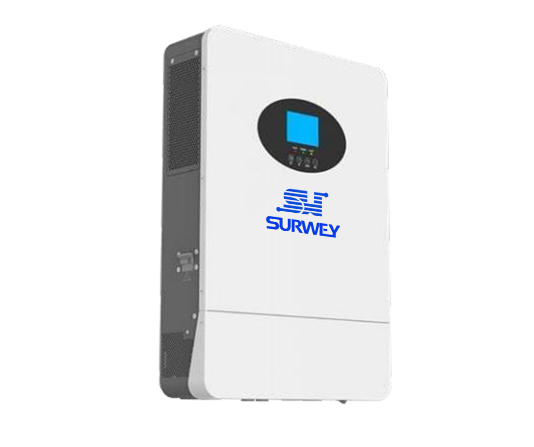
SW 10K-EU 10kW Hybrid On/Off Grid Inverter
(3) Energy Storage Battery Pack: 51.2V, 340Ah lithium iron phosphate battery
The energy storage unit uses low-voltage lithium iron phosphate (LiFePO₄) batteries with a nominal voltage of 51.2 V and a rated capacity of 340 Ah. The total energy storage capacity is calculated as follows: Energy storage capacity = 51.2 V × 340 Ah = 17,408 Wh ≈ 17.5 kWh, which perfectly matches the daily energy storage target specified in the plan.
The battery is integrated with an intelligent BMS (Battery Management System) that enables bidirectional communication with the inverter, allowing real-time monitoring of cell voltage, temperature, and charge/discharge currents. It features multiple protection mechanisms against overcharging, over-discharging, overcurrent, short circuits, and high temperatures, and is designed for long-term cyclic charging and discharging. It serves to store excess solar energy during the day, power loads at night, and provide emergency backup power during outages. The inverter’s battery port is rated at 48 VDC, and the 51.2 V lithium-ion battery’s float charge and charge/discharge ranges are fully compatible with the inverter’s battery management system, eliminating the need for additional step-down conversion equipment.
III. Verification of PV String Voltage Matching (Core Technical Calculations)
1. Maximum Power Point Voltage (Vmp) of the string under standard test conditions (25°C STC) Total
2. Standard Open-Circuit Voltage (Voc) at 25°C, Total
3. Verification of Maximum Open-Circuit Voltage in Extreme Low-Temperature Environments (Inverter’s Minimum Operating Temperature: -10°C)
4. String Current Matching Verification
IV. Estimation of System Power Generation and Energy Storage Capacity
(1) Calculation of Average Daily Photovoltaic Power Generation
(2) Analysis of Energy Capacity Matching for Energy Storage Systems
The lithium-ion battery has a total energy storage capacity of 17.5 kWh, providing a storage solution for surplus solar power generated during the day. The system operates as follows:
During daylight hours, solar power is prioritized to directly supply household loads; any remaining power after the loads are met is fed into the lithium-ion battery for charging, with a maximum daily storage capacity of 17.5 kWh of clean electricity;
In the evening and at night when there is no sunlight, the lithium-ion battery discharges stored energy to power the loads, reducing the need to draw power from the utility grid;
When PV output is insufficient and the battery is depleted, the inverter automatically switches to a hybrid mode with the utility grid to ensure stable power supply to the loads;
In the event of a grid outage, the system switches to pure off-grid mode, with the battery capable of supporting 17.5 kWh of load consumption to provide emergency power for essential household appliances.
Logic behind matching energy storage capacity with PV installation: The average daily surplus PV generation is approximately 17–20 kWh. A 17.5 kWh battery perfectly absorbs the excess daytime electricity, preventing both the waste of surplus power due to insufficient storage capacity and the idling of initial investment caused by excessive battery capacity, thereby achieving an optimal balance between PV generation capacity and energy storage capacity.

51.2V 340Ah Lithium Iron Phosphate Energy Storage Battery Pack
V. Detailed Explanation of the System’s Operating Modes
1. Photovoltaic Priority Grid-Connection Mode (Mainstream Mode for Daily Use)
2. Energy-Saving Charge/Discharge Mode (Electricity Cost Optimization Mode)
3. Hybrid Synergistic Power Supply Mode
4. Off-Grid Emergency Standby Mode

France: 10 kW Grid-Connected/Off-Grid Hybrid Solar System
VI. System Security and Environmental Compatibility
(1) Multi-tiered Electrical Protection System
PV Side: Overvoltage, overcurrent, reverse connection, and DC insulation fault protection; automatic MPPT power reduction in case of overvoltage;
Battery Side: Dual interlock protection between the BMS and inverter; shutdown in case of overcharge, over-discharge, overcurrent, or high temperature;
AC Side: Protection against grid overvoltage, undervoltage, overfrequency, short circuits, and ground faults; anti-islanding protection for grid-connected systems;
Overall Protection: IP21-rated enclosure, dust- and drip-resistant, suitable for installation in indoor server rooms or simple outdoor shelters.
(2) Ability to Adapt to a Wide Range of Environments
Operating Temperature Range: Inverter - 10°C to 55°C, PV modules - 40°C to 85°C, batteries 0°C to 50°C; can be used reliably in both northern and southern regions with high and low temperatures;
Altitude Compatibility: The entire unit supports operation without derating at altitudes up to 2,000 meters, making it suitable for high-altitude rural areas and mountainous farms;
Humidity Tolerance: Operates in non-condensing environments with humidity levels between 5% and 95%, posing no risk of corrosion in coastal islands with high humidity or rainy regions in southern China;
Electromagnetic Compatibility: Class B EMC certification ensures it does not interfere with televisions, communication systems, or household low-voltage equipment.
(3) Equipment Standardization and Reliability
VII. Summary of the Solution’s Practical Value
Cost Reduction
With a theoretical average daily solar power generation of 59 kWh and 17.5 kWh of energy storage for peak shaving and off-peak charging, this system significantly reduces grid power consumption. The equipment investment pays for itself over the long term, offering outstanding cost benefits for farms, single-family homes, and remote rural areas;
Stable Power Supply
Grid-tied and off-grid dual-mode operation, ensuring uninterrupted power supply during grid outages; suitable for areas with unreliable or no power grid;
Reliable device compatibility
The voltage of the string consisting of 8 modules connected in series falls within the inverter’s core MPPT operating range; even under extreme low-temperature conditions, it only slightly touches the upper limit, ensuring safe electrical matching with no safety hazards; dual independent MPPT channels enhance power generation efficiency under low-light conditions;
High versatility across different scenarios
A single system covers a wide range of scenarios, including residential areas, farms, communication base stations, islands, and pastoral regions. It supports dual-energy expansion via both grid power and diesel generators. The standardized equipment is easy to procure, install, and maintain, and complies with EU market access regulations for renewable energy.
The complete solution balances rigorous theoretical design with stable on-site operation, with voltage, power, and energy storage capacity optimized to work in tandem. It serves as a standardized, mature technical solution for small- and medium-sized residential, as well as small-scale commercial and industrial off-grid and grid-connected energy storage projects, offering significant value for widespread adoption and implementation.


