
250 m² Cold Storage Plant in Hangzhou – How to Manage 300–400 kWh Daily Power Consumption: A Complete Breakdown of a 50 kW Solar-Storage Solution
1. Project Overview
1.1 Project Background
This project is located at a manufacturing plant in Hangzhou equipped with an on-site cold storage system. The cold storage operates nonstop for 24 hours, with compressors, air coolers and defrosting devices running continuously. A power outage would directly damage goods inside the storage, creating substantial operational risks.
The plant roof is suitable for photovoltaic installation. The client intends to build an integrated solar-plus-storage system to leverage rooftop space for self-consumption. Power generated by solar panels during daytime supplies the cold storage load; surplus electricity is stored in batteries to power the cold storage at night, reducing reliance on grid power and improving power supply redundancy.

PV Module Installation Drawing
1.2 On-site Basic Conditions
- Location: Standard factory building in Hangzhou
- Critical Load: 380 V three-phase cold storage equipment, rated power 13 kW, continuous 24-hour operation
- Actual Power Consumption: Daily electricity use of the cold storage ranges from 300 to 400 kWh
- Available Roof Area: 250 m² with a flat surface, ideal for rack-mounted photovoltaic arrays
- Client Expectations: Approximately 200 kWh of daily solar generation and around 70 kWh usable energy from the energy storage system for day-night coordinated power supply
1.3 Scope of this Document
This report covers equipment selection, electrical string design, area and power generation estimation, operational logic and construction considerations, based on site operating conditions and solar irradiance data for Hangzhou. Pricing and brand information are excluded. The configuration prioritizes matching on-site operational requirements, safety and ease of future maintenance.
2. Overall System Configuration
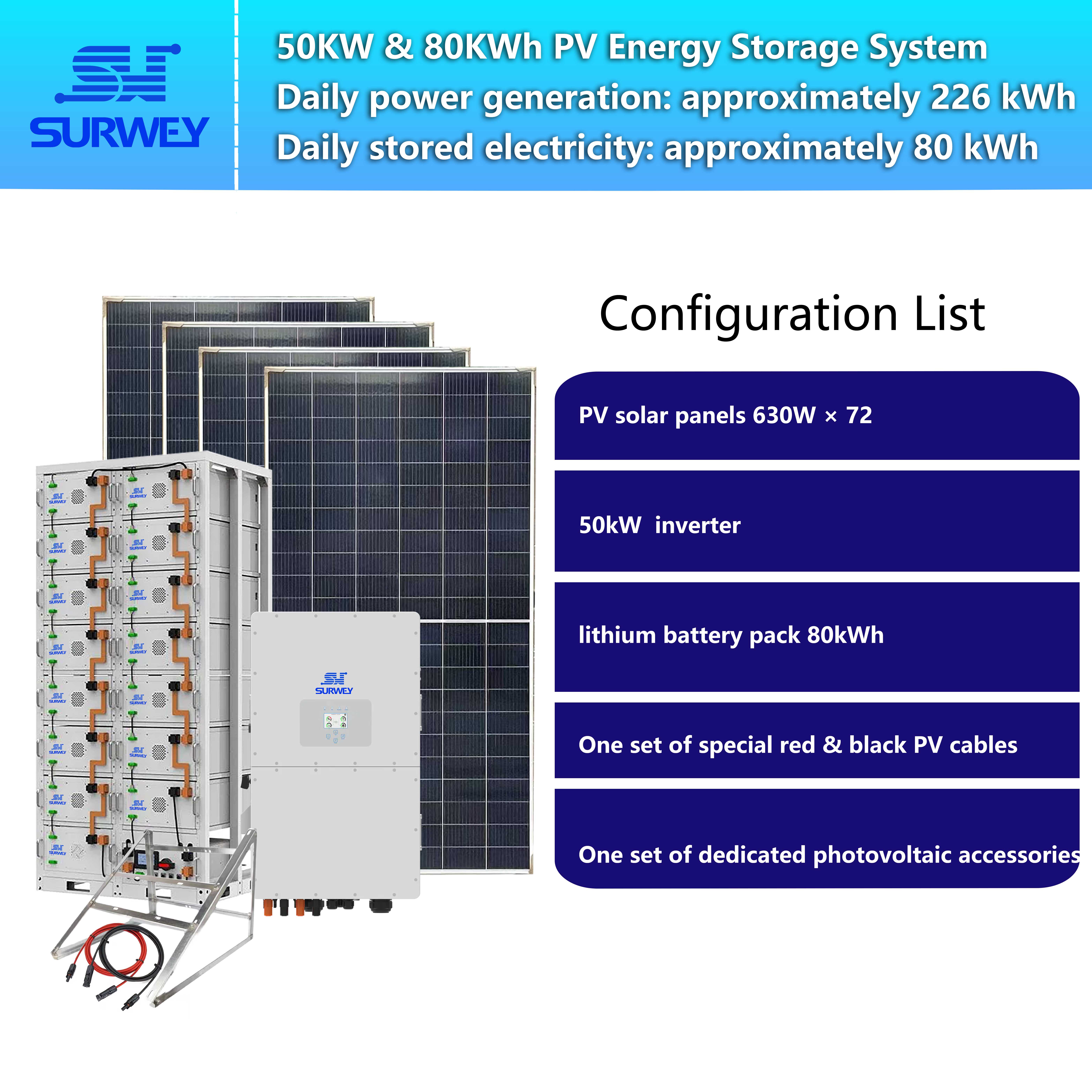
The solar-storage system consists of photovoltaic modules, a three-phase hybrid grid-tied inverter, high-voltage rack-mounted lithium iron phosphate battery packs, PV mounting racks, DC cables and connection accessories. The integrated setup enables automatic coordinated operation of solar power generation, battery charging and discharging, and grid supplementation.
| No. | Equipment Name | Specifications | Quantity | Remarks |
|---|---|---|---|---|
| 1 | PV Module | 630 W per unit; operating voltage: 41.82 V; open-circuit voltage: 53.04 V; operating current: 14.99 A | 72 pieces | Total installed capacity: 45.36 kWp |
| 2 | Three-Phase Hybrid Grid-Tied Inverter | Rated power: 50 kW; 380 V three-phase output; 4 independent MPPT channels; maximum allowable current per MPPT: 40 A | 1 unit | Compatible with factory three-phase grid; supports coordinated dispatch of PV, battery and grid power |
| 3 | High-Voltage Rack-Mounted Energy Storage Battery | Total capacity: 80 kWh; modular high-voltage rack-mounted lithium iron phosphate battery | 1 set | Approximately 70 kWh usable capacity at safe depth of discharge, meeting night-time load demand |
| 4 | PV Array Mounting Rack | Roof-mounted array bracket | 1 set | Designed for local wind and snow loads in Hangzhou |
| 5 | DC Cable | 4 mm² dedicated DC cable | 400 m | For wiring between PV modules and the inverter DC side |
| 6 | PV Connector | MC4 waterproof connectors | 8 pairs | Outdoor module interconnection, waterproof and ageing-resistant |
3. PV String Electrical Design
3.1 String Design Principles
To ensure balanced power output and lower failure risks, all series branches contain an identical number of modules. The design adopts 12 modules per string for the 72 modules in total, facilitating installation and later troubleshooting.
3.2 Single String Voltage Verification
- Series operating voltage: \(V_{mp}=12 \times 41.82 = 501.84\ \text{V}\)
- Open-circuit voltage under low-temperature conditions: \(V_{oc}=12 \times 53.04 = 636.48\ \text{V}\)
Verification result: The low-temperature open-circuit voltage of 636.48 V is well below the inverter’s DC safety limit of 1000 V. No overvoltage risk exists under Hangzhou’s winter low-temperature conditions, and the electrical parameters satisfy safety requirements.
3.3 MPPT Channel Allocation
There are 72 modules in total, grouped into 6 series strings of 12 modules each, distributed across the inverter’s four MPPT ports:
- MPPT 1: 2 parallel strings (24 modules)
- MPPT 2: 2 parallel strings (24 modules)
- MPPT 3: 1 string (12 modules)
- MPPT 4: 1 string (12 modules)
Total: \(2+2+1+1 = 6\) strings, covering all 72 modules.
3.4 Branch Current Safety Check
Operating current of one string: 14.99 A
- MPPT 1 & MPPT 2: Two parallel strings each, total branch current ≈ 29.98 A, less than the 40 A per-channel limit with adequate safety margin
- MPPT 3 & MPPT 4: Single string connection, branch current 14.99 A, within equipment limits
Conclusion: Voltage and current for all MPPT branches fall within the inverter operating window; the electrical design is safe and compliant.

System Topology Diagram
4. Roof Footprint and Power Generation Estimation
4.1 Installation Area Calculation
Seventy-two 630 W high-power PV modules with array racks require reserved gaps for maintenance, ventilation and heat dissipation. The PV array occupies roughly 220 m² of roof space. With 250 m² available on site, there is ample room for the full system, and leftover roof space is reserved for future expansion.
4.2 Power Generation Assessment
Based on an annual equivalent sunshine duration of 4 hours for Hangzhou:
Theoretical average daily generation = 45.36 kWp × 4 h = 181.44 kWh
On sunny days with strong irradiance, daily output can approach 200 kWh, matching the client’s target. Generation drops naturally on overcast, rainy or hazy days due to reduced solar resource, which is normal.
5. System Operating Logic
Video of System Operating Principle
The cold storage runs 24/7 as a continuous load. The solar-storage system automatically manages power flow without manual intervention across three operating phases:
- Daytime with sufficient sunlight: Solar power prioritises the cold storage compressors and fans. Excess generation charges the battery until it reaches the upper usable capacity limit (around 70 kWh).
- Evening and night with no solar output: PV production ceases, and the battery discharges to supply the cold storage, offsetting grid consumption overnight.
- Low battery state: Once the battery reaches its cut-off threshold, the system automatically switches to grid power to maintain uninterrupted cold storage operation and avoid shutdowns.
Additional benefit: During scheduled grid maintenance or unexpected outages, the battery can provide temporary backup power, minimising the risk of cargo loss caused by cold storage shutdown.
6. Key Equipment Description
50 kW Three-Phase Hybrid Grid-Tied Inverter

50 kW Three‑Phase Hybrid Grid‑Tied Inverter
Built for 380 V three-phase industrial power in factories, it features four independent MPPT channels for multiple PV branches. It dynamically routes power among solar panels, the battery and the utility grid. As cold storage compressors start and stop frequently and create fluctuating loads, the inverter provides voltage stabilisation to protect motor-type loads.
80 kWh High-Voltage Rack-Mounted Lithium Iron Phosphate Energy Storage System
.

80 kWh High‑Voltage Rack‑Mounted Lithium Iron Phosphate Energy Storage Battery Pack
This system uses LiFePO4 cells assembled into 16 battery modules. Its rated voltage is 819.2 V with an operating window of 672–928 V. The nominal total capacity is 81.92 kWh; at a standard 90% depth of discharge, usable energy reaches 73.73 kWh, comfortably covering the client’s night-time requirement of roughly 70 kWh.
It has a rated DC power of 80 kW, with peak discharge capability to handle short load surges from the cold storage. Recommended regular charge and discharge current is 50 A, with a maximum of 100 A. At 25 °C, it supports 125 A peak discharge for two minutes, offering sufficient headroom for compressor inrush currents.
PV Mounting Racks and Auxiliary Materials
The array brackets are engineered for Hangzhou’s wind and snow loads to guarantee secure roof installation. 4 mm² DC cables are deployed to control line losses on the DC side, while MC4 waterproof connectors maintain reliable outdoor electrical connections and reduce contact failures over decades of exposure.
7. Critical Implementation Notes
- Verify roof load capacity before construction to confirm it can support the weight of the PV array.
- Protect DC cables during routing to prevent insulation abrasion and reduce DC-side fault risks.
- Ensure good ventilation around the battery bank; keep it away from heat sources and reserve clear access for servicing.
- Follow the string configuration defined in this report strictly during module wiring. Do not mix modules of different string counts or specifications, which would cause MPPT imbalance and generation loss.
- Record all equipment parameters after commissioning to support future maintenance and troubleshooting.
8. Project Summary
This customised solution combines a 45.36 kWp photovoltaic array and an 80 kWh energy storage system for the nonstop power demand of the Hangzhou cold storage. Rigorous string allocation keeps all electrical parameters within safe boundaries, and the 250 m² roof provides enough installation space.
On sunny days, the system delivers nearly 200 kWh of solar generation, while the battery supplies around 70 kWh for night-time consumption. The design achieves self-consumption of solar energy and peak shifting via energy storage.
Rather than chasing theoretical full-power operation, the scheme prioritises safety, simple construction and convenient maintenance, closely matching the real operational profile of the cold storage plant. It effectively cuts the cold storage’s grid power draw day and night while upgrading on-site emergency power resilience. This configuration is tailored for the specific site; separate recalculation is required for facilities with different loads or roof conditions.


