
From “At the Mercy of the Grid” to Self-Power Generation: A Field Record of a Residential PV-Storage System in Ghana

PV Module Installation Diagram
1. Project Overview
This project is located in Ghana. Situated in the equatorial tropical zone, the site enjoys excellent solar irradiance with high annual total radiation, offering favourable natural conditions for photovoltaic development. However, the municipal grid suffers from poor power supply reliability with frequent intermittent outages. Conventional diesel backup generators come with loud noise, cumbersome maintenance, high running costs and emission pollution, making them inadequate to meet reliable household power demand.
The homeowner required a standalone off-grid photovoltaic energy storage system independent of the utility grid to deliver round-the-clock stable power. It covers all household loads including refrigeration, lighting, air conditioning, water supply, audio-visual equipment and small kitchen appliances, prioritising uninterrupted power for critical loads. The system shall be reliable, easy to maintain and reserved for future expansion.
Core project objectives: Solar power supplies loads during daytime, and excess power is stored in batteries. Batteries supply power at night and on overcast days. String voltage and power are fully verified to stay within the equipment operating limits. Communication and protection logic among inverters, batteries and modules are well matched. The system supports status monitoring and fault alerts for convenient maintenance.
2. Core System Configuration
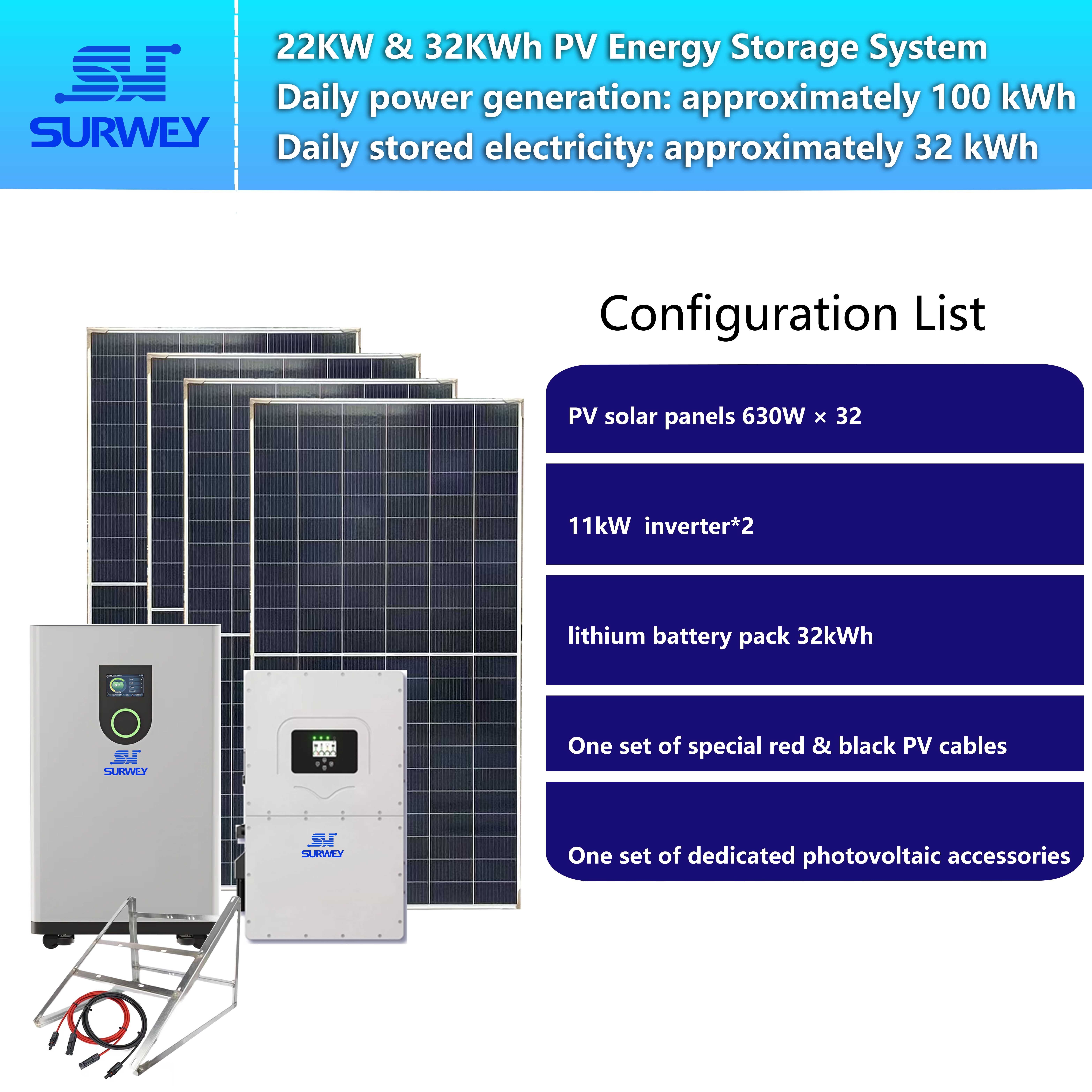
System Configuration Diagram
- Off-grid PV Inverter: 11 kW, 220/230 Vac output, dual independent MPPT, IP21 protection, parallel capable — 2 units (MT series, maximum 6 units in parallel)
- LFP Energy Storage Battery Pack: 32 kWh vertical household storage battery; nominal capacity 32.768 kWh, nominal voltage 51.2 V, rated capacity 628 Ah, integrated BMS and mobile casters
- N-type Monocrystalline PV Module: 630 W, 132-cell design; Vmp = 41.82 V, Voc = 49.34 V under STC — 32 pieces
Each piece of equipment fulfils its designated function: PV modules generate power in daylight, batteries store surplus energy, and inverters convert direct current into household alternating current while coordinating the whole system. The entire setup operates off-grid without relying on utility power.
3. Load Calculation and Daily Power Consumption Analysis
The customer reported frequent air-conditioner use during hot seasons. Refrigerators and freezers need continuous operation to preserve food, the water pump runs periodically to supply domestic water, lighting and televisions are mostly used in the evening, while rice cookers, electric kettles, washing machines and chargers for mobile phones and laptops are used on a daily basis. Based on all listed appliances and usage habits, load statistics and daily power consumption were calculated:
| Electrical Appliance | Specification | Operating Duration | Daily Power Consumption |
|---|---|---|---|
| 1.5 HP Air Conditioner | 1100 W | 1 unit for 5 h by day; 2 units for 6 h at night | 18.0 kWh |
| Refrigerator + Freezer | Total 120 W | 24-hour continuous operation | 2.8 kWh |
| Ceiling Fans (4 units) | 40 W per unit | Total 12 h per day | 1.9 kWh |
| Televisions (2 units) | 60 W per unit | Total 12 h per day | 1.4 kWh |
| LED Lighting (10 lamps) | 10 W per lamp | 9 h at night | 0.9 kWh |
| Water Supply Pump | 150 W | Total 7.5 h per day | 1.1 kWh |
| Washing Machine | 400 W | 1.5 h per day | 0.6 kWh |
| Kitchen Appliances (Electric Kettle, Rice Cooker) | Total 1000 W | 1.2 h per day | 1.2 kWh |
| Mobile Phone & Laptop Charging | Total 40 W | 12 h per day | 0.5 kWh |
Total daily power consumption: approximately 28.4 kWh, dominated by air conditioning.
Power generation verification: Total installed capacity = 32 × 630 W = 20.16 kWp. The peak sunshine duration at the Ghana site is taken as 4.5–5 hours. Accounting for temperature loss, cable loss, inverter conversion loss and shading, an overall efficiency factor of 0.8 is adopted. Theoretical daily energy yield = 20.16 kWp × (4.5–5 h) × 0.8 ≈ 72.6–80.6 kWh, far exceeding the daily load demand. Sufficient surplus power on sunny days fully charges the battery. The 32 kWh battery bank covers major night-time consumption and provides ample power buffer for consecutive cloudy days.
4. PV String Design (Core Electrical Matching)
Two 11 kW off-grid inverters are deployed, each equipped with two independent MPPT channels. The two channels operate separately, track maximum power independently and tolerate strings with different voltages. All 32 modules are fully utilised with the following allocation: 16 modules per inverter.
- MPPT Channel 1: 2 strings × 5 modules = 10 modules
- MPPT Channel 2: 1 string × 6 modules = 6 modules
Total per inverter: 10 + 6 = 16 modules; total for two inverters: 32 modules.
Voltage verification (STC): Single module Vmp = 41.82 V, Voc = 49.34 V
- String of 5 modules: Vmp = 209.1 V, Voc = 246.7 V
- String of 6 modules: Vmp = 250.9 V, Voc = 296.0 V
Both string voltages fall within the inverter MPPT operating window of 60–500 Vdc with no overvoltage risk. The advantage of dual MPPT lies in independent maximum power tracking; strings with different module counts and voltages do not interfere with each other, avoiding generation losses caused by parameter mismatch.
Power verification: Each inverter connects 16 × 630 W = 10080 W (10.08 kW), below the inverter’s PV input limit of 11 kW, leaving adequate safety margin.
5. Key Equipment Description
11 kW Off-grid PV Inverter

IP21 protection, pure sine-wave 220/230 Vac output. It supports dual independent MPPT and multi-unit parallel operation (2 units used in this project; maximum 6 units). Built-in BMS communication automatically recognises and adapts charging profiles for LFP batteries. The two AC output circuits can be configured for graded power supply to separate critical and non-critical loads. It comes with an LCD screen and RGB status indicators, with optional Wi-Fi remote monitoring. A battery-less mode is available to power loads directly from PV under sufficient irradiance. Integrated protections include overvoltage, undervoltage, overload, short-circuit and overtemperature protection.
32 kWh Mobile LFP Battery Pack

32 kWh Mobile LFP Battery Pack
It stores surplus solar energy and supplies stable power to household loads at night, on cloudy days or when PV output drops. Adopting LFP cells, this battery pack has a nominal capacity of 32.768 kWh, nominal voltage of 51.2 V and rated capacity of 628 Ah, with an operating voltage range from 40.5 V to 56.7 V. It achieves good matching with the inverter and supports long-duration household power supply.
630 W N-type Monocrystalline PV Module
Module efficiency reaches 23.3%, with a maximum system voltage of 1500 Vdc. Its power temperature coefficient is −0.29%/°C and open-circuit voltage temperature coefficient is −0.25%/°C, delivering low degradation and stable power output under Ghana’s high-temperature climate. High-power modules reduce the quantity of modules, mounting structures and cables for a given installed capacity.
6. System Operation Logic
System Operating Principle Video
- Sufficient daylight: Solar power prioritises active loads, and surplus energy charges the battery while the SOC rises gradually.
- Dusk / Night with no irradiance: PV generation stops, and the inverter automatically switches to battery power to sustain all loads.
- Low light / Consecutive cloudy days: Stored battery energy maintains power supply. When SOC drops to the protection threshold, non-critical loads are disconnected according to preset rules to safeguard core loads such as refrigerators and water pumps.
- Protection interlock: The battery BMS communicates with the inverter in real time to halt charging and discharging upon battery faults. The inverter cuts off output automatically under overload or short-circuit conditions.
7. Project Summary
This off-grid PV-storage solution consists of two 11 kW off-grid inverters, a 32 kWh LFP battery bank and 32 pieces of 630 W N-type PV modules. String layouts pass dual voltage and power verification, making full rational use of all modules. Dual MPPT maximises energy harvesting. The system delivers ample daily generation with energy storage sized for night-time consumption, reliably resolving frequent blackouts caused by unstable utility grids in Ghana. Featuring high equipment compatibility, comprehensive protection and low maintenance requirements, the design reserves capacity for parallel expansion and fits the demand for independent residential off-grid power supply locally.


