
Grid-Tied with Backup Residential Solar-Storage System Deployment in the Philippines — A Complete 4kW US-Spec Hybrid System Analysis
Southeast Asia boasts abundant solar irradiance. Residential solar-storage systems, featuring self-consumption, emergency backup power and grid complementation, are increasingly adopted by households. Tailored for Filipino residential users, this solution integrates a US-spec single-phase hybrid inverter, wall-mounted LiFePO4 battery and 580W monocrystalline solar modules to build a stable and reliable residential solar-storage system. This article provides a full breakdown of the residential solar-storage project from dimensions including power consumption estimation, equipment selection, string design, system operation logic, product specifications, safety protection and application scenarios.
 PV Module Installation Photo
I. Project Background and Household Power Consumption Estimation
The client resides in the Philippines, where grid power supply is unstable. Frequent peak-hour load shedding, sudden short blackouts and voltage fluctuations greatly disrupt daily household life. The client put forward a clear requirement for a hybrid solar-storage power supply system.
The household is a family of four with regular appliances including refrigerator, lighting, fans, TV, compact washing machine, air cooler, plus charging devices for mobile phones and laptops. Stable power supply for these essential appliances is required. The core requirements are as follows: solar power shall feed household loads on sunny days; surplus generation shall be stored in the battery. During evenings or cloudy periods with insufficient irradiance, the battery discharges to supply power. When the grid is available, the system runs in grid-tied complementary mode. Once grid power fails, the system shall automatically switch to off-grid mode to sustain critical loads such as refrigerators and lighting without interruption.
The client provided appliance ratings and usage patterns. Based on rated power, operating hours and power draw, we calculated the daily power consumption as shown below:
| Appliance | Rated Power per Unit | Quantity | Daily Operating Hours | Daily Energy Consumption |
|---|---|---|---|---|
| LED Lighting | 12W | 6 pcs | 6h | 0.432 kWh |
| Household Refrigerator | 120W | 1 unit | 24h | 2.88 kWh |
| TV + Set-Top Box | 150W | 1 set | 5h | 0.75 kWh |
| Fan | 60W | 3 units | 8h | 1.44 kWh |
| Mobile Phone & Laptop Charging | 80W | 1 set | 4h | 0.32 kWh |
| Compact Washing Machine | 350W | 1 unit | 1h | 0.35 kWh |
| Air Cooler | 400W | 1 unit | 4h | 1.6 kWh |
Total daily base load consumption reaches approximately 7.77 kWh.
The client noted the long rainy season and frequent cloudy days in the region and expressed concerns over insufficient solar yield during prolonged low-irradiance periods. To accommodate this, a 10.24 kWh energy storage battery is configured to support full-day base loads when sunlight is limited. Under sufficient irradiance, solar generation supplies loads first, and excess power charges the battery to complete the energy cycle. The peak simultaneous load of all appliances is around 1,800 W. The 4 kW hybrid inverter easily covers the peak startup demand with ample derating margin.
II. Introduction of Core Equipment
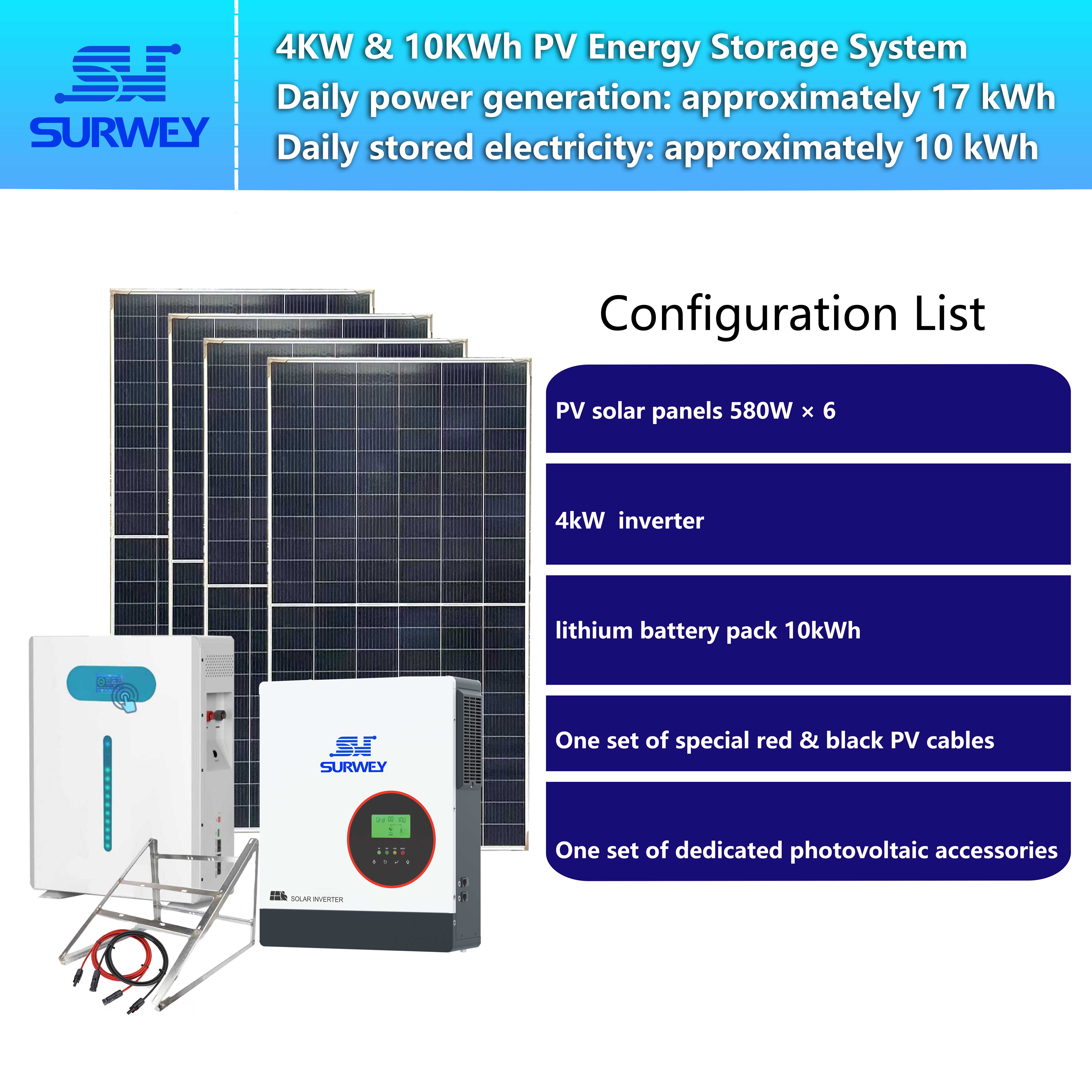
The complete system consists of three core components: a US-spec single-phase hybrid inverter, wall-mounted LiFePO4 battery pack and 580W half-cut monocrystalline solar modules. All components comply with the 110 V AC US standard matching the local grid in the Philippines.
(1) 4,000 W US-Spec Single-Phase Hybrid Inverter
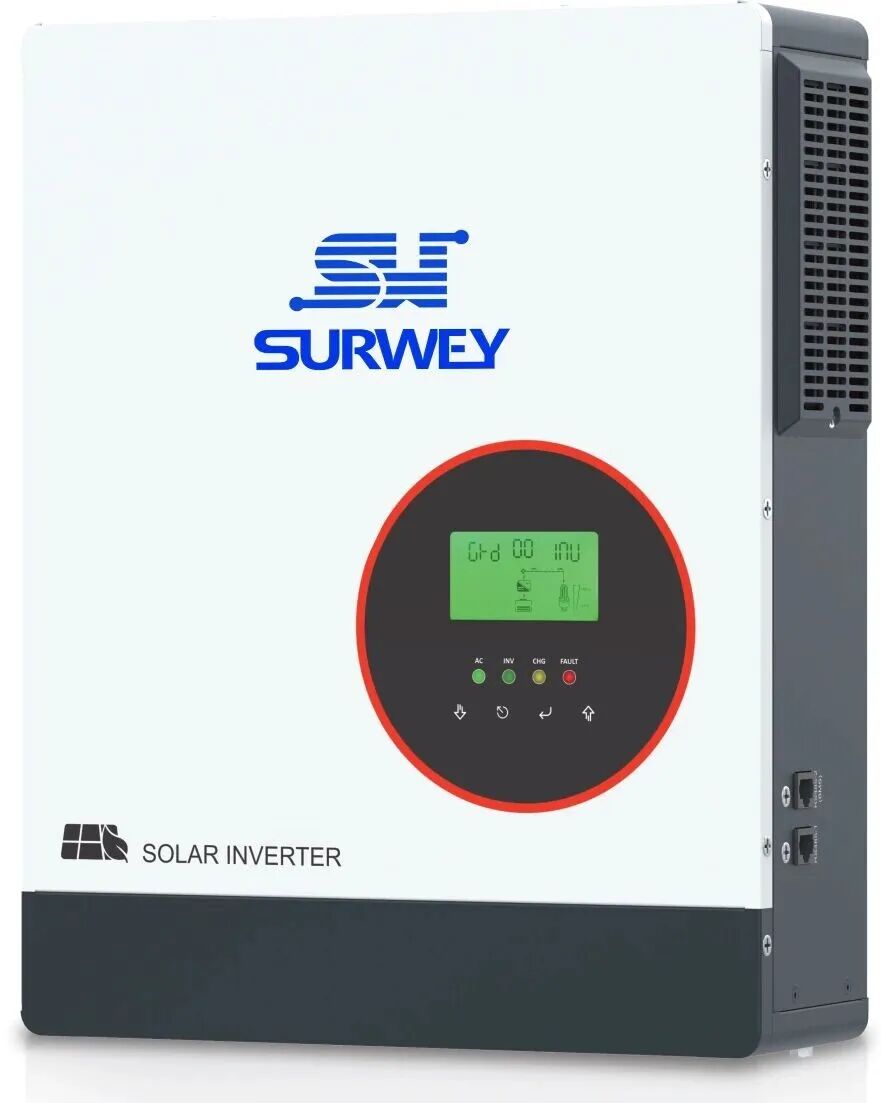
4000W US-Spec Single-Phase Hybrid Inverter
This hybrid inverter serves as the control hub of the whole system. It integrates MPPT solar charging, bidirectional battery conversion, grid transfer and off-grid inversion. It supports both grid-tied complementary operation and standalone off-grid operation. It delivers AC output at 105 / 110 / 115 / 120 VAC with adaptive 50 Hz / 60 Hz frequency, perfectly matching local grid parameters.
On the solar side, it accepts a maximum PV input of 6,000 W. The MPPT operating voltage window ranges from 40 VDC to 300 VDC with a maximum PV charging current of 22 A. On the battery side, it is designed for 48 V battery systems with a rated charging voltage of 48 V and a maximum charging current of 160 A. It is compatible with lead-acid and lithium batteries. Users may adjust charge and discharge protection thresholds via internal menus for seamless communication with the selected 48 V lithium battery pack.
The AC side supports bidirectional power interaction. When the grid is present, the system runs in complementary mode: solar power supplies loads first, and any power deficit is supplemented by the grid. Upon grid failure, the inverter switches to off-grid mode within milliseconds and supplies pure sine-wave power to loads. The seamless transfer prevents appliance restarts and damage. The unit achieves a peak conversion efficiency of 92% and an MPPT tracking efficiency up to 99.9%.
In terms of hardware protection, it is equipped with battery over / under voltage alarms, overcurrent protection, output short-circuit protection and overheating protection. Intelligent air cooling is adopted for thermal management. It carries an IP20 protection rating and supports RS485 communication. An external module enables remote monitoring for real-time viewing of operational data, generation statistics and battery SOC. Wall-mounted installation is designed for indoor household deployment.
(2) SW-WH-10 kWh Lithium Energy Storage Pack
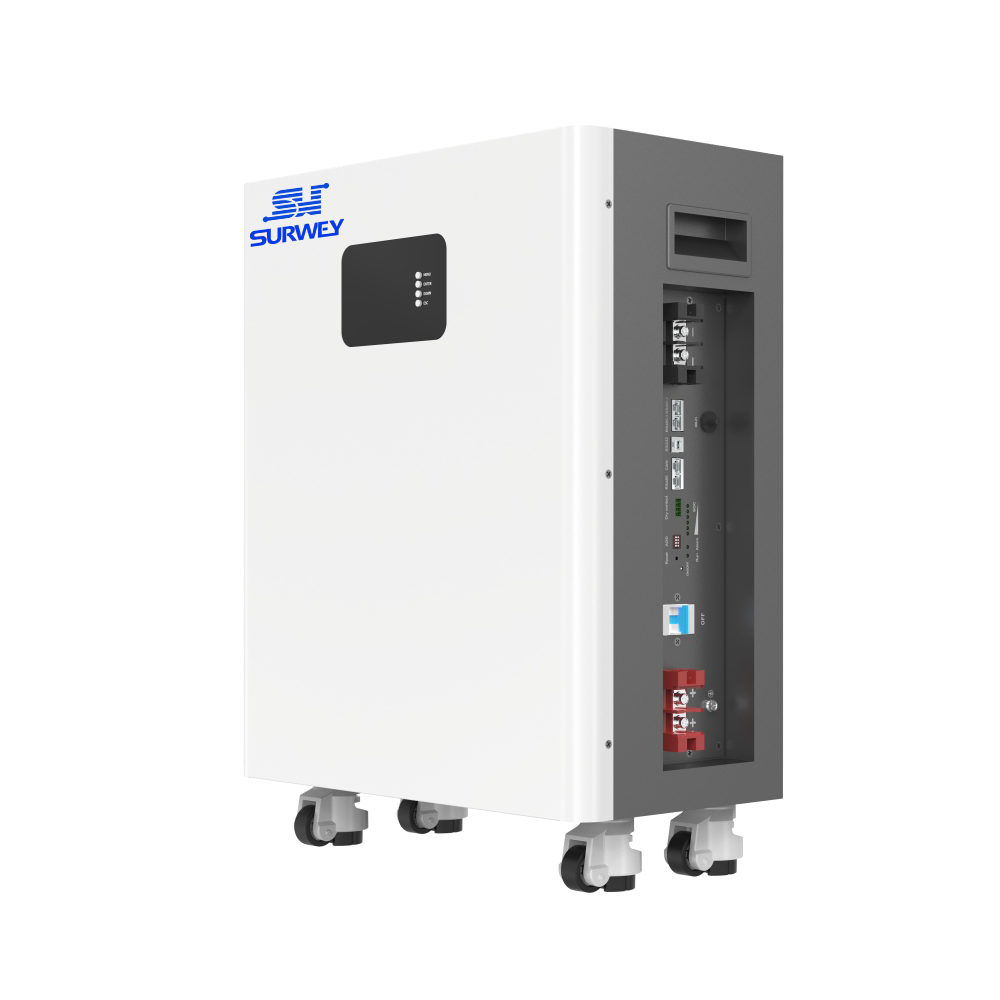
SW-WH-10 kWh Lithium Energy Storage Pack
This matched storage battery has a nominal voltage of 51.2 V, nominal capacity of 200 Ah and rated energy of 10.24 kWh. Built with LiFePO4 cells, it features excellent thermal stability and low risk of thermal runaway. Its cycle life exceeds 3,000 cycles, supporting over ten years of service under typical residential conditions.
The battery supports a maximum continuous charging current of 120 A and a maximum continuous discharging current of 200 A. Its charge cutoff voltage is 58.4 V and discharge cutoff voltage is 44.8 V. A built-in BMS provides comprehensive protection against overvoltage, undervoltage, overload, short circuit and overtemperature. Communication ports include RS232, RS485 and CAN. Real-time communication with the inverter transmits battery SOC, voltage, current and temperature data. The inverter automatically adjusts charge and discharge power according to battery status to avoid cell degradation caused by overcharge or deep discharge.
(3) 580 W Half-Cut Monocrystalline Solar Module
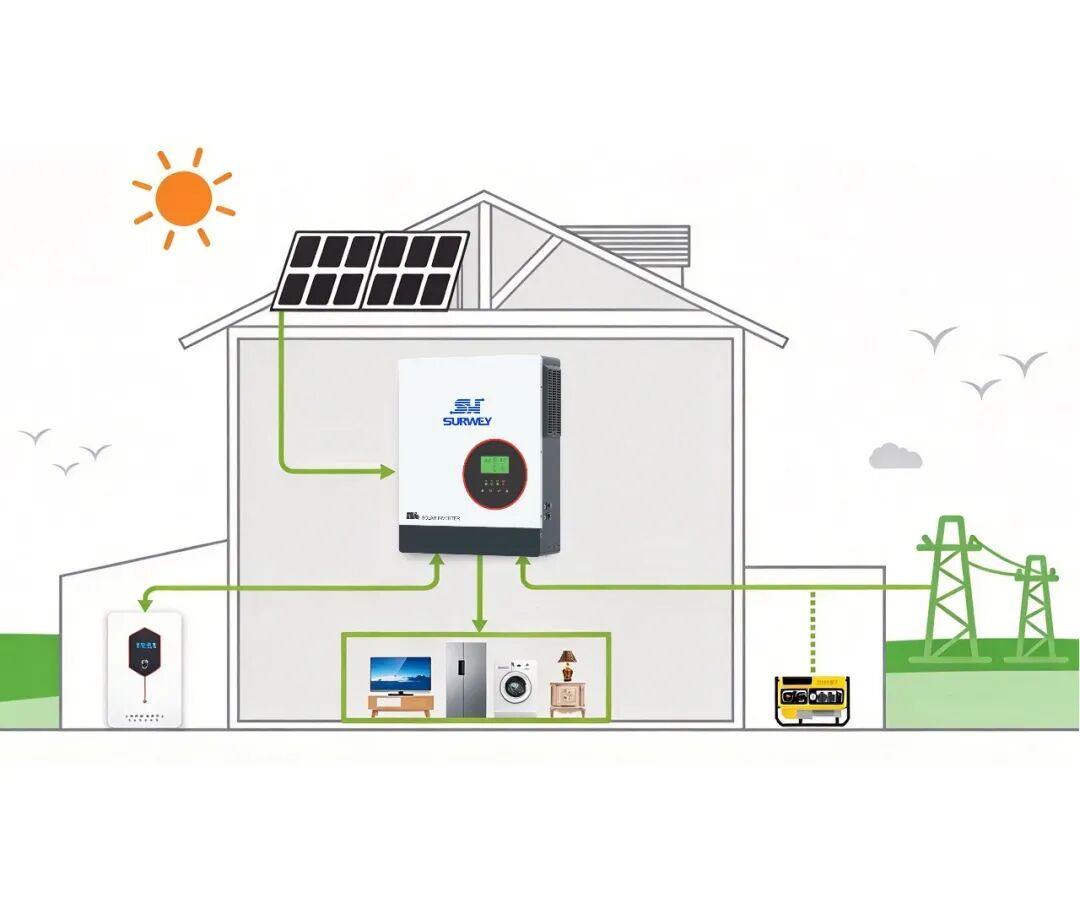
System Topology Diagram
The PV array adopts high-efficiency 580 W half-cut monocrystalline modules with a conversion efficiency of 22.50%. Under STC:
- Open-circuit voltage (Voc): 51.46 V
- Maximum power voltage (Vmp): 42.83 V
- Maximum power current (Imp): 13.66 A
- Short-circuit current (Isc): 14.44 A
The module uses a 144-cell half-cut design. Compared with conventional full-cell modules, it reduces hot-spot risks and mitigates generation drop under partial shading, making it ideal for residential rooftops with occasional obstructions. It maintains moderate power derating under high ambient temperatures typical in the Philippines. The maximum system voltage is 1,500 V with a rated fuse current of 30 A. Its mechanical strength withstands regular wind and snow loads for long-term outdoor rooftop exposure.
III. PV String Design and Compliance Verification
Six pieces of 580 W solar modules are deployed for this project. In consideration of the inverter MPPT voltage range of 40–300 VDC, the configuration is two modules per string with three parallel strings.
For a single string of two modules:
- Series open-circuit voltage: 51.46 V × 2 = 102.92 V
- Series maximum power voltage: 42.83 V × 2 = 85.66 V
The string voltage falls well within the inverter MPPT operating window, eliminating risks of out-of-range high voltage or insufficient voltage for tracking startup.
The operating current of each string equals the module Imp of 13.66 A. If all three strings are paralleled, the total PV input current would reach 40.98 A. Given the maximum charging current of 22 A per MPPT channel of the inverter, the three strings are split across two MPPT ports during physical wiring: two strings on one port (27.32 A) and one string on the other port (13.66 A).
Total PV array power equals 580 W × 6 = 3,480 W, well below the inverter’s maximum allowable PV input of 6,000 W. This preserves sufficient margin to sustain stable operation despite long-term module power degradation and parameter shifts under high-temperature conditions.
IV. System Operating Logic
System Operating Principle Video
This hybrid solar-storage system has four typical operating modes adapted to varying solar irradiance and grid conditions in the Philippines.
Grid Available on Sunny Days — Self-Consumption with Surplus Charging
With ample sunlight, solar modules generate power. The inverter prioritizes solar energy for household loads. When PV generation exceeds load consumption, excess power automatically charges the 48 V storage battery until the full-charge cutoff voltage is reached. The grid barely contributes to power supply to maximize solar utilization.
Cloudy Days / Evenings with Grid Available — Battery Discharge plus Grid Supplement
When PV output is insufficient to meet load demand, the system first discharges the storage battery. Once the battery SOC drops to the preset low threshold, the inverter automatically engages grid power to maintain uninterrupted supply.
Off-Grid Emergency Mode during Grid Outage
At the moment of grid failure, the inverter switches to off-grid operation within milliseconds and isolates the grid loop. Solar power and the battery jointly supply critical loads. During daytime, solar generation simultaneously feeds loads and recharges the battery. At night, stored battery energy sustains essential equipment including refrigerators, lighting and communication devices. The off-grid output is pure sine-wave AC matching grid waveform to protect sensitive appliances.
Low-Irradiance Mode for Extended Cloudy Periods
After consecutive days of poor sunlight, once the battery drains down to the protection limit, the inverter halts battery discharge and waits for grid restoration or solar recovery. The BMS continuously monitors cell status to prevent permanent degradation from deep discharge.
Energy dispatch is centrally managed by the inverter main controller. The battery BMS reports cell parameters in real time, enabling coordinated communication and fully automatic mode switching without manual intervention. The system runs autonomously once commissioned for ordinary households.
V. Installation Environment and Safety Design
The project is deployed on a residential rooftop in the Philippines within a tropical marine climate characterized by year-round high temperature, high humidity and heavy seasonal rainfall. Equipment selection and installation are customized for such conditions.
Solar modules are mounted on sun-facing rooftop zones while avoiding shading from trees and eaves. The tilt angle is set according to local latitude to maximize annual solar irradiation intake. PV cables are UV-resistant with properly waterproofed and insulated connectors. Cables are securely fastened to prevent tearing under typhoon stress.
The inverter and battery are placed indoors in ventilated dry locations away from direct sunlight and rain splash, with reserved clearance for heat dissipation; sealed enclosures are prohibited. The battery is wall-mounted on load-bearing walls and kept away from flammable materials. DC and AC circuits are equipped with circuit breakers and fuses following standard specifications. Anti-reverse protection is installed at the PV combiner for the DC side, and overload protection is fitted at the AC output.
Multi-layer redundant protection is built in: anti-reverse and overvoltage protection on the PV side; BMS-controlled overcharge, overdischarge, overcurrent and overtemperature protection on the battery side; short-circuit, overheating and output overload protection from the inverter. Environmental suitability is validated: the inverter operates from −10°C to 50°C, the battery from −20°C to 60°C, and modules tolerate −40°C to 85°C. All equipment supports up to 95% non-condensing relative humidity to withstand humid rainy seasons.
VI. Project Summary
This residential solar-storage integrated solution for Filipino households centers on a 4 kW US-spec hybrid inverter paired with a 10.24 kWh wall-mounted lithium battery and six 580 W high-efficiency PV modules. The string design of two modules in series with three parallel strings satisfies the inverter voltage and current requirements with well-matched hardware parameters.
Calibrated against local household load profiles, the system covers daily base consumption for a family of four. It enables solar self-consumption on sunny days to reduce grid reliance and automatic off-grid switching for emergency backup during blackouts. Compatible with the local 110 V US grid standard and tropical hot humid climate, the system features comprehensive safety protection, fully automatic operation and low maintenance requirements. It represents a practical distributed storage solution for Southeast Asian residential applications.
For regions with unreliable grid supply, such hybrid solar-storage systems convert solar energy into stable household power. Aligned with the global clean energy transition, they resolve genuine household power pain points and deliver high reference value for field deployment.


