
Application Report of Solar-Storage Integrated System for a Medium and Small-Sized Food Processing Plant in Panama

PV Panel Installation Drawing
Project Overview
This project is located in Panama and serves a local medium and small-sized food processing enterprise. The plant is mainly engaged in aquatic product pre-treatment and fresh fruit and vegetable cold storage, adopting a single-shift daytime production model. The cold storage preservation system runs uninterrupted all year round. The power consumption of the plant consists of daytime production loads and a 24-hour continuous basic cold storage load, which imposes high requirements on power supply continuity. In the event of grid flicker or power outage, fresh raw materials and finished products in the cold storage are highly susceptible to deterioration, resulting in direct production losses. Meanwhile, electricity prices in Panama fluctuate significantly with hydropower output during the dry and rainy seasons, creating heavy power consumption pressure during peak hours. The client intends to adopt a solar-storage integrated system to boost self-consumption of on-site generated power and acquire emergency power backup capability.
1. Description of Client’s Power Consumption Requirements
The plant maintains stable historical electricity records with a monthly total power consumption of approximately 22,000 kWh, translating to a stable daily power demand. The load structure falls into two categories:
- Daytime Production Loads (08:00–18:00): Cleaning and sorting equipment, aquatic and fruit & vegetable processing lines, packaging machinery, workshop ventilation and temperature control units. These loads are concentrated during daylight hours, highly aligned with the photovoltaic power generation window.
- Non-Stop Basic Loads (24-hour continuous operation): Low-temperature cold storage refrigeration units, classified as priority protected loads. Power supply must not be interrupted regardless of production status, making them the primary loads covered by the energy storage backup function of this project.
Core requirements of the client: ① Under normal grid-tied operating conditions, prioritize the consumption of photovoltaic power to optimize the electricity consumption mix; ② In case of grid anomalies or short-term power outages, the system can independently support continuous power supply for core cold storage loads; ③ The overall system shall feature a well-organised architecture with uniform string specifications to facilitate later operation, maintenance and capacity expansion.
2. Overall System Configuration List
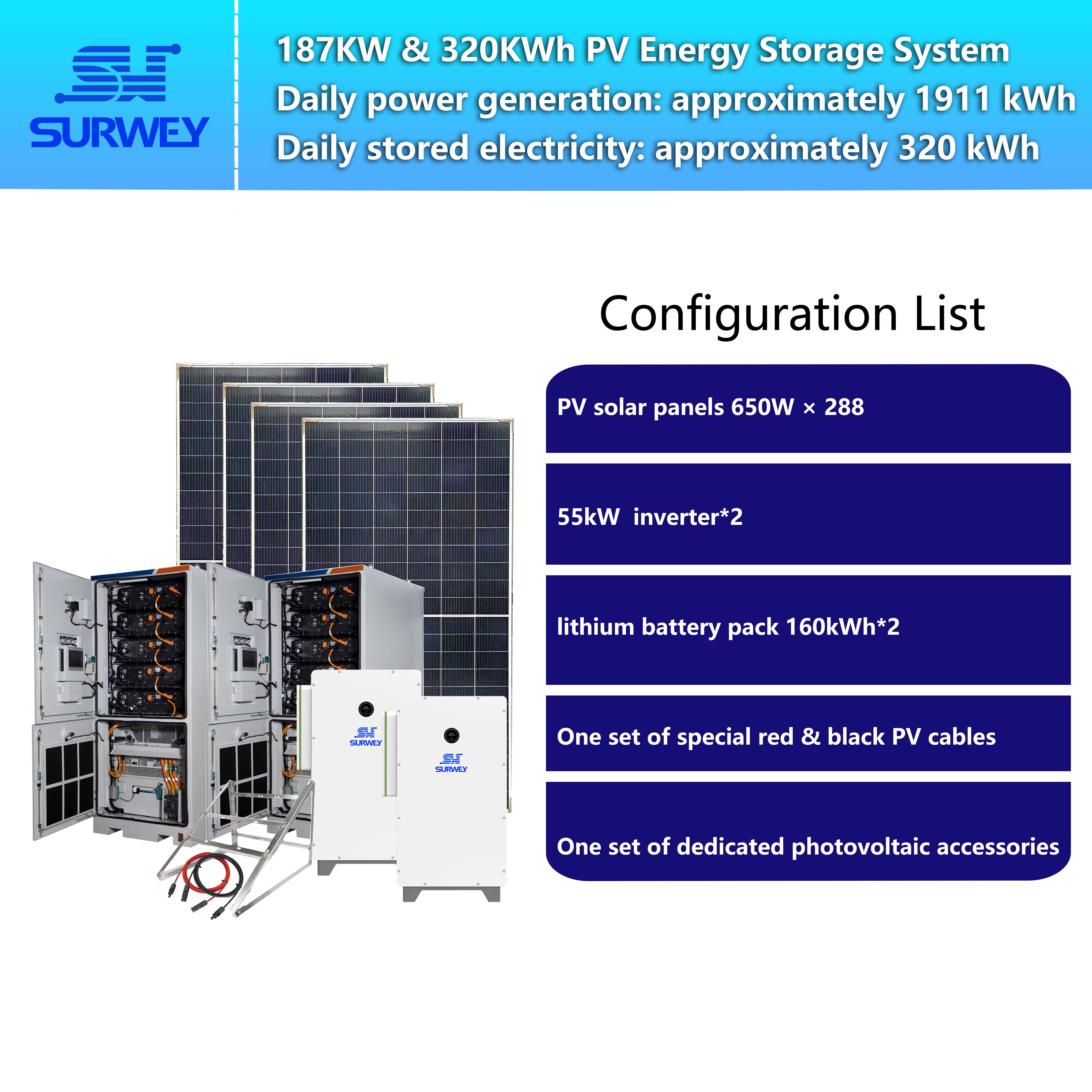
System Configuration Diagram
| Equipment Name | Specification | Quantity | Remarks |
|---|---|---|---|
| N-type Monocrystalline Silicon PV Module | 650 W | 288 pcs | All modules share identical specifications |
| Hybrid Energy Storage Inverter | 55 kW US-standard hybrid grid-tied inverter | 2 units | Each unit integrates 10 independent MPPT channels |
| Lithium Iron Phosphate Energy Storage Cabinet | 160 kWh | 2 units | Equipped with BMS battery management system |
The complete system adopts a hybrid photovoltaic plus energy storage architecture, supporting dual operating modes: grid-tied self-consumption and off-grid emergency backup. It complies with local grid standards in Panama and is adapted for outdoor installation under tropical climatic conditions.
3. Design Specification for PV Array and Strings
This project adopts 650 W N-type monocrystalline silicon PV modules paired with SW 55KW‑US L2 hybrid energy storage inverters. The valid MPPT voltage range is 180 V to 550 V.
Panama features a substantial diurnal temperature difference; low temperatures will raise the open-circuit voltage of modules. The voltage of each string must be kept within the allowable range of the inverter. After calculation, nine modules connected in series form one string.
| Item | Parameters & Calculation Results |
|---|---|
| Parameters of Single Module | Voc = 50.13 VVmp = 41.89 V |
| Number of Modules per Series String | 9 pcs / string |
| Open-Circuit Voltage per String | 9 × 50.13 = 451.17 V |
| Operating Voltage per String | 9 × 41.89 = 377.01 V |
| Total Quantity of Modules | 288 pcs |
| Total Number of Strings | 288 ÷ 9 = 32 strings |
| Quantity of Inverters | 2 units of 55 kW hybrid inverters |
| Strings Connected to Each Inverter | 32 ÷ 2 = 16 strings per unit |
| MPPT Allocation per Unit | 6 MPPT channels: 2 strings in parallel per channel4 MPPT channels: 1 string per channelTotal: 6 × 2 + 4 × 1 = 16 strings |
| Total Installed Capacity | 288 × 0.65 = 187.2 kWp |
💡 Note: Both the open-circuit voltage and operating voltage of each string lie within the MPPT window of the inverter, with sufficient safety margin reserved for low-temperature conditions. Strings connected in parallel to the same MPPT channel feature uniform specifications without current mismatch risks. The design accommodates variable irradiance during Panama’s rainy season, allowing all modules to be connected to the grid for power generation.
4. Introduction to the 55 kW Hybrid Energy Storage Inverter

55 kW US-Standard Hybrid Grid-Tied Inverter
The two 55 kW hybrid inverters serve as the energy dispatching core of the entire system, collectively performing functions including DC-to-AC conversion for photovoltaic power, bidirectional charge and discharge management for batteries, grid interaction and off-grid standby power supply.
On the PV side, each inverter supports a maximum DC input power of 108 kW, matching the connected PV capacity of this project with ample DC-side load margin to eliminate overloading risks. The maximum input current of each MPPT channel is 40 A, compatible with the output current of PV strings.
On the battery side, the inverter supports a DC voltage range of 380 V to 650 V with a recommended operating voltage of 512 V. It delivers bidirectional charge and discharge control for lithium batteries and supports communication linkage with the BMS of energy storage cabinets to collect real-time data of cell voltage and temperature, and automatically limit current or shut down for protection under abnormal conditions.
The AC side adopts US-standard specifications, conforming to local grid voltage and frequency criteria in Panama.
Operating Modes
- Grid-Tied Mode: Photovoltaic power supplies plant loads on priority. When power generation exceeds real-time load demand, surplus power is automatically stored in the energy storage system. When sunlight is insufficient, the energy storage system discharges to supplement power for loads. Excess electricity that cannot be stored can be fed into the grid in accordance with the local net metering policy for electricity credit.
- Off-Grid Backup Mode: Upon grid failure or voltage sag, the equipment switches rapidly to independent power supply and outputs stable alternating current to sustain refrigeration compressors and other critical loads. It boasts strong adaptability to the inrush current during compressor startup and low output harmonic distortion to protect on-site electrical equipment.
The unit integrates comprehensive protection functions: PV reverse connection protection, AC & DC lightning protection, insulation monitoring, residual current monitoring, short-circuit protection, anti-islanding protection, etc., to mitigate risks associated with lightning strikes and cable ageing prevalent in tropical regions. It adopts intelligent air-cooling heat dissipation with an IP66 protection rating and supports outdoor cabinet installation. A local display screen and remote communication interfaces are provided, enabling operation and maintenance teams to remotely monitor power generation of each MPPT channel, battery status and load data for convenient inspection.
The two inverters operate in coordination with evenly distributed loads. When one unit is shut down for maintenance, the other can continue to carry part of the loads, enhancing the fault tolerance of the whole system.
5. Introduction to the 160 kWh Lithium Iron Phosphate Energy Storage Cabinet

160 kWh Lithium Iron Phosphate Energy Storage Cabinet
Two integrated 160 kWh lithium iron phosphate energy storage cabinets are deployed in the system, acting as energy buffers and emergency standby power sources. The storage cells are prismatic lithium iron phosphate cells with excellent cycling performance, suited for daily charge-discharge cycles in commercial and industrial scenarios.
Parameters of a single cabinet: nominal voltage 192 V, capacity 800 Ah, maximum continuous charge and discharge current 400 A. The cabinet integrates a BMS, which monitors cell voltage and temperature in real time, automatically balances cells, and triggers protective actions in cases of overcharge, over-discharge, overcurrent, excessively high or low temperature.
The energy storage system delivers three core values for this project:
- Peak Shaving and Valley Filling: Surplus photovoltaic power generated on sunny days is stored and released during late afternoon when sunlight fades and electricity prices rise, reducing power draw from the utility grid;
- Power Backup during Outages: In the event of grid flicker or blackout, the system switches to off-grid mode together with inverters to continuously supply power for critical cold storage loads and avoid losses caused by spoilage of fresh produce;
- PV Output Smoothing: When cloud cover causes rapid fluctuations in photovoltaic output, the energy storage system rapidly absorbs or releases power to stabilise downstream voltage and reduce impact damage to refrigeration units and packaging equipment.
The energy storage cabinets are equipped with built-in temperature control systems to adapt to high ambient temperatures in Panama and suppress capacity degradation of cells under heat stress. The cabinets are fully assembled before delivery; only on-site wiring and communication commissioning are required, shortening the construction cycle. The two energy storage cabinets work in one-to-one coordination with the two inverters for balanced distribution of charge and discharge loads.
Video of System Operating Principle
6. System Operating Logic
The daytime production window from 08:00 to 18:00 overlaps with continuous cold storage loads, matching the photovoltaic power generation period perfectly.
- Bright Sunny Conditions: Photovoltaic power directly supplies all plant loads with self-consumption prioritised. If PV output exceeds power demand, surplus energy is stored in the energy storage system.
- Partly Cloudy Afternoons with Declining Irradiance: The energy storage system automatically discharges to compensate for load consumption.
- After Sunset with No PV Generation: Photovoltaic power generation ceases. The energy storage system discharges to supply the cold storage on priority; once the energy storage capacity is depleted, the system automatically switches back to grid power supply.
- Grid Failure and Power Cut: Inverters switch to off-grid operation within milliseconds, and the energy storage system independently powers cold storage and other priority loads. Production lines may be connected selectively as required. Once grid power is restored, the system automatically reverts to grid-tied mode without manual intervention.
Compared with pure grid-tied photovoltaic systems, this solution features independent backup power supply, addressing the core demand for uninterrupted cold storage power for food processing plants. When compared with diesel generator sets, it consumes no fuel and produces no exhaust emissions or noise during daily cycling operation while requiring less routine maintenance. Generators can be deployed as supplementary equipment for prolonged power outages. The whole system supports phased capacity expansion to accommodate future production upgrades of the plant.
7. Operation and Maintenance Guidelines for Tropical Environments
Tailored to the tropical climate of Panama, the operation and maintenance scheme includes the following measures:
- PV Array: Dust tends to accumulate on modules during the dry season; regular cleaning is required to maintain light transmittance. Corrosion-resistant brackets are adopted. Fastening components, earthing and lightning protection systems shall be inspected periodically in the rainy season;
- Inverters and Energy Storage Cabinets: Install in well-ventilated locations and avoid direct solar radiation that exacerbates overheating. Clean heat dissipation filters and inspect fan performance regularly;
- Battery System: Monitor cell balance status continuously via the backend. Built-in charge-discharge strategies prevent full charging or deep discharging to slow down cell degradation;
- Remote Monitoring: The entire system supports online data viewing and alarm push. Alerts are sent in advance for abnormal events to enable on-site maintenance on demand and cut operation and maintenance costs.
8. Project Summary
This project delivers a customised solar-storage integrated solution matching the load characteristics of a medium and small-sized food processing plant in Panama. Equipped with 288 pieces of 650 W PV modules, two 55 kW hybrid inverters and two 160 kWh energy storage cabinets, the design features uniform and well-organised PV strings with reliably matched equipment parameters.
The system fulfils two core objectives: maximising clean energy consumption under normal operating conditions and providing emergency power backup for cold storage during grid failures. It responds to the typical pain points of the aquatic and fruit & vegetable processing industries in the region. The solution enjoys strong replicability for similar food and fresh produce processing sites across Central America, offering local commercial and industrial users a stable and reliable clean energy power supply option.


