
Overseas Commercial Solar-Storage Integration Project Launched: A Case Record of a 30 kW Hybrid Energy Storage System for a Café in Morocco
In overseas commercial and industrial operations, unstable power supply, fluctuating electricity demand and unreliable grid service have long plagued brick-and-mortar stores. Many catering and retail outlets see concentrated power consumption during daytime opening hours. When all equipment runs at peak hours, electricity demand surges. Power outages and grid disturbances disrupt refrigeration, lighting and back-of-house appliances immediately, bringing business to a halt.
This solar-storage integration project for a local café in Morocco adopts a 30kW hybrid grid-tied energy storage inverter paired with rack-mounted high-voltage LFP energy storage battery packs and high-efficiency N-type PV modules. It builds a distributed energy storage system featuring self-consumption, backup power and flexible multi-mode switching. Capable of photovoltaic power generation, energy storage, off-grid emergency power supply and coordinated grid-tied operation, the system matches the store’s daily power consumption profile and delivers stable, reliable power for commercial premises. This article dissects the full commercial solar-storage solution from project power consumption profile, core equipment selection, PV string design, system operating logic and scenario-specific value.

PV Module Installation Drawing
I. Project Overview and Power Consumption Characteristics
Located in Morocco, the facility is a local café, a typical small-to-medium commercial power consumer. Historical electricity bills reveal distinct consumption patterns: power use concentrates during daytime opening hours with stable monthly consumption, while daily load fluctuates in line with business hours.
| Load Type | Power Consumption Features | Project Pain Points | Value Delivered by the System |
|---|---|---|---|
| Refrigeration and preservation equipment | 24-hour continuous base load with zero tolerance for power cuts | Shutdown causes spoilage and direct financial losses | Seamless off-grid backup power to prioritise cold chain continuity |
| Beverage preparation equipment | Intermittent start-stop with high inrush power at startup | Impulsive loads trigger voltage dips and tripping | Fast energy storage response to smooth instantaneous power surges |
| Lighting, ventilation and auxiliary electrical devices | Activated alongside opening hours with steady daytime draw | Flickering and equipment malfunctions under unstable grid supply | PV self-consumption and regulated power supply |
Since consumption peaks during opening hours with pronounced load swings, besides reducing grid electricity bills by shaving peak demand with solar generation, uninterrupted emergency backup power represents the client’s top priority.
Full system bill of materials:
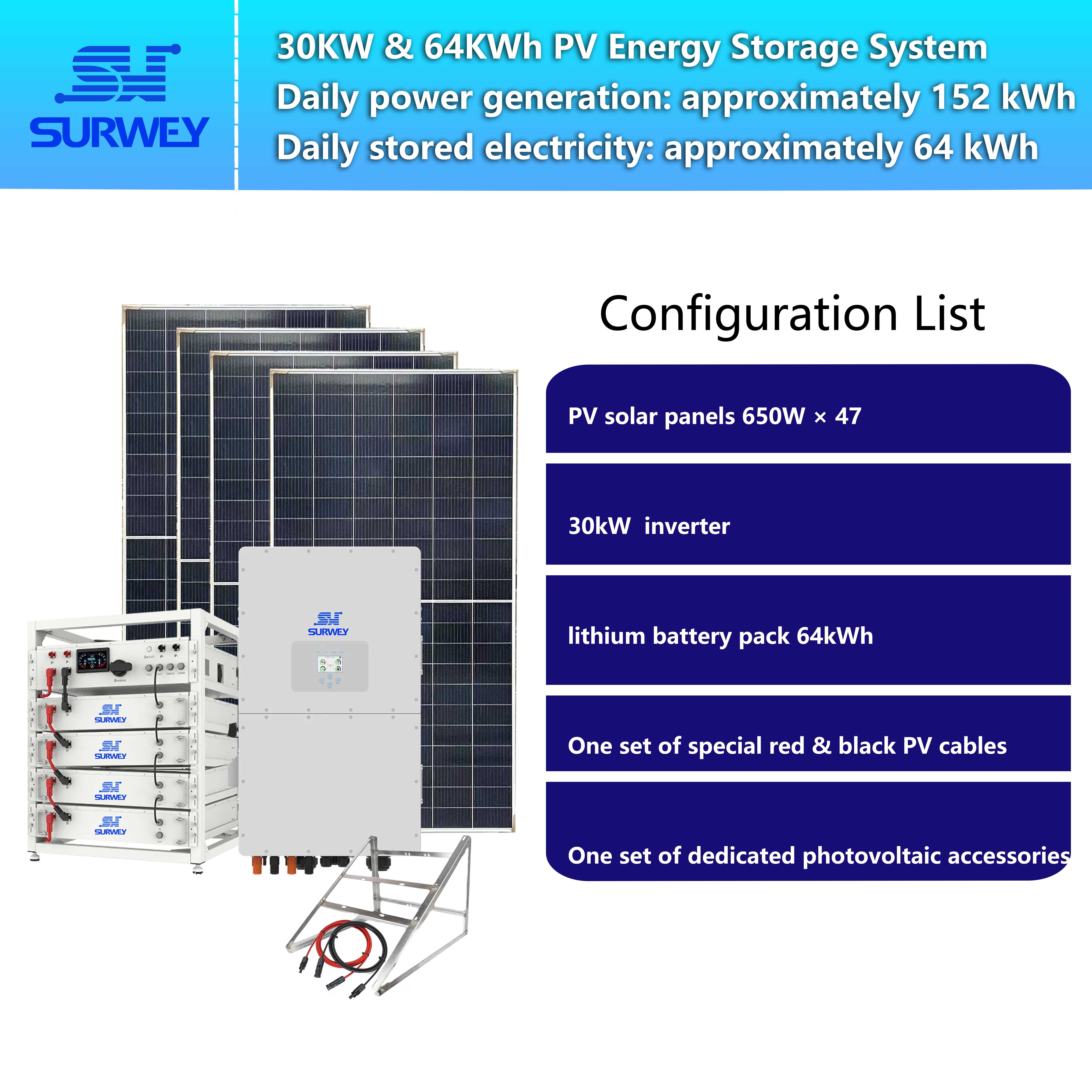
- ✅ Hybrid grid-tied energy storage inverter: 1 unit of SW-EST30KH
- ✅ Energy storage battery: SW-G4-64KWH rack-mounted high-voltage LFP battery pack
- ✅ PV modules: 47 pieces of 650W N-type monocrystalline PV modules
- ✅ System architecture: Multi-MPPT independent PV inputs, supporting three operating modes: grid-tied operation, standalone off-grid power supply and genset integration
Per inverter datasheet, the SW-EST30KH delivers a rated grid-tied output of 30kW with ample short-term overload capability. It integrates three independent MPPT PV input channels, each performing separate voltage tracking. PV strings with different orientations or series counts can operate reliably as long as they are not mixed on a single MPPT channel — the foundational principle for this string design. Compatible with both lithium and lead-acid batteries, the inverter covers a battery voltage window of 220–800V, perfectly matching the operating voltage range (499.2–700V) of this high-voltage rack battery. Comprehensive AC and DC protection is embedded to satisfy safety codes for overseas commercial deployments.
II. Introduction of Core Supporting Products
(1) SW-EST30KH 30kW Three-Phase Hybrid Grid-Tied Energy Storage Inverter

30 kW Three‑Phase Hybrid Grid‑Tied Energy Storage Inverter
Acting as the control heart of the whole system, this hybrid inverter serves as the “brain” of the solar-storage setup, interconnecting PV, batteries, the utility grid and loads, making it ideal for commercial applications. On the PV side, it features three independent MPPT channels with a maximum input current of 36A per channel and an MPPT operating voltage window of 180–900V. The wide voltage range supports power tracking for diverse PV string configurations. Each MPPT accepts dedicated PV strings; mixing strings with different series counts on one MPPT is prohibited to avoid mismatched voltage and generation loss, a rule strictly followed in this design.
The AC side comprises grid-tied, off-grid and genset connection ports, enabling flexible switching among three modes. Under grid-tied operation, solar power feeds the on-site loads first, and surplus power charges the energy storage battery. Once the battery reaches full state of charge, the system runs per pre-set strategies. Upon grid failure, it switches rapidly to off-grid mode within less than 10 ms, powering critical loads jointly by PV and batteries. End-users will not perceive any interruption, keeping refrigeration and key appliances running. A reserved port for diesel generators is available for extreme scenarios with prolonged low irradiance and depleted battery capacity, adding further power redundancy.
For safety, the unit integrates DC reverse polarity protection, overcurrent protection, anti-islanding protection, AC short-circuit protection, residual current protection and insulation monitoring. It carries Class II DC protection and Class III AC protection with an IP65 ingress rating. Wall-mounted installation allows placement outdoors or in semi-outdoor plant rooms. Its operating temperature spans -25°C to 60°C; automatic power derating activates above 45°C, adapting to hot tropical climates. Communication options include wired RS485, optional WiFi and 4G modules, alongside BMS CAN communication for real-time exchange of SOC, voltage, current and fault data with the battery pack. This enables coordinated protection and supports remote monitoring and parameter commissioning.
The inverter achieves a peak efficiency of 98.2% and a European efficiency of 97.1%, cutting conversion losses between AC and DC power. It holds certifications to IEC international standards, EN European standards and relevant grid interconnection certificates, complying with compliance requirements for commercial projects in Southeast Asia.
(2) SW-G4-64KWH Rack-Mounted High-Voltage LFP Energy Storage Battery Pack

64 kWh Rack‑Mounted High‑Voltage LFP Energy Storage Battery Pack
The energy storage unit uses one SW-G4-64KWH rack-mounted high-voltage lithium iron phosphate battery pack. Featuring LiFePO4 chemistry, it boasts strong thermal stability and outstanding cycle life. The base module is a 51.2V / 16kWh, 314Ah cell unit. Four modules are connected in series to form the battery cluster, delivering a rated system voltage of 204.8V and a usable capacity of 64.3kWh within an operating voltage window of 166.4V–232V.
For charge and discharge performance, the recommended continuous charge/discharge current is 100A, with a maximum of 150A and a peak discharge of 350A for 2 minutes at 25°C. Its power rating easily satisfies continuous charging and discharging demands of the 30kW inverter. A built-in BMS supports dual CAN2.0 / RS485 communication and directly interfaces with the CAN port of the SW-EST30KH inverter. The BMS continuously samples cell voltage and temperature, performs active balancing, and sends protection commands to the inverter upon overvoltage, undervoltage, overcurrent or overtemperature, triggering coordinated shutdowns to mitigate hazards from the battery side.
Operating temperature range: 0°C–55°C for charging and -20°C–55°C for discharge, suited for tropical conditions. With an IP20 rating, it can be rack-mounted or floor-standing inside ventilated plant rooms. It offers ≥6,000 cycles at 25°C ± 2°C under 0.5C charge-discharge and 90% DOD, backed by a 5-year warranty (whichever comes first between the warranty period and total discharged energy), meeting long-term stable operation for commercial sites. Up to 16 modules can be cascaded in series for expansion, reaching a maximum output voltage of 819.2V. Multiple capacity variants are available in the same product line, allowing capacity upgrades by adding modules if the café expands its electricity consumption later. The product carries a full suite of certifications including CE, IEC62619, VDE2510-50, UN38.3 and MSDS to satisfy customs clearance and acceptance for overseas projects.
(3) 650W N-Type Monocrystalline PV Modules
The modules support a maximum system voltage of 1500V DC, compatible with high-voltage string designs. They exhibit excellent temperature coefficients with a power temperature coefficient of -0.29%/°C, meaning milder power derating as ambient temperature rises and stable generation yields under year-round hot climates. Pre-attached cables and MC4 connectors simplify installation. Mechanical load ratings of 5400 Pa front side and 2400 Pa rear side deliver robust wind and pressure resistance for reliable long-term outdoor deployment.
III. PV String Design Specification
Video of System Operating Principle
The system deploys a total of 47 pieces of 650W PV modules across three independent MPPT channels of the inverter. Core design rules: modules in series on the same MPPT channel must have identical series counts; different string lengths are permitted across separate MPPT channels, with each string assigned exclusively to one channel. Mixing unequal string lengths on a single MPPT is forbidden to avoid circulating current and generation loss, a common pitfall in engineering practice.
Recommended string allocation:
- MPPT 1: One string of 18 × 650W modules
- MPPT 2: One string of 18 × 650W modules
- MPPT 3: One string of 11 × 650W modules
Voltage verification: Under STC conditions, each module has an open-circuit voltage of 50.13V and an operating voltage of 41.89V.
- 18 modules in series: Operating voltage ≈ 754V, open-circuit voltage ≈ 902V
- 11 modules in series: Operating voltage ≈ 461V, open-circuit voltage ≈ 551V
The inverter MPPT window of 180V–900V fully covers both strings for reliable startup and power harvesting. Open-circuit voltage rises slightly at low temperatures; the 18-module string sits close to the upper limit yet remains safe under local climatic conditions.
The three MPPT channels operate independently and track the maximum power point of their respective strings without mutual interference, even when uneven shading or tilting affects individual strings. Splitting 47 modules into identical strings is impossible, and forcing mismatched strings onto one MPPT would drastically cut generation efficiency. This layout represents the optimal balance of module quantity, MPPT channels and voltage safety.
Total installed PV capacity: 47 × 650W = 30.55 kW, well matched to the 30kW inverter PV input rating with moderate oversizing. At high irradiance, solar output can hit the inverter’s absorption ceiling; under weak light, the larger module array boosts total daily generation, aligning with the café’s daytime load curve. Solar power is consumed on-site first to reduce grid draw.
IV. System Operating Logic Tailored for Café Operations
This hybrid solar-storage system automatically switches between typical operating modes based on grid availability and irradiance.
Normal Grid-Tied Mode (Grid Available)
On sunny days, PV generation prioritises on-site loads such as refrigeration, back-of-house equipment and lighting. When generation exceeds real-time consumption, surplus power charges the 64.3kWh high-voltage energy storage battery. Once the battery hits the upper SOC threshold, the system follows pre-set operational strategies. After sunset when PV output ceases, stored energy supplies the store first. When the battery drains to the lower SOC limit, the system reverts automatically to grid power. This workflow perfectly matches daytime café operations: solar self-consumption reduces grid reliance while the storage system performs peak shaving and load shifting. The usable capacity of 55.29 kWh covers most base loads during non-sunlight hours, offering ample backup duration.
Off-Grid Emergency Backup Mode (Grid Outage)
When the utility grid fails, the inverter switches to off-grid mode within less than 10 ms to maintain uninterrupted power for critical loads. Power is supplied jointly by PV and batteries: solar recharges the battery during daytime to sustain loads, while stored energy runs key equipment overnight to keep refrigeration active and prevent food spoilage — the core value of this solution for the café. The inverter maintains its rated 30kW output under off-grid conditions to accommodate peak demand. Direct communication between the high-voltage battery cluster and inverter enables fast high-power discharge and stable load handling.
Genset Coordinated Charging Mode (Prolonged Overcast Conditions)
With the dedicated genset port, a diesel generator can be connected during extended periods of low solar yield and depleted battery capacity. The genset powers loads and recharges the battery, establishing triple power redundancy: solar, energy storage and diesel generation to minimise outage risks.
Coordinated Battery Protection Logic
The high-voltage battery cluster integrates a full BMS. The BMS aggregates cell voltage, current, temperature and SOC data and communicates continuously with the inverter via CAN bus. The inverter adjusts charge and discharge power dynamically according to SOC, cell temperature and voltage. Charging or discharging halts automatically once protection thresholds are triggered to avoid overcharge and overdischarge and extend battery service life. Compared with parallel low-voltage battery banks, this high-voltage integrated rack design reduces wiring and simplifies communication loops, lowering risks of inconsistent communication and circulating current among multiple units for enhanced stability.
V. Summary
This 30kW solar-storage solution for the Moroccan café centres on the SW-EST30KH three-phase hybrid grid-tied inverter, paired with the SW-G4-64KWH high-voltage rack-mounted LFP battery cluster and 47 pieces of 650W N-type PV modules. Differentiated string design across three independent MPPT channels delivers a stable, practical engineering layout given the fixed module count.
It is far more than a photovoltaic generator: it functions as a multi-redundancy commercial power system. It enables self-consumption and energy storage on sunny days, seamless off-grid transfer during blackouts and genset support for extreme weather. The high-voltage integrated storage architecture simplifies system cabling, improves reliability and allows flexible future expansion. For countless catering, retail and small processing users across Europe, similar hybrid storage schemes effectively mitigate operational risks caused by unreliable grids.
As distributed energy storage continues to gain traction overseas, all-in-one solutions combining PV, high-voltage rack storage and hybrid inverters will emerge as a mainstream power upgrade option for small and medium commercial premises, delivering both maximised solar utilisation and reliable emergency backup.


