
Residential PV-Storage Design for Tropical Regions|120/240 V Split-Phase PV Energy Storage Solution in Guayaquil, Ecuador
I. Project Overview
1.1 Project Background and Application Scenario
Ecuador is located in the northwest of South America, crossed by the Equator. It boasts excellent solar resources with an annual global horizontal irradiation of approximately 1,500–2,000 kWh/㎡, making it highly suitable for residential distributed photovoltaic development. This project is sited at a detached residential house on the outskirts of Guayaquil, Ecuador.
The local power grid has prominent weaknesses: municipal power supply suffers low reliability; hydropower output declines in the dry season, resulting in frequent grid power rationing; severe voltage fluctuations occur during afternoon and evening peak demand. Residential power distribution in Ecuador adopts the North American split-phase power supply configuration, with an L1+N+L2 three-wire incoming service. The voltage between L1 and N, as well as L2 and N, is 120 V respectively, while the line-to-line voltage between L1 and L2 is 240 V. Household loads fall into two categories: 120 V low-power loads including lighting, routers, televisions and small kitchen appliances, and 240 V high-power loads such as electric water heaters, small air conditioners and water supply pumps. Conventional 220 V single-phase PV inverters cannot directly adapt to the local power architecture and fail to meet power consumption requirements.
The system owner is a four-person self-occupying household with stable daily power load, holding three core requirements:
- Prioritize self-consumption of solar power to reduce electricity bills;
- Enable seamless off-grid switching during grid outages to guarantee uninterrupted power supply for critical domestic loads;
- Deploy a complete set of equipment compliant with the Ecuadorian 120/240 V split-phase standard, supporting both grid-tied and off-grid modes with reserved capacity for future expansion.
Combined with load calculation and solar resource assessment, this solution adopts a 3 kW North American standard split-phase hybrid inverter, four pieces of 630 W N-type PV modules and a 5 kWh lithium iron phosphate energy storage battery pack to build a grid-tied and off-grid compatible residential PV energy storage system. It covers basic household electricity consumption and serves as a backup power source for power failures.
1.2 Construction Site
A detached dwelling on the outskirts of Guayaquil, Ecuador

(PV Panel Installation Drawing)
1.3 System Construction Objectives
This integrated residential PV-storage system adopts the technical route of photovoltaic generation plus lithium iron phosphate energy storage and a North American split-phase hybrid inverter to realize intelligent operation under multiple working conditions. When sunlight is sufficient, the electricity generated by PV modules supplies loads first, and surplus power charges the energy storage battery. Once the battery is fully charged under grid-tied mode, excess power can be fed back into the municipal grid. On cloudy days or at night with no PV output, the battery discharges to supply loads preferentially; when the battery state of charge (SOC) drops below the protection threshold, the system automatically switches back to utility power. Upon grid failure, the system switches to off-grid mode within milliseconds and powers critical loads continuously using solar generation and batteries, delivering UPS uninterrupted backup functionality. The AC output strictly conforms to the local 120 V/240 V split-phase standard in Ecuador, compatible with all household loads while balancing power supply reliability and economic efficiency.
II. Load and Resource Calculation
2.1 Local Solar Resources
Guayaquil features a tropical wet-and-dry climate with abundant sunshine all year round. Cloud cover in the rainy season slightly reduces power generation. The equivalent full-load hours for this PV project are set at 1,300 hours per year.
- PV installed capacity: 630 W × 4 = 2,520 W = 2.52 kWp
- Theoretical annual power generation: 2.52 kW × 1,300 h = 3,276 kWh
- Average daily power generation: approx. 8.97 kWh
The average daily basic electricity consumption of ordinary local households ranges from 6 kWh to 9 kWh. The power generated by the system can basically cover routine basic demand. Surplus power is stored in the battery for nighttime use, and any power shortage is supplemented by utility power.
2.2 Load Analysis
Loads are divided into 120 V branch circuits and 240 V cross-phase loads according to the split-phase layout:
- 120 V (L1‑N / L2‑N) loads: LED lighting, WiFi routers, televisions, laptops, small refrigerators and fans, with continuous total power of 800–1,200 W
- 240 V (L1‑L2) loads: Cold water supply pumps and high-power 240 V kitchen appliances, with a peak power up to 2,200 W
The inverter provides a rated output of 3,000 W and a short-term peak output of 4,500 W, capable of supporting simultaneous operation of all loads. Equipped with a 5 kWh energy storage battery, the system can stably supply a 1 kW critical load for roughly four hours without solar input, securing essential needs including refrigeration, lighting, communication and running water during blackouts.
Load allocation principle: A split-phase system must balance loads on L1 and L2 to suppress phase unbalance. Excessive unbalance will trigger inverter alarms and current limiting protection. During design, high-power devices are distributed across the two phases.
III. Overall System Scheme and Operating Principle
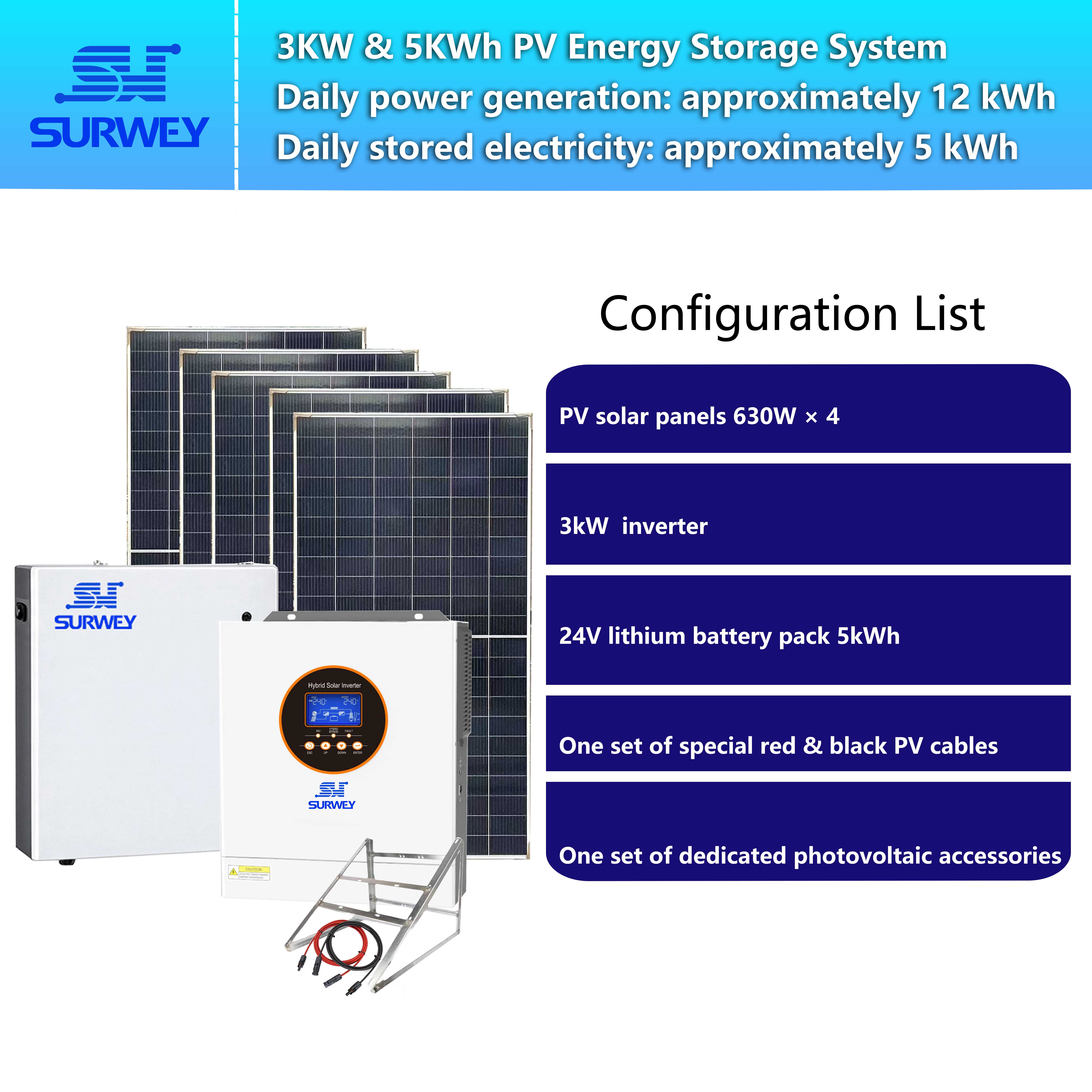
(System Configuration Diagram)
3.1 System Topology and Composition
The complete system consists of seven modules: PV array, North American standard split-phase hybrid inverter, lithium iron phosphate battery pack, utility power input circuit, split-phase AC output load circuit, lightning protection and grounding assemblies, and communication monitoring module.
PV String Design
The PV array comprises four 630 W N-type monocrystalline modules connected in series as one single string to the single MPPT channel of the inverter:
- String configuration: 4 × 630 W in series, total string power 2,520 Wp
- Voltage verification (adapted to high-temperature conditions in equatorial Guayaquil): The open-circuit voltage at ambient temperature and temperature coefficient of modules are verified. Under the local lowest temperature, the total string open-circuit voltage is below 500 VDC (the maximum PV open-circuit voltage limit of the inverter). Under year-round high operating temperatures, the MPPT operating voltage stays within the inverter MPPT window of 120–450 VDC, avoiding voltage out-of-limit and MPPT loss of lock.
- String wiring: Modules are connected end to end in series. The DC positive and negative cables from the string lead into a DC combiner box fitted with a DC fuse and DC surge protective device, before feeding into the PV terminals of the inverter.
- Advantages: The single-string layout features a simple structure without multiple MPPT channels, facilitating construction and reducing failure points at DC connectors. The inverter supports a maximum PV input power of 3,600 W; the current 2,520 W configuration leaves ample margin for future expansion by adding identical modules into the same string.
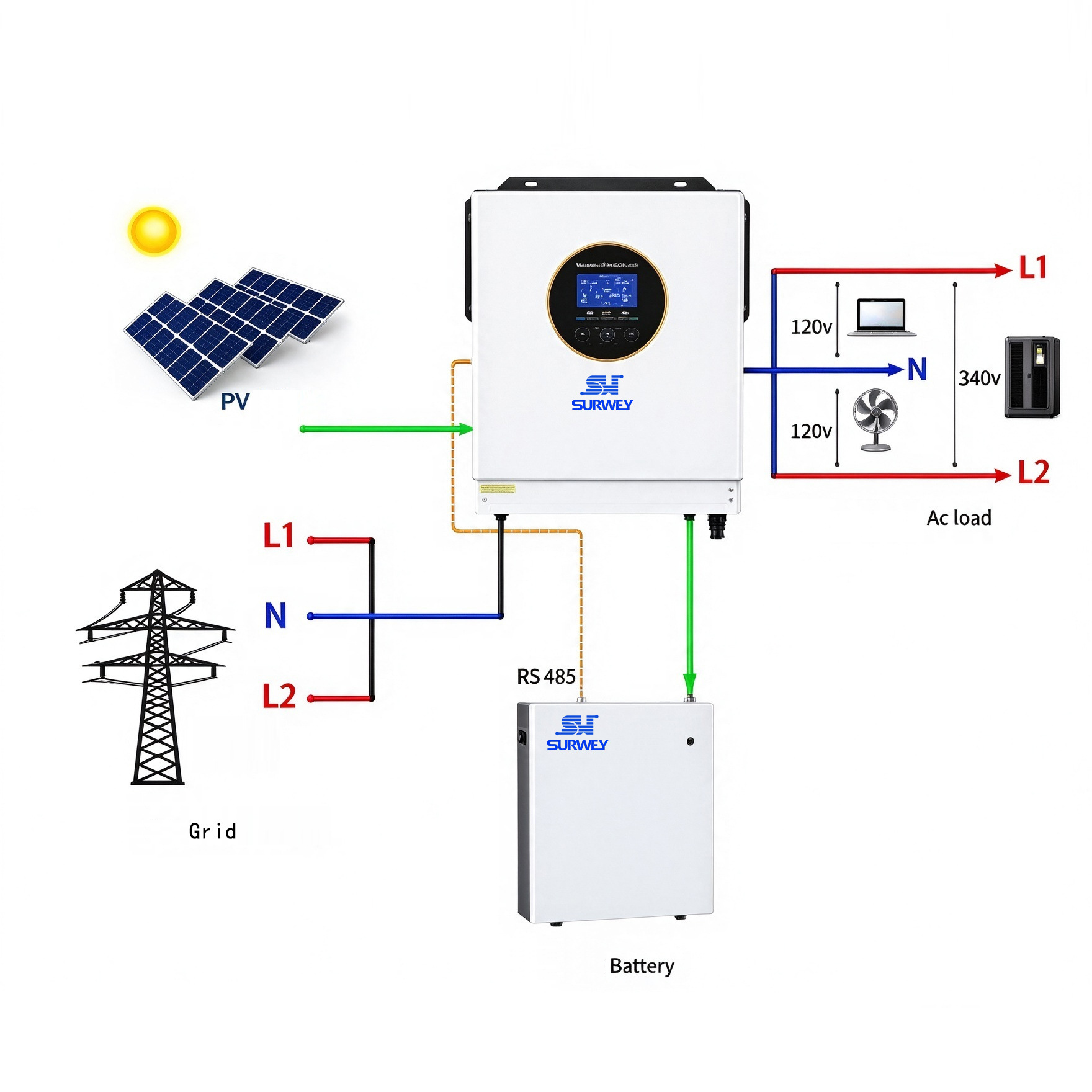
Topology path: DC output from PV modules → built-in MPPT controller of inverter → DC bus of inverter. The energy storage battery connects to the battery terminals of the inverter on the DC side. Utility power L1/N/L2 is connected to the AC INPUT of the inverter. The AC OUTPUT of the inverter delivers 120/240 V split-phase AC power to the indoor distribution panel for all household loads. The inverter communicates with the battery BMS via RS485 to collect real-time battery voltage, current, SOC and fault signals for coordinated charge and discharge control.
3.2 System Operating Modes
(Video of System Operating Principle)
Mode 1: Grid-tied Self-Consumption (Grid available, with solar irradiance)
After MPPT optimization, DC power from PV modules is sent to the inverter and converted into 120/240 V AC power to supply household loads preferentially. If power generation exceeds consumption, surplus energy charges the energy storage battery. Once the battery reaches the upper SOC limit, charging stops and remaining power is fed into the municipal grid. When PV output is insufficient, utility power automatically compensates for the power gap.
Mode 2: Grid-tied Battery Discharge (Grid available, night / cloudy, no solar output)
With zero PV generation, the energy storage battery discharges through the inverter to power loads. When SOC falls to the preset lower limit, discharge terminates and the system switches to utility power automatically to prevent over-discharge damage to the battery.
Mode 3: Off-Grid Backup Mode (Grid outage)
Upon detection of utility loss, the inverter rapidly disconnects from the grid and switches to independent off-grid operation. Solar generation and the battery jointly supply critical loads. In daytime, solar power serves loads first with excess energy recharging the battery; at night, the battery provides power. The system shuts down for protection once battery energy is depleted. It automatically resumes grid-tied operation once utility power restores without manual intervention, targeting frequent local blackouts.
Mode 4: Battery-Free Operation Mode
This inverter model supports battery-free operation. When the battery fails or is removed for maintenance, the system can still maintain grid-tied power generation with PV directly feeding loads, improving the fault tolerance of the whole system.
IV. Core Equipment Selection and Technical Parameters

(Indoor Installation Drawing of Key PV Equipment)
4.1 North American Standard Split-Phase Hybrid Inverter (Model: SW‑3KW‑24V)
As the core device of the system, it is developed for the North American split-phase grid and perfectly fits the 120/240 V scenario in Ecuador.
- Rated power: 3,000 W; peak power: 4,500 W
- Compatible battery specification: 24 V version, matching a 25.6 V lithium iron phosphate battery pack
- MPPT PV input: MPPT operating voltage 120–450 VDC; maximum PV open-circuit voltage 500 VDC; maximum PV input power 3,600 W. The 2,520 W PV array of this project provides sufficient capacity margin
- AC electrical specifications: AC input 240 VAC (180–280 VAC); split-phase output 115 Vac ±5% / 230 Vac ±5%, switchable between 50 Hz and 60 Hz. Preset to 60 Hz at factory for the Ecuadorian grid
- Conversion efficiency: Peak efficiency of 93.5% under battery inversion mode; pure sine wave output with low harmonic distortion, compatible with sensitive electronic loads such as televisions and computers
- Protection functions: Built-in protection against overload, overheating, short circuit, battery overcharge, over-discharge and reverse connection; intelligent air cooling; IP21 protection rating, suitable for wall mounting in indoor distribution rooms
- Communication and HMI: RS485 for BMS communication, WiFi/4G remote monitoring; mobile APP for checking power generation, consumption, SOC and alarms; local configuration via color LCD and physical buttons; RGB status indicators for convenient operation and maintenance
- Dimensions and weight: 300 × 105 × 373 mm, net weight 9 kg; wall-mounted design saves space
4.2 PV Array: Four Pieces of 630 W N-Type Modules
Each module is rated at 630 W, bringing a total installed capacity of 2,520 Wp. Modules are connected in series to the inverter MPPT port. Given the high ambient temperature near the Equator, the low-temperature open-circuit voltage after series connection leaves adequate margin and will not exceed the inverter limit of 500 VDC, satisfying voltage matching requirements.
Installation: Roof racking with tilt angle matched to local latitude; facing true north for the Southern Hemisphere to maximize irradiation capture. Supporting DC circuit breakers and DC lightning arresters are equipped to guarantee safety on the DC side.
4.3 Energy Storage Battery Pack: 5 kWh Lithium Iron Phosphate (LFP) Battery Pack

(5 kWh Lithium Iron Phosphate Battery Pack)
- Specification: Nominal voltage 25.6 V, capacity 200 Ah; composed of eight 3.2 V cells in series; built-in BMS with continuous allowable current of 150 A; usable capacity 5 kWh
- Dimensions and weight: 650 × 350 × 160 mm, net weight 45 kg, gross weight 54.5 kg
- Advantages: Lithium iron phosphate features superior thermal stability, suitable for the high-temperature environment in South America with higher safety than ternary lithium. The integrated BMS provides cell balancing plus overvoltage, undervoltage, overcurrent and temperature protection. Bidirectional RS485 communication with the inverter enables coordinated charge and discharge current control
- Operating voltage window: 21–29 V, fully compatible with the 24 V version of the inverter
- Installation location: Dry indoor distribution area beside the inverter, away from direct sunlight and rain
4.4 Auxiliary Material List
PV DC cables, DC fuses, DC surge protective devices, isolation circuit breakers for utility input, split-phase output distribution breakers, grounding copper bars, green-yellow grounding wires, roof PV mounting brackets, RS485 communication cables, cable conduits and safety labels. All electrical auxiliary materials follow the NEC wiring standard of North America.
V. Economic Analysis
Residential electricity tariffs in Ecuador remain high for a long time, and blackouts bring implicit losses such as spoiled food and interrupted internet. With an installed capacity of 2.52 kWp and annual power generation of roughly 3,276 kWh, the system substitutes utility power through self-consumption and continuously cuts electricity expenditure. The 5 kWh energy storage serves as backup power and mitigates indirect losses caused by power rationing.
Without rotating moving parts, the system enjoys a long service life: PV modules carry a 25-year power output warranty, the lithium iron phosphate battery achieves ≥ 6,000 charge-discharge cycles, and the inverter has a design lifespan exceeding ten years for stable long-term returns. The whole set complies with North American split-phase standards and can pass local electrical acceptance. Expansion is reserved: the inverter accepts up to 3.6 kW of PV input, and one additional 630 W module may be added later to boost generation; batteries can also be paralleled for higher capacity.
VI. Conclusion
Targeting unstable grids and the local 120/240 V split-phase residential power supply in Guayaquil, Ecuador, this project deploys a 3 kW North American split-phase hybrid inverter paired with a 2.52 kW PV array and a 5 kWh lithium iron phosphate battery pack to build a dual-mode grid-tied and off-grid residential PV-storage system.
The solution perfectly adapts to the local split-phase power standard and fulfills two core objectives: daily electricity cost reduction and UPS uninterrupted power supply during outages. The equipment is reasonably sized with sufficient margin for power and voltage. Complete safety protections including lightning protection, anti-islanding and overload protection are integrated. It requires simple maintenance and accommodates the tropical high-temperature climate of South America, serving as a cost-effective distributed PV-storage solution for local detached houses.
With stable and reliable operation, the system reduces long-term household power expenses and addresses the pain point of frequent blackouts, delivering sound practical and economic value.


