
A 50-kWh Solar-Storage System at a Small-to-Medium-Sized Factory in Zimbabwe Ensures Uninterrupted Production
In Zimbabwe, southern Africa, abundant bright sunshine is a natural gift to this land. Yet for numerous small and medium-sized processing plants across the country, this plentiful solar resource can hardly be converted directly into stable, usable power for production.
The local power grid suffers from ageing infrastructure, resulting in a persistent power supply deficit. Regular load shedding and unplanned power outages have become commonplace for businesses, with many factories facing several hours of blackouts every day, and voltage fluctuations a frequent occurrence. This is especially true for the food processing sector, where production lines, mixing equipment and cold storage facilities demand an uninterrupted stable power supply. A sudden power cut does not merely halt production lines; raw materials being processed will be spoiled outright, and temperature loss in cold stores leads to massive wastage of finished goods. Every power outage translates into tangible economic losses.
Previously, many small processing plants could only rely on diesel generators as emergency backup power. However, fuel procurement costs remain high, and fuel transportation is subject to various external constraints. Continuous generator operation generates loud noise, and routine maintenance, repairs plus spare part replacement push up overall operating costs over the long term. Many factory owners are caught in a dilemma: without backup generators, production stops immediately during outages; yet sustained diesel consumption eats relentlessly into profit margins.
I. The Power Outage Crisis: Real Challenges Faced by Small Food Factories in Zimbabwe

System Solar Panel Installation Diagram
A small food processing plant located in Zimbabwe’s industrial zone once struggled with exactly this predicament. Specialising in local specialty food production, the site features production lines, raw material handling equipment and cold storage for finished products, all of which require high power stability.
The factory originally deployed a diesel generator set for backup power, yet practical operation revealed a host of problems. Unannounced grid tripping often forced running processing machinery to shut down abruptly, rendering semi-finished products useless. Diesel prices fluctuated constantly, with monthly fuel expenses accounting for a large share of operating costs. Generators suffered high failure rates during prolonged operation; once broken, the factory lost its emergency power supply entirely.
To maintain normal production, the factory needed to break away from the old model of relying solely on the grid and diesel generators. After multiple on-site surveys, load profiling and solar irradiance assessments, we implemented a 20kW hybrid solar-storage integrated system for this food processing plant. Combining solar panels, hybrid storage inverters and high-voltage lithium batteries, the solution addresses core power supply pain points for manufacturing operations, delivering a replicable energy solution for small and medium-sized industrial and commercial facilities.
II. System Configuration and Core Product Introduction
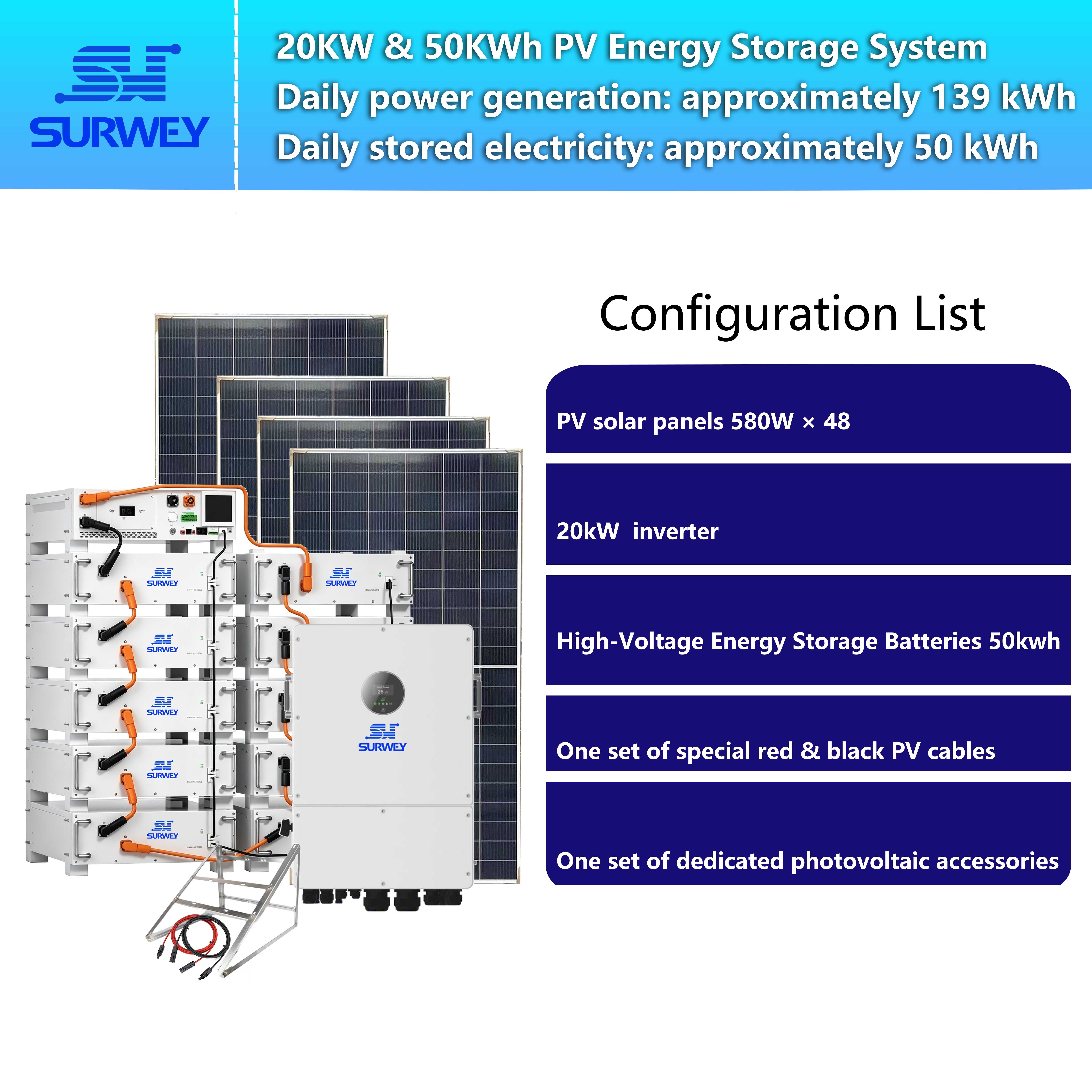
System Configuration Diagram
All hardware components of the complete system were selected to withstand the harsh operating conditions of African industrial and commercial sites: high ambient temperatures, heavy dust and severe voltage fluctuations. Full system specification: 20kW hybrid storage inverter, 50kWh high-voltage stacked lithium battery, and 48 pieces of 580W photovoltaic modules.
20kW Hybrid Storage Inverter (Core Host)

Diagram of a 20 kW Grid-Tied Inverter
Acting as the control hub of the whole system, this model is developed for off-grid / grid-tied hybrid overseas industrial and commercial scenarios. It supports a maximum string current of 20A and a maximum overall charge/discharge current of 420A. Up to 10 units can be paralleled to facilitate capacity expansion for future production growth. It delivers 200% short-time overload capability for 10 seconds and supports 100% unbalanced three-phase output, with each phase capable of carrying up to 50% of rated power. Equipped with generator access terminals and intelligent load management functions, it can work in tandem with external diesel units. Two independent MPPT solar ports are available to accommodate different photovoltaic arrays. The product holds multiple international safety certifications and is suitable for demanding outdoor installation environments.
Energy Storage Unit: 50kWh High-Voltage Stacked Lithium Iron Phosphate Battery

Image of a 50 kWh High-Voltage Stacked Lithium Iron Phosphate Battery
Compared with conventional low-voltage batteries, the high-voltage stacked design reduces DC circuit losses and heat generation, making it better suited to high-temperature operating conditions in Africa. The modular stacked structure simplifies installation and maintenance. A built-in BMS (Battery Management System) monitors the voltage and temperature of every cell in real time, with multi-layer protection against overcharging, overdischarging, overcurrent, high temperature and short circuits to ensure safe and long-duration battery operation.
Photovoltaic Array: 48 × 580W High-Efficiency PV Modules, total installed PV capacity: 27.84kW
Electrical layout design: 12 modules are connected in series to form one string, with four strings in total. Two strings are paralleled and connected to one MPPT channel, while the remaining two strings are paralleled and connected to the second MPPT channel. The two MPPT channels operate independently. If one array is affected by cloud cover or partial shading, the other array can continue power generation normally to maximise the power output of the solar panels.
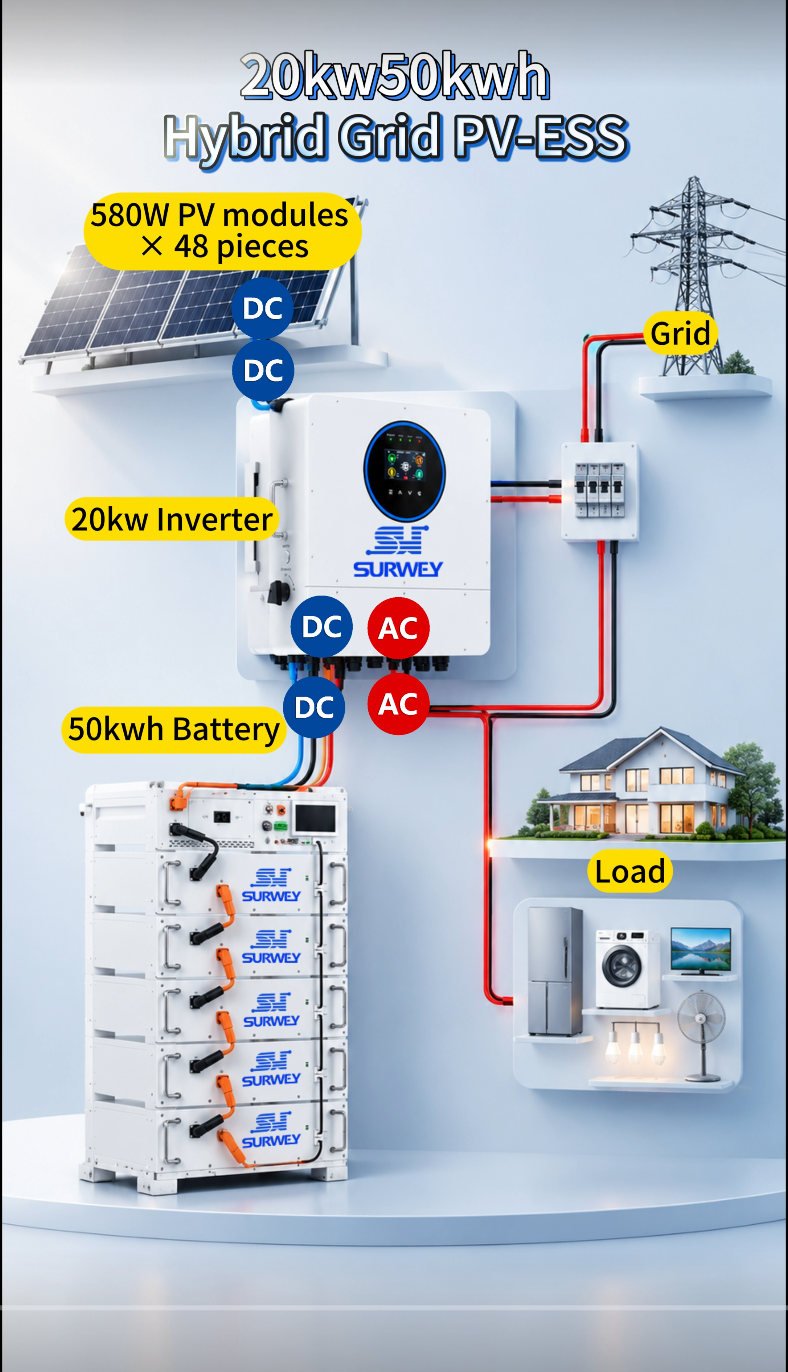
System Topology Diagram
The full configuration was rigorously calculated. The total photovoltaic power is moderately higher than the inverter rated power to maximise electricity generation using abundant local sunlight without overloading equipment. The 50kWh high-voltage battery matches the high-voltage DC port of the inverter to minimise conversion losses. All hardware components are well-matched, avoiding resource waste from either over-sized or under-sized equipment.
III. System Load Capacity: Supported Equipment Power and Power Supply Duration
A top concern for factory owners: what equipment can this system power, and how long can it sustain production during grid outages?
The inverter has a rated output power of 20kW and can withstand a 40kW overload surge for 10 seconds, perfectly coping with the inrush current generated at startup by motors and compressors. The factory’s core daily loads include food mixing and processing equipment, packaging lines, cold room refrigeration units, workshop lighting and small auxiliary electrical control devices. It can stably support simultaneous loads within 20kW.
- Scenario 1: Grid outage with available sunlight. During daytime hours with solar irradiance, photovoltaic power is generated simultaneously. The system can fully support the 20kW core loads for continuous production, unaffected by grid blackouts.
- Scenario 2: Grid outage with no sunlight (dusk / night). Power supply relies entirely on the 50kWh battery. If only critical loads of 8–10kW are maintained, including cold storage and basic lighting, the battery can operate stably for 4–6 hours. If the full set of processing equipment (15–20kW) is activated, battery power can sustain continuous production for 2–2.5 hours.
This system is not designed to run all non-essential factory equipment; instead, it prioritises powering core production loads. When battery state of charge drops to a preset low threshold, the system automatically triggers the diesel generator to start supplementary charging and prevents deep battery discharge that would shorten service life. This load design ensures uninterrupted key production while balancing battery lifespan and project cost-effectiveness.
IV. Operating Principle of the Full System
This is a hybrid solar-storage-diesel power system with grid-tied and backup power modes. It automatically switches operating modes according to grid status, solar irradiance and battery state of charge with no manual intervention required.
Video on How the System Works
- Grid available + sufficient sunlight: Solar power takes priority. Electricity generated by PV modules supplies workshop equipment directly. Any surplus power after meeting load demand charges the 50kWh lithium battery. If load consumption exceeds PV generation, the grid automatically supplements the power deficit. Once the battery is fully charged, excess solar power can be configured to remain unused or supply non-critical loads as required.
- Grid available + insufficient sunlight (cloudy days / dusk): PV output decreases, and stored battery energy is consumed first. When battery charge falls below the preset lower limit, the system switches automatically to mains grid power for factory consumption.
- Grid outage, entering off-grid backup mode: At the moment of grid disconnection, the system switches within milliseconds to supply power entirely via PV and battery. Solar power is prioritised during daytime to drive equipment while recharging the battery. After sunset, lithium batteries discharge to maintain workshop operation. When battery SOC drops to the protection threshold, the system sends an output signal to activate the factory’s existing diesel generator automatically. The generator connects to the system to charge the battery and supply factory loads simultaneously. Once battery charge returns to a high level, the system shuts down the diesel generator and reverts to solar-storage power supply.
- Load surge protection logic: The instant startup of cold room compressors and processing motors in the workshop creates large inrush current. The inverter’s 200% short-time overload capability absorbs instantaneous surges without tripping equipment. The three-phase unbalanced output function ensures stable power delivery even when a mix of single-phase and three-phase workshop equipment causes unbalanced three-phase loads.
The overall operating logic follows the principle: Solar power first, energy storage for peak shaving, grid as auxiliary, diesel for final backup, operating in a fully automatic cycle and reducing manual workload for factory staff.
V. Post-Implementation: Tangible Improvements in Production and Cost
After commissioning, the value of this solar-storage system gradually became evident. On sunny days, solar energy directly powers factory production equipment, including mixing, processing and packaging machinery, with surplus electricity stored in the battery. After sunset with no solar input, the energy storage battery discharges to maintain workshop production and cold room operation.
In the event of grid load shedding, the system switches seamlessly to solar-storage power within milliseconds. Workshop equipment no longer shuts down abruptly due to blackouts, eliminating raw material spoilage losses caused by previous power cuts. Diesel generators are only activated briefly for supplementary charging during prolonged cloudy periods with heavy battery depletion. Compared with the setup before renovation, diesel consumption has dropped sharply, and monthly expenditure on fuel and generator maintenance has been greatly reduced.
Beyond cost savings on electricity and fuel, this solar-storage system grants the food factory greater control over production. Previously, production schedules were heavily constrained by grid outages, and order planning had to accommodate unstable power supply. Unplanned blackouts disrupted production timelines and delayed deliveries. With this solar-storage system, the factory can secure its own power supply. Production scheduling no longer needs to passively adapt to grid availability, order delivery becomes more reliable, and the risk of contract breaches caused by power outages is mitigated.
VI. Pitfalls to Avoid for Overseas Projects: Solar-Storage Systems Are Not Simple Hardware Stacking
Many small and medium-sized overseas plant owners misunderstand solar-storage projects, assuming more solar panels always yield better results, while ignoring MPPT matching of inverters and compatibility between battery capacity and actual loads. Poor series-parallel design or mismatched MPPT voltage can drastically reduce power generation efficiency even with large PV arrays installed, wasting capital investment on hardware.
Take this project as an example: the configuration of 48 × 580W modules arranged into four strings (12 modules per string), two strings paralleled to each of the two MPPT channels, is not arbitrary. Calculations were performed for the open-circuit voltage of the series-connected modules to ensure voltage does not exceed the inverter’s maximum MPPT withstand voltage under local low-temperature conditions. Meanwhile, the operating voltage stays within the inverter’s optimal working range to guarantee efficient power tracking under varying irradiance. Two separate MPPT channels manage the two PV arrays to minimise generation losses from partial shading and unlock the full power potential of every solar panel.
Storage capacity is not a case of “the larger the better”. The 50kWh capacity was calculated based on the factory’s real electricity load profile. It can absorb surplus daytime solar power and support critical equipment operation at night or during blackouts, without redundant battery capacity inflating upfront investment. Hardware selection fully accounts for Zimbabwe’s high-temperature and dusty local environment. The inverter features a high protection rating for harsh outdoor installation and holds multiple international certifications compliant with local industrial and commercial power standards. Post-operation maintenance is straightforward, and local technicians can complete routine inspections after brief training.
VII. Local Outlook: The Practical Value of Renewable Energy for African Industry
Across Zimbabwe, many more small and medium-sized factories face similar challenges. The country boasts abundant solar resources and considerable annual sunshine hours, creating natural advantages for solar-storage development. Local policies are opening up the private energy sector and encouraging renewable energy adoption. A growing number of local industrial and commercial operators are recognising the benefits of integrated solar-storage solutions, moving away from total reliance on the grid and diesel generators to sustain production.
Nevertheless, overseas solar-storage projects need to be viewed objectively. Installing hardware does not deliver permanent, trouble-free operation. On-site surveys are critical for overseas deployments: real factory load curves must be measured on site to distinguish mandatory core loads from non-essential ones. Inverter power, PV module quantity and battery capacity are matched according to local solar irradiance data and ambient temperature, with a well-designed electrical series-parallel scheme.
Hardware selection must accommodate high-temperature, dusty climates and meet overseas voltage standards with comprehensive protection functions. Long-term operation and maintenance channels, spare part supply and technical training should all be planned in advance to ensure stable long-term performance of the complete system.
For numerous small and medium-sized industrial and commercial operations in Africa, integrated solar-storage solutions are no longer an unattainable concept but a practical tool to resolve production bottlenecks. The solution does not completely abandon the original grid and diesel generators; instead, it establishes a hybrid power model prioritising solar power, supported by energy storage for peak shaving, with the existing grid and diesel sets as backup. It leverages local solar resources to reduce dependence on expensive fuel and unstable grid supply, safeguards production continuity and minimises economic losses caused by blackouts.
This case study of the Zimbabwe food processing plant offers insights for us delivering solar-storage projects to small and medium industrial clients overseas. The optimal solution is not always the one with the most impressive specifications. It is the design tailored to the customer’s real production scenario, with well-matched hardware parameters, rigorous electrical engineering, balanced upfront investment and long-term performance, addressing the client’s most urgent power challenges.
Sunlight continues to fall over Zimbabwe. Today, rows of solar panels on rooftops convert plentiful sunshine into steady electricity. Inverters run smoothly, and energy storage batteries store daytime solar energy to keep food processing machinery running in workshops. In many developing regions, new energy means more than green low-carbon development. It delivers reliable power security for small and medium enterprises, freeing production from power outage disruptions and providing solid support for the real economy. More such solar-storage projects will be rolled out in the future, turning sunlight into a driving force for factory growth.


