
Technical Proposal for Low-Voltage Hybrid Solar Energy Storage System for Private Residence in Arusha, Tanzania
This proposal is designed to meet the electricity demand of a private residence in Arusha, Tanzania. It adopts a PV + energy storage hybrid power supply architecture, providing both grid backup and off-grid independent power supply capabilities, tailored to the local solar irradiance and unstable grid conditions.
The project is equipped with 4 pieces of 590W bifacial N-type PV modules, 1 set of 3.5kW hybrid inverter-charger, and 1 set of 5kWh wall-mounted low-voltage energy storage battery. The system achieves an average daily power generation of approximately 11kWh, with a daily energy storage capacity of 5kWh. The system prioritizes solar power to supply residential loads; surplus electricity is stored in the energy storage battery. When solar irradiance is insufficient, the energy storage battery supplements power. The utility grid serves as a backup power source to guarantee uninterrupted household power supply. The complete system is equipped with comprehensive protection functions, adapted to the tropical outdoor environment in Africa, and can satisfy basic household power consumption including lighting and home appliances, reducing reliance on the utility grid and cutting electricity expenses.
1. Overview of Overall System Configuration
This residential hybrid PV energy storage system consists of PV array, hybrid inverter-charger, energy storage battery, AC/DC power distribution and protection components.
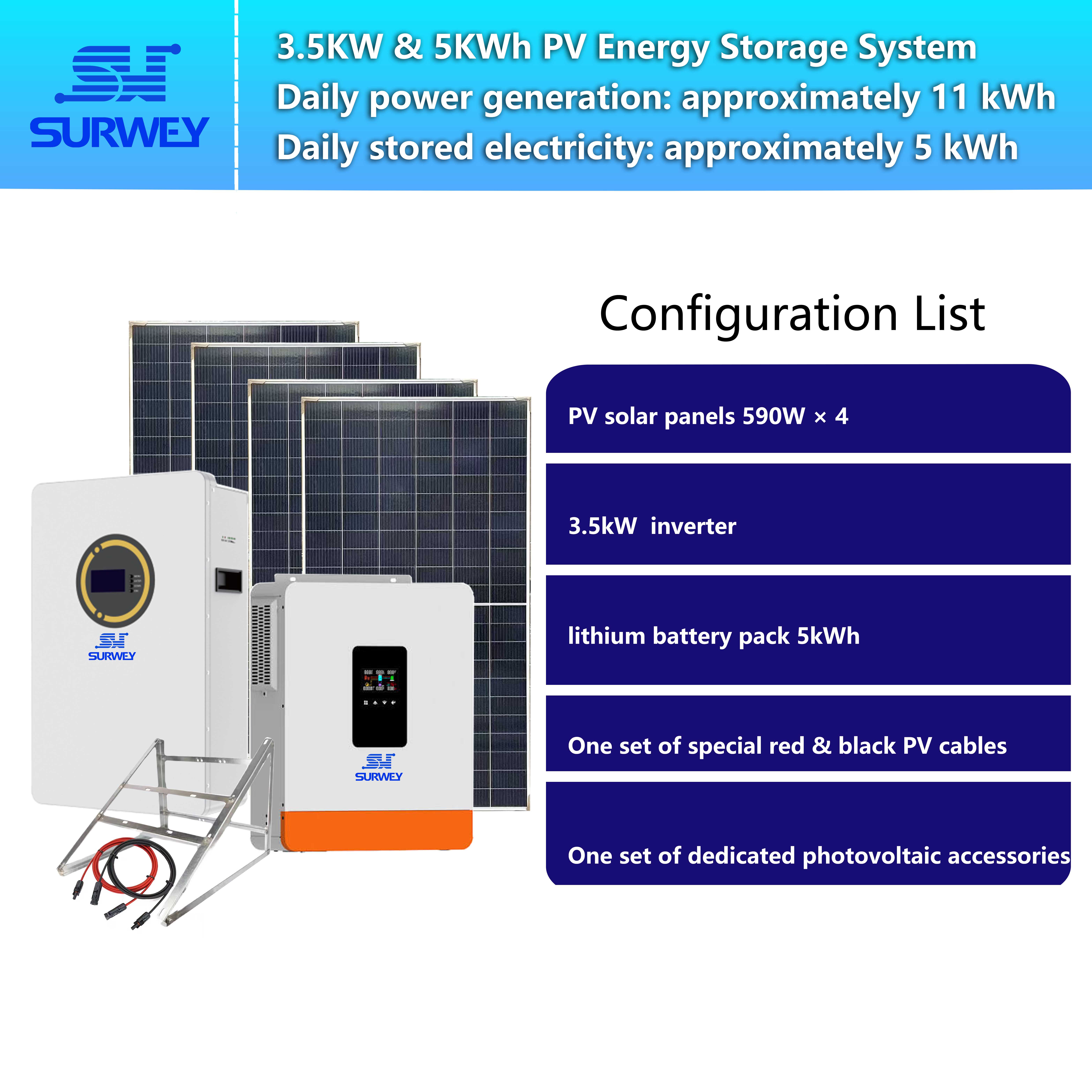 System Configuration Diagram
The PV array comprises 4 pieces of 590W bifacial N-type modules connected in series to form a single string. DC power is fed into the 3.5kW hybrid inverter-charger, which integrates MPPT charging, inversion and grid switching functions. A 5kWh wall-mounted low-voltage lithium battery is matched as the energy storage unit. The system is designed for an average daily power generation of 11kWh and a daily stored energy of 5kWh to meet basic household load requirements.
The system operates under a solar-priority logic: solar power supplies residential loads first, and excess energy charges the energy storage battery. When solar generation drops, the battery discharges to power loads. Once the battery state of charge reaches the lower limit, the system automatically switches to utility grid power for uninterrupted supply.
2. Introduction of Main Project Equipment
590W Bifacial N-type PV Module
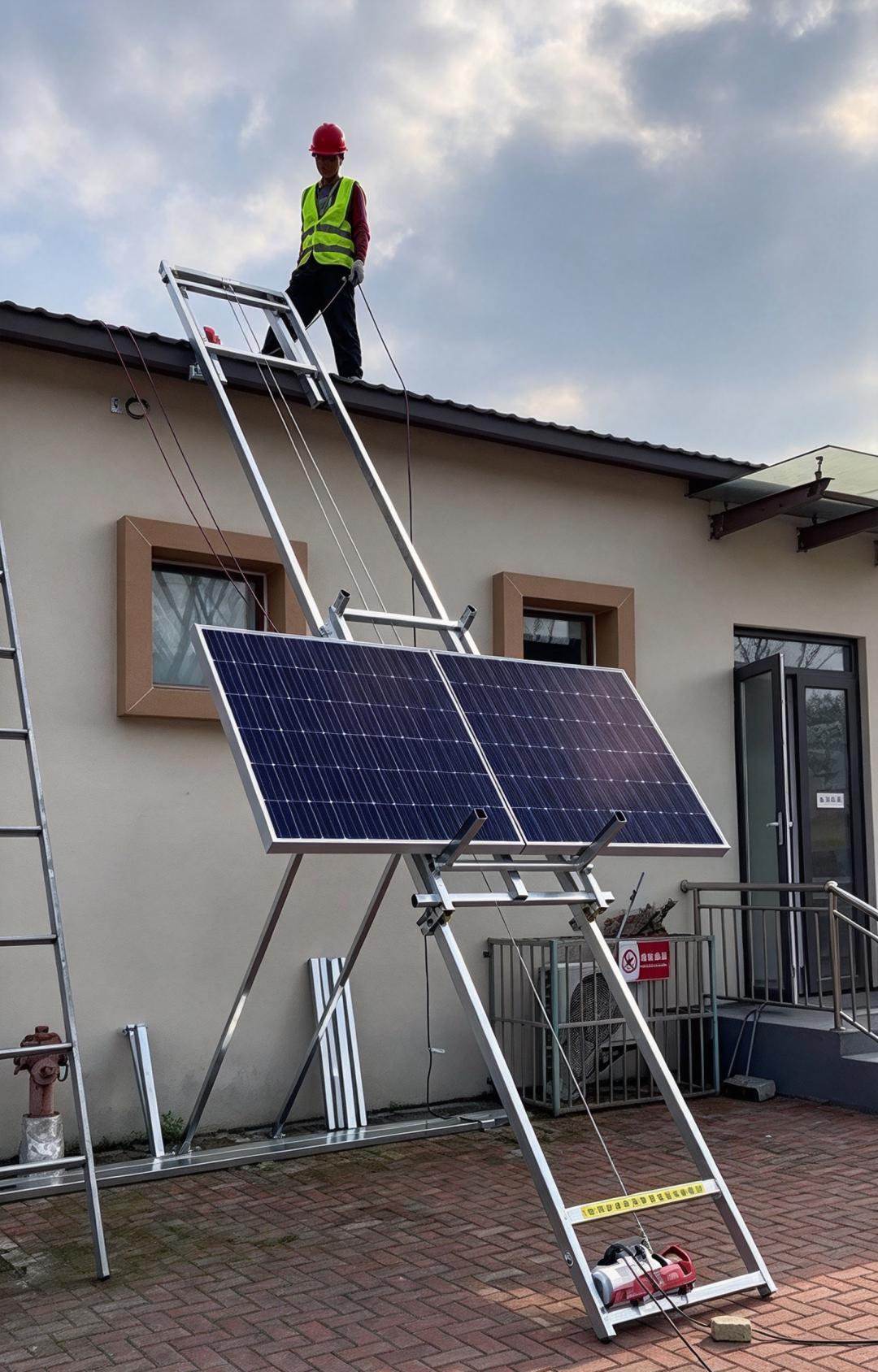
PV Module Installation Drawing
This module adopts N-type bifacial cells, with a single power rating of 590W and 132 solar cells. Cell dimension: 182×105mm. Module dimension: 2382×1134×30mm, weight: 32.5kg. The front side uses 2.0mm high-transmittance anti-reflection coated glass, delivering excellent low-light performance with a bifaciality of 80±5%. The rear side can capture ground-reflected light to boost power output.
The junction box reaches IP68 protection class, embedded with 3 bypass diodes to mitigate hot spot losses. Output cable cross-section: 4.0mm² with MC4-compatible connectors, and cable length can be customized. Under STC conditions, open-circuit voltage: 47.4V, maximum power voltage: 40.1V, short-circuit current: 15.64A, conversion efficiency: 21.84%. It features outstanding weather resistance, suitable for high-temperature outdoor environments in Arusha.
3.5kW Hybrid Inverter-Charger

This is a single-phase low-voltage hybrid inverter-charger with 220/230Vac AC output. It has a built-in MPPT solar charge controller, maximum PV input voltage of 500Vdc, pure sine wave output and power factor up to 1.0. The unit supports multi-mode operation via PV, battery and utility grid, and can run without battery under harsh working conditions. It is fitted with an RS485 communication port for remote monitoring and supports configurable charge/discharge priority strategies.
Full electrical protections including overvoltage, undervoltage, overload, short circuit and overheating are integrated, with IP21 protection class. Seamless switching between utility grid and PV energy storage is realized within 10~20ms to ensure load continuity. It supports battery activation function: the battery can start automatically once utility grid or PV power is connected, compatible with low-voltage lithium batteries.
5kWh Wall-mounted Low-voltage Energy Storage Battery

The 5kWh wall-mounted energy storage battery has a nominal voltage of 25.6V, capacity of 200Ah and rated energy of 5120Wh. Continuous charge/discharge current ranges from 0 to 150A. A built-in BMS (Battery Management System) provides overvoltage, undervoltage, overload, short-circuit and over-temperature protection. Communication interfaces including RS232, RS485 and CAN enable linkage communication with the hybrid inverter-charger.
Cycle life ≥8000 cycles, operating temperature range: -20℃ ~ 60℃, relative humidity ≤95%, maximum applicable altitude: 4000m, adapting to the large diurnal temperature difference in Arusha. Wall-mounted design saves residential space, with lightweight packaging for convenient on-site installation.
3. Electrical Verification of PV String
The PV array consists of 4 pieces of 590W modules connected in series. Open-circuit voltage Voc of one module under STC = 47.4V. Total open-circuit voltage of the 4-series string: 4 × 47.4V = 189.6V.
The maximum PV input voltage of the hybrid inverter-charger is 500Vdc, and the minimum MPPT operating voltage is 60V. The module open-circuit voltage rises slightly under low-temperature conditions in Arusha. The calculated extreme low-temperature voltage remains far below the 500V maximum DC withstand voltage of the inverter and higher than the MPPT minimum startup voltage. The string voltage falls within the inverter MPPT operating range.
Short-circuit current Isc of a single module under STC = 15.64A. The string short-circuit current remains 15.64A after series connection. The maximum PV input current of the built-in MPPT of the inverter is 15A, which falls within the allowable matching range for safe operation.
Total power of 4 modules: 2360W. Combined with the local equivalent sunshine hours in Arusha, the estimated average daily power generation is approximately 11kWh, and the energy storage battery can store up to 5kWh surplus power per day. The string voltage and current are both within the allowable operating range of the inverter, avoiding overvoltage shutdown and current overload risks. The string design is safe and compliant, capable of stably delivering DC power to the inverter.
4. System Operating Principle
This hybrid energy storage system adopts a PV-storage complementary hybrid grid architecture with automatic multi-source switching logic.
Animation Video for System Operating Principle
During daytime with sufficient solar irradiance, the 590W PV array converts solar energy into DC power and transmits it to the 3.5kW hybrid inverter-charger. The inverter prioritizes converting DC power from PV into 230V AC power to supply residential loads. When PV output power exceeds load consumption, surplus DC power charges the 5kWh energy storage battery via the built-in MPPT charge controller of the inverter, with maximum daily stored energy up to 5kWh.
At dusk, night or on cloudy days when PV output is insufficient to meet load demand, the system automatically switches operation mode. The energy storage battery releases DC power, which is inverted into AC power by the hybrid inverter-charger to supply loads. When the battery state of charge drops to the preset lower limit, the system automatically switches to utility grid power to feed loads. Subject to configuration settings, the utility grid can also charge the energy storage battery.
Built-in protection logic coordinates PV, battery and utility grid power sources automatically without manual intervention. If PV, energy storage and utility grid all fail, the system shuts down for protection to prevent equipment damage. The whole system can smoothly switch among grid-tied, off-grid and backup power modes, adapting to the unstable local grid.
5. Available Load Capacity and Continuous Power Supply Duration
5.1 Allowable Load Power
The rated output power of the inverter is 3.5kW with short-time overload capability. It can simultaneously drive AC loads with total power not exceeding 3.5kW. Suitable household loads include LED lighting, TV sets, refrigerators, fans, small water pumps and mobile phone charging. High-power loads such as electric ovens and high-power water heaters are recommended to operate in staggered time slots to avoid simultaneous startup overload.
Typical reference load power: LED lighting 100W, refrigerator 150W, TV 80W, fan 80W, small domestic water pump 300W. Total basic household load: approximately 710W.
5.2 Calculation of Energy Storage Power Supply Duration
Available battery capacity: 5kWh. Considering the comprehensive efficiency of inversion and battery charge/discharge at around 85%, usable energy ≈ 4.25kWh.
- When total load power is 710W, the fully charged battery can supply power continuously: 4.25 ÷ 0.71 ≈ 6 hours
- With only lighting + TV (total 180W), the battery can supply power continuously for about 23 hours
- At 2kW load, the battery can supply power continuously for around 2.1 hours
During daytime, PV generates power continuously to supply loads and recharge the battery, further extending the overall power supply duration. Once the battery is depleted, the system switches to utility grid automatically to maintain uninterrupted power.
6. System Auxiliaries and Safety Design
On the DC side, PV DC fuses and DC circuit breakers are configured to provide short-circuit and overload protection for the PV array. On the AC output side, AC circuit breakers and lightning protection devices are installed to resist lightning surges, adapting to thunder-prone outdoor environments in Africa. All cables are selected per the 4.0mm² specification for PV modules. AC and DC cables are routed separately with proper insulation and fixation.
Equipment installation locations are preferably well-ventilated and shielded from direct sunlight. The PV module mounting tilt angle is designed according to the latitude of Arusha to maximize solar irradiance capture and improve power generation. The battery is wall-mounted away from humid areas. BMS monitors the voltage and temperature of each cell string in real time and cuts off charge/discharge automatically upon abnormalities to ensure battery safety. The inverter is equipped with over-temperature derating protection and reduces output power automatically under high temperature to protect the equipment.
7. Summary
This low-voltage hybrid PV energy storage proposal for a private residence in Arusha, Tanzania adopts 4 pieces of 590W PV modules, a 3.5kW hybrid inverter-charger matched with a 5kWh energy storage battery. The electrical parameters of the system are reasonably matched, and the string voltage and current are within the inverter operating range. Equipment selection adapts to local climatic conditions.
The system achieves an average daily power generation of 11kWh and can store 5kWh surplus energy. It meets basic household power demand and provides several hours of uninterrupted power supply via energy storage during utility grid outages. Featuring simple structure, low maintenance requirement and high reliability, the system effectively reduces dependence on the utility grid and cuts power cost. Balancing economy and practicality, this solution addresses blackout issues caused by unstable local grid, supplies stable clean renewable energy for residences and delivers favorable application value.


