
Technical Proposal for 5kW Residential PV Energy Storage System in Uzbekistan
Technical Proposal for 5kW Residential PV Energy Storage Power Supply System in Uzbekistan
Preface
Uzbekistan boasts abundant solar irradiance resources with sufficient annual equivalent sunshine hours. However, power grid stability is insufficient in some remote areas, featuring voltage fluctuations and short-term power outages that disrupt residents’ daily electricity consumption.
This residential PV energy storage system leverages local high-quality solar energy resources and adopts an integrated PV-storage solution consisting of photovoltaic modules and an all-in-one energy storage unit to realize on-site collection, storage and on-demand supply of solar power. When the utility grid is normal, the system operates under self-consumption mode to reduce grid power usage. In case of grid faults, it automatically switches to off-grid mode to guarantee continuous power supply for critical loads.
The whole system balances safety, economy and practicality, and adapts to the installation conditions of local residential buildings. It can meet household power demands such as lighting and home appliances, help users cut electricity costs and improve power supply reliability, providing a deployable solution for distributed residential new energy applications in the region.
1. Overview of Overall System Configuration
The total installed capacity of the residential PV-storage system for this project is 3.48kW, composed of 6 pieces of 580W monocrystalline silicon PV modules and 1 set of 5kW/10kWh stackable all-in-one energy storage unit.
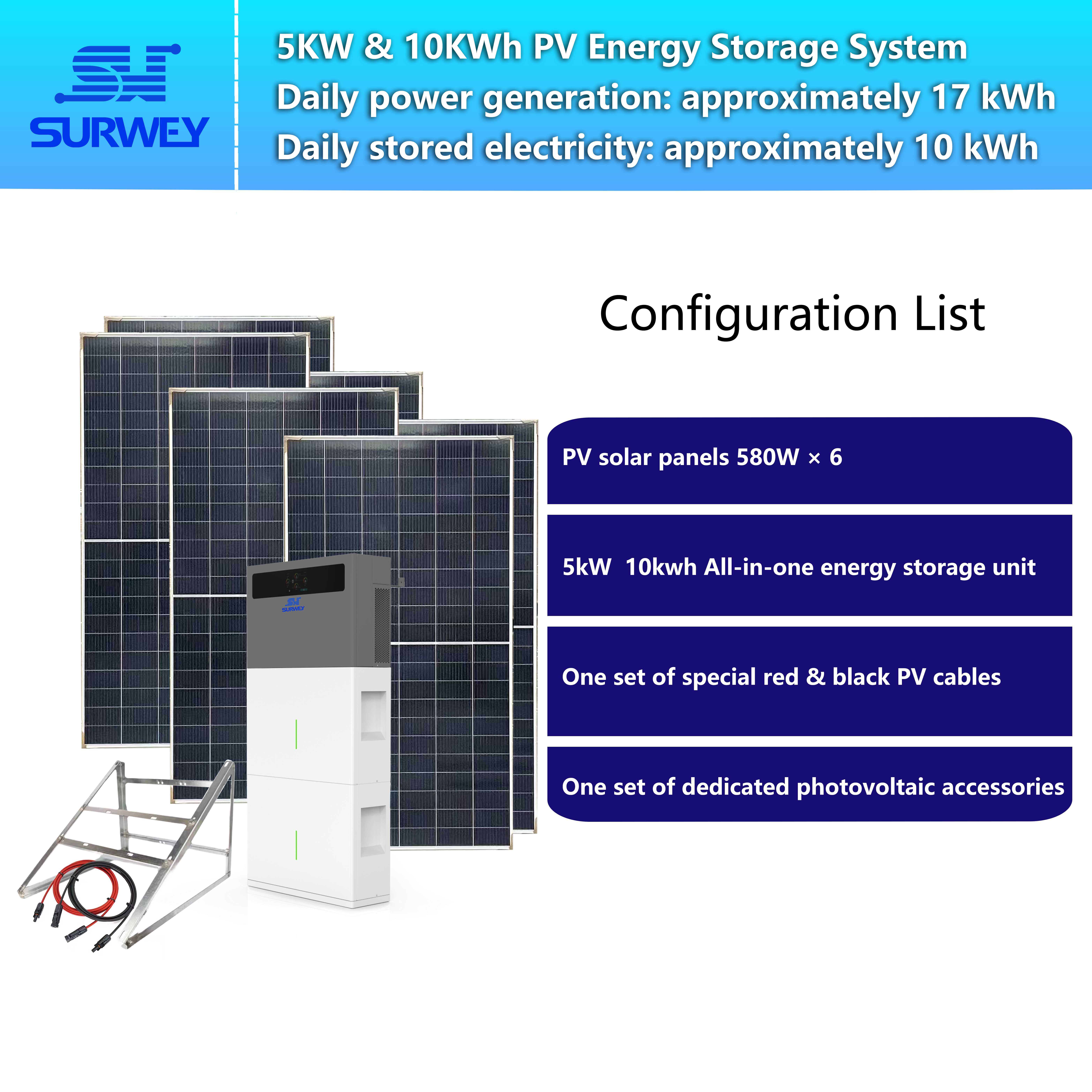 System Configuration Diagram
The PV array converts solar energy into direct current and transmits it to the built-in MPPT module of the energy storage all-in-one unit. After power conversion, part of the electric energy is directly supplied to household loads, and surplus power is stored in the energy storage battery. During nighttime or low-irradiance periods, the energy storage battery discharges to power the loads. The system supports dual-mode operation of grid-tied and off-grid, enabling multi-source coordinated switching among utility power, PV generation and energy storage. The daily power generation of the complete system reaches 17.4kWh, and the effective stored energy of the energy storage system is 10kWh, satisfying both daily self-consumption and emergency backup power demands for household scenarios in Uzbekistan.
2. Introduction of Main Equipment Parameters
2.1 580W Monocrystalline Silicon PV Module

Roof PV Panel Installation Drawing
The module adopts a design of 144 half-cut monocrystalline silicon cells with a conversion efficiency of 22.50%.
Under standard test conditions, the maximum power is 580W, operating voltage 42.65V, operating current 13.60A, open-circuit voltage 51.46V, short-circuit current 14.38A, and the maximum system voltage reaches 1500VDC. The module dimension is 2279mm×1134mm×30mm with a weight of 32kg. Its surface uses 2mm high-transmittance coated tempered glass, paired with anodized aluminum alloy frame. The junction box achieves IP68 protection rating. It delivers excellent sand resistance and wide temperature tolerance, with an operating temperature range of -40℃ ~ +85℃, adapting to the outdoor environment of Uzbekistan characterized by large diurnal temperature differences and heavy dust. The output cable of the module is 4.0mm², and cable length can be customized as required to ensure stable power generation in long-term outdoor operation.
2.2 5kW/10kWh Stackable All-in-One Energy Storage Unit

This stackable PV-storage unit with IP65 protection class integrates lithium iron phosphate battery packs. The battery has a nominal voltage of 51.2V and a capacity of 10kWh. The rated output power of the equipment is 5kW, and peak output power reaches 12kW, supporting 230V single-phase AC output at 50Hz frequency.
The device is equipped with 2 built-in MPPT PV input channels. The MPPT operating voltage range is 120~450VDC, and the maximum PV input power is 4500W per channel, meeting the access requirements of the PV array. It comes with input interfaces for utility power and generator complementary power supply, enabling automatic switch to off-grid power supply upon utility grid blackout. The battery achieves a cycle life of over 8000 times, with functions including electrical isolation, short-circuit protection, over-charge and over-discharge protection. The whole unit adopts a combined heat dissipation solution of heat sink and air cooling, with operating ambient temperature ranging from -20℃ to 60℃, adaptable to outdoor installation environments in Central Asia. Remote monitoring and parameter adjustment are supported for convenient operation and maintenance.
3. PV String Electrical Verification & Power Generation Calculation
The system adopts 6 pieces of 580W PV modules for string design, and the string matching is verified against the MPPT voltage range (120~450VDC) of the energy storage all-in-one unit.
The open-circuit voltage of a single module is 51.46V and operating voltage 42.65V. The 6 modules are divided into 2 strings, with 3 modules connected in series per string. Open-circuit voltage of one string at ambient temperature: 51.46V × 3 = 154.38V Operating voltage of one string: 42.65V × 3 = 127.95V
PV module open-circuit voltage rises under low-temperature conditions. Even at the local minimum temperature in winter, the open-circuit voltage of each string remains below the upper limit of 450VDC and higher than the minimum MPPT startup voltage of 120V. The string operating current equals the module operating current of 13.60A, and the string short-circuit current is 14.38A, which falls within the allowable maximum input current range of the inverter MPPT.
The voltage and current of the entire string stay within the MPPT operating range of the energy storage all-in-one unit, avoiding equipment damage caused by excessive voltage or MPPT tracking failure due to insufficient voltage. The string design is safe and reasonable.
Power Generation Calculation
The total PV power of the system is 3.48kW. Combined with the equivalent sunshine hours at the project site, the daily power generation can reach 17.4kWh. Solar power generated during daytime is preferentially supplied to household loads, and surplus power charges the built-in energy storage battery with a maximum storable capacity of 10kWh. In high-irradiance daytime periods, PV output can simultaneously satisfy household power consumption and battery charging. At dusk and nighttime without sunlight, the energy storage battery discharges to continuously power loads. When daily PV generation exceeds household daytime consumption, the surplus power after full battery charge can be handled in accordance with system settings. If the irradiance is weak and power generation is insufficient, the system will automatically draw supplementary power from the utility grid to ensure uninterrupted power supply.
4. System Operating Principle
The complete residential PV-storage system operates in grid-tied and off-grid modes, and multi-power automatic dispatching is realized by the internal control unit of the energy storage all-in-one unit.
Schematic Video of Current Flow for System Operating Principle
Grid-tied Mode: When the utility grid operates normally, PV modules generate direct current under solar irradiance and feed it into the MPPT circuit of the energy storage all-in-one unit for DC voltage regulation. Electric energy is preferentially supplied to household AC loads. When PV output exceeds load consumption, surplus DC power charges the built-in lithium iron phosphate battery. Once the battery is fully charged, charging can be restricted according to strategies. If PV output is insufficient and load consumption exceeds PV generation, the system automatically draws power from the utility grid to cover the power gap.
Off-grid Emergency Mode: Upon grid faults and power outages, the system rapidly detects grid anomalies and switches to off-grid operation within milliseconds, disconnecting from the utility grid. The energy storage battery inverts DC power into 230V AC power to continuously supply critical loads. At this time, the PV array can still generate power to directly feed loads and replenish battery capacity. After utility power restoration, the system automatically detects grid parameters and smoothly switches back to grid-tied mode without manual operation. The system reserves a generator access interface. In scenarios of prolonged rainy weather and depleted battery SOC, an external diesel generator can be used as backup power. The built-in communication module enables remote status viewing via wireless network, real-time monitoring of PV generation, battery SOC, load power consumption and other data for users to track system operating conditions. The equipment integrates multi-level electrical protection including overvoltage, overcurrent, short-circuit, leakage current, battery over-charge and over-discharge protection to guarantee safe operation of the whole system.
5. Available Load Power & Continuous Power Supply Duration of the System
The rated output power of the energy storage all-in-one unit is 5kW, and the short-term peak power can reach 12kW, capable of driving most conventional household electrical appliances.
Conventional Load List: LED lighting, TV, router, refrigerator, washing machine, small kitchen appliances, etc. Maximum rated continuous load: 5kW (long-term operation beyond this power is prohibited). Short-term maximum withstandable surge load: 12kW (for motor startup).
The usable capacity of the energy storage battery is 10kWh. When fully charged, the continuous power supply duration under different loads is as follows:
- Total load power 1kW (lighting + TV + router + refrigerator): approx. 10 hours of continuous power supply
- Total load power 2kW (adding small kitchen appliances): approx. 5 hours of continuous power supply
- Total load power 3kW: approx. 3.3 hours of continuous power supply
- Total load power 5kW: approx. 2 hours of continuous power supply
Note: The actual power supply duration is affected by ambient temperature, battery aging and power fluctuation of electrical appliances. The values are theoretical references. When operating off-grid, it is recommended to prioritize basic domestic power consumption and avoid simultaneous startup of high-power loads to extend emergency power supply time.
6. Conclusion
This residential PV energy storage system for Uzbekistan makes full use of local solar energy resources, adopting a 3.48kW PV array matched with a 5kW/10kWh all-in-one PV-storage unit. Electrical verification confirms that the voltage and current of the PV string match the MPPT operating range of the equipment, and the electrical design is safe and reliable. The system achieves daily power generation of 17.4kWh and 10kWh storable energy, realizing coordinated operation of PV and energy storage for both daily power saving and emergency backup power against blackouts.
The system is equipped with comprehensive electrical protection. The equipment’s temperature resistance, dustproof and waterproof performance adapt to local climatic conditions. It features high automation level with automatic mode switching without manual intervention and simple operation & maintenance.
This solution can effectively reduce household grid power consumption and improve power supply stability to solve short-term utility power outages. With mature technology, properly selected equipment and flexible installation, the complete solution is suitable for promotion in local residential scenarios. The system supports stacking expansion of energy storage capacity according to users’ future power demand, featuring good expandability. It serves as a reliable power supply solution for residential distributed new energy in Central Asia.


