
PV-ESS Microgrid Solution for Private Villa in Central Africa, Compatible with Off-grid / Grid-tied Operation | Stable Power Supply & On-site Solar Consumption
Preface
Parts of Africa suffer from weak grid infrastructure, severe voltage fluctuation and frequent power outages, which greatly disrupt daily residential power consumption for villas. This customized residential PV-ESS microgrid system is designed for a private villa in Central Africa. It meets daily load demand and backup power needs, enables self-consumption of solar energy and reduces reliance on the unstable local public grid.
 Roof PV Module Installation Diagram
The system harvests solar energy via PV modules and stores surplus power in storage batteries. A 12kW hybrid inverter manages energy dispatch. It can connect to mains supply or run independently in off-grid mode. The solution is tailored to local solar irradiance and villa load characteristics. String electrical matching verification is performed to ensure all electrical parameters stay within the allowable operating range of equipment. It guarantees long-term safe and stable operation to continuously power villa lighting, air conditioners, home appliances and build a highly reliable clean energy residential power supply system.
1 Overview of Overall System Configuration
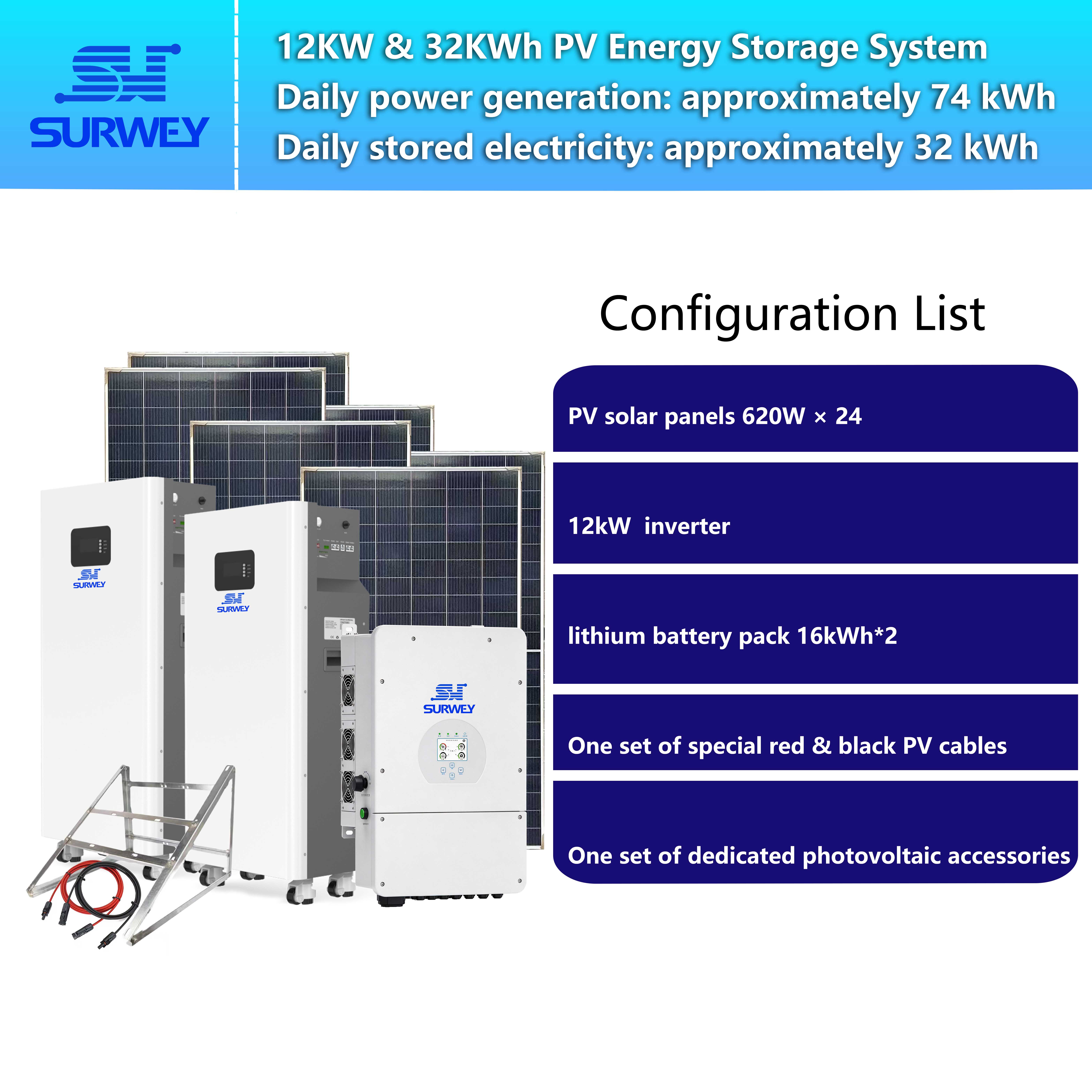
The PV side adopts 24 pieces of 620W N-type monocrystalline PV modules. The energy storage side uses 2 sets of 16kWh mobile floor-standing LiFePO4 batteries, with a total storage capacity of 32kWh and rated battery voltage of 51.2V. The wheeled mobile design facilitates relocation. The core control device is a 12kW single-phase hybrid inverter. The whole system also includes AC/DC protective switches, dedicated PV cables and a monitoring unit.
The system generates 74kWh daily with up to 32kWh of daily energy storage. Multi-source coordinated power supply from PV, battery and mains is supported. PV supplies villa loads first, and surplus power is stored in batteries. Batteries discharge for power supply at night or on cloudy days. In case of grid failure, the system seamlessly switches to off-grid mode to guarantee villa power supply.
2 Main Product Introduction
620W N-type Monocrystalline PV Module
Adopting N-type monocrystalline cells, the module achieves a maximum conversion efficiency of 23.3% and excellent low-light performance. It features strong PID resistance and can withstand 5400Pa front mechanical load, adapting to high-temperature and strong-wind outdoor environments in Africa. Under STC, its open-circuit voltage is 49.34V and MPP voltage is 41.82V. It steadily outputs 620W with a favorable temperature coefficient for less power degradation at high temperatures and a 25-year outdoor service life.
12kW Single-phase Hybrid Inverter

This 12kW single-phase hybrid inverter integrates multi-channel MPPT solar tracking, with a maximum PV input power of 19200W. It supports multi-source input from PV, battery and mains. It is IP65 rated, equipped with a color touch LCD screen and programmable 6-stage battery charge/discharge time settings. It supports AC-coupling retrofitting and parallel connection of up to 16 units, and can be paired with diesel generators for supplementary charging. Its maximum charge/discharge current reaches 250A. Built-in comprehensive protections include anti-islanding protection, arc fault protection, overvoltage, overcurrent and overheating protection. It operates stably in a wide temperature range of -40℃ ~ +60℃.
32kWh Mobile LiFePO4 Battery (2 × 16kWh)

Each battery unit has a capacity of 16kWh, rated voltage of 51.2V and 314Ah LiFePO4 cells. Two units are paralleled to form a 32kWh energy storage system. It supports 90% depth of discharge with a cycle life up to 8000 cycles @90% DOD for long service life. The cabinet is fitted with moving wheels and floor brackets for easy installation and transportation. The built-in BMS monitors cell voltage and temperature in real time and provides cell balancing plus overcharge/over-discharge protection. Communication ports including RS232, RS485 and CAN enable real-time communication with the inverter for precise charge and discharge control, with IP21 protection rating.
3 PV String Electrical Parameter Verification
The PV array consists of 24 × 620W modules arranged into 3 strings, with 8 modules connected in series per string. STC parameters per module: Voc=49.34V, Vmp=41.82V. 8 modules in series: String open-circuit voltage: 8 × 49.34V = 394.72V String MPP voltage: 8 × 41.82V = 334.56V Inverter MPPT operating voltage range: 150V~425V, PV startup voltage:125V.
The maximum string open-circuit voltage 394.72V is lower than the upper MPPT limit of 425V. The string MPP voltage 334.56V falls within the 150~425V MPPT tracking window and exceeds the inverter startup voltage, which qualifies the electrical matching. Even under low-temperature conditions in Central Africa, the slight rise of module open-circuit voltage will not exceed the maximum allowable DC input voltage of the inverter and will not trigger DC overvoltage protection.
Isc of each single module is 16.27A, so each string short-circuit current is 16.27A. The maximum input short-circuit current of each MPPT channel on the inverter can bear the load. The 3 strings are independently connected to 3 separate MPPT channels of the inverter for independent maximum power tracking, reducing generation loss caused by shading and module inconsistency. The theoretical daily generation is 74kWh, and the battery can store up to 32kWh per day. Surplus daytime solar power is stored in batteries for villa loads at night.
4 System Operating Principle
This villa PV-ESS microgrid is a multi-source complementary power supply system, composed of PV array, storage batteries, 12kW hybrid inverter, villa AC loads and optional mains input.
Animation Video of System Operating Principle
- Sufficient sunlight in daytime: PV modules generate DC power and feed it to the MPPT port of the inverter. The inverter firstly converts DC power into AC power to supply villa loads. When PV power exceeds real-time villa consumption, excess power automatically charges the 32kWh battery until the battery reaches the set upper SOC limit.
- Cloudy / evening with insufficient sunlight: PV output drops and cannot support villa loads. The storage battery discharges automatically. DC power flows into the inverter and is inverted to AC power to continuously feed loads.
- Mains available: The system runs in grid-tied mode. PV and battery power are prioritized for self-consumption. When battery energy is depleted, the system automatically switches to mains for supplementary power.
- Mains outage: The system automatically detects grid anomalies and rapidly switches to independent off-grid mode, disconnecting from the grid. PV and battery jointly supply power to critical villa loads to achieve uninterrupted power supply.
Battery protection logic: BMS monitors battery status in real time. When SOC drops to the lower limit, discharge is stopped to prevent irreversible battery damage. The inverter has multiple built-in protections. It can shut down quickly upon DC-side or AC-side faults to ensure safe and stable operation of the whole system.
5 Supported Load Power & Continuous Power Supply Duration
The inverter rated output power is 12kW, with short-time peak power up to twice the rated value, capable of handling 24kW surge loads for a short period. It can simultaneously power air conditioners, refrigerators, lighting, water pumps, kitchen appliances and various other household loads in the villa. Total battery capacity: 32kWh. With the maximum allowable DOD of 90%, usable capacity = 32kWh × 0.9 = 28.8kWh.
Scenario 1: Basic villa loads, average power 3kW (lighting, fridge, fan and other essential appliances) Theoretical backup duration = 28.8 ÷ 3 = 9.6 hours, covering basic night-time power consumption of the whole villa.
Scenario 2: Medium loads, average power 6kW (basic loads + 1 air conditioner) Theoretical backup duration = 28.8 ÷ 6 = 4.8 hours.
Scenario 3: Full-load operation, 12kW full power output, only for short-time operation, duration approx. 2.4 hours.
When sunlight is available in daytime, continuous PV generation replenishes battery energy and greatly extends backup time. Under good solar irradiance, the system supplies loads and recharges batteries simultaneously during the day, with energy stored in batteries for night use. In case of consecutive cloudy days when batteries are exhausted, mains can be connected as backup power.
Conclusion
For this residential PV-ESS microgrid system of private villa in Central Africa, electrical parameter verification confirms that PV string voltage and current are fully within the MPPT operating range of the 12kW hybrid inverter, featuring safe and rational electrical design. The system delivers 74kWh daily generation and up to 32kWh daily stored energy. Solar self-consumption plus peak-shaving backup storage effectively solves local pain points of unstable grid and frequent blackouts.
Equipment selection is adapted to the hot outdoor climate in Africa. PV modules feature strong weather resistance, storage batteries have long cycle life and the inverter has high protection grade. Supporting both grid-tied and off-grid modes with intelligent energy scheduling, the system meets the full household load demand of the villa. Equipped with multiple electrical protections, it operates safely and reliably with simple maintenance. It can steadily supply clean renewable power to the villa for a long time, cutting electricity costs and improving power supply reliability for residence.


