
Technical Solution of Integrated PV Energy Storage System for Residential Houses in Poland
Preface
Residential electricity prices in Poland have kept rising in recent years, accompanied by occasional short-term grid outages in some regions. Residential PV energy storage systems have become a practical solution for households to cut power bills and improve power supply reliability. Targeting single-family houses in Poland and considering local solar irradiance and the 230V/50Hz mains standard, this solution designs an integrated PV plus energy storage system. It aims to boost the self-consumption rate of PV power and provide emergency power supply during grid blackouts.
The system is designed to generate 17 kWh of PV power daily and store up to 8 kWh into the energy storage system, satisfying both daily household load consumption and backup emergency requirements. The solution fully takes the impact of low winter temperatures in Poland on PV modules and storage batteries into account. Safety margins are reserved in string selection, equipment parameter verification and load matching to guarantee long-term stable operation. This document serves only as a technical design reference. On-site installation and safety verification shall be implemented in compliance with local electrical codes.
1 Overview of Overall System Configuration
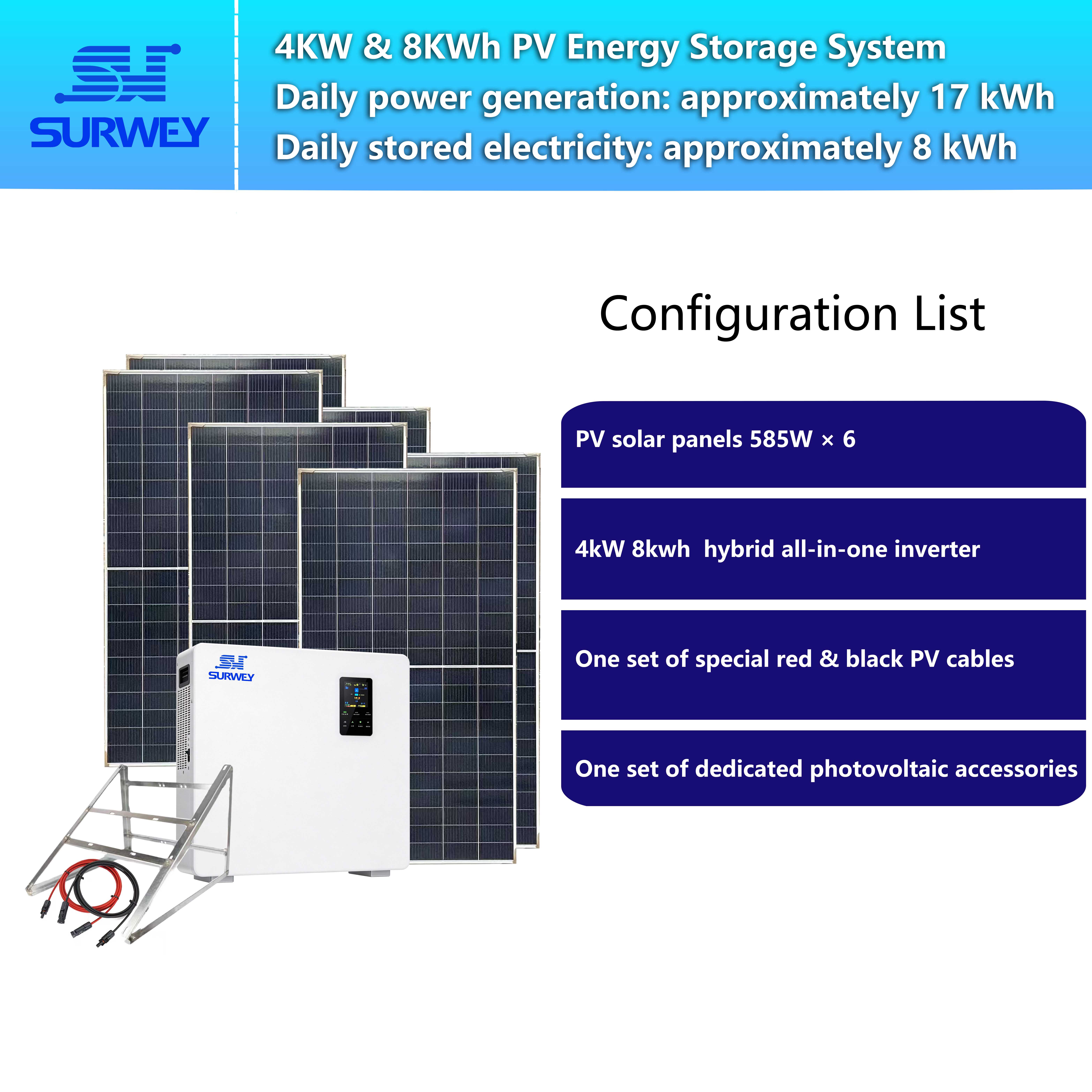
This residential PV-ESS is designed for single-family houses in Poland. It consists of six 585W PV modules, one 4kW 8kWh hybrid inverter/controller, PV mounting brackets, AC & DC cables and power distribution protection devices. The total installed PV power is 3510Wp. The system is designed for 17 kWh daily power generation and maximum daily energy storage of 8 kWh. The hybrid inverter supports a maximum PV DC input of 500 VDC, dual AC input from mains and generator, and features fast UPS transfer function.
Operating logic: PV supplies household loads first, and surplus power is stored in the battery. When PV output is insufficient, stored battery power is prioritized. Once battery energy is depleted, the system automatically switches to mains supply. In case of grid failure, it switches to off-grid mode to deliver emergency power for critical household loads. Fully compatible with the European 230V/50Hz single-phase standard, it covers both daily self-consumption and blackout emergency scenarios.
2 Main Equipment Parameters
Core equipment includes 585W PV modules and the 4kW 8kWh hybrid inverter/controller. The PV array is composed of six 585W modules. The hybrid inverter integrates MPPT solar charging, inverter output, LiFePO4 battery BMS and mains transfer functions. No separate solar controller or standalone battery cabinet is required. Its high integration simplifies on-site installation and suits rooftop mounting for residential buildings.
585W PV Module
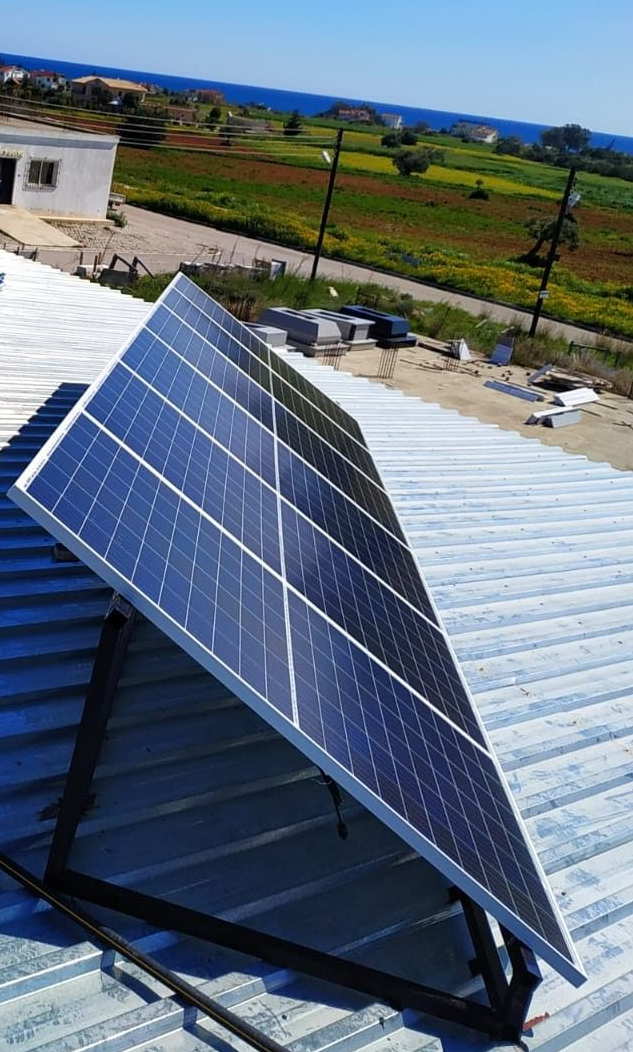
Each module has a rated power of 585W with corresponding open-circuit voltage, operating voltage, short-circuit current and operating current. Adopting monocrystalline solar cells, it delivers high conversion efficiency and stable output under low temperatures. The module features excellent snow and wind resistance, adapting to cold and snowy winters in Poland.
Six modules form the PV array with a total capacity of 3510Wp. Proper series connection ensures string voltage and current fall within the MPPT operating window of the hybrid inverter, enabling reliable PV harvesting across all seasons. Modules are mounted on the south-facing roof with brackets at a fixed tilt angle to maximize utilization of local solar resources.
4kW 8kWh All-in-One Energy Storage Unit
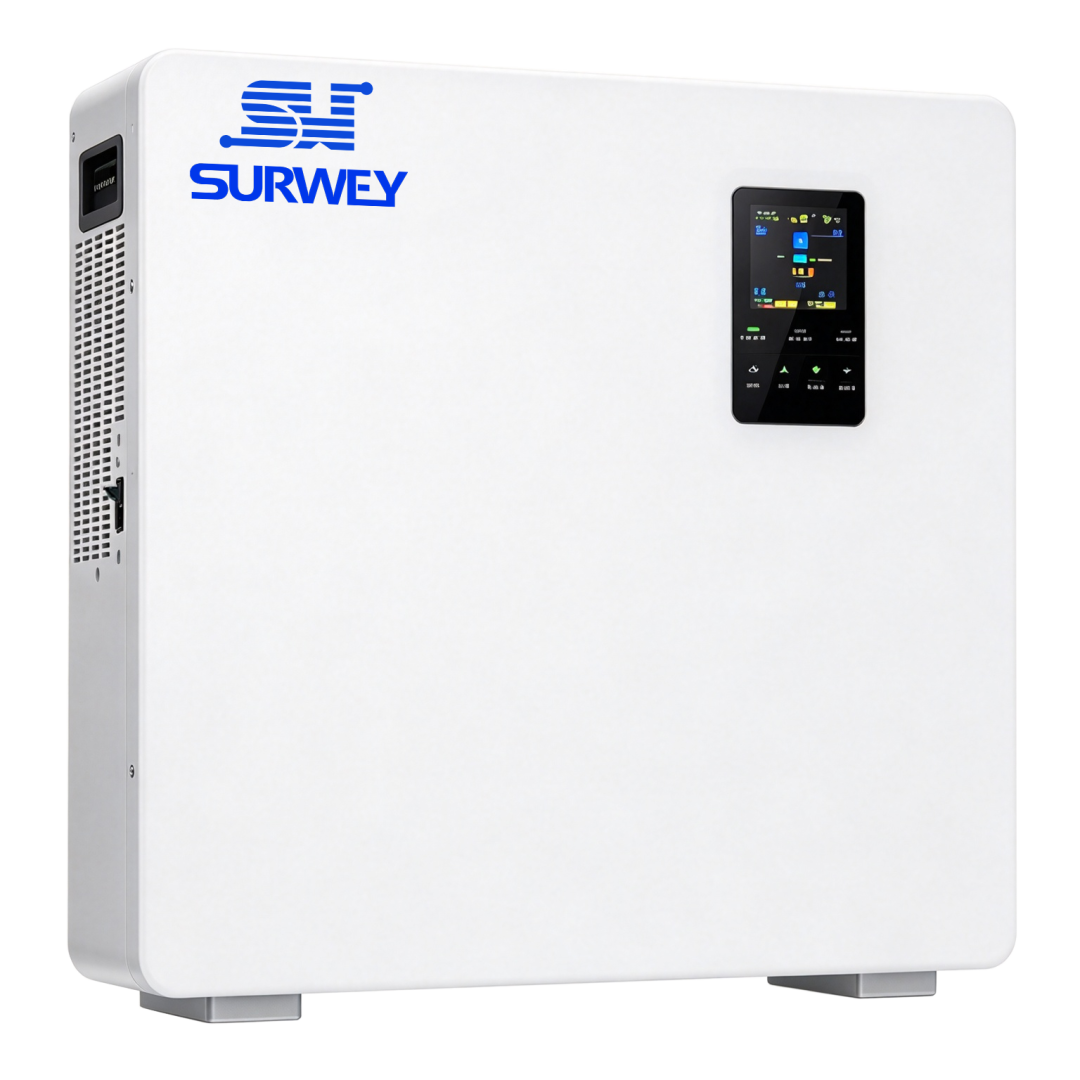
This 4kW 8kWh hybrid energy storage inverter delivers a rated continuous AC output of 4kW, with an integrated 8kWh LiFePO4 battery and complete BMS. It provides protections against overcharge, overdischarge, overcurrent, high and low temperatures.
Maximum PV DC input voltage reaches 500 VDC. Dual AC input from mains and generator is supported. Millisecond-level switching upon grid failure enables it to work as household UPS. It outputs 230V/50Hz single-phase AC matching Polish residential power standards. Integrated with MPPT charging, bidirectional inverter and battery storage, the compact design reduces wiring points and failure risks. It supports off-grid backup operation and does not allow feed-in to the public grid.
3 PV String Voltage & Current Verification
The PV array uses six 585W modules connected in series as one single string feeding the hybrid inverter, whose maximum PV DC input voltage is 500 VDC. PV module open-circuit voltage rises as temperature drops. In Poland, winter outdoor temperature can reach -15°C, which greatly increases Voc and constitutes the main risk of overvoltage. In hot summer conditions, module operating voltage decreases. It must stay above the minimum MPPT startup voltage to keep the inverter working normally. For this single string, total voltage equals the sum of individual module voltages, and string current equals the current of one single module.
Typical parameters of the 585W monocrystalline module under STC: Open-circuit voltage Voc≈41.2V, MPP voltage Vmpp≈33.4V, short-circuit current Isc≈18.2A, MPP current Impp≈17.5A.
After six modules are connected in series, the string open-circuit voltage under STC is 247.2V. The inverter MPPT operating range is 120~450 VDC. After temperature correction for -15°C, the maximum cold Voc remains far below the 500 VDC limit, with sufficient safety margin to avoid DC overvoltage protection. In hot summer, the string MPP voltage stays above the minimum MPPT threshold for normal startup. The string short-circuit current equals that of one module with no parallel superposition, so DC input current stays within the inverter’s allowable range without overcurrent hazards.
Full-condition verification confirms that the single string of six modules works reliably both in extreme cold winter and hot summer. String open-circuit voltage, operating voltage and current are all within the inverter’s operating range, preventing overvoltage damage, overcurrent faults or generation shutdown caused by low high-temperature voltage. Matched with local solar resources, the array is designed for 17 kWh daily generation. After household loads consume part of the daytime PV power, surplus energy charges the storage battery to hit the target of 8 kWh daily stored energy.
4 System Operating Principle
This is a mains-tied hybrid PV backup system with four typical automatic operating modes managed by the 4kW 8kWh hybrid inverter without manual intervention.
Animation Video of System Operating Principle
- Sufficient sunlight & healthy grid: PV modules convert sunlight into DC power for the inverter. Part of the DC power is inverted to 230V AC to supply household appliances instantly. Excess DC power charges the 8kWh battery via the built-in MPPT until fully charged, achieving up to 8 kWh stored daily.
- Insufficient sunlight (evening, night, cloudy days) & healthy grid: PV output is low or zero. The system draws stored battery energy first and inverts DC to AC for household loads. When battery state hits the protection threshold, the system automatically switches to mains supply.
- Grid outage, off-grid emergency mode: Day or night, upon grid loss detection, the unit quickly switches to UPS off-grid mode. PV and battery jointly power critical household loads. With sunlight available, PV supplies loads and recharges the battery. Without sunlight, the 8kWh battery provides AC output below 4kW to sustain essential appliances.
- Low battery state and insufficient sunlight: When battery reaches the low cutoff and PV output cannot support loads, a generator can be connected as backup power to guarantee continuous supply.
The system prioritizes solar energy. Storage absorbs surplus daytime PV power and shifts solar energy to evening peak consumption, raising PV self-consumption rate while retaining blackout emergency capability.
5 Supported Appliance Power & Backup Duration
The inverter provides rated continuous output of 4kW and peak surge capacity around 6kW, suitable for common household appliances in Poland. Total continuous load power shall not exceed 4kW. Motor loads such as refrigerators and water pumps have high inrush starting current, so power margin must be reserved to avoid overload shutdown.
5.1 Applicable Household Appliances
✅ Continuous use (total load ≤4kW): Lighting, routers, TVs, fans, refrigerators, washing machines, rice cookers, electric kettles, 1HP air conditioners and other regular domestic devices.
❌ Not recommended: 2HP+ air conditioners, high-power ovens, instant electric water heaters and other single appliances over 3kW. Simultaneous activation of multiple high-power devices will easily trigger overload protection.
The usable battery capacity is reduced by BMS discharge limits. The 8kWh battery delivers roughly 6.4‑6.8 kWh usable energy, with additional inverter losses. The table below shows reference backup durations under real operating conditions:
表格
| Total Load Power | Practical Backup Duration | Typical Load Combination |
|---|---|---|
| 200W | 32‑34h | Lighting + Router + TV |
| 500W | 12.5‑13.5h | Refrigerator + Fan + Lighting |
| 1000W | 6.4‑6.8h | Rice cooker operation |
| 2000W | 3.2‑3.4h | Electric kettle and similar high-power devices |
| 3000W | 2.1‑2.3h | Multiple high-power appliances running together |
| 4000W | 1.6‑1.7h | Full-limit rated output |
Note: Durations above refer to battery-only discharge with zero PV input. With daytime PV generation, the system charges while supplying loads, so actual runtime will be much longer. Low winter temperatures reduce available battery capacity, shortening backup time by 10‑20%.
6 System Design Considerations
6.1 Installation Environment & Climate Adaptation
The project site is Poland with cold winters that affect PV module and battery performance. The all-in-one energy storage unit should be installed indoors or in an insulated utility room instead of outdoors to mitigate battery capacity degradation. PV mounting structure must consider snow sliding and meet local wind and snow load standards.
6.2 Electrical Safety
The DC side operates at high voltage. Installation must comply with local European electrical codes. DC fuses are fitted on PV circuits, while AC breakers and residual current protection are deployed on AC output with reliable full earthing. This inverter is designed only for backup power and does NOT support grid feed-in. Tampering with parameters to force grid injection is prohibited.
6.3 Operation & Maintenance
Regular inspection of dust and snow on PV modules and equipment status checks are required. The LiFePO4 battery shall not undergo frequent deep discharge. The built-in BMS automatically manages charge and discharge cycles with no manual operation needed in daily use.
Conclusion
This solution is designed for single-family houses in Poland. It adopts a 3510Wp PV array paired with a 4kW 8kWh hybrid inverter/controller, with 17 kWh designed daily generation and maximum daily stored energy of 8 kWh. String voltage and current verification confirms the six 585W modules operate fully within the inverter’s allowable working range. Equipment selection meets the local 230V/50Hz power standard and relevant safety certifications.
The system enables PV self-consumption: surplus daytime solar power is stored for nighttime use to reduce grid electricity purchase, while offering UPS emergency power during blackouts to keep critical household loads running continuously.
It should be noted that system performance is subject to solar irradiance and seasonal temperatures. Lower winter sunshine reduces actual generation and usable battery capacity. The unit does not support grid feed-in and is best suited for households focusing on self-consumption and backup power. During on-site construction, installation, commissioning, earthing and protective devices must strictly follow local electrical codes. Simple regular maintenance ensures the system delivers the designed performance steadily over its service life.


