
Technical Proposal for 14kW Solar-Storage Integrated Power Supply System for a Private Villa in Senegal, West Africa
Preface
Senegal boasts abundant solar irradiance resources. However, the local power grid suffers from poor stability. Urban villas frequently experience power outages and voltage fluctuations. Diesel generators come with high operation and maintenance costs as well as severe noise pollution. Private households have a growing demand for stable and independent power supply.
This project targets private villas in Senegal and designs a hybrid solar-storage system consisting of a 14kW PV array, a 16kW three-phase low-voltage hybrid grid-tie inverter/controller, and a 32kWh low-voltage lithium iron phosphate energy storage battery. The system supports both grid-connected self-consumption and off-grid backup power supply during blackouts.

The system fully leverages local solar energy resources to reduce reliance on utility grid power and guarantee uninterrupted residential power supply for the villa. This technical design covers equipment selection, electrical verification, operation principles, load matching and environmental adaptability. It is tailored to local operating conditions including high ambient temperature, coastal salt spray and grid voltage fluctuations, delivering a clean and reliable household power solution for the villa.
1. Overview of Overall System Configuration
This hybrid solar-storage system is a grid-tied/off-grid switchable power supply system for residential villas.
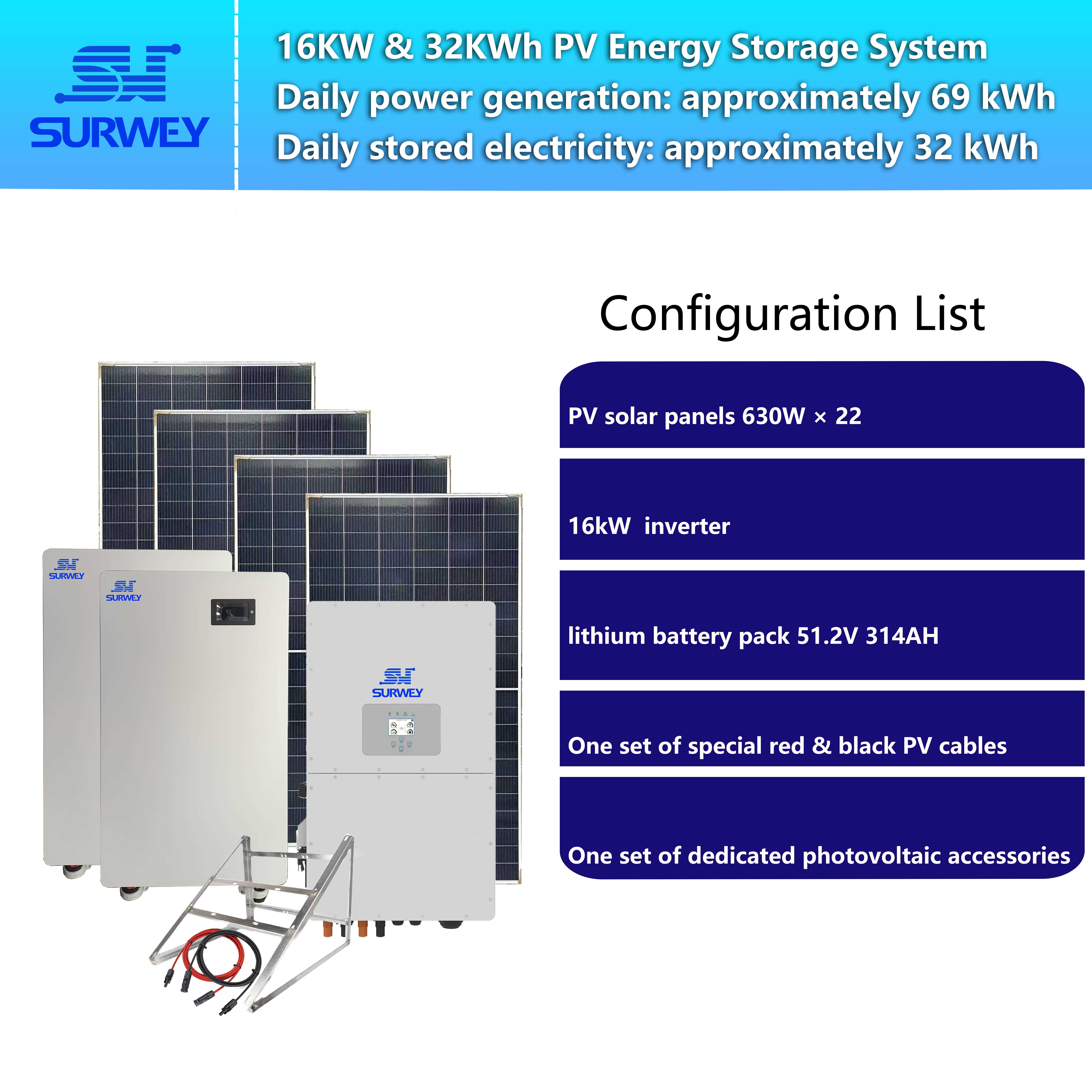
On the DC side, the PV array comprises 22 pieces of 630W PV modules with a nominal installed PV capacity of 14kW. Modules are configured in 2 strings, with 11 modules per string. The two strings are separately connected to the two MPPT input ports of the 16kW hybrid inverter. Energy storage adopts a 32kWh vertical low-voltage lithium iron phosphate battery pack. The core power equipment is the 16kW three-phase low-voltage hybrid grid-tie inverter/controller, which supports grid-connected operation and automatic switchover to off-grid backup mode upon power failure. The system is designed to achieve a daily power generation of 69 kWh. Excess PV power is prioritized to charge the battery, with a daily stored energy of 32 kWh.
2. Main Equipment Parameters of the Project
Three core units are adopted for the complete system: 630W PV modules, 16kW three-phase low-voltage hybrid grid-tie inverter/controller, and 32kWh vertical low-voltage energy storage battery.
630W PV Module
High-efficiency monocrystalline silicon PV modules are selected. Each module is rated at 630W, with a total quantity of 22 pieces and nominal installed capacity of 14kW. Featuring excellent temperature coefficients, the modules adapt to the high-temperature outdoor environment in Senegal and are resistant to wind and sand. The module protection rating satisfies requirements for open-air rooftop installation. Power degradation is controllable within the 25-year service life with stable output performance, serving as the DC power source of the system. Modules are arranged into two series strings of 11 modules each, connected separately to the dual MPPT channels of the inverter to realize independent maximum power point tracking for each string.
16kW Three-phase Low-voltage Hybrid Grid-tie Inverter/Controller

It is a three-phase low-voltage hybrid inverter/controller supporting seamless switchover between grid-tied and off-grid modes. It is equipped with dual MPPT PV input interfaces. The battery port supports adaptive BMS communication for low-voltage lithium batteries, with a maximum battery charging current of 300A and maximum discharging current of 300A. The equipment reaches IP65 protection rating and operates within the temperature range of -40℃ ~ +60℃. Automatic derating will be triggered when ambient temperature exceeds 45℃. Built-in Class II AC and DC lightning protection is integrated to accommodate the locally volatile grid voltage. Remote communication and monitoring are supported. Full set of electrical protections including overvoltage, overcurrent, short circuit and arc fault protection are provided to meet West African household safety standards. Multiple operating modes are available: PV charging battery, battery inversion for load power supply, and utility grid bypass power supply.
32kWh Vertical Low-voltage Energy Storage Battery

Formed by two parallel 16kWh (51.2V, 314Ah) vertical low-voltage lithium iron phosphate battery units for a total capacity of 32kWh. The cell cycle life ≥ 8000 times. Built-in BMS (Battery Management System) provides protection against overcharge, overdischarge, overcurrent and over-temperature. The vertical cabinet structure allows easy placement indoors or in the equipment room of the villa. Adaptive BMS communication with the hybrid inverter/controller enables precise charge-discharge logic control. The regular depth of discharge (DOD) of the system is controlled at 80%, corresponding to an available capacity of approximately 25.6kWh, which supplies power at night and serves as emergency backup during grid outages.
3. Electrical Matching Verification of PV Strings
The PV array of this project adopts a configuration of 11 pieces of 630W modules in series per string, with 2 strings in total. The two strings are independently connected to the two MPPT channels of the inverter. The MPPT voltage operating window of the equipment ranges from 160V to 650V, and the maximum PV input voltage is 800V.
For one string of 11 series-connected modules, the maximum power point voltage and open-circuit voltage under STC standard condition, high-temperature condition and local extreme low-temperature condition all fall within the inverter MPPT operating window. The maximum string open-circuit voltage is lower than the maximum DC input withstand voltage of 800V of the inverter, eliminating overvoltage risk. The operating current and short-circuit current of each string are within the allowable current range of each single MPPT channel. The two strings operate independently without mutual interference. Even if one string suffers shadow shading, the other string can continue normal power generation.
The nominal installed DC PV capacity of 14kW is less than the maximum allowable PV access power of the inverter. The DC power ratio is reasonably designed to avoid inverter overload. Senegal features high ambient temperature in daytime. The rising module operating temperature will slightly reduce operating voltage. The temperature-corrected string voltage under high temperature is still higher than the minimum MPPT startup voltage of 160V, ensuring continuous maximum power point tracking by the inverter at noon under high temperature without quitting MPPT and stopping power generation. All DC-side electrical parameters comply with the hardware limits of the inverter. The string design is safe and compliant to guarantee long-term stable power generation of the system.
4. System Operating Principle
This integrated hybrid solar-storage inverter system has two core operating logics: grid-tied mode and off-grid emergency mode.
Grid-tied Mode (Utility Power Available)
In sufficient daylight, the 630W PV array converts solar energy into DC power. The two strings feed power into the dual MPPT channels of the inverter respectively, and the inverter converts DC power into three-phase AC power. Power generated by PV is supplied to villa household loads on priority. When PV output exceeds real-time household power consumption, excess DC power charges the 32kWh energy storage battery via the battery port of the inverter, achieving the design target of 32 kWh daily stored energy. When PV output is insufficient and load consumption exceeds PV generation, stored energy from the battery is discharged to supply loads on priority. Once the battery state of charge (SOC) reaches the discharge cutoff limit, the power deficit will be supplemented by the utility grid.
Off-grid Emergency Mode (Utility Power Failure)
Upon grid blackout, the hybrid inverter/controller detects grid abnormality and completes grid-tie to off-grid switchover within milliseconds, disconnecting from the utility grid and forming an independent microgrid. At this time, PV power continues to supply villa loads on priority, and surplus power keeps charging the 32kWh battery. During nighttime or cloudy days with insufficient sunlight, the energy storage battery releases power. All villa loads are jointly powered by PV and battery. When battery SOC drops to the protection threshold, an external backup diesel generator can be connected to recharge the system.
The system embeds energy management logic. Battery charge and discharge thresholds can be configured to prevent deep overdischarge and extend the 8000-cycle service life of the battery. Remote monitoring is supported to read real-time data including power generation, battery SOC and load power, facilitating operation and maintenance personnel to track equipment operating status.
5. Available Load Power and Power Supply Duration
The 16kW hybrid inverter delivers a continuous AC rated output of 16kW under off-grid conditions, with short-term peak power up to twice the rated power. The total energy storage capacity is 32kWh, and the actual available capacity is 25.6kWh at 80% depth of discharge. Power supply duration is calculated based on common electrical appliances used in Senegalese villas.
- Full high-power load scenario: Multiple air conditioners, high-power kitchen appliances and water heaters are switched on simultaneously with total load power of 12kW. For battery-only power supply at night without PV generation, the available duration ≈ 25.6kWh ÷ 12kW ≈ 2.1 hours, supporting short-time use of high-power appliances.
- Medium household load scenario: Air conditioners, lighting, TV and refrigerator with total load of 6kW. Nighttime battery-only power supply lasts approximately 4.2 hours, covering major evening activity periods.
- Basic critical load scenario: Refrigerator, lighting, security monitoring and network devices with total load of 2kW. Nighttime battery-only power supply can last roughly 12.8 hours, fully securing basic domestic power supply overnight.
When PV generation is available in daytime, battery supply duration will be greatly extended. On sunny days, the PV system generates 69kWh power, supplying loads while recharging the battery. Continuous all-day power supply can be maintained during grid outages. In case of consecutive rainy and cloudy days with sharply reduced PV output, it is recommended to activate the backup diesel generator to avoid deep battery discharge and cell damage.
6. Local Environmental Adaptation Points for Senegal
The project site is located in Senegal, West Africa. Coastal areas are subject to salt spray, with high temperature all year round. The dry season brings strong solar irradiance while the rainy season features cloudy weather and rainfall, accompanied by frequent grid voltage fluctuations.
The selected inverter reaches IP65 protection rating. Outdoor installation requires sun shielding and good ventilation. All DC & AC connectors and mounting brackets in coastal zones are treated for salt spray corrosion. The inverter supports wide voltage input to adapt to local grid voltage fluctuations. Two-stage AC & DC lightning protection devices are configured to cope with thunderstorms in tropical regions.

Layout Drawing for Indoor Installation of Main System Equipment
The battery is installed in a ventilated equipment room away from direct sunlight, mitigating the impact of high temperature on lithium battery service life. The designed daily power generation of 69kWh is a typical value for sunny days in dry season. Power generation will decrease in cloudy weather during rainy season, followed by reduced battery charging volume, which belongs to normal system operating conditions.


