
Technical Solution for Solar-Storage Integrated Power Supply System for Private Villa in Ogun State, Indonesia---Tropical Sunshine · Green Power to Residence
Preface
Ogun State of Indonesia is located near the equator, featuring abundant sunshine throughout the year and stable irradiation, with an annual effective sunshine duration of over 1,800 hours, offering excellent natural conditions for photovoltaic power generation. However, the power grid infrastructure in areas where some private villas are situated is weak, with unstable utility power supply and frequent blackouts. Continuous power supply for air conditioners, lighting, kitchen appliances and security equipment cannot be guaranteed, which seriously impairs living quality and asset safety.
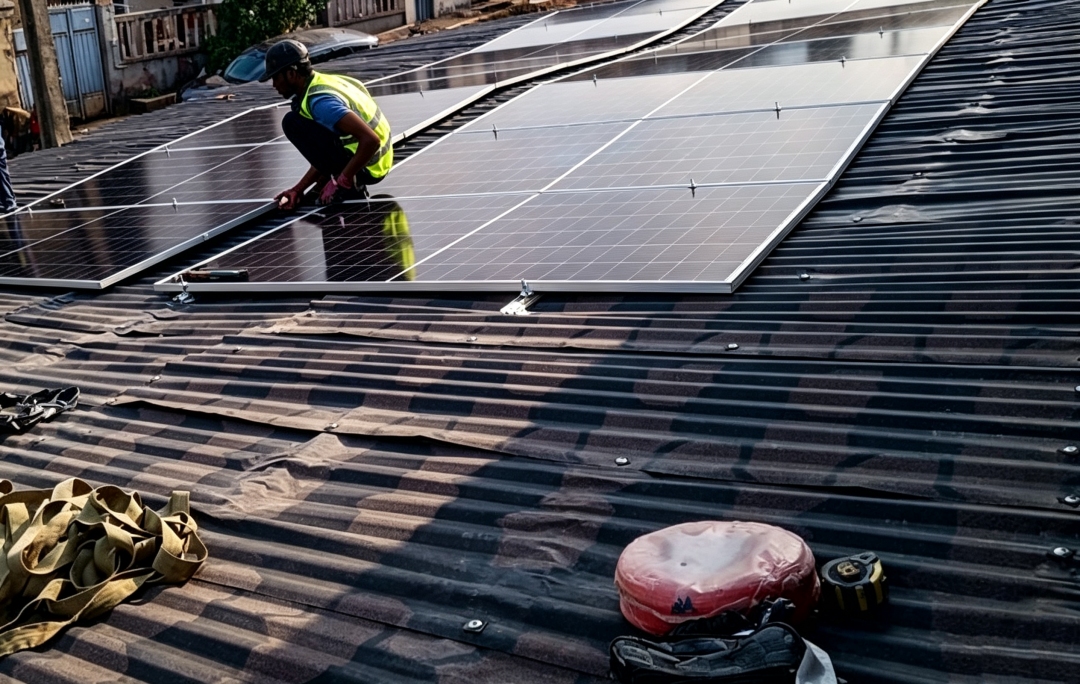
Roof PV Module Installation Diagram
This solution customizes an off-grid photovoltaic energy storage power supply system for the private villa. Adhering to the core design concept of on-site generation for self-consumption, energy storage for backup power, and intelligent dispatch, it builds a fully independent green power supply system through a three-level architecture: DC power generation by photovoltaic modules, energy storage by lithium iron phosphate batteries, and AC output by hybrid inverter & controller. The system can operate independently without utility power, providing stable, clean and silent power guarantee for the villa. Meanwhile, it substantially cuts long-term electricity costs and aligns with the development trend of green residences in tropical regions.

Indoor Layout Diagram of Key System Equipment
1. Main Equipment Parameters of the Project
The system is equipped with 16 pieces of 625W N-type monocrystalline silicon PV modules, 1 set of 12kW hybrid inverter & controller, and 1 pack of 17.5kWh stackable lithium iron phosphate batteries. The total installed PV capacity is 10kWp, with a designed daily power generation of 50 kWh and a daily energy storage capacity of 17.5 kWh.

The project system consists of three parts: photovoltaic power generation unit, energy storage unit and inverter control unit.
- PV side: 16 pieces of 625W N-type monocrystalline silicon modules are configured. 8 modules are connected in series to form one string, with 2 strings in total, which are connected to 2 MPPT input ports of the hybrid inverter & controller respectively.
- Energy storage side: 1 pack of 51.2V/340Ah stackable lithium iron phosphate batteries with a rated energy storage capacity of 17.5 kWh.
- Inverter side: 1 set of 12kW hybrid inverter & controller with IP66 protection rating. It integrates MPPT charging control, bidirectional DC-AC inversion, BMS communication and AC/DC power distribution functions, realizing automatic energy management: photovoltaic power supply first, surplus power storage and battery discharge at night.
625W N-type Monocrystalline Silicon PV Module
This project adopts high-power 625W N-type monocrystalline silicon double-glass modules with 132 cells (6×22 layout). The module dimension is 2382×1134×30 mm, and the weight of a single module is 32.8 kg. It adopts silver anodized aluminum alloy frame and 2.0+2.0 mm semi-tempered glass encapsulation. The mechanical load capacity reaches 5400 Pa on the front side and 2400 Pa on the rear side, with strong wind and snow load resistance, suitable for outdoor tropical environments with high temperature and high humidity.
In terms of electrical performance, under Standard Test Conditions (STC: 1000W/m², 25℃, AM1.5), the rated peak power of the module is 625W, rated peak voltage 41.69V, rated peak current 14.99A, open-circuit voltage 49.19V and short-circuit current 16.19A. The nominal module conversion efficiency is 23.1%, up to 23.3%. The power attenuation is no more than 1.0% in the first year, and no more than 0.4% annually afterwards. The power output can still maintain more than 85% of the initial power at the end of the 25-year service life. The module is equipped with HCB40 standard connectors, optional MC4-EVO2A interface, with positive cable length 350 mm and negative cable length 250 mm, wire gauge 4mm²/12AWG, meeting the safety current-carrying requirement for large current.
For string configuration, 16 modules are divided into 2 strings with 8 modules connected in series per string. The open-circuit voltage of a single string is 8×49.19V=393.52V, the peak operating voltage of a single string is 8×41.69V=333.52V, and the peak current of a single string is 14.99A. The two strings are independently connected to the 2 MPPT ports of the inverter. The MPPT voltage operating range of the inverter is 125~425Vdc. The open-circuit voltage of a single string (393.52V) falls within this range and reserves voltage margin for low-temperature rise. The maximum input current of a single MPPT channel is 27A and maximum power 9000W. The current of a single string is 14.99A and power 5000W, all within the allowable range of the inverter. The electrical matching of the string is reasonable to ensure stable and efficient maximum power point tracking.
12kW Hybrid Inverter & Controller

The 12kW hybrid inverter & controller with IP66 protection rating is adopted in this project, serving as the core energy management device of the system.
The rated output power of the inverter is 12000W, maximum peak power 24000VA, rated output voltage 230Vac, rated output current 52.2A, maximum output current 57.4A, output frequency adjustable at 50/60Hz, total harmonic distortion less than 3%, power factor from 0.8 leading to 0.8 lagging. It outputs high-quality sine wave AC power to directly drive various inductive and resistive loads of the villa.
2 independent MPPT channels are built in the photovoltaic side, with maximum input power 9000W+9000W, maximum input current per channel 27A+27A, maximum open-circuit voltage 500Vdc, MPPT voltage range 125~425Vdc, MPPT tracking efficiency up to 99.9%, and maximum overall efficiency 97.5%. The battery side supports self-adaptation of lithium batteries and lead-acid batteries. The rated battery voltage is 51.2V, battery operating voltage range 40~60Vdc, maximum PV charging current 200A. It supports lithium battery BMS communication, which can read battery SOC, SOH and temperature data in real time to realize refined charge and discharge management.
The whole unit has IP66 protection rating, adopting combined heat dissipation of heat sink and intelligent air cooling. The operating temperature range is -20℃~60℃ (derated operation above 45℃), humidity range 5%~95% non-condensing. The net weight of the product is 52kg with dimension 750×500×246mm, supporting wall-mounted or floor installation. Communication interfaces include RS485/CAN/USB/dry contact. Optional Wi-Fi/4G remote monitoring module is available, supporting real-time viewing of power generation, energy storage and load data via mobile APP and cloud platform. It has functions such as peak-valley time management, generator linkage access and parallel expansion (up to 6 units).
17.5kWh Stackable Lithium Iron Phosphate Battery

This project is equipped with 1 pack of 51.2V/340Ah lithium iron phosphate battery with brand-new Grade A cells, rated energy storage capacity 17.5kWh. The outline dimension is about 475×350×665mm (W×D×H), weight about 120kg. It adopts sheet metal paint shell with universal wheels at the bottom for easy moving and placement indoors or in equipment room.
The nominal battery voltage is 51.2V, operating voltage range 51.2V~60.8V, charging termination voltage 57.6V, continuous maximum charge and discharge power 10000W, maximum charge and discharge current 200A. The operating temperature range is -20℃~50℃ with wide temperature adaptability. The built-in BMS battery management system monitors key parameters such as cell voltage, charge-discharge current and module temperature in real time, with protection functions including over-charge protection, over-discharge protection, over-current protection, short-circuit protection, over-temperature protection and balance management, ensuring safe and reliable operation of the battery pack.
The cells adopt lithium iron phosphate chemistry with a cycle life of no less than 8,000 times (under standard charge-discharge rate and 25℃ environment). Calculated based on one complete charge and discharge cycle per day, the designed service life can exceed 20 years, highly matching the life cycle of photovoltaic systems. The battery communicates with the hybrid inverter & controller via CAN/RS485. The charge and discharge strategy is uniformly scheduled by the inverter. SOC upper and lower threshold limits can be set to avoid deep discharge of the battery and extend its service life.
2. System Operating Principle
This system adopts an off-grid solar-storage integrated power supply architecture. Energy flow is automatically switched among three stages, intelligently scheduled by the 12kW hybrid inverter & controller without manual intervention.
Schematic Video of System Operation Principle
Daytime PV Power Generation Stage: After sunrise, solar irradiance gradually rises. 625W PV modules convert solar energy into DC power, which is sent to the inverter MPPT circuit through 2 strings. The MPPT module scans the operating point of the PV array in real time and adjusts the output to the maximum power point with a tracking efficiency of 99.9%. At this time, the priority of electric energy is: first supply AC loads of the villa (air conditioners, lighting, kitchen appliances, water pumps, security equipment, etc.). If the PV output exceeds the load demand, surplus electric energy charges the 17.5kWh lithium iron phosphate battery after DC-DC conversion of the inverter. The charging current is automatically adjusted by the inverter according to surplus PV power and battery BMS status, with a maximum charging current up to 200A. If PV output cannot cover the load, battery discharge will be invoked simultaneously to make up for the power gap.
Energy Storage Discharge Stage at Night and on Overcast Days: After sunset or when PV output is lower than load demand, the inverter automatically switches to battery power supply mode. The battery outputs 48V DC power, which is inverted into 230V/50Hz AC power by the inverter to supply loads. When the battery SOC drops to the set lower limit (usually 20%~30%), the inverter will trigger low battery alarm. If the system is connected to the backup generator interface, the generator can be automatically started for power supplement or manually started. After PV power resumes on the next day, priority will be given to fully recharge the battery, forming an energy cycle of charging in daytime and discharging at night.
System Protection Logic: The inverter monitors PV voltage & current, battery voltage & temperature, load power and output waveform in real time. Protection actions will be triggered once any parameter exceeds the limit (overvoltage shutdown, overcurrent current limiting, overtemperature derating, short-circuit cut-off, etc.). All operating data is uploaded to the cloud via Wi-Fi/4G. The owner can check daily power generation, remaining battery capacity, load power consumption distribution and historical power generation reports anytime through mobile APP.
3. Available Load Power and Power Supply Duration of the System
The rated AC output power of the system is 12kW, and the maximum short-term peak power is 24kVA, which can support the simultaneous startup and operation of major electrical equipment of the villa. Typical load configuration is as follows: 4 sets of air conditioners for living room and bedrooms (1.5kW per unit, total about 6kW), lighting and LED strips about 1.5kW, kitchen appliances (refrigerator, rice cooker, microwave oven, electric kettle) about 3kW, domestic water pump and security monitoring about 1kW, total about 11.5kW. The system reserves a margin of about 0.5kW to meet the simultaneous use of all daily loads.
In terms of energy storage power supply duration: the rated battery capacity is 17.5kWh. Based on the recommended available depth of discharge of 90% for lithium iron phosphate batteries, the available electric energy is about 15.75kWh. For the typical night-time load scenario of the villa: 2 air conditioners + lighting + refrigerator with an average load power of about 3.5kW, the continuous power supply by pure battery can reach about 4.5 hours. For basic night loads only (lighting + refrigerator + fan, about 1.5kW), continuous power supply can last about 10.5 hours. Combined with continuous PV charging in daytime, the system generates 50 kWh of electricity per day. Apart from covering daytime load consumption, it can fully charge the battery to 17.5 kWh storage capacity, guaranteeing basic power supply demand at night and during consecutive cloudy days (1~2 days).
4. Conclusion
Targeting the actual pain point of unstable utility power in the private villa of Ogun State, Indonesia, this solution adopts the solar-storage configuration: 16 pieces of 625W PV modules (10kWp) + 12kW hybrid inverter & controller + 17.5kWh lithium iron phosphate battery. Electrical verification is performed for the strings: the open-circuit voltage of a single string is 393.52V, operating voltage 333.52V and current 14.99A, all falling within the inverter MPPT range of 125~425Vdc and capacity range of 27A/9000W per channel, with rigorous matching and reliable operation.
The system has a designed daily power generation of 50 kWh and daily energy storage capacity of 17.5 kWh. It features rated output of 12kW and peak power of 24kVA, capable of covering the simultaneous operation of villa loads including whole-house air conditioners, kitchen appliances, lighting and security equipment. The pure battery power supply duration at night ranges from 4.5 to 10.5 hours (depending on load power). With daytime PV charging, long-term stable off-grid power supply can be realized. The equipment reaches IP66 protection rating, the battery cycle life is no less than 8,000 times. The system operates fully automatically with remote monitoring and simple maintenance. It not only solves the livelihood problem of unstable utility power, but also improves villa quality and asset value with zero-carbon green power, delivering remarkable economic and environmental benefits.


