
Grid-Tie and Off-Grid Integrated PV Energy Storage Power Supply Technical Solution for Côte d’Ivoire Manor
Grid-Tie & Off-Grid PV Energy Storage Power Supply Technical Solution for Côte d’Ivoire Manor
Côte d’Ivoire enjoys abundant solar irradiation resources, yet the development of public power grid infrastructure is limited. Grid voltage fluctuations and short-duration power outages occur frequently. The manor contains various electrical loads including living utilities, security monitoring, refrigeration appliances and auxiliary small equipment. Unstable grid power may directly cause equipment shutdown and data loss, disrupting normal manor operation and living experience.
To improve the manor’s power supply condition, reduce reliance on the public utility grid and boost energy self-sufficiency, this project designs a grid-tie and off-grid integrated photovoltaic energy storage power supply system. The system fully harnesses local solar energy resources. PV modules capture sunlight and convert it into DC electricity, the inverter accomplishes AC/DC conversion, and the energy storage battery stores surplus power. When the mains power is normal, the system operates in grid-tie mode to consume PV power. Once the mains supply fails and cuts off, the system seamlessly switches to off-grid mode, and PV together with energy storage jointly power the loads.
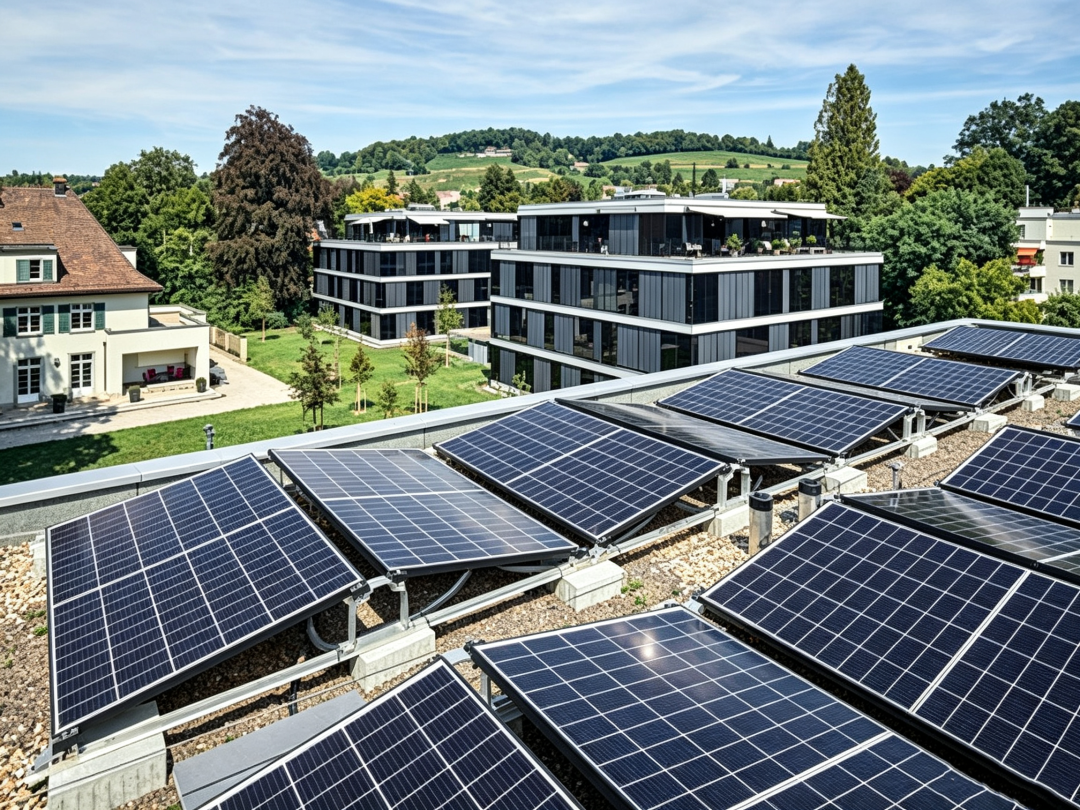
PV Panel Array Layout on Manor Roof
I. Overview of Overall System Configuration
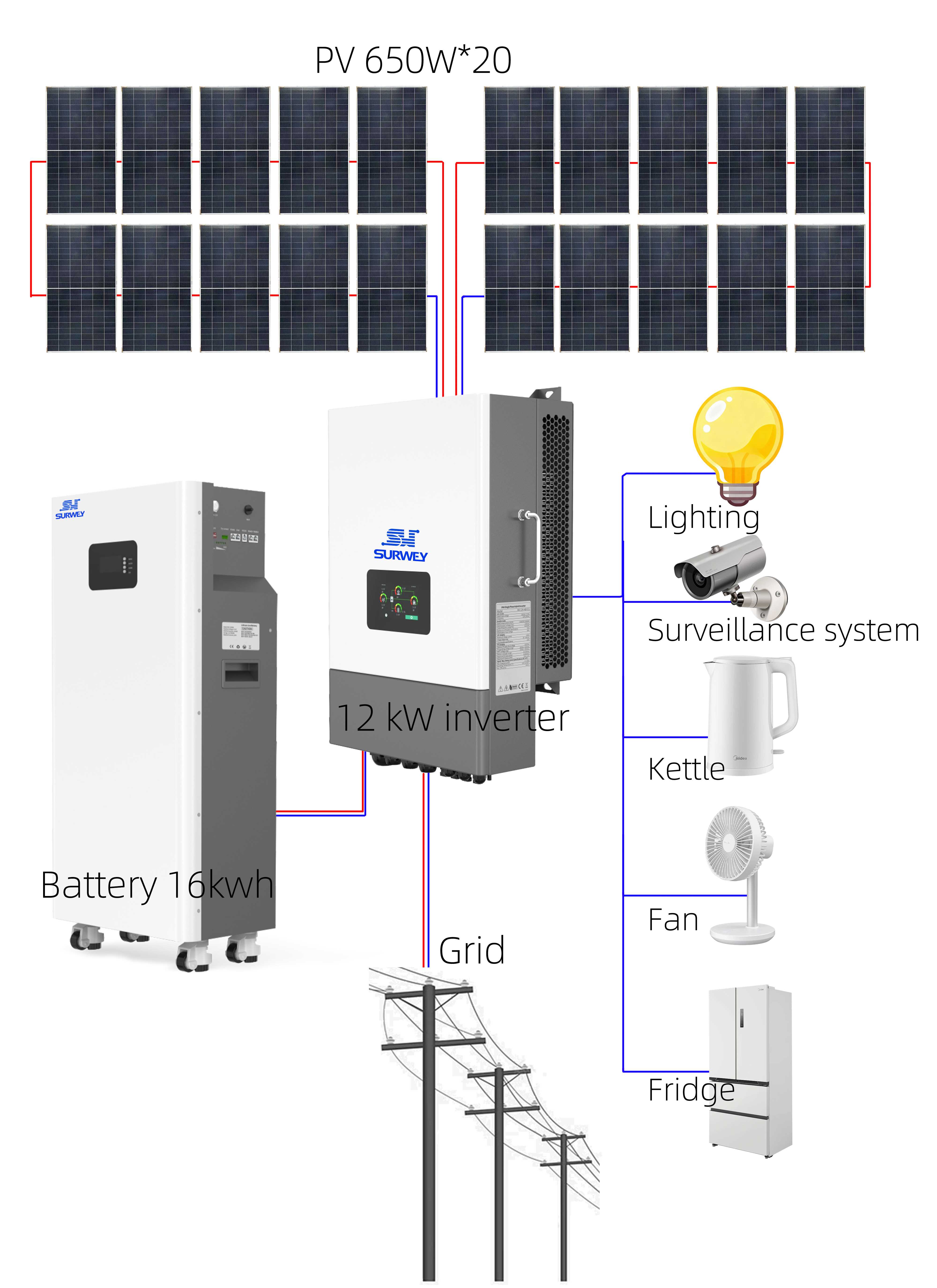
This grid-tie/off-grid solar-storage system consists of: 20 pieces of 650W monocrystalline silicon PV modules, 1 set of 12kW IP66 grid-tie off-grid hybrid inverter, and 1 set of 16kWh floor-standing lithium iron phosphate energy storage battery.
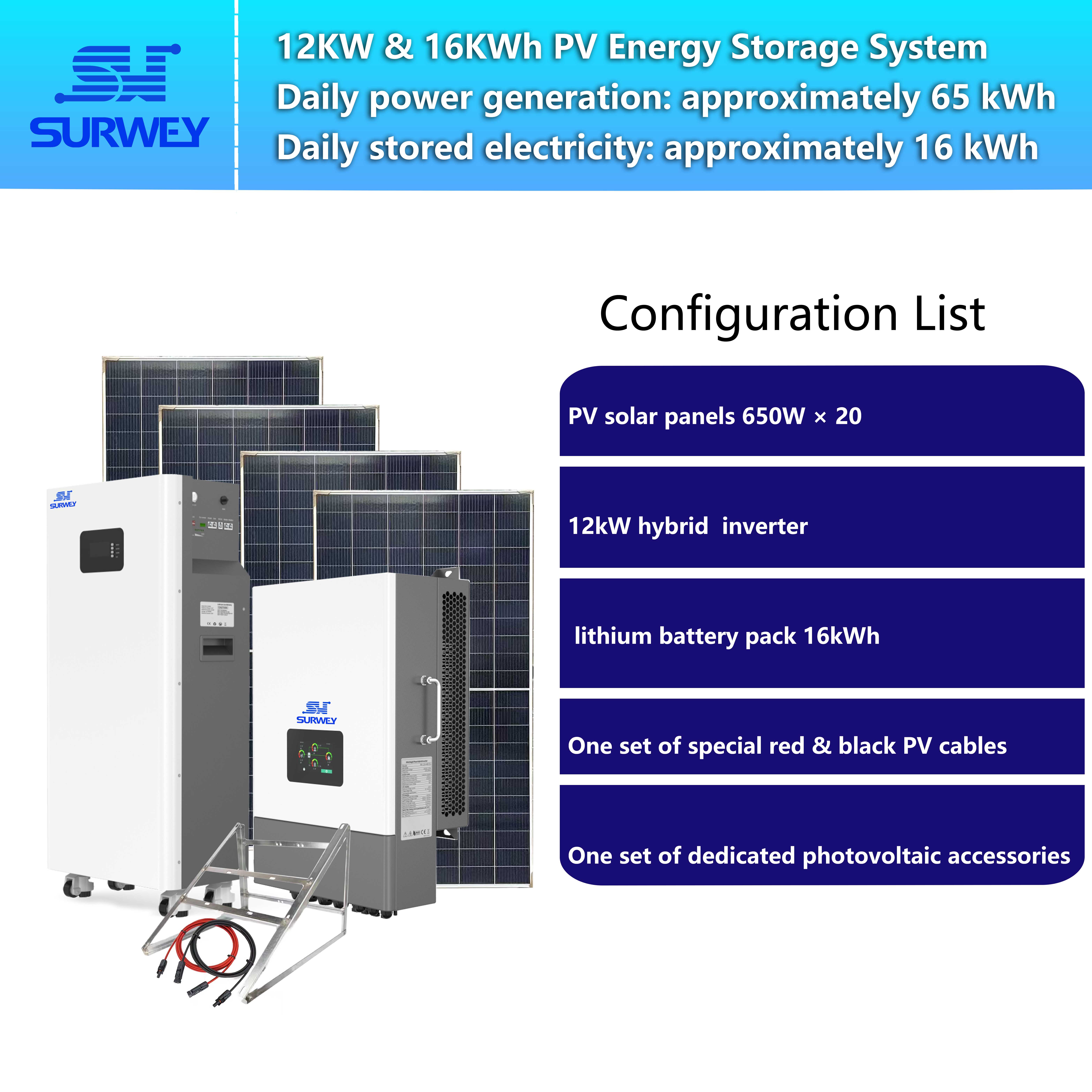
The system is designed with a daily power generation capacity of 65kWh and usable energy storage capacity of 16kWh. The inverter is equipped with two independent MPPT channels. Each MPPT channel connects 10 modules in series, and the two strings adopt identical configuration. The system supports seamless switching between grid-tie and off-grid operation modes.
When mains power is available, the system runs on grid-tie mode. PV power supplies manor local loads preferentially, surplus electricity is stored in the energy storage battery. After the battery is fully charged, excess power can be fed back to the grid. When the utility grid fails and cuts power, the system quickly disconnects from the grid circuit and switches to off-grid mode. PV and battery work in synergy to deliver uninterrupted power to manor loads. Integrating multiple functions including on-site self-consumption, surplus energy storage and emergency backup, the system meets the manor’s all-day power demand.
Main Equipment Introduction
(1) 650W PV Module
Monocrystalline silicon PV module, rated power 650W under STC. Open-circuit voltage: 45.2V; maximum power voltage: 37.8V; maximum power current:17.20A; short-circuit current:18.26A; conversion efficiency:20.9%. Temperature coefficient of open-circuit voltage: −0.26%/℃; temperature coefficient of short-circuit current: 0.043%/℃; temperature coefficient of power: −0.36%/℃. Operating temperature range: −40℃ ~ +85℃. It features reliable mechanical load resistance against wind and snow, with junction box IP68 protection. Power tolerance: 0~+5W with positive power deviation to guarantee actual power output. The module is resistant to damp heat and ultraviolet rays, suitable for high-temperature and high-humidity outdoor conditions in Côte d’Ivoire, steadily converting solar energy into DC power as the energy source of the whole system.
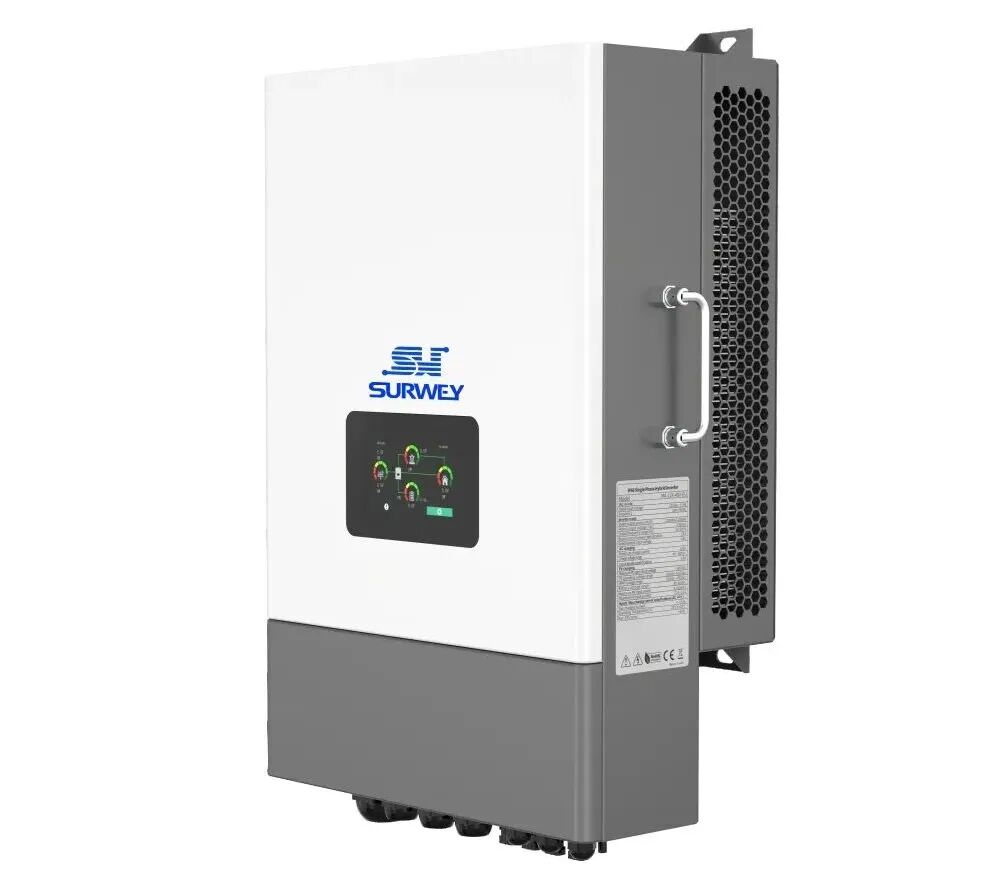
IP66 high-protection grid-tie off-grid hybrid inverter. Peak MPPT tracking efficiency reaches up to 99.9%. It has two independent PV MPPT input channels. Max PV input current per channel: 27A; maximum allowable PV open-circuit voltage: 500Vdc; MPPT operating voltage window:125‑450Vdc.
Compatible with lithium iron phosphate, lead-acid and other types of storage batteries. It supports BMS communication to read battery status in real time and precisely control charge and discharge processes. Millisecond-level switching to off-grid output upon mains failure to guarantee uninterrupted load power supply. Adopting dual software & hardware safety design, it is built-in with multiple protection functions including overvoltage, overcurrent, overload, overheating and islanding protection, and supports peak-valley timing control. With IP66 dustproof & waterproof enclosure and heat dissipation structure adapted to high-temperature environments, it realizes AC/DC conversion and coordinates energy distribution among PV, battery, utility grid and loads, acting as the core control unit of the solar-storage system.
(3) 16kWh Floor-standing Energy Storage Battery
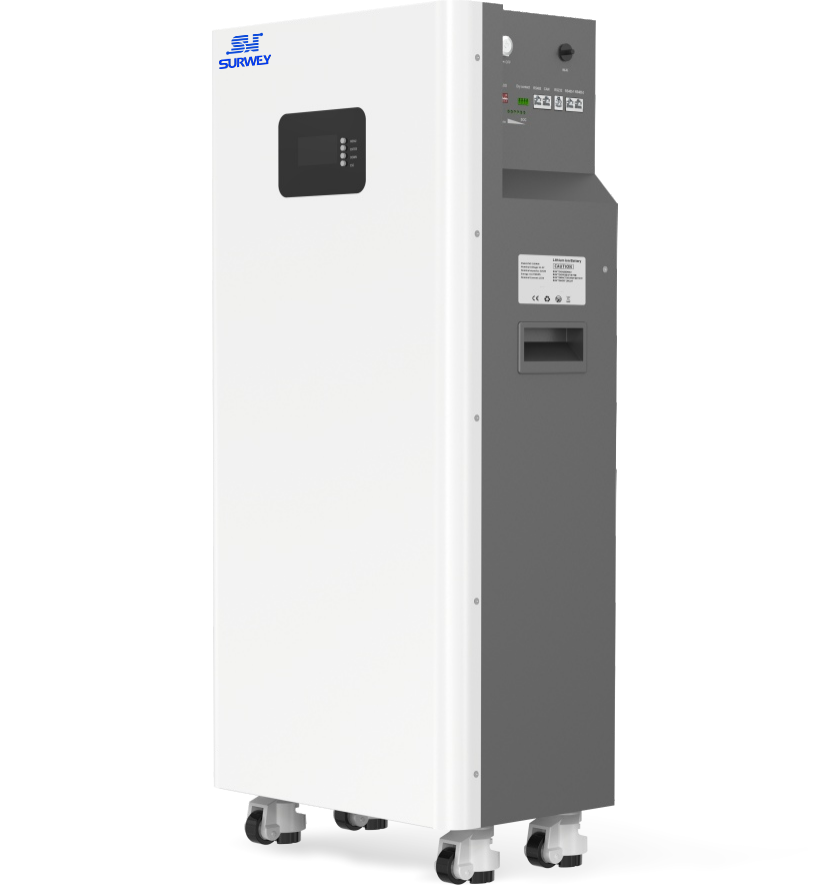
Movable floor-mounted lithium iron phosphate battery. Nominal voltage: 51.2V, rated capacity:314Ah, usable discharge depth up to 90%, excellent cycle life. Equipped with touch display screen to locally view real-time operating parameters including battery voltage, current and SOC. Multiple units can be paralleled for capacity expansion to flexibly increase energy storage capacity later.
It has multiple communication interfaces including RS232/RS485/CAN for BMS communication with the inverter. After acquiring battery status, the inverter adjusts charge-discharge strategies to effectively avoid overcharge and over-discharge. Fitted with rollers and floor bracket for easy installation and transportation. Protection grade IP21, suitable for indoor installation. It mainly stores surplus electricity generated by PV modules and releases power when sunlight is insufficient or grid blackout occurs, providing emergency power support for manor loads.
II. Electrical Matching Verification of PV Strings
The project adopts 20 pieces of 650W PV modules. The inverter has two MPPT channels. Each MPPT channel connects 10 modules in series, and the two strings have identical configuration.
Under STC: Voc of single module =45.2V; after connecting 10 modules in series, STC open-circuit voltage =45.2 ×10 =452V. Low-temperature voltage check based on module temperature coefficient −0.26%/℃: the minimum night ambient temperature in Côte d’Ivoire is taken as 20℃. Compared with STC test temperature of 25℃, open-circuit voltage of PV modules rises when ambient temperature drops by 5℃. Voltage rise ΔVoc =452 ×0.26% ×5 =5.88V; maximum string open-circuit voltage under low-temperature extreme condition≈457.88V.
Cross-reference with inverter specifications: the maximum allowable PV open-circuit voltage of the inverter is 500Vdc, MPPT operating voltage range:125‑450Vdc. The maximum string open-circuit voltage at low temperature 457.88V <500Vdc, which will not cause DC-side overvoltage damage to the inverter. Under STC, maximum power point voltage Vmp for 10-series modules =37.8×10=378V, falling within the MPPT tracking window of 125‑450Vdc, so the inverter can stably achieve maximum power tracking. Each MPPT channel adopts one string of 10 modules in series, input operating current equals module Imp=17.20A. The inverter’s maximum single-channel PV input current is 27A, leaving sufficient safety margin for current.
Peak power of the whole PV array: 20×650W=13000W, improving power output under weak light. The system is designed with daily power generation of 65kWh and usable stored energy of 16kWh. PV power supplies manor local loads preferentially during daytime. Surplus power is stored in the battery. Once the battery reaches full SOC, excess power can be fed into the public utility grid.
III. System Operating Principle
Video: Schematic Demonstration of System Working Principle
Grid-tie mode with normal mains supply: PV modules generate DC power under sunlight, which is transmitted to the 12kW inverter. The inverter converts DC into standard AC power, supplying various manor loads preferentially. When PV output exceeds real-time load consumption, extra power is first stored in the 16kWh battery. When battery SOC hits full threshold, remaining PV power is delivered to the public grid. If sunlight is insufficient and PV generation fails to meet manor power demand, public mains will automatically fill the power gap and ensure continuous load operation.
Off-grid mode during mains blackout: Once the grid fails, the inverter detects mains abnormality and rapidly disconnects grid-side connection. The system switches to independent off-grid operation. With sufficient sunlight, PV modules directly supply power to manor loads and charge the battery simultaneously. When sunlight is poor or there is no PV output at night, the energy storage battery releases stored electricity to power critical manor loads. The inverter keeps continuous BMS communication with the battery, monitoring battery voltage, SOC and temperature in real time, dynamically adjusting charge and discharge power to avoid abnormal conditions such as overcharge, over-discharge and overcurrent, guaranteeing safe and stable operation of the whole system.
IV. Reference Power Supply Duration for Driven Loads
Note: Calculation only uses the 16kWh usable battery capacity without real-time PV generation, pure off-grid battery power supply estimation
| Total Load Power | Available Power Duration | Example Applicable Loads |
|---|---|---|
| 2kW | Approx. 8h | Lighting, monitoring, router, small household appliances |
| 4kW | Approx. 4h | Lighting + TV + refrigerator + fan |
| 6kW | Approx. 2.7h | Multiple electrical appliances working simultaneously |
| 8kW | Approx. 2h | Mixed high-power equipment operation |
Remark: Actual runtime will fluctuate subject to sunlight conditions, equipment conversion efficiency, ambient temperature and battery aging degree.
Conclusion
This grid-tie & off-grid PV energy storage system for Côte d’Ivoire manor completes full equipment selection and rigorous string electrical verification, adopting two MPPT channels with 10 modules in series per string. According to low-temperature voltage check, the maximum string open-circuit voltage under extreme low temperature is 457.88V, lower than the inverter’s 500Vdc withstand limit. The maximum power point voltage lies within the inverter MPPT tracking range and operating current is within equipment allowable range, with reasonably matched electrical parameters.
Designed for daily power generation of 65kWh and usable storage capacity of 16kWh, the system makes full use of solar energy to reduce mains consumption and provides emergency power supply during grid failure. All equipment features excellent weather resistance to adapt to the hot and humid climate in Côte d’Ivoire. Multiple built-in protection mechanisms ensure high operation safety. With mature and stable operating logic, supporting daily self-consumption and backup power during blackouts, the system effectively improves power supply conditions for the manor, enhances power stability and energy self-sufficiency.


