
Technical Scheme of 3.5kW Off-Grid Residential PV Energy Storage System for the Philippines
Preface
This project is deployed in the Philippines, where the local residential grid supplies 220V AC power for household loads including lighting, home appliances and small office equipment. It adopts an off-grid PV-energy storage architecture without grid connection. Solar power is generated and stored during daytime, and batteries supply loads at night to resolve frequent blackouts and unstable grid power in the region.
Working Principle of 3.5kW/5kWh PV Energy Storage System
1. Project Overview
1.1 System Configuration
System components: 5 pieces of 620W monocrystalline double-glass PV modules, a 3.5kW off-grid all-in-one solar inverter, and a 5.12kWh wall-mounted lithium iron phosphate battery. The system generates 15.5kWh PV power on average per day, with 5kWh electricity reserved for energy storage daily. Surplus solar power directly feeds local loads to realize self-consumption.
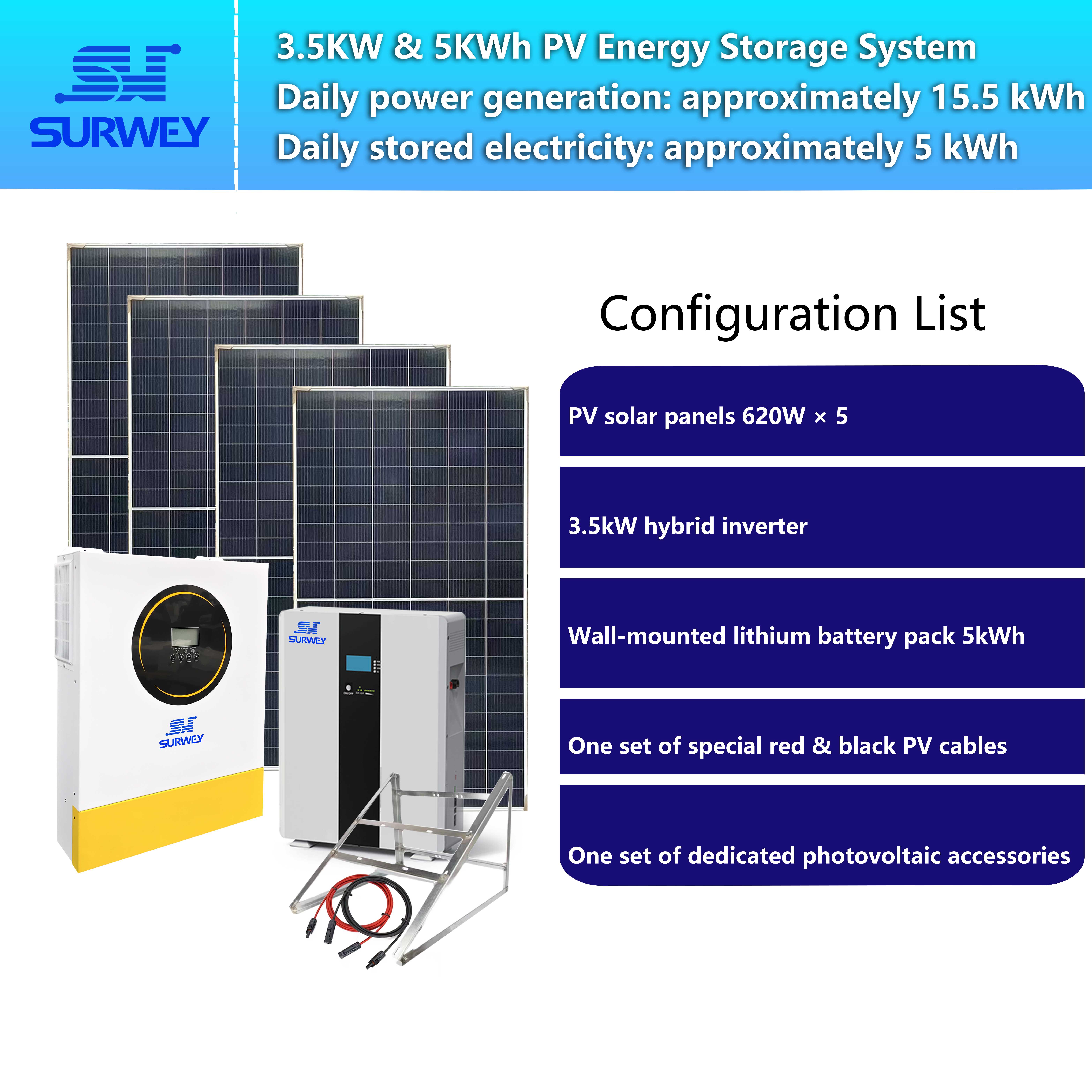
Configuration Diagram of 3.5kW/5kWh PV Energy Storage System
1.2 Design Principles
- Adapt to tropical sunlight conditions in the Philippines; PV modules feature anti-PID and high-temperature attenuation resistance.
- PV series voltage falls within the inverter’s MPPT operating range to maximize power generation efficiency.
- Reasonable power matching for the off-grid system; battery capacity meets basic nighttime power demand.
- Equipment protection ratings fit rainy, hot and humid climates to ensure long-term stable operation.
2. Selection Specifications of Core Equipment
2.1 620W Monocrystalline Double-Glass PV Module
Electrical parameters under Standard Test Conditions (STC): Rated power: 620W; Open-circuit voltage (Voc): 56.33V; Maximum power voltage (Vmp): 47.33V; Short-circuit current (Isc): 13.76A. Adopting 182mm monocrystalline cells with 2.0+2.0mm double semi-tempered glass packaging and IP68 split junction boxes, it boasts excellent wind and hail resistance. Key performance indicators: maximum conversion efficiency of 23.25%, power attenuation ≤1% in the first year followed by linear annual attenuation of 0.4%, suitable for long-term outdoor tropical operation.
2.2 3.5kW Off-Grid All-in-One Solar Inverter

3.5kW Solar Inverter
AC output: 230VAC, compatible with 220V household loads in the Philippines; rated output power 3.5kW with pure sine wave output to support inductive and resistive appliances such as refrigerators and TVs. Built-in MPPT charge controller with PV input voltage range of 60VDC~500VDC, maximum PV input voltage 500VDC and rated charging current 100A. Compatible with 24V energy storage systems, it supports three operating modes: solar priority, grid backup and battery-free operation, and is equipped with WiFi remote monitoring.
2.3 Energy Storage Battery: 51.2V 100Ah Wall-Mounted LiFePO₄ Battery

5kWh Wall-Mounted Lithium Iron Phosphate Battery
Nominal voltage: 51.2V; rated capacity: 100Ah; energy capacity: 5.12kWh. Continuous charge/discharge current: 120A; cycle life ≥8,000 times. Integrated multi-protection against overvoltage, undervoltage, overload, short circuit and overheating. RS485/CAN communication links with the inverter for coordinated BMS management, and wall-mounted installation saves indoor space.
3. PV Series Voltage Verification
The system adopts 5 pieces of 620W PV modules connected in series to verify voltage compatibility with the inverter’s MPPT range.

PV Module Installation Scenario
- Standard open-circuit voltage of single module Voc=56.33V; total series open-circuit voltage = 5 × 56.33 = 281.65V
- Maximum power voltage of single module Vmp=47.33V; total series operating voltage = 5 × 47.33 = 236.65V The inverter’s MPPT operating range is 60~500VDC. Verification conclusion: both series open-circuit voltage and operating voltage stay within the effective MPPT window, enabling continuous maximum power point tracking by the inverter. In high-temperature Philippine environments, module Voc drops slightly yet remains above the 60V lower limit; voltage never exceeds the 500V upper limit on cloudy days, supporting efficient charging all year round.
4. Power Generation & Energy Storage Operation Logic
4.1 Power Generation Calculation
Total installed PV power = 5 × 620W = 3.1kW. Based on local sunshine conditions in the Philippines, the system generates 15.5kWh daily. Operation rule: solar power feeds real-time loads first, and surplus power charges the storage battery. 5kWh electricity is reserved daily exclusively for nighttime power supply without sunlight. After covering load consumption and battery charging, excess daytime power is automatically dissipated to prevent battery overcharging.
4.2 Energy Storage Control Strategy
The built-in MPPT module charges the lithium battery during daytime, with a charging cut-off voltage of 58.4V; the inverter automatically stops charging once the battery is full. At night, the battery inverts DC to AC for loads, with a discharge cut-off voltage set to 44.8V to avoid deep discharge and extend battery service life. For consecutive cloudy days with insufficient PV output, grid power can be connected as backup to guarantee uninterrupted load supply.
5. Overall System Topology Architecture
This DC-coupled off-grid PV energy storage system consists of three layers.
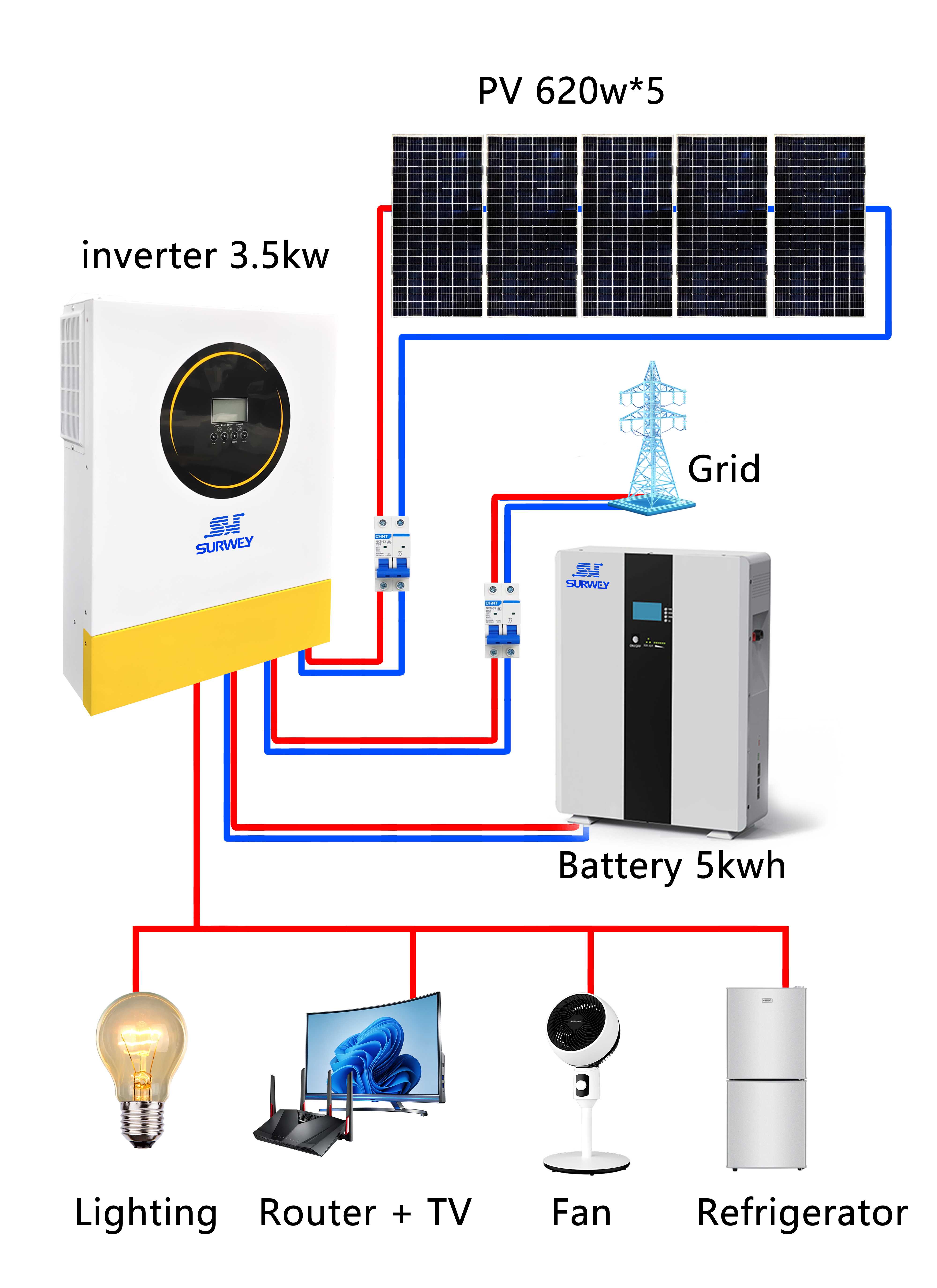
Topology Diagram of 3.5kW/5kWh PV Energy Storage System
- Power Generation Layer: 5 series-connected 620W PV modules form an array installed on outdoor south-facing tilted brackets to convert sunlight into DC power.
- Control & Storage Layer: PV DC power flows into the PV terminal of the 3.5kW all-in-one inverter. The built-in MPPT unit stabilizes voltage and current; part of the power is inverted for loads, and the rest charges the 51.2V lithium battery. The battery and inverter interlink to monitor electrical parameters in real time.
- Power Consumption Layer: The inverter outputs 230V pure sine wave AC power to match 220V Philippine household loads, with a reserved grid backup interface.
Three system operating modes: Solar Priority Mode, Grid Complementary Mode, Battery-Free Direct Load Mode.
6. Installation Scheme & Climate Adaptation Design
PV Array Installation
5 PV modules form a single series string mounted on south-facing outdoor brackets with a tilt angle of 15°~20°, matching Philippine latitude to maximize solar irradiance reception. Modules are horizontally arranged with ventilation gaps to mitigate power attenuation caused by tropical high temperatures. Module frames are earthed for lightning protection, and MC4 waterproof connectors are used at wiring terminals to adapt to humid rainy seasons.
Indoor Equipment Installation
The all-in-one inverter and wall-mounted lithium battery are placed in well-ventilated, dry indoor spaces; the battery is wall-hung away from ground moisture, and sufficient heat dissipation space is reserved for the inverter. 4.0mm² special PV cables are used for DC wiring with conduit protection; AC output circuits adopt graded power distribution and circuit breakers for segmented overload and short-circuit protection.
Tropical Environment Optimization
- Double-glass PV modules resist moisture and mildew, fitting high-humidity rainy seasons in the Philippines.
- The inverter operates stably from -10℃ to 55℃ to withstand tropical high temperatures.
- Lithium batteries work between -20℃ and 60℃ without overheating shutdown in summer.
7. System Operation Benefit Analysis
- Power Supply Benefit: Daily generation reaches 15.5kWh; solar power supplies loads during daytime while 5kWh stored energy supports nighttime use, meeting full-day basic demand for lighting, TVs and small appliances and freeing households from unstable local grids.
- Service Life: PV modules have gentle power attenuation with ≥87.4% power retention after 30 years; lithium batteries deliver a cycle life of over 8,000 times, and the whole system maintains stable operation for more than 12 years.
- Easy Maintenance: WiFi on the inverter enables remote viewing of power generation, battery state of charge and load power. Only 1~2 annual PV panel cleanings are required, leading to ultra-low maintenance costs.
8. Supported Electrical Appliances & Continuous Operation Duration
With 5kWh usable storage energy at night and a 3.5kW rated inverter output, the system drives most 220V household appliances in the Philippines. Continuous runtime for different load combinations is shown below:
| Load Combination | Total Power | Continuous Runtime |
|---|---|---|
| Full-house LED lighting (total 150W) | 150W | Approx. 33 hours |
| LCD TV + Router (120W+15W) | 135W | Approx. 37 hours |
| Single pedestal fan (60W) | 60W | Approx. 83 hours |
| Household refrigerator | Daily consumption 0.8kWh | Stable operation all night |
| Full set of basic nighttime loads (Lighting + TV + Fridge + Fan) | 450W | ≥11 hours |
With sufficient solar power during daytime, the 3.5kW inverter can simultaneously run high-power appliances including washing machines, electric rice cookers and water dispensers to meet all daily household electricity needs.
9. Solution Summary
This 220V off-grid PV energy storage system for the Philippines features 3.1kW installed PV capacity, paired with a 3.5kW all-in-one inverter and a 5.12kWh storage battery. Voltage verification confirms the series voltage of 5 modules falls within the inverter’s MPPT operating range, allowing full absorption of PV power.
The system generates 15.5kWh daily and stores 5kWh electricity for nighttime use. Its solar-priority control logic matches local household power habits, eliminating blackout troubles and cutting electricity expenses. Equipped with double-glass PV modules and long-cycle lithium batteries (≥8,000 cycles), the system adapts to the hot, humid tropical climate of the Philippines, balancing safety, stability and economy to deliver long-term reliable off-grid power supply.


