
Technical Solution for a Distributed Off-Grid Photovoltaic Power Supply System — Designed for Food Waste Disposal Units and Household Appliances

Roof-mounted Solar System in Jaipur, India
I. Overview of the Proposal
This solution is designed to address food waste disposal and daily household electricity needs by integrating a photovoltaic system, energy storage, and an off-grid inverter into a single, integrated off-grid power supply system. The core configuration includes a 2.9 kW PV array, a 4 kW RV-style pure sine wave inverter (SW-AR-40, with integrated 60A MPPT), and a 5 kWh wall-mounted lithium iron phosphate (LiFePO4) battery (SW-WH-48100), capable of reliably powering a 1,000 W food waste disposer, a 400W mixer motor, as well as standard household loads such as refrigerators, air conditioners, and fans. The system features PV priority, grid-tied backup, smart energy storage, and time-of-use power supply capabilities. It is suitable for scenarios without grid power, with unstable grid power, or for green and energy-efficient applications. By balancing efficient power generation, safe energy storage, and stable power supply, it provides a zero-carbon, reliable, and economical energy solution for the safe disposal of food waste and household electricity needs.
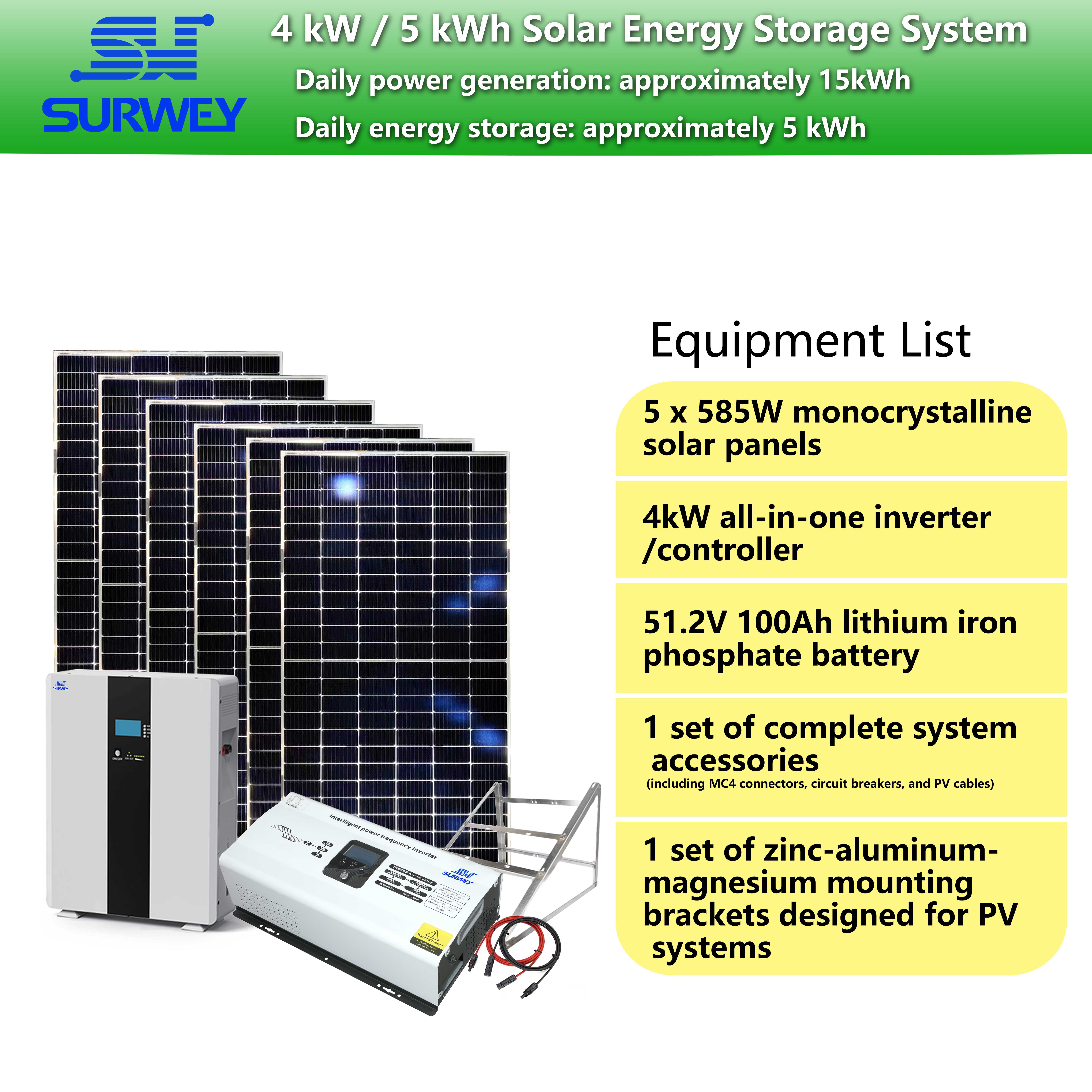
4 kW / 5 kWh Solar Power System Configuration Diagram
Animated Video Explaining How It Works

Wiring Diagram for a 4 kW/5 kWh Solar Power System
II. Selection of Core Equipment and Technical Specifications
(1) Photovoltaic array: 2.9 kW high-efficiency power generation unit
The photovoltaic array consists of five 585W high-efficiency monocrystalline silicon solar modules, with a total installed capacity of 2,925W (approximately 2.9kW). The modules feature high conversion efficiency and excellent low-light performance, making them ideal for outdoor open-air installations. Requiring an installation area of approximately 16 square meters, they can be flexibly arranged on rooftops, open courtyards, and other locations without occupying indoor space, ensuring easy installation.
As the core power generation component of the system, the photovoltaic array converts solar energy into direct current (DC) to charge the energy storage batteries. It also provides a direct DC input to the inverter, prioritizing the power needs of connected loads to achieve self-sufficiency in clean energy.
(2) Off-grid inverter: 4 kW pure sine wave inverter (SW-AR-40)

1. Key Electrical Specifications
Input: AC 165–260 VAC, 45–65 Hz; DC compatible with 48 V storage batteries; supports multiple input sources including solar, grid power, and generators.
Output: Pure sine wave 110/120/220/230/240 VAC, 50/60 Hz; conversion time <3 ms; no switching surges; compatible with all types of sensitive appliances.
Power Characteristics: Supports low-voltage, high-power output, suitable for high-load demands in RVs and off-grid scenarios; perfectly drives a 1000W food waste disposer and a 400W mixer motor in time-sharing operation.
Protection Features: Includes high-voltage, low-voltage, overload, short-circuit, over-temperature, and reverse-connection protection. At 120% overload, the unit sounds a continuous alarm for 10 seconds before shutting down; at >120% overload, it shuts down immediately within 1 second, ensuring comprehensive equipment safety.

Side view of a 4 kW pure sine wave inverter
2. Functional Advantages
Pure Sine Wave Output: The waveform matches that of the utility grid, with no harmonic interference, ensuring no damage to inductive loads such as food waste disposers and mixer motors, thereby extending the equipment’s service life.
Smart Energy Management: Prioritizes power from solar panels, using excess power to charge the battery; when solar power is insufficient, the battery discharges to supplement power; when the battery is low, it automatically switches to utility power or a generator to recharge, achieving optimal energy utilization.
Low-Power Energy-Saving Design: Automatically enters energy-saving mode after 5 seconds of no load, with no-load power consumption of approximately 5W; automatically wakes up when the load exceeds 10W, reducing standby energy consumption.
High-Definition Display Panel: Real-time display of parameters such as input voltage/frequency, output voltage/frequency, battery voltage, load power, and operating mode, facilitating convenient operation and maintenance.

Side view of a 4 kW pure sine wave inverter
(3) Energy Storage Battery: 5 kWh Wall-Mounted Lithium Iron Phosphate Battery (SW-WH-48100)
1. Key Technical Specifications
Electrical Specifications: Rated voltage 51.2V, charge cut-off voltage 58.4V, discharge cut-off voltage 44.8V–46.5V; continuous charge/discharge current 0–120A, meeting the requirements for fast charging and high-load discharge.
Performance Specifications: Utilizes high-quality lithium iron phosphate (LiFePO₄) cells with a cycle life of >6,000 cycles and a design service life of 10 years; features a high safety margin and is resistant to thermal runaway.
Communication and Protection: Equipped with RS232/RS485/CAN communication interfaces, supporting real-time communication and bidirectional monitoring with inverters; includes overvoltage, undervoltage, overload, short-circuit, and overtemperature protection to ensure real-time battery safety.
Installation and Environment: Wall-mounted design with dimensions of 610 × 490 × 160 mm to save indoor space; operating temperature range of -20°C to 60°C, humidity <95%, and altitude <4,000 m, suitable for a variety of installation environments.
2. Adaptability Advantages
Capacity Matching: With a 5kWh capacity, it can store 2–3 hours of full-output power from a solar array, sufficient to power a food waste disposer (1000W) for a single 30-minute operation, a mixer motor (400W) for a single 1-hour operation, and cover basic household electricity needs at night.
High Compatibility: Perfectly paired with the SW-AR-40 inverter, it supports multi-source charging via solar panels, grid power, and generators. The charging current can be adjusted to three levels—15A, 50A, or 80A—to accommodate various charging scenarios.
Safe and Reliable: Lithium iron phosphate (LiFePO₄) battery cells pose no explosion risk, are heat-resistant, and offer high stability. They are suitable for high-risk electrical environments such as kitchens, ensuring safe power supply for food waste processing equipment.
(4) Core Equipment: Food Waste Processing Equipment
Food Waste Disposer: Rated power 1000W. Responsible for grinding and pulverizing food waste, offering high processing efficiency and low noise levels. Suitable for on-site food waste processing in households and small food service establishments.
Mixing Motor: Rated power 400W. Used to mix and blend food waste after it has been ground, facilitating subsequent fermentation and decomposition. Features low power consumption and operates on a staggered schedule to avoid overlapping with the disposer’s power usage.

III. System Operating Principles and Modes
(1) System Architecture
The PV array (2.9 kW) outputs DC power, which is connected to the inverter’s 60A MPPT port. After being rectified by the inverter, this power charges the energy storage battery (5 kWh) while simultaneously supplying power directly to AC loads;
The energy storage battery (5kWh) is connected to the inverter’s DC terminal. When solar power is insufficient, it discharges, and the inverter converts the DC power into pure sine wave AC power to drive the food waste disposer, mixing motor, and household loads;
Mains power serves as an emergency backup channel. When the battery is depleted or solar power is insufficient, the inverter automatically switches to mains power to charge the battery and directly supply power to the loads;
On the load side, a 1000W food waste disposer and a 400W mixing motor are connected on a time-sharing basis, while conventional household loads such as refrigerators, air conditioners, and fans are connected in parallel. The inverter intelligently allocates power to ensure stable operation of all loads.
(2) Four Major Operating Modes
1. Solar Priority Mode (during daylight hours)
2. Energy Storage Discharge Mode (Nighttime / Cloudy or Rainy Days)
3. Grid-tied hybrid mode (insufficient solar power + low battery charge)
4. Emergency Power Mode (Mains Power Outage + Insufficient Solar Power)
(3) Load Shedding Logic
When the disposer is running (1000W), the inverter outputs 1000W, the mixer motor is powered down and put on standby, and the remaining 3kW of redundant power can drive household loads such as refrigerators and fans;
When the mixer motor is operating (400W), the inverter outputs 400W, the food waste disposer is powered off and put on standby, and the remaining 3.6kW of excess power meets the needs of other household loads;
When neither device is operating, the PV system prioritizes charging the battery; once the battery is fully charged, the inverter enters energy-saving mode, with a no-load power consumption of only 5W, reducing standby energy consumption.
IV. System Advantages and Performance Analysis
(1) High efficiency and energy savings; carbon-neutral and environmentally friendly
(2) Stable, reliable, and highly adaptable
Pure Sine Wave Output: The inverter’s output waveform matches that of the utility grid, with no harmonic interference. This protects inductive loads such as 1000W food processors and 400W mixer motors, preventing equipment burnout and extending their service life;
Multiple Safety Protections: The inverter features overvoltage, overload, short-circuit, and over-temperature protection, while the battery includes overcharge, over-discharge, and short-circuit protection. These comprehensive safeguards ensure the safety of both the system and equipment, making it suitable for humid and dusty kitchen environments;
Wide-Range Compatibility: With weather-resistant PV modules, an inverter supporting a wide input voltage range, and batteries designed for extreme temperatures, the system operates stably in environments ranging from -20°C to 60°C, making it suitable for various settings including urban residences, rural courtyards, and remote cabins.
(3) Intelligent Operations and Maintenance, User-Friendly Operation
Automatic Energy Dispatching: The system automatically detects light intensity, battery charge level, and load status, intelligently switching between PV, energy storage, and grid-connected modes without manual intervention, ensuring simple operation and maintenance;
Real-time Data Monitoring: The inverter’s high-definition display shows real-time parameters such as voltage, frequency, power, and energy consumption. The battery supports remote monitoring, allowing users to view the system’s operational status in real time, with automatic fault alerts;
Flexible Installation: The PV array requires only a small installation area of 16 m², the battery features a wall-mounted design, and the inverter is compact (566.2 × 327 × 184.5 mm), taking up minimal indoor space. Installation is quick and cost-effective.
(4) Precise power matching and load adaptation
V. Installation and Maintenance Guidelines
(1) Installation Guidelines
Photovoltaic Array: Install in an unobstructed area with ample sunlight, at an angle of 30°–45°. Maintain a spacing of ≥20 cm between modules to prevent shading; when wiring, clearly distinguish between positive and negative terminals, and ensure proper waterproofing and insulation to prevent electrical leakage;
Inverter: Wall-mount the inverter in a well-ventilated, dry location near the battery, leaving ≥20 cm of clearance on all sides for heat dissipation, and avoid high-temperature environments; Ensure all connections at the AC input/output terminals and DC PV/battery terminals are secure; loose connections are strictly prohibited;
Energy Storage Battery: Wall-mount in a dry, well-ventilated indoor location, away from water sources and heat sources. When wiring, connect the positive terminal first, followed by the negative terminal; reverse this order when disassembling. Ensure communication cables are securely connected to maintain real-time communication with the inverter;
Load terminals: Food waste disposers and mixer motors must be wired separately and equipped with independent circuit breakers for time-based control; when wiring, distinguish between live, neutral, and ground wires, and ensure proper grounding protection to prevent electric shock.
(2) Daily Operations and Maintenance
Photovoltaic Array: Clean dust and debris from the module surfaces regularly (monthly) to prevent reduced power generation efficiency; inspect connection terminals and cables for signs of aging or loosening, and perform waterproofing checks during the rainy season;
Inverter: Check the display parameters daily to ensure that voltage, frequency, and power output are normal; clean dust from the cooling fans regularly (quarterly) to ensure effective heat dissipation; immediately shut down the system and troubleshoot when a fault alarm occurs; never operate the system while a fault is present;
Energy Storage Batteries: Regularly check battery charge level and voltage to prevent prolonged undercharging (below 44.8V) or overcharging; avoid storing in high-temperature or humid environments; maintain a charge level of 50%–70% during prolonged periods of non-use, and recharge once a month;
Load Equipment: Regularly clean internal residue from food waste disposers and mixer motors, and check motor insulation; strictly prohibit overloading to prevent jamming or motor burnout.
VI. Summary of the Proposal
This 2.9kW PV + 4kW inverter + 5kWh energy storage off-grid power supply system is precisely tailored to meet the time-shifted operational requirements of a 1,000W food waste disposer and a 400W mixer motor, while also supporting daily household electricity needs. It offers four core advantages: high energy efficiency, stability and reliability, intelligent operation and maintenance, and environmental sustainability. The system achieves optimal energy utilization through self-generated and self-consumed solar power, energy storage for peak shaving and valley filling, and emergency grid backup, resulting in zero carbon emissions and low operating costs. Suitable for various scenarios such as residential homes, small restaurants, and rural courtyards, it provides green energy support for on-site food waste processing, promoting low-carbon environmental protection and a green lifestyle.
The solution features mature equipment selection, scientifically configured power ratings, and intelligent operating modes. It is easy to install and maintain, offering significant long-term economic and environmental benefits. It serves as an ideal distributed PV-storage power supply solution for food waste treatment scenarios. In the future, PV modules and energy storage battery capacities can be flexibly expanded to meet load growth requirements, accommodating higher-power food waste processing equipment or additional household loads. The system offers strong scalability and long-term value.


