
75 kW PV 50 kW Hybrid Grid-Tied/Off-Grid Inverter 128 kWh Commercial and Industrial Solar-Storage System Technical Solution

75 kW Commercial and Industrial Solar-Plus-Storage System in New Zealand
I. Project Overview
Designed to meet the electricity needs of small and medium-sized commercial and industrial users, this solution employs an integrated configuration comprising 75 kW of photovoltaic modules, an SW-EST50KH three-phase hybrid grid-tied/off-grid inverter, and an SW-G8-128KWH high-voltage rack-mounted energy storage battery. It establishes a green, smart power supply system that combines self-generation for self-consumption, excess power storage, peak-valley arbitrage, emergency backup power, and seamless grid-tied/off-grid switching. Based on an average of 5 hours of effective sunlight per day, the system generates approximately 375 kWh daily, significantly reducing corporate electricity costs and enhancing power supply reliability
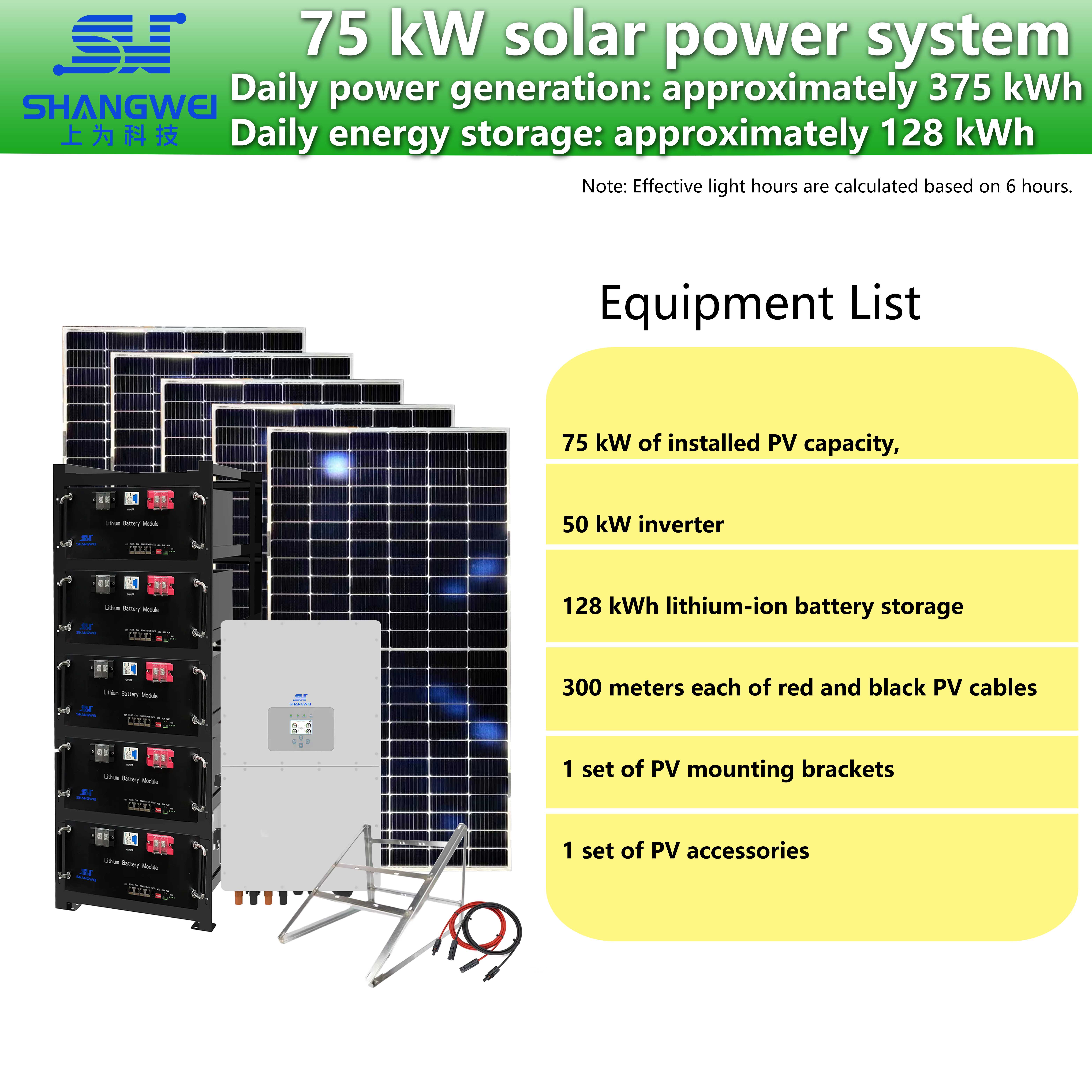
Configuration Diagram for a 75 kW Commercial and Industrial Solar-Storage System
The system employs a DC-coupled architecture with highly integrated photovoltaic and energy storage components. It supports coordinated power supply from multiple energy sources, including the utility grid, solar power, energy storage, and diesel generators. The system features core capabilities such as millisecond-level grid-tied/off-grid switching, intelligent energy management, and remote monitoring and maintenance. It is suitable for applications with high demands for power supply stability and cost-effectiveness, such as factories, retail stores, data centers, office buildings, and agricultural facilities.
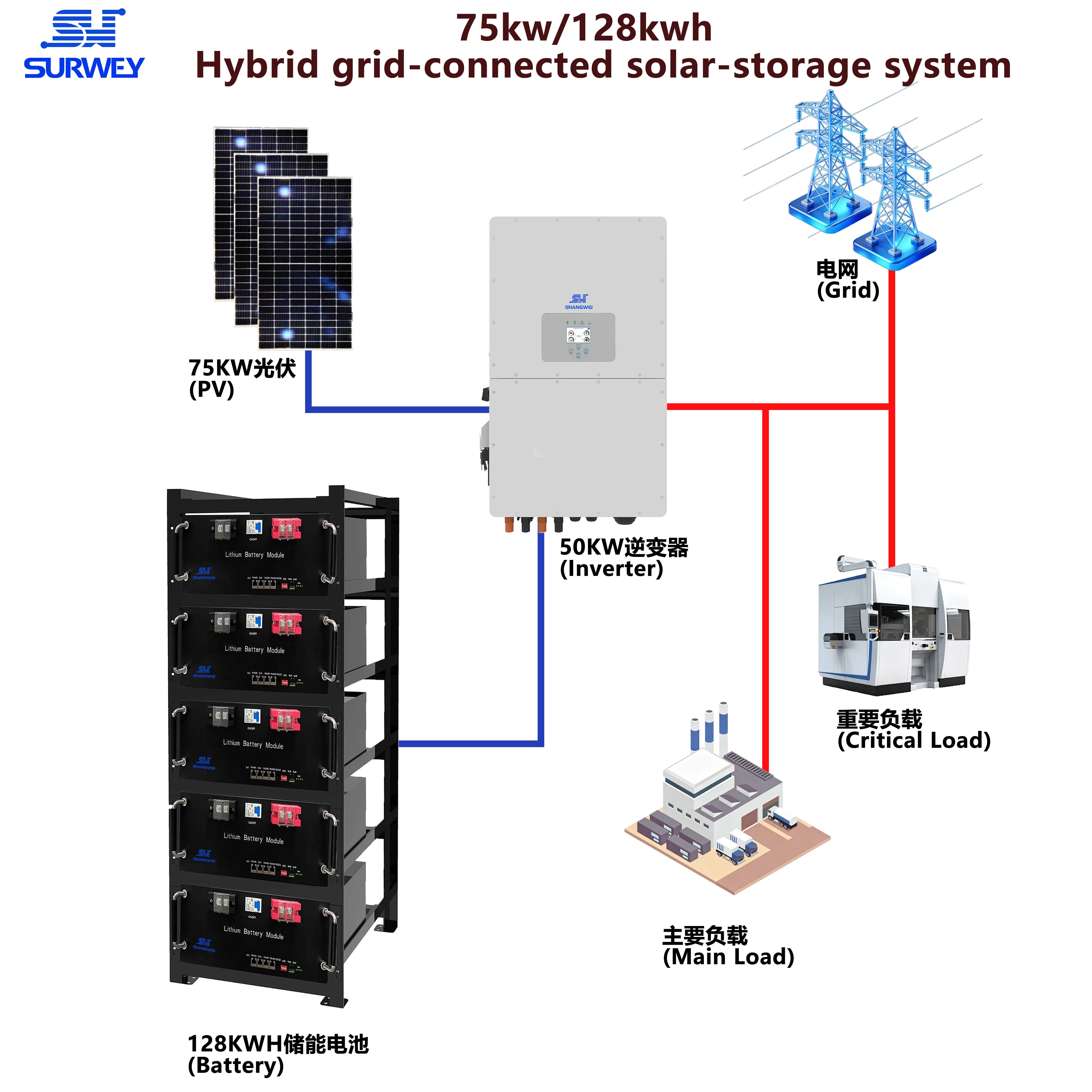
Wiring Diagram for a 75 kW Commercial and Industrial Solar-Storage System
Video of a 75 kW Commercial and Industrial Solar-Plus-Storage System
II. Design Basis and Principles
(1) Design Basis
National and Industry Standards
GB/T 19964-2012 “Technical Specifications for the Connection of Photovoltaic Power Stations to the Power System”
GB/T 36547-2018 “Technical Specifications for the Connection of Energy Storage Systems to the Grid”
IEC 62109-1/-2 “Safety Requirements for Photovoltaic Inverters”
EN 61000-6-1/-2/-3/-4, IEC 61000 Electromagnetic Compatibility Standards
IEC 62619, VDE 2510-50 Safety Standards for Energy Storage Batteries
UN 38.3, MSDS Lithium Battery Transportation and Safety Regulations
Basic Project Parameters
PV Installed Capacity: 75 kW
Inverter Model: SW-EST50KH 50 kW Three-Phase Grid-Tied/Off-Grid Hybrid Inverter
Energy Storage System: SW-G8-128kWh High-Voltage Lithium Iron Phosphate Rack-Mounted Battery Bank
Average Daily Effective Sunlight: 5 hours
Theoretical Daily Power Generation: 75 kW × 5 h = 375 kWh
Grid Connection: Three-phase 380/400 V, 3L/N/PE, 50 Hz
(2) Design Principles
Safe and reliable
End-to-end multi-layer protection and IP65 outdoor rating ensure reliable operation in challenging environments, including extreme temperatures, high humidity, and high altitudes.
Highly efficient and cost-effective
High conversion efficiency and a wide MPPT voltage range maximize the utilization of solar power generation and reduce the cost per kilowatt-hour.
Smart and user-friendly
Features built-in EMS (Intelligent Energy Management System), supporting remote monitoring, updates, and troubleshooting to simplify operations and maintenance.
Flexible scalability
Modular design supports parallel operation of multiple units and power/capacity expansion to accommodate future load growth.
Both on-grid and off-grid compatible
Operates in grid-connected mode when mains power is available and seamlessly switches to off-grid mode during power outages to ensure uninterrupted power supply to critical loads.
III. Core System Configuration and Technical Specifications
(1) Photovoltaic Array Unit
System Configuration: Total installed capacity of 75 kW, utilizing high-efficiency monocrystalline silicon photovoltaic modules. The system is designed in a string configuration and connected to the inverter’s MPPT channels, compatible with the SW-EST50KH’s wide voltage input range to ensure efficient power generation under low-light and high-temperature conditions.
Interface Matching Parameters
Maximum PV Input Power of Inverter: 75 kW
Maximum Input Voltage: 1000 V
MPPT Operating Range: 180–900 V (Rated at 610 V)
Maximum input current per MPPT channel: 36A; independent control of multiple MPPT channels reduces shading losses
String configuration: Multiple strings connected in parallel to ensure voltage and current matching, enhancing system stability
(2) Core Inverter Unit: SW-EST50KH Three-Phase Grid-Tied/Off-Grid Hybrid Inverter
This project utilizes the SW-EST50KH (an optimized upgrade of the original KY-EST50KH) 50kW three-phase grid-tied/off-grid hybrid inverter, which serves as the core of the system’s energy conversion and control. It integrates PV inversion, energy storage conversion, grid-tied/off-grid switching, and EMS management into a single unit.

50 kW Three-Phase Photovoltaic-Storage Hybrid Grid-Tied/Off-Grid Inverter
Key Electrical Specifications
Rated Output Power: 50 kW
Maximum Apparent Power: 55 kVA
AC Rated Voltage: 380/400 V, 3L/N/PE, 50/60 Hz
Maximum Output Current: 79A, supports 100% three-phase unbalanced output
Grid-Tied/Off-Grid Switching Time: <10ms, enabling zero-sensation uninterrupted power supply
Maximum Efficiency: 98.2%, European Efficiency: 97.1%
Cooling Method: Natural convection, ultra-quiet < 40dB
Protection Rating: IP65, all-aluminum chassis, outdoor wall-mounted installation
Operating Temperature: -25°C to +60°C (derated at >45°C)
Operating Altitude: <4000m
Dimensions: 800×875×350mm, Weight: 100kg (excluding mounting bracket)
Core Functional Advantages
Integrated PV and Storage
Integrated PV and storage interfaces, compatible with lithium-ion and lead-acid batteries, simplifying system architecture.
Multi-MPPT Design
Multiple independent MPPT channels enhance power generation efficiency in complex scenarios.
Seamless Switching
Automatic switching between grid-connected, off-grid, and diesel generator modes; supports black start.
Diesel Generator Compatibility
Direct connection to a diesel generator for battery charging ensures backup power in extreme scenarios.
Intelligent Protection
Integrated full protection against DC reverse connection, overcurrent, anti-islanding, AC short circuit, ground fault, insulation monitoring, and surges (DC Class II / AC Class III).
Comprehensive Communication
RS485, CAN, Wi-Fi/4G (optional), supports local USB and remote firmware updates, and integrates with cloud platforms.
(3) Energy Storage Battery Module: SW-G8-128KWH High-Voltage Rack-Mounted Lithium Iron Phosphate Battery Pack

128 kWh High-Voltage Rack-Mounted Lithium Iron Phosphate Battery Pack
Key Battery Specifications
Model: SW-G8-128KWH
Battery Type: LiFePO4 (Lithium Iron Phosphate)
System Rated Voltage: 409.6V
Operating Voltage Range: 332.8–467.2V
Rated Capacity: 128.6kWh
Rated Charge/Discharge Power: 60kW, supports full-power charging and discharging with a 50kW inverter
Charge/Discharge Current: Recommended 100A/100A, Maximum 150A/150A
Peak Discharge: 350A (2 min, 25°C)
Cycle Life: ≥6,000 cycles (25°C, 0.5C/0.5C, 90% DOD, 70% EOL)
Operating Temperature: Charging 0–55°C, Discharging –20–55°C
Communication: CAN 2.0/RS485, seamlessly integrates with inverter BMS interfaces
Protection Rating: IP20, rack-mounted or floor-standing installation
Certifications: CE, IEC 62619, VDE 2510-50, UN 38.3, MSDS
Warranty: 5 years
Advantages of System Matching
Voltage range: 220–800 V; fully compatible with the SW-EST50KH battery port, requiring no additional voltage boosting.
The high-voltage architecture reduces line losses and improves charging and discharging efficiency, making it suitable for high-power commercial and industrial applications.
Supports up to 16 strings in series for flexible capacity expansion to accommodate future load growth.
The intelligent BMS monitors voltage, current, temperature, and SOC/SOH in real time, performs active balancing, and ensures safety and a long service life.
(4) System Support Equipment
DC Cables: PV1-F cables designed specifically for photovoltaic systems, weather-resistant and UV-resistant, meeting current-carrying and insulation requirements.
AC Cables: Flame-retardant and fire-resistant three-phase cables rated for the system’s current, ensuring safe transmission in both grid-connected and off-grid modes.
Lightning Protection and Grounding: DC Class II and AC Class III surge protection; combined grounding resistance ≤4Ω.
Smart Meter: Bidirectional metering, monitoring data on PV grid feed-in, electricity consumption, and energy storage charging/discharging.
Communication Module: Wi-Fi/4G data logger, enabling remote monitoring, data upload, and alarm notifications.
Mounting System: Aluminum alloy / hot-dip galvanized steel mounts, wind resistance rating ≥12, suitable for rooftop / ground-mounted installations.
IV. System Architecture and Operating Principles
(1) Overall Architecture
This system employs a DC-coupled, off-grid hybrid architecture. Core components: PV array → SW-EST50KH hybrid inverter → AC busbar → load / grid Energy storage battery ←→ DC-side diesel generator (optional) → AC-side of the inverter
System integration: Combining five key functions—PV inversion, energy storage charging/discharging, grid interaction, off-grid inversion, and intelligent dispatch—to form a coordinated closed-loop system encompassing generation, grid, load, and storage.
(2) Multi-mode Operation Logic
Grid-connected mode (mains power available)
Solar power is prioritized for direct supply to loads, with excess energy stored in the battery.
Once the battery is fully charged, surplus energy can be fed into the grid (a grid-tie inverter is required in accordance with local regulations).
The system automatically charges during off-peak grid hours and discharges during peak hours, thereby balancing peak and off-peak loads and reducing electricity costs.
Real-time control via the EMS maximizes self-consumption rates and increases returns.
Off-grid mode (power outage)
<10 ms seamless switching
The inverter actively establishes voltage and frequency to support local loads.
Combined PV and battery power supply ensures uninterrupted operation of critical loads.
When sunlight is insufficient, the battery discharges first; if the battery level is low, the diesel generator can be activated to recharge it.
Supports black start, allowing the system to automatically restore power in the absence of grid power.
Combined diesel-electric mode
When the PV system and battery are low on power, the diesel generator automatically starts up to prioritize power supply to the load and recharge the battery.
The diesel generator works in tandem with the inverter to stabilize voltage and frequency, improving power quality while reducing fuel consumption and operational and maintenance costs.
(3) Energy Management Strategy (EMS)
Generation Side: MPPT maximizes solar energy capture; multi-channel independent control reduces string mismatch losses.
Storage Side: Intelligent charging and discharging based on SOC, time, and electricity rates; stores energy during off-peak hours, discharges during peak hours, and maintains power supply during outages.
Load Side: Distinguishes between critical and standard loads; prioritizes power supply to critical equipment during off-grid operation.
Grid Side: Adjusts power factor on demand (adjustable from 0.8 leading to 0.8 lagging), supporting reactive power compensation.
Safety Side: Comprehensive protection against overvoltage, overcurrent, overtemperature, islanding, ground fault, insulation failure, and reverse connection.
V. Projected Electricity Generation and Revenue
(1) Estimation of Electricity Generation
Installed capacity: 75 kW
Average daily effective sunlight: 5 hours
Overall system efficiency: 85% (including losses from the inverter, wiring, shading, and temperature)
Average daily theoretical power generation: 75 kW × 5 hours = 375 kWh
Average daily actual power generation: 375 kWh × 85% ≈ 319 kWh
Annual power generation (based on 300 days): 319 kWh × 300 ≈ 95.7 MWh
(2) Economic Benefit Analysis
Revenue from self-generation and self-consumption is calculated based on the commercial and industrial electricity rate of 0.8 yuan/kWh and a self-generation and self-consumption rate of 80%: Annual electricity cost savings = 95.7 MWh × 80% × 0.8 yuan ≈ 612,000 yuan
Peak-shaving and off-peak charging revenue is calculated based on a peak-to-off-peak price differential of 0.5 yuan/kWh, with an average daily discharge of 50 kWh: Annual revenue = 50 kWh × 300 × 0.5 yuan ≈ 75,000 yuan
(3) Return on Investment
The system has a total lifespan of 25 years and a battery cycle life of ≥6,000 cycles. Based on current electricity prices and subsidy policies, the payback period is approximately 5 years, and the returns over the entire lifecycle are stable and substantial.
VI. Installation, Construction, and Deployment Plan

Installation of a 75 kW Commercial and Industrial Solar-Plus-Storage System in Scotland
(1) System Requirements
Inverter: Outdoor wall-mounted, well-ventilated, unobstructed, free from corrosive gases, IP65-rated for outdoor use.
Battery Bank: Indoor rack-mounted, ambient temperature 0–35°C, well-ventilated and dry, dust-proof and moisture-proof.
PV Array: Orientation preferably due south, tilt angle 25°–35°, avoid shading, and ensure the roof can support the load.
Altitude ≤4000 m, humidity 0–95% (non-condensing), and meet equipment operating specifications.
(2) Construction Process
Site Survey and Load/Safety Assessment
Mounting Foundation Construction and Array Installation
Inverter and Battery Cabinet Positioning and Securing
DC/AC Cable Laying and Wiring
Grounding and Lightning Protection System Installation
System Power-On Testing and Parameter Configuration
Integrated Testing of Grid-Tied/Off-Grid Switching, Charging/Discharging, and Protection Functions
Cloud Platform Integration and Final Acceptance
(3) Key Construction Points
Strictly distinguish between positive and negative terminals to prevent equipment damage caused by reverse DC connection.
Ensure cables are securely connected and properly insulated to prevent overheating and short circuits.
Install batteries according to specifications, and route communication and power cables separately to prevent interference.
Verify each item during commissioning: MPPT tracking, charging and discharging, switching times, protection functions, and communication monitoring.
VII. Protection and Safety Design
(1) Inverter-level protection
DC side: Reverse connection, overvoltage, overcurrent, insulation monitoring, Class II surge
AC side: Overvoltage, undervoltage, overcurrent, short circuit, anti-islanding, Class III surge
System level: Overtemperature, leakage current, overload, unbalanced protection
(2) Battery-level protection
Individual / Total Overvoltage, Overcharge, and Overdischarge Protection
Overcurrent and Short-Circuit Protection During Charging and Discharging
Over-Temperature and Under-Temperature Protection
Balancing Control and Fault Alarms
(3) System-level security
Equipotential Bonding and Reliable Grounding
Integrated Design of Lightning Protection and Grounding
Fire Protection and Ventilation Systems
Remote Real-Time Alarms and Rapid Fault Localization
VIII. Monitoring and Maintenance Plan
(1) Intelligent Monitoring System
Local Monitoring: The LCD touchscreen displays voltage, current, power, SOC, energy generation, operating mode, and error codes in real time.
Remote Monitoring: Cloud platform + mobile app, supporting access via PC or mobile devices, with data visualization and historical trend analysis.
Communication Interfaces: RS485, CAN, Wi-Fi/4G, supporting remote parameter configuration, firmware updates, and fault diagnosis.
(2) Operations and Maintenance System
Daily Maintenance: Regularly inspect cables, connectors, heat dissipation and dust, and keep the environment clean.
Periodic Maintenance: Inspect insulation, grounding and protection functions quarterly; calibrate metering and communication annually.
Intelligent O&M: Automatic system inspection, abnormal alarm and operation report generation to reduce labor costs.
Spare Parts Support: Core parts in stock for fast fault response, ensuring high system availability.
IX. Project Advantages and Application Value
Highly reliable power supply
Seamless switching between online and offline modes, with millisecond-level response times, ensuring critical loads never lose power.
Save on electricity
Self-generation for self-consumption + load leveling significantly reduces electricity bills and demand charges.
High system efficiency
Maximum efficiency of 98.2%, wide MPPT range, and excellent low-light performance.
Easier to deploy
All-in-one design, natural cooling, ultra-quiet operation, IP65-rated for direct outdoor mounting.
More flexible expansion
Modular design, supports parallel operation of multiple units, and allows for on-demand expansion of power capacity.
Smarter Operation
EMS features autonomous scheduling, remote monitoring, and stable, unattended operation.
Environmentally Friendly and Low-Carbon
Replacing grid power with clean energy reduces carbon emissions and helps businesses obtain green certification.
X. Conclusions and Outlook
This 75kW PV + 50kW SW-EST50KH hybrid inverter + 128kWh SW-G8 energy storage commercial and industrial hybrid grid-tied and off-grid system features a scientifically designed solution, a well-balanced configuration, and high compatibility. with an average daily power generation of approximately 375 kWh. It delivers safe, efficient, economical, intelligent, and stable power supply, effectively addressing the pain points faced by commercial and industrial users, such as high electricity costs, unstable power supply, and significant losses due to power outages.
The system features core capabilities such as grid-tied and off-grid compatibility, diesel generator integration, intelligent dispatch, remote operation and maintenance, and flexible scalability. It is suitable for a wide range of scenarios, including factories, retail centers, data centers, office buildings, and agricultural parks. With outstanding economic and environmental benefits, it is the preferred solution for small and medium-sized commercial and industrial users seeking energy self-sufficiency, low-carbon transition, cost reduction, and efficiency improvement.


