
Complete Technical Solution for a 1.5 HP, 48 V Off-Grid Solar Air Conditioning System

48V DC Off-Grid Solar Power Supply System for Air Conditioners
I. System Overview
This solution is a 48V DC off-grid solar power supply system designed specifically for air conditioning. At its core is the SW-35GW/DC 1.5P DC inverter-based solar air conditioner, paired with 585W high-efficiency monocrystalline silicon photovoltaic modules, a 48V/60A MPPT solar controller, and a 10kWh lithium iron phosphate energy storage battery. Together, these components form an integrated off-grid energy solution comprising “photovoltaic power generation — intelligent charge control — Energy Storage & Power Supply — DC Cooling" integrated off-grid energy solution. The system operates independently of the utility grid: during the day, solar panels generate electricity to directly power the air conditioner, with excess power automatically stored in the battery; at night and on cloudy or rainy days, the battery provides continuous power, ensuring 24-hour uninterrupted cooling/heating. It offers advantages such as high energy efficiency, stability, reliability, environmental friendliness, and easy installation, making it perfectly suited for cooling needs in areas without grid coverage or with unstable power supply. It is widely used in remote mountainous regions, islands, deserts, outdoor farming, RVs, shipping containers, and field operations.
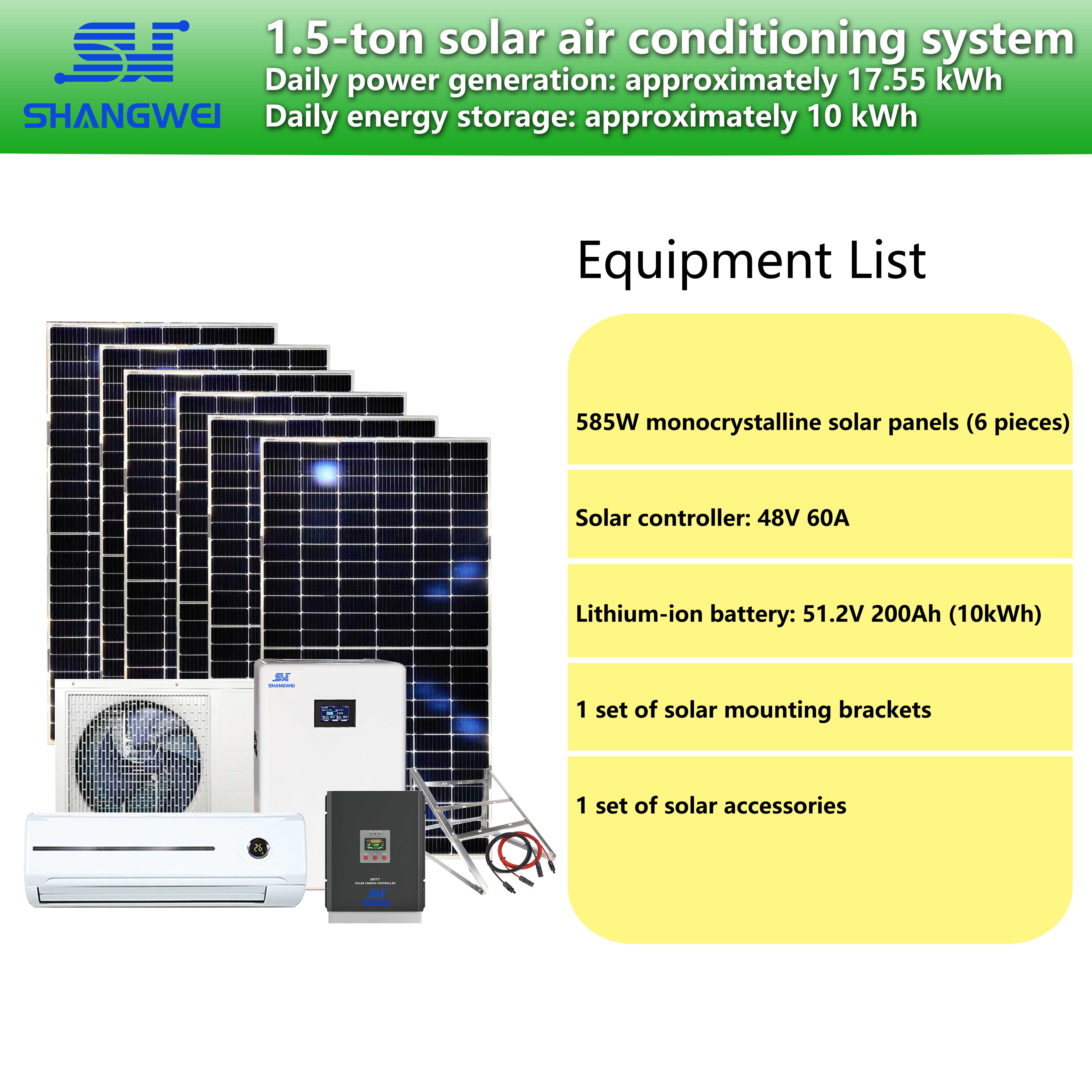
1.5-HP Solar Air Conditioning System Configuration Diagram
The system is designed strictly in accordance with a safe 48V DC voltage, with no inverter losses throughout the process, resulting in a power generation utilization rate that is more than 20% higher than that of traditional AC solar air conditioners; The photovoltaic array generates an average of 17.55 kWh per day, far exceeding the average daily power consumption of a 1.5-ton air conditioner. Paired with a high-capacity 10 kWh energy storage battery, it achieves a closed-loop operation that enables “self-generation for self-consumption, storage of surplus power, and replenishment during power shortages,” completely resolving the challenge of powering air conditioners in off-grid environments.

1.5 HP Solar Air Conditioning System Wiring Diagram
Click→Video of a 1.5-ton solar air conditioning system
II. Technical Specifications of Core Equipment
(1) Main Unit: SW-35GW/DC 1.5 HP 48V Off-Grid DC Solar Air Conditioner
The SW-35GW/DC is a DC inverter wall-mounted air conditioner specifically designed for off-grid photovoltaic systems. By eliminating the traditional inverter conversion process and operating directly on a 48V DC power supply, it is optimized to match the output characteristics of photovoltaic panels and batteries, thereby minimizing energy consumption. It serves as a core component in off-grid cooling applications.

Basic Specifications
Capacity: 1.5 HP
Rated Cooling Capacity: 3.5 kW
Rated Heating Capacity: 3.8 kW
Operating Voltage: DC 48V (Wide voltage range: 40–60V)
Full-Load Current: 25A
Airflow: 600 m³/h
Refrigerant: R32 (Environmentally Friendly)
Protection Rating: Indoor Unit IP20, Outdoor Unit IPX4
Installation Type: Wall-mounted
Key Features
DC Inverter Technology
High-efficiency, energy-saving design
Wide voltage range
24/7 operation
Quiet and low-noise
Eco-friendly and durable
Structural Parameters
Outdoor unit dimensions: 760 × 320 × 510 mm, weight: 26 kg
Communication interface: RS485, supports system-linked monitoring

Solar Air Conditioning System
(2) Photovoltaic Power Generation Unit: 585W high-efficiency monocrystalline silicon solar panels (6 panels)
Component Specifications
Power per panel: 585W
Quantity: 6 panels
Total installed power: 3510W
Panel type: Grade A monocrystalline silicon
Conversion efficiency: ≥23%
Operating voltage: DC 48V system compatible voltage
Protection rating: IP67, wind-resistant, hail-resistant, UV-resistant
Power Generation Performance
System Advantages
High Conversion Efficiency: Monocrystalline silicon offers superior low-light performance, enabling stable power generation during early mornings, evenings, and on cloudy or rainy days, with power output increased by 10%–15% compared to polycrystalline silicon modules.
High Durability: Featuring a double-glass, bifacial design, these modules offer excellent weather resistance and are suitable for harsh environments such as high temperatures, wind and sand, and high humidity, with a service life of ≥25 years.
High Compatibility: With 6 modules configured in series or parallel, the output voltage is perfectly matched to 48V systems and MPPT controllers, eliminating voltage incompatibility issues.
(3) Smart Control Unit: 48V/60A MPPT Solar Controller (SW-MPPT-60)
Key Specifications
Charging Method: MPPT (Maximum Power Point Tracking)
Rated Current: 60A
System Voltage: 48V DC
Conversion Efficiency: ≥97%
Compatible Batteries: Lead-acid batteries, Lithium iron phosphate (LiFePO4) batteries
Communication Interface: RS485
Protection Features: Overcharge, over-discharge, overcurrent, short circuit, reverse connection, and over-temperature protection
Features
MPPT Smart Tracking
Real-time tracking of the photovoltaic array’s maximum power point increases power generation efficiency by 15%–25% compared to traditional PWM controllers, ensuring that every kilowatt-hour of electricity is fully utilized.
Three-stage charging: Intelligent switching between constant current, constant voltage, and float charging precisely matches the charging curve of lithium iron phosphate batteries, preventing overcharging damage and extending battery cycle life.
Intelligent current-limiting protection: When PV power is overloaded, the system automatically adjusts the charging current to ensure the safe operation of the controller, battery, and air conditioner, preventing overload failures.
Bidirectional power management: During the day, priority is given to powering the air conditioner, with excess electricity automatically stored in the battery; once the battery is fully charged, the system intelligently limits the charging current to protect system equipment.
Wide-temperature operation: Designed to operate in ambient temperatures ranging from -20°C to +60°C, ensuring stable performance in high-altitude, cold, and hot regions.
(4) Energy Storage Unit: 10 kWh lithium iron phosphate battery (SW-T512V10KWH-B)
Battery Specifications
Model: SW-T512V10KWH-B
Battery Type: LiFePO4 (Lithium Iron Phosphate)
Nominal Voltage: 51.2V
Rated Capacity: 200Ah
Rated Energy: 10.24kWh
Operating Voltage: 43.2–58.0V
Charge/Discharge Current: Recommended 150A, Maximum 300A
Cycle Life: ≥6,000 cycles (25°C, 0.5C charge/discharge, 90% DOD)
Display: 4.3-inch LCD touchscreen
Communication: RS485, CAN 2.0, Bluetooth, App Monitoring
Protection Rating: IP20
Warranty Period: 5 years
Performance Advantages
Weight: 66 kg
Installation type: Floor-standing
Operating temperature: Charging: 1°C to 55°C; Discharging: -20°C to 55°C
III. How the System Works
This system employs an off-grid operation mode featuring “direct PV supply plus energy storage backup,” providing power entirely via direct current with no inverter losses, thereby maximizing energy utilization. The specific workflow is as follows:
Daytime Power Generation Operation Mode
When sunlight hits the photovoltaic modules, the six 585W modules generate 48V DC power. After voltage regulation and MPPT tracking by the TSW-MPPT-60 controller, this power is used first to directly power the SW-35GW/DC air conditioner. The air conditioner consumes 700W of power, and any excess energy is automatically stored in a 10kWh lithium iron phosphate battery until the battery is fully charged. The average daily power generation is 17.55 kWh. With the air conditioner operating an average of 10 hours per day and consuming only 7 kWh, the remaining 10.55 kWh is fully stored, achieving the goal of “using electricity for free and saving the surplus.”
Power Supply Mode for Energy Storage During Nighttime and Rainy Weather
When there is no sunlight, the system automatically switches to battery power mode. The 51.2V lithium iron phosphate battery releases 48V DC power, which is regulated by the controller and supplied to the air conditioner. The BMS system monitors the battery status in real time to prevent damage from over-discharge. A 10 kWh battery can support continuous air conditioning operation for 14.3 hours, fully meeting nighttime cooling needs. During prolonged periods of cloudy or rainy weather, low-light photovoltaic power generation supplements the battery charge, and combined with battery storage, ensures uninterrupted operation for 3–5 days.
Smart Protection Mode
The system features comprehensive protection functions, including PV reverse connection protection, battery overcharge/overdischarge protection, AC overvoltage/undervoltage protection, short-circuit protection, and over-temperature protection. In the event of any abnormality, the system automatically cuts off power to ensure the safety of personnel and equipment.
IV. System Configuration Advantages
Pure DC with no power loss, resulting in significant energy savings
The system is powered entirely by 48V DC, eliminating the traditional “AC-to-DC” inversion process found in conventional air conditioners. This reduces energy loss by 15%–20% and significantly improves power generation efficiency compared to similar products. With a COP of 5.0, the air conditioner can operate for 1.4 hours per kilowatt-hour of electricity, resulting in an average daily power consumption of just 7 kWh—far lower than that of a traditional 1.5-ton air conditioner.
Ample power generation capacity and long battery life
With a total installed capacity of 3,510 W, the system generates 17.55 kWh of electricity on average per day under 5 hours of sunlight—2.5 times the average daily power consumption of an air conditioner, ensuring a substantial surplus of electricity. The 10 kWh high-capacity battery provides 14.3 hours of runtime at night, eliminating the need for grid power during cloudy or rainy days and enabling true off-grid, independent operation.
High compatibility with equipment; stable and reliable operation
The solar panels, controller, batteries, and air conditioner are all designed to meet 48V system standards, ensuring perfect voltage compatibility and eliminating any compatibility issues. The MPPT controller provides precise charge control, while the BMS battery management system offers intelligent protection. The entire system operates continuously 24/7, 365 days a year without failure, with a service life of at least 10 years.
Eco-friendly, zero-cost electricity
Powered by clean solar energy, it produces zero carbon emissions and zero noise pollution, meeting environmental standards; there are no electricity costs during operation, and the equipment can be recouped within 2–3 years, making it extremely cost-effective for long-term use.
Easy to install and suitable for a wide range of applications
With its all-in-one integrated design, there is no need for complex wiring. A single person can complete the installation, including mounting the solar panel brackets, placing the battery on the ground, and wall-mounting the air conditioner. It operates in ambient temperatures ranging from -15°C to +45°C and can be used in areas without electricity or with limited power supply, such as high-altitude regions, deserts, islands, and remote rural areas.
Smart monitoring, easy maintenance
The battery is equipped with a 4.3-inch touchscreen and a Bluetooth app, allowing you to view parameters such as power generation, battery charge level, air conditioner status, and charging current in real time. The unit has no wear-and-tear parts, and the filter can be washed repeatedly, keeping annual maintenance costs under 100 yuan.

Solar Air Conditioning System Production Line
V. Calculation of System Energy Consumption and Electricity Generation
Photovoltaic power generation
Total installed capacity: 585 W × 6 = 3,510 W Average daily sunlight hours: 5 hours Daily power generation: 3,510 W × 5 h ÷ 1,000 = 17.55 kWh Monthly power generation: 17.55 kWh × 30 = 526.5 kWh Annual power generation: 17.55 kWh × 365 = 6,405.75 kWh
Air conditioner energy consumption
Rated input power: 700W
Daily power consumption (based on 10 hours of operation): 700W × 10h ÷ 1000 = 7 kWh
Monthly power consumption: 7 kWh × 30 = 210 kWh
Annual power consumption: 7 kWh × 365 = 2,555 kWh
Energy Storage Compatibility
Battery capacity: 10.24 kWh
Continuous air conditioning runtime: 10.24 kWh ÷ 0.7 kW = 14.3 hours
Daily surplus power generation: 17.55 kWh – 7 kWh = 10.55 kWh (all stored in the battery)
Conclusion
The system generates far more electricity than the air conditioner consumes; the surplus power can meet energy needs at night and on cloudy or rainy days, eliminating the need for an external power supply and enabling fully off-grid, self-sufficient operation. With ample battery capacity, the system provides enough power to meet round-the-clock cooling needs, ensuring 100% compatibility.
VI. Applicable Scenarios
Off-grid areas
Remote mountainous areas, rural areas, islands, deserts, the Gobi Desert, and other regions without access to the municipal power grid.
Mobile work scenarios
RV, shipping containers, field exploration, construction projects, and outdoor work camps.
Specialized Animal Husbandry / Crop Cultivation
Outdoor livestock sheds, greenhouses, and livestock farms require 24-hour constant temperature control.
Emergency backup
For homes, retail stores, and small offices, to address power outages and power rationing.
Green Energy-Saving Projects
Solar demonstration villages, low-carbon guesthouses, and eco-tourism sites—all striving for zero electricity bills and environmental sustainability.
VII. System Installation and Maintenance
Controller: Install indoors in a dry, well-ventilated area away from direct sunlight, within 1 meter of the batteries for easy wiring connections.
Batteries: Place on a flat, dry, and well-ventilated surface, avoiding high-temperature, humid, or flammable/explosive environments.
Air Conditioner: Install the indoor unit on the wall and mount the outdoor unit on a well-ventilated wall to ensure proper heat dissipation.
Batteries: Check cell temperature and voltage quarterly to prevent overcharging and over-discharging. Maintain a 50%–60% charge level during long-term storage.
Air Conditioner: Clean the air filter every 3 months and check refrigerant pressure annually to ensure operational efficiency.
Wiring: Regularly inspect terminal connections to prevent loosening and oxidation, ensuring a stable power supply.
VIII. Conclusion
This 1.5-ton 48V off-grid solar air conditioning system (SW-35GW/DC) is a mature off-grid energy solution that integrates high-efficiency power generation, intelligent control, large-capacity energy storage, and DC cooling. Its core components utilize industry-leading technology, featuring a scientifically optimized configuration, stable performance, energy efficiency, and eco-friendly durability. With an average daily power generation of 17.55 kWh, the system perfectly meets the power requirements of a 1.5-ton air conditioner. The 10 kWh battery ensures uninterrupted operation around the clock, eliminating the need for grid power and resulting in zero electricity costs, thereby completely resolving the challenge of cooling in off-grid environments.
Whether for daily use in remote areas or emergency support during outdoor operations, this system meets users’ cooling needs with its high reliability, cost-effectiveness, and advanced intelligence, establishing itself as the benchmark configuration in the off-grid solar air conditioning sector.


