
Solar Energy Storage System Solutions for African Households: A Detailed Overview of the 11kW/16kWh Off-Grid Solar Energy Storage System

Residential Solar Power Plant in the Sahel Region of Mali, Africa

10 kW Split-Type Energy Storage System Configuration Diagram
I. Core System Configuration and Architectural Design
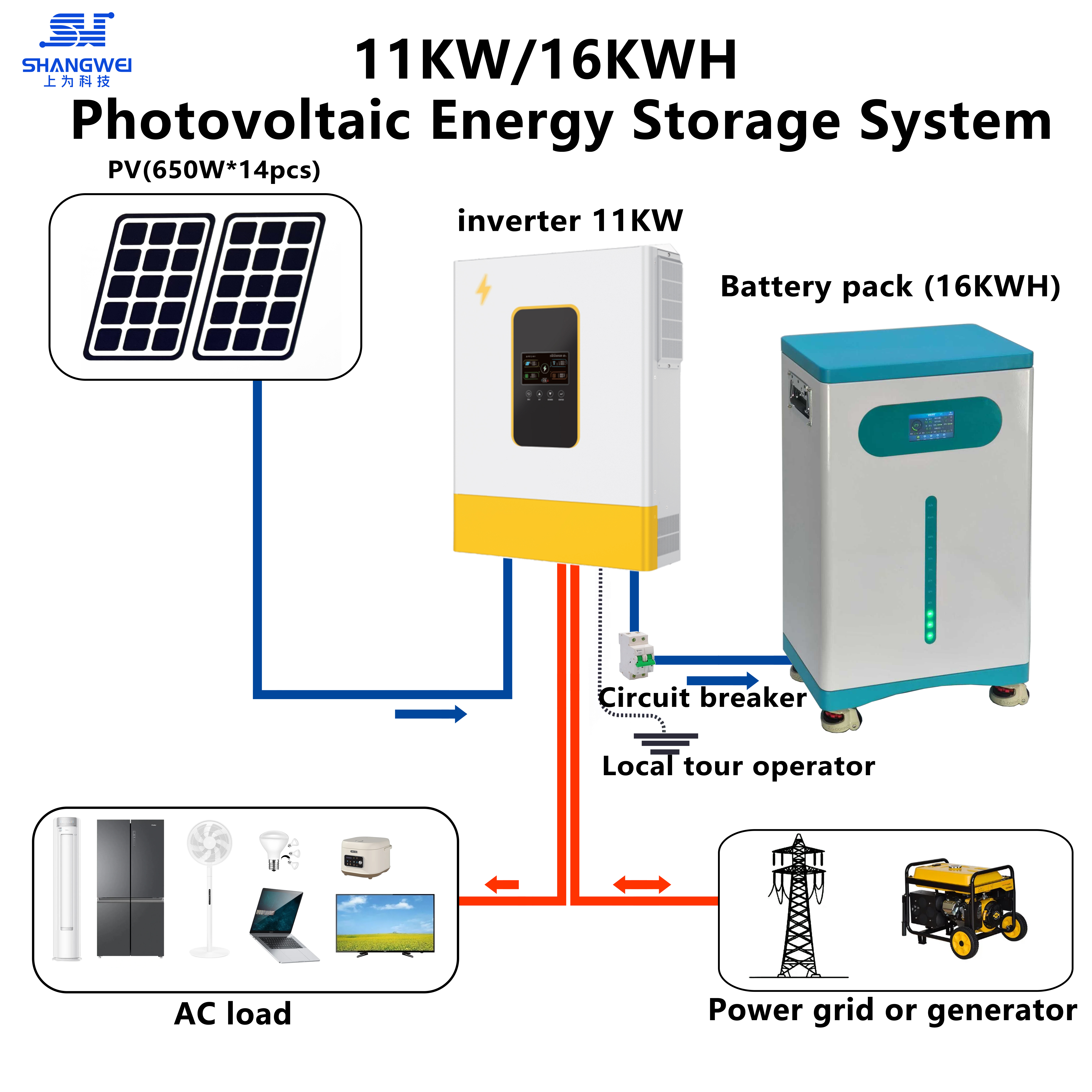
Topology Diagram of a 10 kW Split-Type Energy Storage System
1. PV module array: High-power modules + optimized series-parallel design
Total Array Power and Power Generation Capacity
14 panels × 650 W = 9,100 W (9.1 kW). Assuming an average of 4 hours of effective sunlight per day, the theoretical average daily power generation is 9.1 kW × 4 h = 36.4 kWh, which is sufficient to fully cover a household’s daily electricity needs and provide ample charging power for the battery bank.
Advantages of Series-Parallel Design
Seven modules are connected in series to form a single string, and two strings are connected in parallel to the inverter’s dual MPPT channels. The dual MPPT input design reduces power generation losses caused by partial shading and module mismatch, improves power generation efficiency under complex lighting conditions, and is well-suited for scenarios in parts of Africa characterized by uneven morning and evening sunlight and partial shading.
Component Compatibility
These 650W large-format modules feature high conversion efficiency and excellent low-light performance. In the high-irradiance environments of Africa, they can deliver stable power output over the long term. Additionally, they offer good resistance to PID and weathering, making them ideal for long-term outdoor installation.
2. Core Control Unit: 11 kW SW-EMT1000T-48L PRO Solar Inverter

SW-EMT1000T-48L PRO Solar Inverter
Power and Electrical Performance
With a rated AC output power of 11 kW and a peak output power of up to 22 kW, this unit can handle the simultaneous operation of home air conditioners, refrigerators, televisions, lighting, and small kitchen appliances. It features short-term overload capacity and is designed to handle the inrush current associated with inductive loads. The AC output is a pure sine wave at 220 V/230 VAC, with an output voltage accuracy of ±2% and a frequency stability of ±0.5 Hz, ensuring the stable operation of precision home appliances.
MPPT Solar Charging Performance
Features a built-in MPPT charge controller with a maximum current of 160A and a maximum PV input voltage of 500 Vdc, compatible with the input voltage range of two-string PV modules. With an MPPT efficiency of up to 99.9%, it enables highly efficient capture and conversion of solar energy. It supports dual MPPT inputs, with two independent MPPT channels capable of connecting two strings of PV modules respectively, thereby improving power generation utilization. It also supports switching between PV-priority charging and battery-priority power supply modes.
Battery Compatibility and Management Features
Designed specifically for 48V DC battery systems, it supports the integration of lithium iron phosphate (LiFePO₄) battery packs. With a built-in BMS communication interface, it enables data exchange with the battery pack’s BMS to monitor battery voltage, current, and temperature in real time, providing protection against overcharging, over-discharging, overcurrent, and overheating. It also supports battery balancing, optimizing cell consistency within the pack and extending cycle life. Designed to meet the charging requirements of 16kWh lithium-ion battery packs, it delivers a maximum charging current of 160A, enabling a full charge in as little as 4 hours to ensure uninterrupted power supply.
Multi-tasking and Expandability
Supports multiple operating modes, including solar priority, grid priority, battery power, and generator backup. In scenarios where the African power grid is unstable, it can seamlessly switch between power sources to ensure uninterrupted power supply to the load. Equipped with an RS485 communication interface, it enables remote monitoring and parameter configuration. When paired with a Wi-Fi module, it allows users to remotely view power generation data, battery status, and energy consumption via a mobile app. It also supports a generator interface, enabling external generator backup during extreme rainy or cloudy weather to enhance system reliability.
Environmental Adaptability and Protective Design
With an IP21 protection rating, it offers dust and moisture resistance, making it suitable for high-temperature, dusty outdoor and semi-outdoor installation environments in Africa. It operates within a temperature range of -10°C to 55°C and can run stably for extended periods in Africa’s hot climate. Equipped with a built-in cooling fan and overheat protection, it automatically derates in high-temperature environments to prevent equipment damage.
3. Energy Storage Unit: 16 kWh, 51.2 V, 314 Ah lithium iron phosphate battery pack

16 kWh, 51.2 V, 314 Ah lithium iron phosphate battery pack
Capacity and Discharge Capability
Rated capacity: 16,076 Wh (approx. 16 kWh), nominal voltage: 51.2 V, continuous discharge current: 200 A, The peak discharge capacity can meet the continuous output requirements of an 11kW inverter. When fully charged, the battery pack can support a continuous power supply for an 11kW load for approximately 1.4 hours, or meet the continuous power supply needs of a 3–5kW basic household load for 3–4 hours, ensuring power supply during nighttime and power outages.
Battery Performance and Lifespan
Featuring lithium iron phosphate (LiFePO₄) cells, the battery offers a cycle life of over 8,000 cycles—significantly longer than traditional lead-acid batteries. It exhibits excellent thermal stability and safety in Africa’s high-temperature environments, with no risk of thermal runaway. It supports a wide charging and discharging voltage range, with a charge termination voltage of 58.4V and a discharge termination voltage of 44.8–46.5V, making it compatible with inverter charging and discharging control strategies. Additionally, it features a built-in BMS (Battery Management System) that provides cell voltage balancing, overcharge and over-discharge protection, overcurrent protection, and temperature protection, thereby preventing lifespan degradation caused by overcharging or over-discharging.
Ease of installation and maintenance
Featuring a wheeled, all-in-one design with built-in casters and a touchscreen, this unit requires no complex battery racks for installation and allows for flexible relocation. Equipped with Bluetooth and Wi-Fi modules, it enables remote battery status monitoring. It comes standard with RS232/RS485/CAN communication interfaces, ensuring seamless communication with inverters and guaranteeing coordinated system operation. It also features a wide operating temperature range of -20°C to 60°C, making it suitable for the extreme temperature fluctuations common in African regions.
II. System Operating Modes and Operational Logic
1. Daytime Solar Power Priority Mode
2. Battery Discharge Emergency Mode
3. Mains Power / Generator Boost Mode
III. The System’s Adaptability Advantages in African Household Settings

Off-Grid Solar Power System for Rural Health Clinics in Cameroon
1. High degree of alignment between power generation and load
2. Strong environmental adaptability and high reliability
3. Ease of Maintenance and Cost Advantages
IV. System Application Scenarios and Value Proposition
V. Conclusion


