
Four Panels for a Peaceful Night: A Small Upgrade in the Colombian Mountains
The rain hadn’t started yet as we drove uphill.
Afternoons around Antioquia are always like this: the sky is an almost unnatural shade of blue, and clouds line up along the opposite ridge, as if waiting for a signal to roll down. At roughly 1,300 metres above sea level, the air feels cool. The sun burns your forearms, yet the wind carries a chill. We were heading to a hillside home where the family grows coffee and raises a few cattle.
The yard is modest. There is one dwelling, plus a shed for drying beans and storage. Beneath the shed eaves hangs an old diesel engine, rusted so badly its age is impossible to tell. I still cannot work out exactly how old it is; the homeowner said it had belonged to his father. Next to it sits a diesel drum, its opening covered with a scrap of cloth.
This was what our new system was meant to replace.
 PV Panel Installation Diagram
Power Outages Are Not Accidents — They Are Part of the Routine
In cities, a blackout counts as a fault. Here, it is simply the schedule.
The lady of the house spoke calmly. Three or four nights a week, the lights cut out on their own. Sometimes it lasts half an hour, sometimes the whole night. Meat from the fridge has to be taken to a neighbour’s house or cooked and eaten the same day. The children do their homework by the light of phone torches, and I did not dare ask where those phones get charged.
When that diesel engine fires up, the whole village knows the household is running on fuel. It is loud and reeks of fumes, and by nightfall the whole house reeks of smoke. It powers the fridge, several light bulbs, an old television and a small water pump. But when all these appliances start together, the engine shakes violently and the lights flicker along with it.
So the goal was simple: to free this family from relying on the weather for power after dark.
First, Tally Every Watt They Use Each Day
Many people approach these systems backwards, starting by asking how many loads a given number of panels can support. The right order is to list the loads first, then design the setup.
We squatted inside the house and went through every appliance one by one. The old double-door fridge cycles its compressor on and off, consuming a little over 1 kWh daily. Five LED bulbs draw less than 10 watts combined and run five or six hours each evening. A fan is only used on muggy rainy nights. The television plays cartoons for the children for around two hours each night. The water pump is not used daily; it runs for just ten-odd minutes every few days to fetch water, though its power draw is high while active.
All in all, their actual evening demand sits at roughly 1.5 kWh per day, with low peak power — the only sharp spike comes when the fridge compressor kicks in.
This figure matters greatly. It means the battery does not need to be oversized, and all heavy power-consuming tasks should be completed while the sun is up.
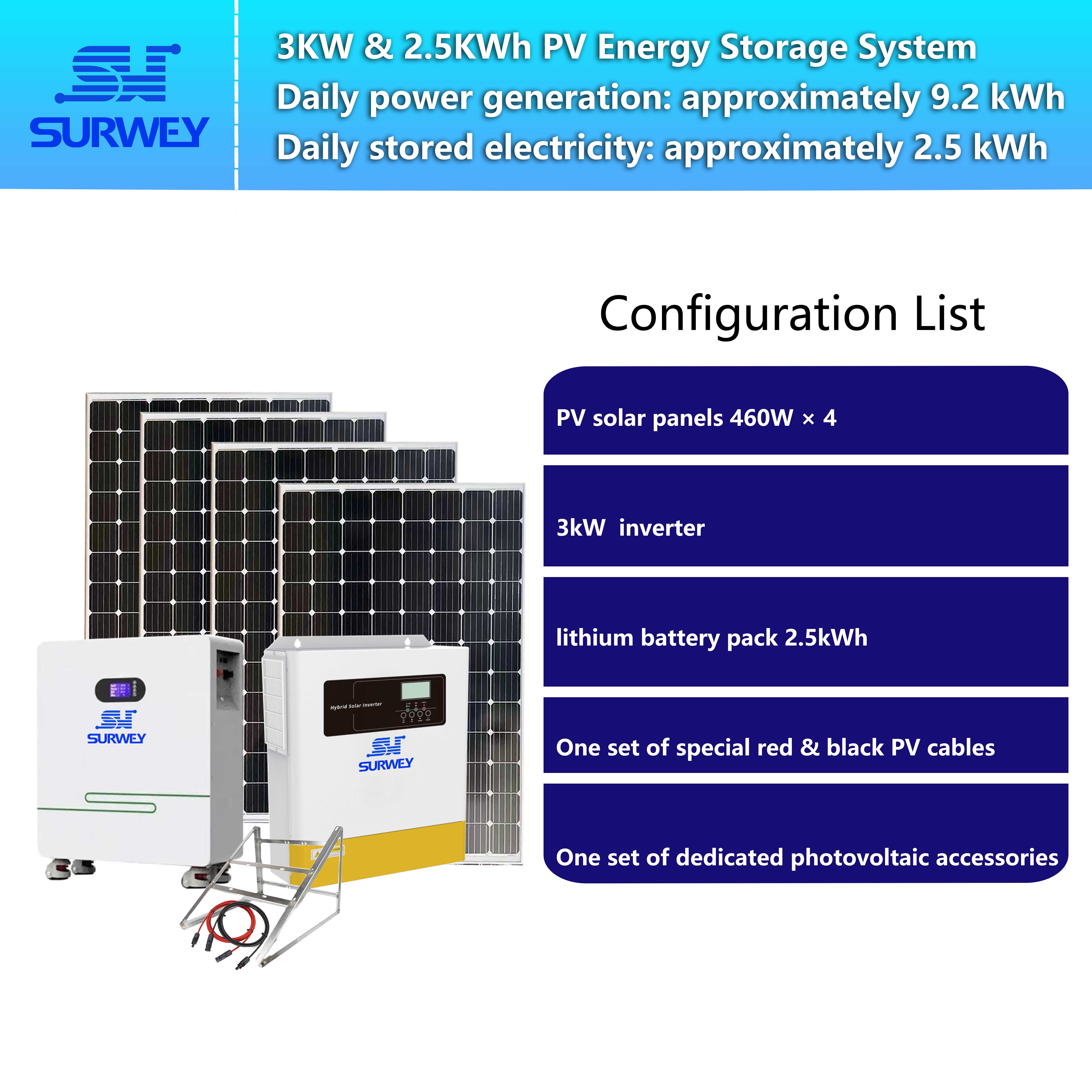
Four Panels: Why Two Strings in Parallel
On the solar side, we used four 460W N-type monocrystalline modules with 108 cells and a conversion efficiency of 23.0%. Each panel measures 1762 × 1134 mm and weighs 24.5 kg, manageable for two people to carry and install.
Rated specs for a single module under standard test conditions — 1000 W/m² irradiance and a cell temperature of 25°C — are as follows: open-circuit voltage 39.85 V, maximum power voltage 34.31 V, short-circuit current 14.59 A, operating current 13.41 A. Outdoors at midday in full sun, the rear of the panel heats up, pulling output down. Sustained real-world output around 400W is excellent, and we set realistic expectations from the start to avoid disappointment later.
The wiring configuration: two panels wired in series to form one string, with the two strings connected in parallel, feeding all four modules into the inverter’s PV input. We considered wiring all four in series, which would bring the open-circuit voltage close to 160V. While still within the MPPT range, this higher voltage imposes stricter requirements for cable insulation and site safety. Splitting into two parallel strings keeps voltage lower for safer on-site wiring. What is more, the two branches operate independently. Partial shading on one string will not disable the entire array, offering better fault tolerance.
When paired in series, each string hits a maximum power voltage of 68.62 V and an open-circuit voltage of 79.7 V, neatly falling inside the inverter’s 60 V to 500 V MPPT tracking window. In mountain valleys with limited effective sunshine hours, the voltage easily clears the startup threshold at dawn, allowing charging to begin as soon as there is daylight.
Combined in parallel, the total operating current reaches 26.82 A, nearly touching the inverter’s PV input limit of 27 A, leaving very little margin. During installation, the two strings must be aligned at identical tilt and azimuth with no shading between panels. Mismatched current between the strings will trigger current limiting and waste generation.
The mounting tilt was fine-tuned for the local latitude. Close to the equator, steep tilts are unnecessary, yet laying the panels completely flat invites dust buildup that rain cannot wash away. All four modules face the same direction to keep light conditions identical for both strings — critical for stable power generation in this series-parallel design.
The 3kW Unit
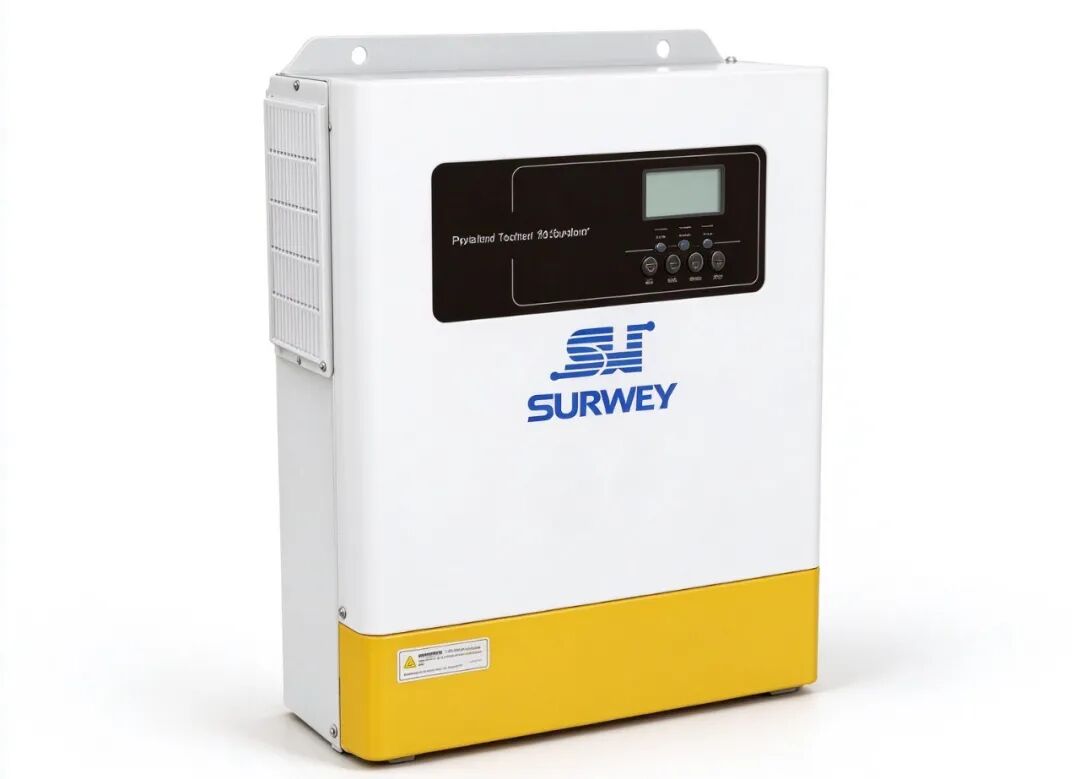
This is a 3 kVA / 3 kW pure sine-wave inverter, rated for 110/120 V, 60 Hz. This specification matches Colombia’s grid directly, removing the need for an extra transformer and cutting complexity.
Several features stand out.
First, surge capacity. The continuous rating is 3kW, yet it can hit 6 kVA instantaneously. This headroom handles the inrush current when the water pump or fridge compressor starts. Without it, the unit would trip at the worst possible moment.
Second, transfer speed. Switching between grid and battery takes 10 ms, extended to 20 ms for motor loads. The number sounds abstract, but in practical terms: the lights flicker briefly, electronics do not reboot, and the fridge keeps running. For a household, those milliseconds separate “barely noticeable” from disruptive outages.
Third, efficiency. Peak efficiency hits 97% when powered directly by solar, and 93% when drawing from the battery. Solar supply is more economical than battery discharge after dark, a fact that shaped how we scheduled their power use.
Fourth, integrated battery management. Separate charge paths are built in for solar and grid power: up to 100A from solar and 60A from the grid. Float charging sits at 27V, with overcharge protection activating at 32V. If cloudy weather drags on for days, the inverter can top up the battery from the grid automatically with no manual oversight.
Its build is utilitarian: 371 mm wide, 327 mm tall, 114.5 mm deep, weighing 6.9 kg. It can be lifted with one hand and wall-mounted inside the shed. Its IP21 rating means it must be sheltered from rain, a point we emphasised twice to the homeowner.
It comes with wireless connectivity and a serial port. Signal is spotty up in these mountains, so we did not rely on remote monitoring, though the interfaces remain available.
One 2.56 kWh Battery — Why Just One
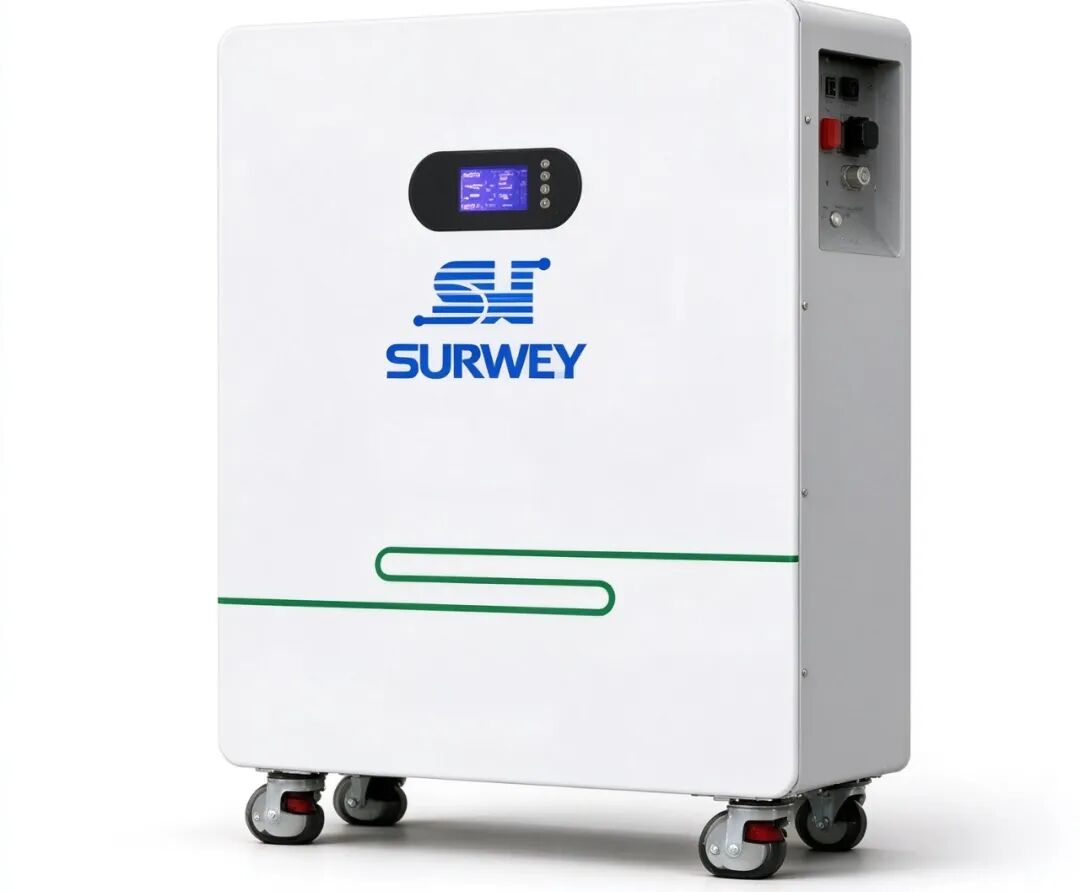
The energy storage is a lithium iron phosphate battery: 25.6 V, 100 Ah, equal to 2.56 kWh. Wall-mounted and weighing 28 kg, it is awkward for one person to carry but easy for two. With an IP54 rating, it withstands damp wall conditions better than the inverter.
Three key parameters define its operating limits.
First, depth of discharge: 80%. That means roughly just over 2 kWh of usable capacity from the 2.56 kWh pack. Draining it further shortens service life, so we avoid that.
Second, maximum charge and discharge current: 100A. This seems generous on paper, yet it sets a hard boundary. At a full 3kW load, the battery-side current rises above 120A and exceeds the limit. Full-load operation therefore requires solar input to supplement the battery; the single battery alone cannot sustain peak output. For night-time use, we capped total power draw below 2.3kW to stay safely within bounds.
For the same reason, we limited charging current to roughly 50A rather than maxing it out. Slower charging preserves battery lifespan, much like pacing a meal.
Third, cycle life: rated for 6,000 cycles at 80% depth of discharge. That figure should not be taken as an absolute guarantee, but the intent is clear: this is not a battery intended for replacement every couple of years. Its design lifespan is listed at ten years, and I treat that claim with cautious optimism.
Why one battery instead of two? Returning to our load calculation. Nighttime consumption hovers around 1.5 kWh, and the 2 kWh usable capacity of this single battery covers the requirement with a small safety buffer. A second battery would sit idle most of the time, dead weight and unnecessary expense. For this application, storage should be sized just enough to get through the night — larger is not always better.
The battery supports parallel connection of up to 16 units. If they later add air conditioning or small processing machinery, expansion is straightforward with standard connectors. No permanent decision needs to be made today.
System Operation Principle Video
When the System Switched On
We closed the breaker for the first time at dusk, just as the sun sank behind the far ridge.
For two quiet seconds after the lights came on, then the child reacted first and ran to turn on the television. The fridge hummed as it started and settled into a steady rhythm. The lady of the house stood in the doorway, watching the silent old diesel engine under the eaves.
We stayed until around ten thirty that night. Voltage held stable; the fan ran without buzz, and the TV picture stayed flicker-free. When I checked the battery at 22:30, it still held more than 60% charge. At seven the next morning, as sunlight touched the valley, the charging indicator lit up.
I logged readings over the following days. At midday on clear days, solar output settled around 1,500W, lower than the theoretical 1,840W total array rating, as expected. Daily generation lands near 6 kWh, enough to run the fridge, pump, television and fan through the day, with an extra 2–3 kWh stored in the battery. Night discharge sits between 1.4 and 1.6 kWh, leaving residual capacity by morning. After two consecutive cloudy days, grid charging kicked in automatically and brought the battery back to 70% without the homeowner noticing.
This is the ideal state for such a system: it works so reliably that people stop thinking about it.
Limitations of the Setup
This configuration is not universal, and its compromises are clear.
The small battery is the most obvious trade-off. If the family installs air conditioning or small threshing and grinding equipment later, this single pack will no longer suffice and expansion will be required. Our choice was not a theoretical “optimum”; it was sized precisely for their present loads.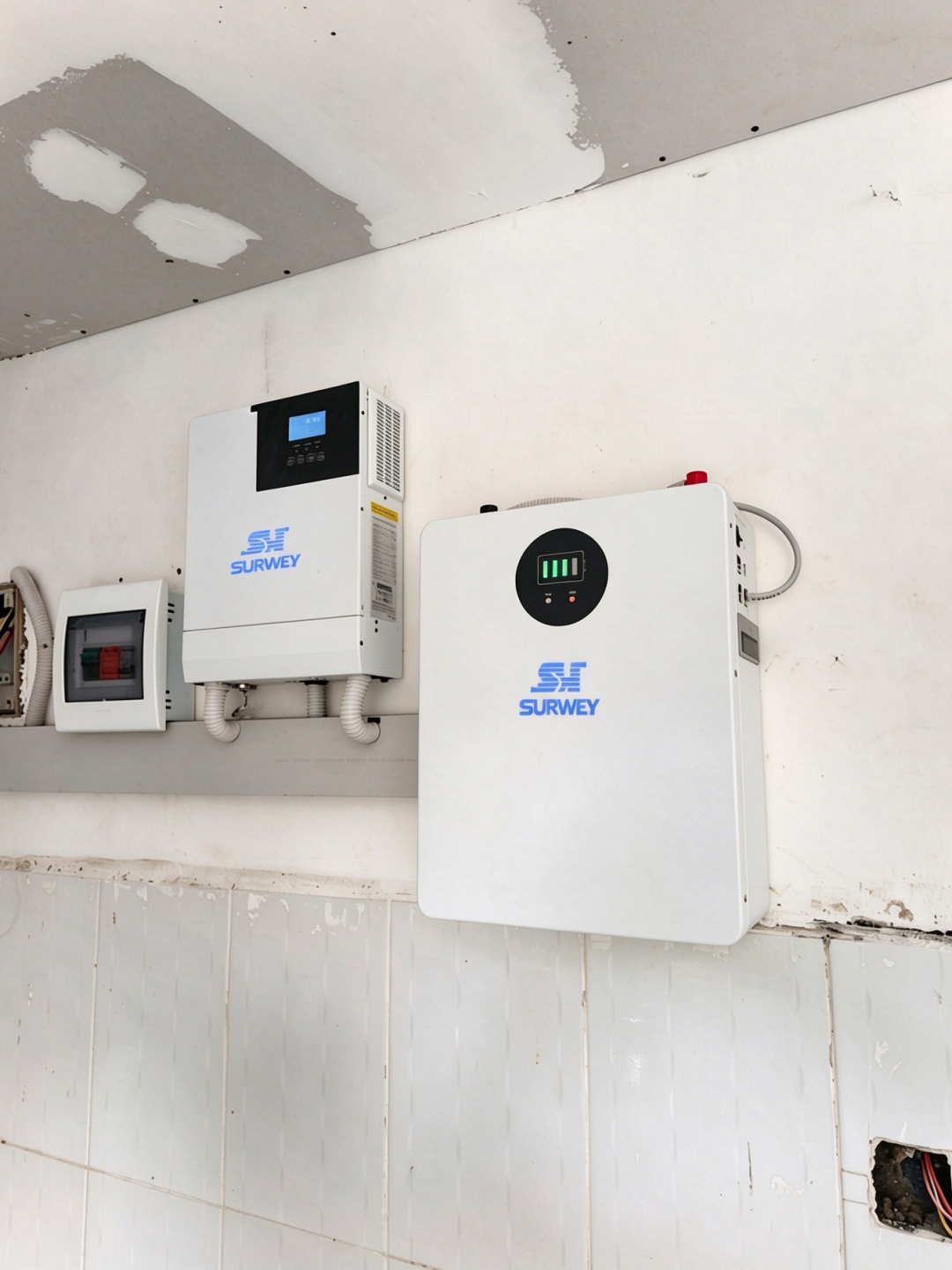
Key PV Equipment Indoor Installation Diagram
Four panels totalling 1,840W paired with a 3kW inverter may look like a tight generation budget on paper, yet daytime loads are modest, and extra panels would go unused. The real bottleneck is not the solar array, but battery capacity and charge current.
Another consideration: on Colombia’s 110V 60Hz grid, ageing wiring and chronically low line voltage are common. The inverter accepts a wide input range, yet grid charging efficiency drops when supply voltage stays persistently low. This stems from local wiring conditions rather than equipment faults, which we explained to the homeowner without being able to resolve the underlying issue.
We also skipped commissioning remote monitoring. Mobile connectivity in these hills is intermittent. Rather than hand them an unreliable dashboard, we taught them to read the indicator lights on the unit.
Closing Thoughts
Rain started falling again as we drove back down the mountain. As the vehicle pulled away from the village, the light in that shed stayed visible in the rear-view mirror.
I have long believed that the value of this kind of work cannot be found on datasheets. Specifications prove a system functions, but they cannot show what it means to people. It means a woman no longer fumbles for candles after dark. It means a child can do homework without worrying about remaining phone battery.
Four panels, one 3kW inverter, one 2.56 kWh battery. Small numbers, yet they hold the night steady for this family.


