
Namibia 8kW Household Off-Grid Backup & Grid-Tied Self-Consumption PV Energy Storage System
This project is implemented in Namibia. The local municipal power grid suffers from insufficient power supply stability with frequent voltage fluctuations and short-term power outages, making it difficult to guarantee continuous daily household power consumption. To improve residential power supply conditions, this project designs a single-phase hybrid grid PV energy storage power supply system. Solar energy is captured by PV modules, surplus electric energy is stored in energy storage batteries, and an 8.5kW hybrid inverter/controller completes power conversion, energy dispatch and system protection.
Combined with the local sunshine and temperature environmental characteristics, this scheme optimizes the PV string wiring topology, and is equipped with low-voltage wall-mounted energy storage batteries with a total capacity of 15kWh. The system supports grid-tied self-consumption and automatically switches to off-grid mode to supply power to critical loads when the grid fails.
This paper fully demonstrates the system electrical parameters, power generation estimation, load power supply capacity and equipment selection, as well as operation logic, to ensure the system is safe, reliable, adapted to the local climate and reduces long-term electricity costs.
1. Project Overview
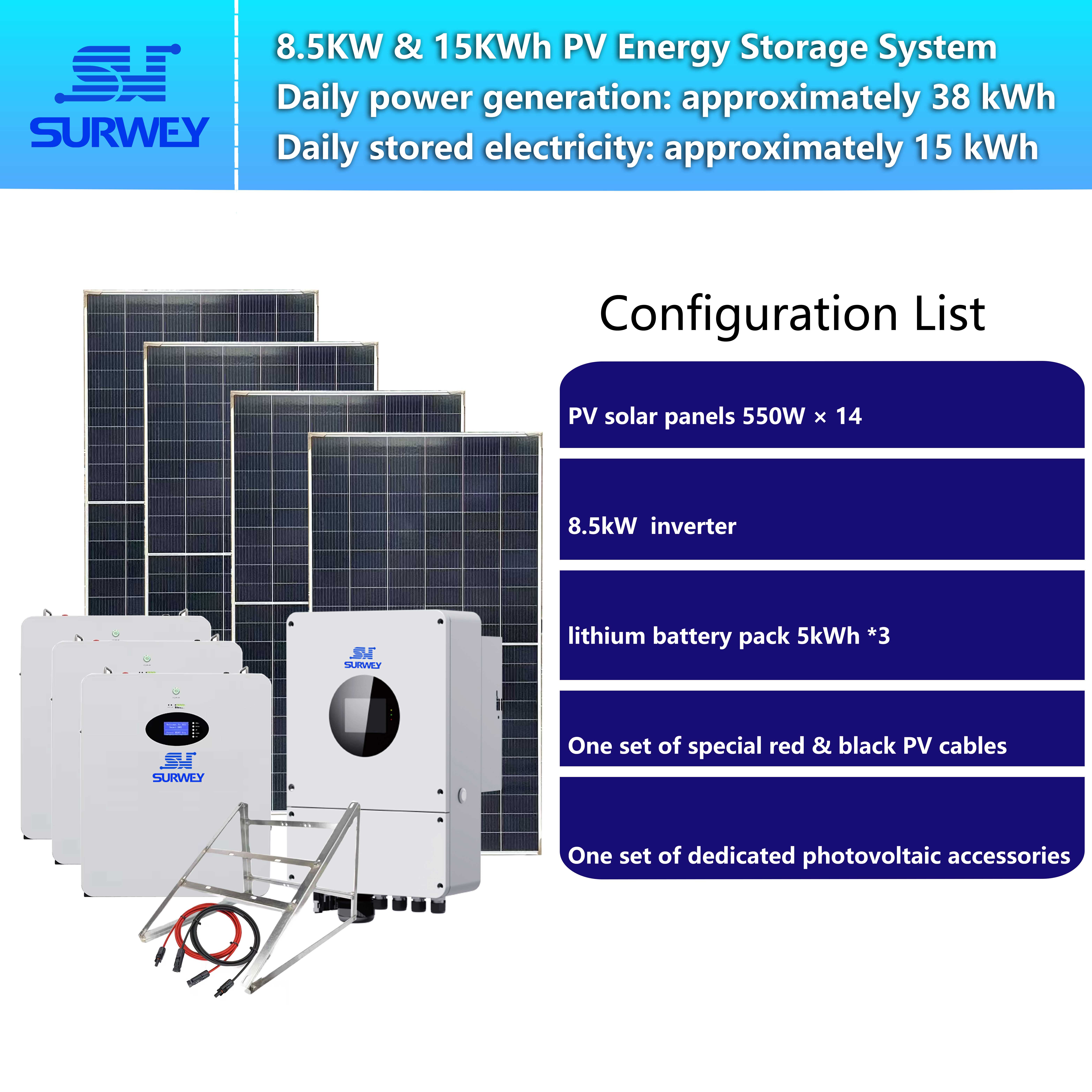
This project is a household hybrid grid PV energy storage system in Namibia, configured with 14 pieces of 550W PV modules, an 8.5kW single-phase hybrid grid inverter/controller and low-voltage wall-mounted lithium batteries with a total capacity of 15kWh. The system achieves an average daily power generation of 38 kWh, with 15 kWh of electricity stored in the energy storage per day. It supports automatic switching between grid-tied and off-grid modes to guarantee uninterrupted power supply for important household loads.
2. Overall System Configuration and Main Equipment Introduction
Overall system configuration: 14 pieces of 550W PV modules, connected as 2 parallel strings with 7 modules in series per string to access the MPPT port of the 8.5kW hybrid inverter/controller. For the energy storage section, 3 units of 5kWh low-voltage wall-mounted lithium batteries are connected in parallel, with a total energy storage capacity of 15kWh. The specification of a single battery is 51.2V/100Ah with a cycle life ≥ 8000 times.
 Roof PV Module Installation Diagram
Monocrystalline high-efficiency PV module. Under STC condition, the maximum power is 550W, Vmp=42.54V, Voc=50.34V. It features excellent sand and high temperature resistance, suitable for the high solar radiation environment in Namibia. The module frame adopts anodized aluminum alloy with IP68 junction box for high reliability, and can stably output DC power under a wide range of irradiation conditions.
8.5kW Hybrid Inverter/Controller

Single-phase 48V hybrid grid inverter/controller, integrating MPPT PV controller, inverter and battery management unit. The MPPT voltage operating range is 60~450VDC, and the maximum PV open-circuit voltage is 500VDC. It supports automatic dual-mode switching between grid-tied and off-grid, equipped with WIFI remote monitoring, built-in full set of protections including overvoltage, overload, short circuit and over-temperature, and can coordinate energy among PV, battery and grid.
15kWh Low-Voltage Wall-mounted Energy Storage Battery

Composed of 3 sets of 5kWh lithium batteries, wall-mounted installation saves indoor space. Nominal specification: 51.2V/100Ah. The low-voltage architecture improves on-site construction safety. It has fast charge-discharge response and long cycle life, and can store surplus PV power to supply loads on cloudy days, at night or during power outages. It is equipped with a built-in BMS battery management system to monitor cell status in real time.
3. Electrical Parameter Verification of PV Strings
PV wiring of this scheme: 7 pieces of 550W modules are connected in series as one string, with 2 strings in parallel to access the MPPT channel of the 8.5kW hybrid inverter/controller.
STC parameters of a single module: Vmp=42.54V, Voc=50.34V. After 7 modules in series per string: operating voltage Vmp=7×42.54V=297.78V; open-circuit voltage Voc=7×50.34V=352.38V. The voltage is within the inverter MPPT operating range of 60~450VDC and lower than the maximum allowable PV open-circuit voltage of 500VDC of the inverter, meeting voltage safety requirements. All electrical parameters of the strings fall within the allowable range of the inverter MPPT without risks of overvoltage or overcurrent, and MPPT can stably track the maximum power point.
The total installed capacity of the system is 14×550W=7.7kW. Considering the local equivalent sunshine duration, module temperature attenuation, cable loss, dust shading and other comprehensive derating factors, the estimated average daily power generation of the system is 38 kWh. The 2-parallel-string topology has better fault tolerance. Partial shading on one string only affects the output of this string, while the other string can still generate power normally.
4. System Operating Principle
This hybrid grid PV energy storage system has two operating modes: grid-tied and off-grid. The 8.5kW hybrid inverter/controller serves as the core energy management unit to coordinate energy flow among PV array, energy storage battery, municipal grid and indoor AC household loads.
System Working Principle Video
During daytime with sufficient sunlight, the 550W PV array converts solar energy into DC power, which is sent to the MPPT port of the hybrid inverter/controller. The MPPT module continuously tracks the maximum output power of the PV array. The electricity generated by PV is preferentially supplied to indoor AC loads. When PV generation power exceeds the current load consumption power, the surplus DC power charges the 15kWh energy storage battery until the battery reaches the charge cut-off voltage. This project is designed to store 15 kWh of electricity per day.
When sunlight fades, such as in the evening, on cloudy days or at night without sunlight, the system automatically draws power from the energy storage battery. The DC power output from the battery is inverted into standard AC power by the hybrid inverter/controller to supply loads. When the battery SOC drops to the set protection threshold, the system automatically switches to municipal grid power supply, and the grid can recharge the battery as required.
When the municipal grid operates normally, the system works in grid-tied mode with PV self-consumption, and the energy storage completes charging and discharging according to the power consumption strategy. Once the grid loses power, the hybrid inverter/controller quickly detects the voltage loss signal, disconnects from the grid and seamlessly switches to independent off-grid mode. The PV and energy storage jointly provide continuous power supply for important household loads. When the municipal grid power is restored, the system automatically switches back to grid-tied state without manual operation.
The equipment is equipped with multiple electrical protections. In abnormal working conditions such as overload, short circuit, battery overcharge/over-discharge and high temperature, the equipment can shut down automatically for protection to avoid equipment damage and potential safety hazards.
5. Available Load Power and Continuous Power Supply Duration of the System
The core AC output unit of the system is the 8.5kW hybrid inverter/controller, with continuous AC output power of 8.5kW. The short-time peak power can meet the starting demand of motor-type impulse loads in households. Indoor electrical loads are divided into critical guaranteed loads and ordinary loads. Load priority can be set in the system to preferentially guarantee power supply for key electrical equipment during power outages.
The total energy storage capacity is 15kWh. Considering the allowable discharge depth of lithium batteries and AC-DC conversion loss of the inverter, the actual releasable effective electricity of the system is about 12kWh.
Scenario Calculation:
- Scenario 1: Total power of critical loads 2kW, energy storage independent power supply duration ≈ 6 hours;
- Scenario 2: Total power of critical loads 1kW, energy storage independent power supply duration ≈ 12 hours;
- Scenario 3: Basic loads including lighting, monitoring and small home appliances totaling 500W, continuous power supply for about 24 hours.
Under daytime conditions with sunlight, PV generates power synchronously to further extend the energy storage power supply duration. In case of consecutive cloudy days with no PV power generation, the power supply duration only depends on the remaining electricity of the energy storage battery. This configuration can meet the continuous power demand of core domestic loads such as household lighting, TV, refrigerator and communication equipment in local families. High-power electrical equipment is recommended to be used in staggered periods to avoid system overload caused by simultaneous startup of multiple high-power devices.
6. System Installation, Operation and Maintenance Points
The PV array is installed with outdoor brackets. The installation inclination angle of modules is optimized according to local latitude to maximize solar irradiance reception. DC cables adopt weather-resistant flame-retardant DC cables with good insulation protection. Wiring shall avoid high temperature and collision-prone areas to reduce line power loss.
 Indoor Main Equipment Installation Diagram
Energy storage batteries are wall-mounted indoors in well-ventilated and dry areas, away from heat sources and humid regions for convenient later inspection and maintenance. The hybrid inverter/controller is arranged close to the energy storage battery to shorten the length of DC cables and reduce power loss on the DC side.
Daily operation and maintenance: Sand and dust are heavy in the local area, and dust accumulation on the module surface will significantly reduce power generation efficiency. It is recommended to inspect and clean the dust on the PV module surface quarterly. Regularly check the operation data of the hybrid inverter/controller, monitor battery SOC, cell voltage and operating temperature. Check whether the wiring terminals are loose or overheated, and whether the cable sheath is aged or damaged. The battery has a built-in BMS management system to monitor cell status in real time and actively report alarms when abnormalities occur. Operation and maintenance personnel shall troubleshoot faults in a timely manner after receiving alarm information. The whole set of equipment has a long service life. The design life of PV modules is 25 years, the cycle life of energy storage batteries ≥8000 times, the later operation and maintenance workload of the system is small, and the long-term operation and maintenance cost is low.
7. Conclusion
This Namibia household hybrid grid PV energy storage system has a PV installed capacity of 7.7kW and energy storage configuration of 15kWh. It adopts the topology of 7 modules in one string and 2 strings in parallel to connect to the single-channel MPPT port of the 8.5kW hybrid inverter/controller. The string operating voltage, open-circuit voltage and operating current all fall within the allowable working range of the inverter. Electrical parameter verification is qualified, and the system is electrically safe and reliable.
The system achieves an average daily power generation of 38 kWh with 15 kWh of electricity stored in energy storage every day, realizing PV self-consumption and storage of surplus power. It guarantees continuous power supply for important household loads during grid outages. The hybrid grid architecture has both economic power consumption under grid-tied mode and emergency power supply capacity under off-grid mode, adapting to the local characteristics of unstable power grid and abundant solar resources. The whole set of equipment is resistant to sand, dust and high temperature with long service life and simple operation and maintenance. It effectively reduces users' dependence on the municipal power grid and stably solves the household power supply problem in Namibia. The project technical scheme is feasible and highly practical.


