
Technical Solution for Photovoltaic and Energy Storage System of Villa in Johannesburg, South Africa
Preface
The municipal power grid in Johannesburg, South Africa has long suffered from unstable power supply. Periodic power rationing and sudden power outages have become common problems for local villa households, leading to household appliance shutdowns, failure of water supply pumps, invalid security equipment and many other troubles. The construction of an integrated photovoltaic and energy storage system can fully utilize the abundant local solar energy resources to realize on-site consumption of photovoltaic power generation and store surplus electric energy in energy storage batteries. It reduces municipal power consumption when the grid operates normally and switches to emergency standby power supply during grid outages to ensure the continuous operation of critical villa loads.
Combined with the local climatic characteristics of Johannesburg, this solution focuses on mitigating the risk of photovoltaic open-circuit voltage rise caused by low winter temperatures. It completes the full set of designs including photovoltaic array wiring, energy storage matching and electrical protection, balancing system safety, power generation performance and emergency power supply capacity to meet the dual requirements of daily villa use and power outage emergency scenarios.
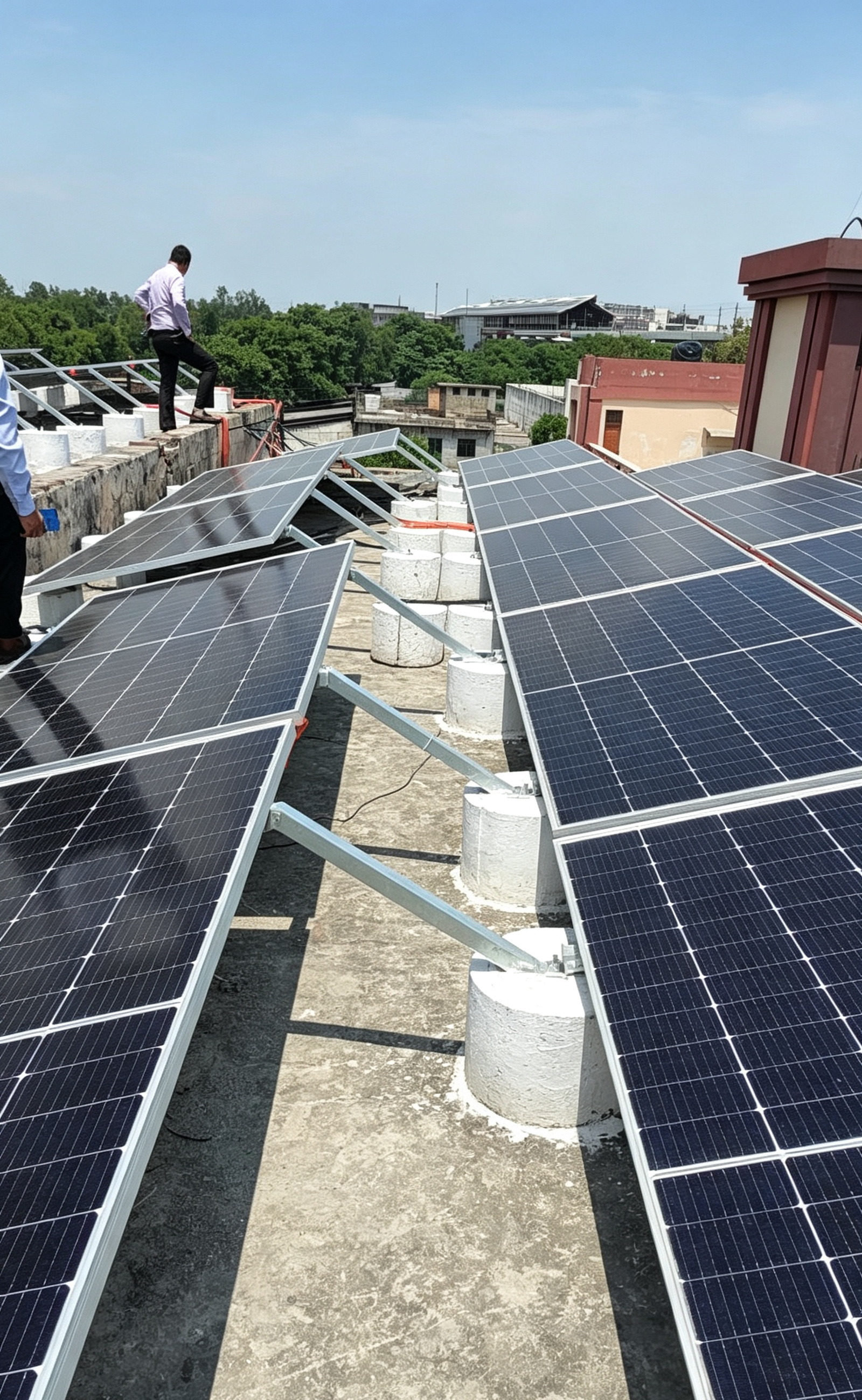
PV Panel Installation Diagram
Project Overview
This project is implemented for a villa in Johannesburg, South Africa. The core configuration of the entire photovoltaic and energy storage system includes 1 set of 20kW hybrid inverter & controller all-in-one machine, 45 pieces of 460W photovoltaic modules, and 2 sets of 16kWh energy storage batteries. The total installed capacity of the photovoltaic array is 20.7kW, with a designed average daily power generation of 103kWh and a daily energy storage capacity of 32kWh.
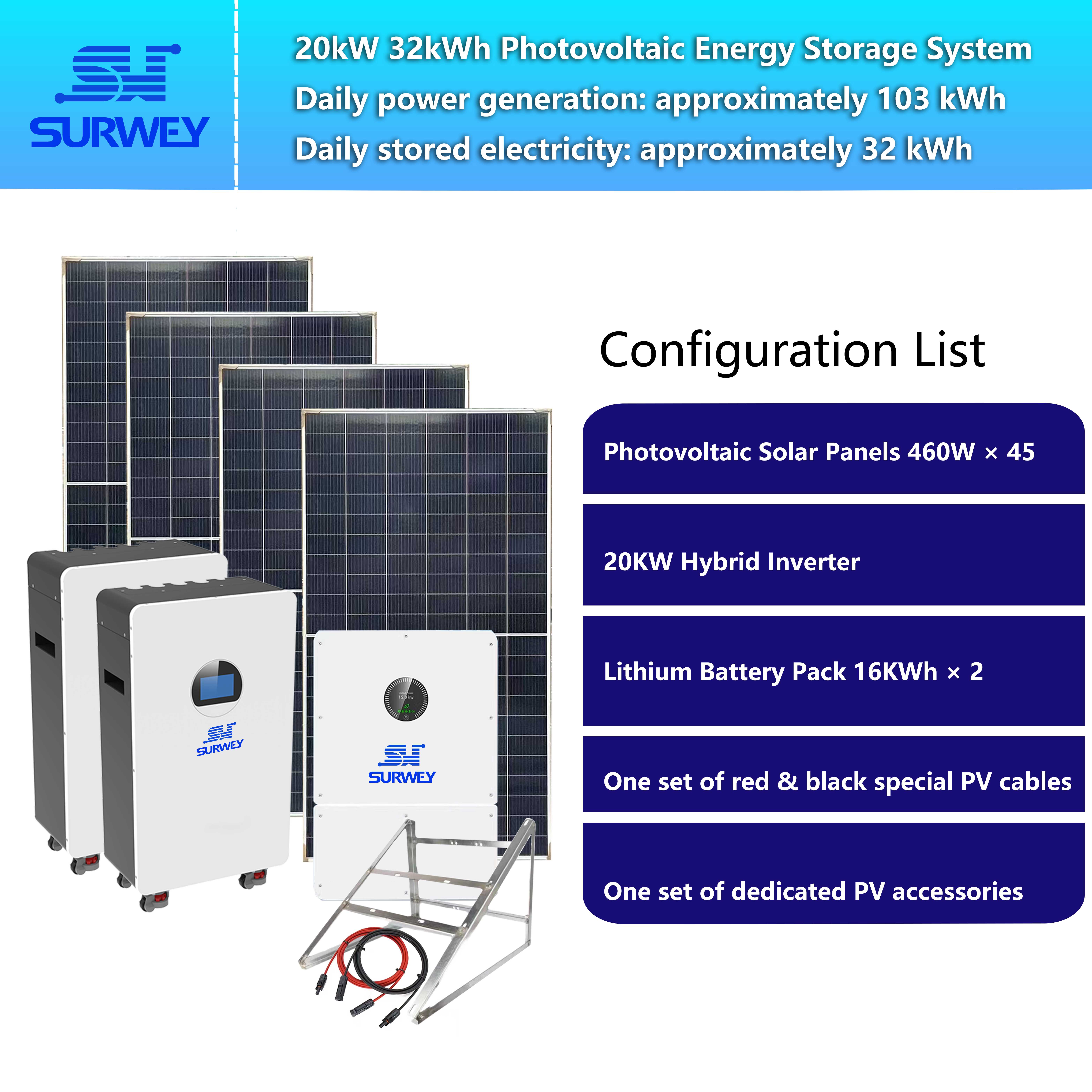
The electrical wiring of the photovoltaic array is designed as 15 modules per string, with a total of 3 strings. Two of the strings are equipped with series fuses and connected in parallel to the first MPPT interface of the hybrid inverter & controller all-in-one machine, and the remaining one string is independently connected to the second MPPT interface. The inverter hardware supports inconsistent power distribution of the two MPPT channels without system error or lockout. On the energy storage side, the two 16kWh batteries are connected in parallel to the battery port of the all-in-one machine and shall not be connected in series.
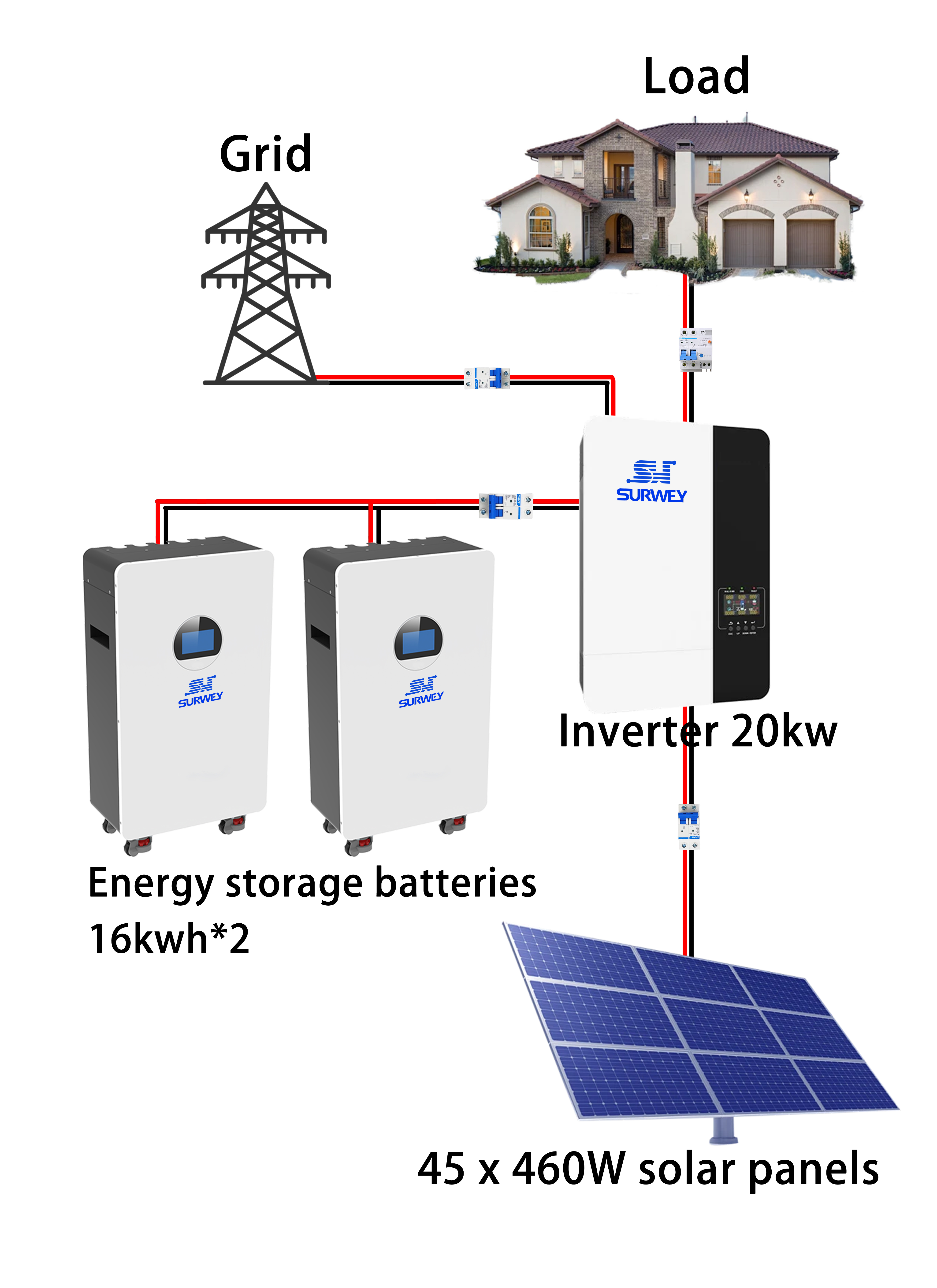
The entire system is a three-phase photovoltaic and energy storage system, supporting two operating modes: grid-tied operation and off-grid standby. It features 100% three-phase unbalanced output capability, adapting to the actual power consumption condition of unbalanced three-phase load distribution in villa households and effectively coping with frequent local power rationing and outages.
System Operating Principle
The system mainly operates in two modes: grid-tied operation and off-grid standby, and supports extended power supplementation via an external generator.
Simplified Schematic Video of System Operating Principle
In grid-tied mode, photovoltaic modules generate DC power under solar irradiation and transmit it to the 20kW hybrid inverter & controller all-in-one machine. Part of the photovoltaic DC power is directly inverted into AC power to supply on-site villa loads. Surplus photovoltaic power is stored in the energy storage batteries. When photovoltaic power generation is insufficient to meet on-site load consumption, the system preferentially uses the electricity stored in the batteries for supplementary power supply. If the battery power is also exhausted, the power gap is automatically supplemented by municipal grid power to ensure uninterrupted load operation. The system controls battery charging and discharging according to preset strategies to achieve the designed daily energy storage target of 32kWh.
In the event of a municipal grid power failure, the all-in-one machine detects abnormal grid signals and quickly switches to off-grid standby mode, automatically disconnecting electrical connection with the municipal grid. The energy storage batteries output DC power, which is inverted into three-phase AC power by the equipment to independently supply power for critical villa loads. Under daytime sunlight conditions, the photovoltaic array can generate power continuously, supplying power to loads directly while recharging the energy storage batteries to extend the emergency power supply duration. The system reserves a dedicated generator input interface. In case of continuous rainy weather with insufficient photovoltaic power generation and battery power dropping to the lower limit, an external diesel generator can be activated in linkage. The power generated by the generator can directly supply loads or charge the energy storage batteries, further improving the power supply redundancy of the entire system. Meanwhile, the equipment’s built-in three-phase unbalanced output function ensures stable power output of each phase even with inconsistent three-phase load power distribution in the villa, adapting to the random variation characteristics of household loads.
Main System Equipment Parameters
20kW Hybrid Inverter & Controller All-in-One Machine
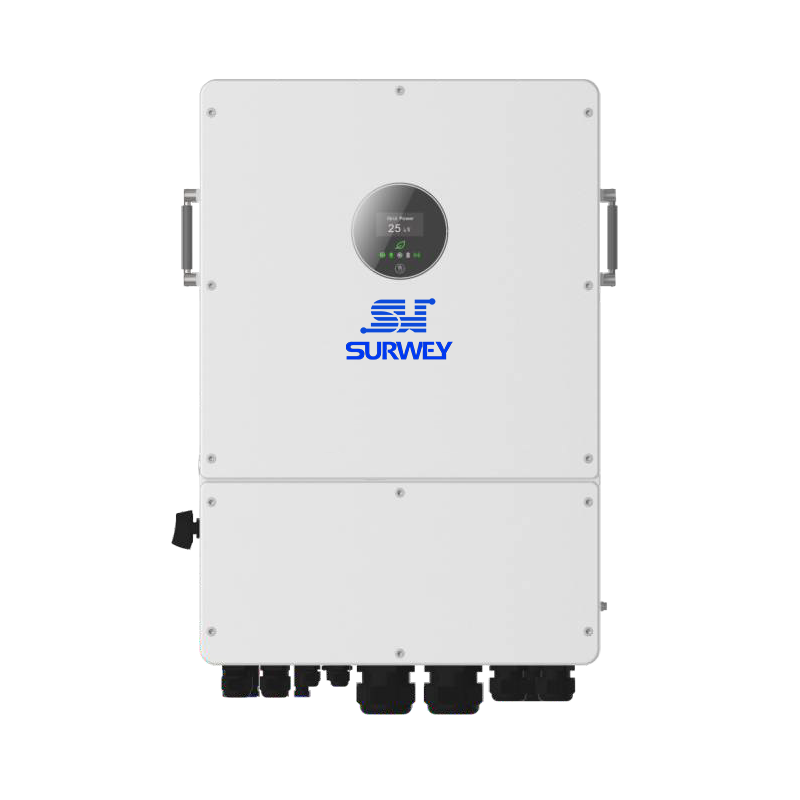
This is a three-phase AC output model with a maximum photovoltaic DC input power of 40kW, photovoltaic startup voltage of 180V, MPPT operating voltage range of 150V‑850V, battery operating voltage range of 40‑60V, and maximum charge-discharge current of 420A. The equipment integrates multiple protection functions including seamless grid-tied/off-grid switching, islanding protection, AC/DC surge protection, insulation resistance monitoring and built-in DC switch. It reserves a generator access port, meets outdoor installation requirements in hardware, and adapts to complex outdoor working conditions in Africa.
460W Photovoltaic Modules (45 Pieces)
Single module parameters: Vmpp≈35V, Voc≈41.7V; adopting a series connection scheme of 15 modules per string.
Voltage Verification (15 modules per string)
· Under STC: Vmpp=15×35=525V, higher than the inverter startup voltage of 180V, enabling normal power generation in the morning and evening ✅; Voc=15×41.7=625.5V.
· At extreme low temperature of -1℃ in winter in Johannesburg, Voc≈682V, which is far below the equipment’s 1000V withstand voltage threshold. The voltage is safe, avoiding equipment damage risks caused by overvoltage under low temperature conditions.
Current Verification
· MPPT-1: 2 parallel strings → I=13.15+13.15=26.3A<40A (maximum MPPT current), safe; short-circuit current is also lower than the 50A limit.
· MPPT-2: 1 string → I=13.15A<40A, safe.
· Total photovoltaic power: 45×460=20700W. The maximum PV input power allowed by the inverter is 40kW, with a capacity ratio of 1.035, fully compliant with design standards.
Wiring Distribution
· MPPT1: String ① (15 modules) and String ② (15 modules) are connected in parallel to the same MPPT channel
· MPPT2: String ③ (15 modules) is independently connected to the other MPPT channel
All three strings of modules adopt unified orientation and installation inclination to avoid building shading and reduce power generation mismatch loss.
16kWh Energy Storage Batteries (2 Sets)

These are 51.2V, 314Ah lithium iron phosphate batteries with a cycle life of ≥8000 times. The total energy storage capacity reaches 32kWh after two batteries are connected in parallel. The battery discharge depth is controlled within 85% during operation to reduce battery attenuation and give full play to the 8000-time long cycle life advantage. During project implementation, only the BMS of one battery communicates with the hybrid inverter & controller all-in-one machine, while the other battery only performs hardware protection to avoid signal conflicts caused by simultaneous communication of multiple BMS systems.
System Load Power and Continuous Power Supply Duration
The rated off-grid output power of the hybrid inverter & controller all-in-one machine is 20kW, supporting 100% three-phase unbalanced output. The maximum single-phase output power is 50% of the rated power. Calculated based on an available battery discharge depth of 85% and an inversion efficiency of 93%, the actual usable AC output energy of the system is approximately 26.8kWh.
· Full-power condition (20kW full load operation): Theoretical continuous power supply duration is about 1.3 hours; this is a short-term extreme condition and not recommended for long-term operation.
· Villa basic load of 5kW (core equipment including refrigerators, lighting, routers, water supply pumps and TVs): Continuous operation for about 5.3 hours.
· Low basic load of 2kW (lighting, refrigerators, network communication equipment): Continuous operation for about 13.4 hours, basically covering a single overnight power outage cycle.
· Light load of 1kW (only refrigerators and network equipment retained): Continuous operation for about 26 hours.
Note: The above durations are theoretical calculated values of pure battery discharge under no-light conditions; the actual power supply duration will be significantly improved with synchronous photovoltaic power generation and charging during daytime.
Summary
Targeting the power consumption pain points of villas in Johannesburg, South Africa, this project completes the design of a photovoltaic and energy storage system. The photovoltaic array adopts a wiring scheme of 15 modules per string with three strings distributed over two MPPT channels, effectively avoiding DC overvoltage risks caused by local low winter temperatures. Equipped with 45 pieces of 460W modules with a total installed capacity of 20.7kW, the system achieves the design indicators of 103kWh average daily power generation and 32kWh daily energy storage.
The energy storage system adopts two 16kWh batteries connected in parallel, strictly complying with parallel construction specifications to ensure safe and reliable energy storage operation. The entire system supports grid-tied self-consumption and off-grid emergency power supply during outages, with compatibility for external generator expansion.
Strict on-site condition control is required during project implementation: the villa must adopt three-phase 400V municipal power access; photovoltaic strings shall maintain consistent orientation and inclination to reduce mismatch loss; DC fuses shall be configured for battery circuits; complete lightning protection and grounding shall be implemented for AC and DC sides, with all electrical components complying with local electrical codes. The hybrid inverter & controller all-in-one machine shall be installed in a ventilated and shaded area to prevent power derating caused by high temperatures. Balancing power generation benefits and emergency power supply capability, this system effectively addresses frequent local power rationing and outages with excellent practicality.


