
Technical Solution for Off-Grid Photovoltaic Energy Storage Systems for Small and Medium-Sized Retail Outlets in Oman
Foreword
The Oman region enjoys excellent solar irradiation conditions; however, some small and medium-sized retail premises face high costs associated with connecting to the mains supply and experience an unstable power supply. By using hybrid inverters operating in pure off-grid mode, these premises can achieve independent power supply entirely through solar energy, without relying on the external grid.
This project involves a purely off-grid distributed photovoltaic-storage system installed on the roof of a commercial building. The electrical design has been developed in accordance with the local high-temperature tropical climate, and calculations have been carried out to ensure the compatibility of the photovoltaic array, energy storage batteries and hybrid inverter-controller unit; A comprehensive analysis of typical electrical equipment and power ratings in the retail premises has been carried out, with separate calculations made for the duration of power supply supported by combined PV-storage operation and by battery-only storage. Whilst ensuring the current power supply requirements of the retail premises are met, provision has been made for future PV capacity expansion, whilst taking into account system reliability, safety and the capacity to accommodate future load growth.

Photograph showing the completed installation of solar panels on the roof of a shop in Oman
I. Overall System Configuration
The complete off-grid system comprises 76 x 630W photovoltaic panels, a 40kW hybrid inverter-controller unit, 32 lead-acid battery banks, AC/DC power distribution units and a system monitoring unit. Although the inverter is equipped with the hardware capabilities for grid connection, this project has been configured to operate in a purely off-grid mode, with no connection to the mains grid; all electricity is generated by the photovoltaic system.

Configuration diagram for a 40 kW, 96 kWh off-grid photovoltaic energy storage system
1) Photovoltaic modules: 76 × 630W photovoltaic modules; specifications per module: maximum power 630W, operating voltage 42.0V, open-circuit voltage 50.3V, operating current 15.01A, short-circuit current 15.94A; total installed photovoltaic capacity: 76 × 630W = 47.88kWp.
2) Hybrid inverter-controller unit: 40 kW hybrid inverter-controller unit, with 4 independent MPPT photovoltaic input channels; MPPT operating voltage range 500–850 V, battery operating voltage range 250–800 V; this unit operates in pure off-grid mode for this project, providing photovoltaic charging, battery charge/discharge management and AC inverter output.

3) Energy storage batteries: 32 × 12V 250Ah lead-acid batteries connected in series; the battery pack has a nominal total voltage of 384V and a capacity of 250Ah, giving a total energy storage capacity of 96kWh, which meets the project’s revised design specification for daily energy storage of 96kWh.

4) Design parameters: Average daily electricity generation of 240 kWh; average daily energy storage of 96 kWh; photovoltaic power is prioritised to supply the shop’s AC loads, with surplus energy stored in the battery; at night, the shop’s loads are powered entirely by the battery.
II. Statistics on Electrical Equipment and Power Consumption in Shops
This small-to-medium-sized shop is a retail premises. The main electrical equipment comprises lighting, refrigeration and air conditioning, display freezers, fans, till equipment and small office equipment. The power ratings of the equipment are detailed below:
Table
| Electrical equipment | Single-unit power | Quantity | Total power |
|---|---|---|---|
| LED shop lighting |
|
8 units |
|
| Commercial Air Conditioning (Refrigeration) |
|
3 units |
|
| Display Freezer Cabinets |
|
2 units |
|
| Industrial cooling fans |
|
4 units |
|
| Cash registers, CCTV, routers |
|
1 set |
|
Total maximum simultaneous load for the shop premises: 13.5 kW; the 40 kW inverter’s output power far exceeds the maximum simultaneous load of the shop premises, providing ample power headroom. Average daily electricity consumption is approximately 192 kWh.
Taking the service life of lead-acid batteries into account, the maximum depth of discharge (DOD) is set at 80 per cent; the actual usable capacity of the battery is therefore 96 kWh × 0.8 = 76.8 kWh.
1) Combined operation of PV and energy storage (during daylight hours): During the day, the PV system generates 240 kWh of electricity, which is prioritised to supply the 13.5 kW shop load, with the remaining electricity used to charge the batteries. During periods of effective sunlight, the PV system continues to generate power, with the load supplied directly by the PV system and the batteries acting as a power buffer; as long as there is effective sunlight, the system can operate continuously without interruption whilst carrying the load; During periods of insufficient sunlight, the system switches to supplementary power from the battery.
2) Pure energy storage operation (no sunlight, at night or on overcast/rainy days, with no reliance on photovoltaic generation): The entire load of 13.5 kW is supplied solely by the battery; theoretical load-bearing duration = available battery capacity ÷ maximum simultaneous load = 76.8 kWh ÷ 13.5 kW ≈ 5.69 hours.
In a real-world engineering scenario, the shop will not be operating at full capacity at night; only the lighting, CCTV and refrigerators (totalling approximately 3.0 kW) will be in use. In pure energy storage mode, the system can operate continuously for: 76.8 ÷ 3.0 = 25.6 hours, which is sufficient to fully cover the shop’s low-load electricity consumption at night, whilst also providing the capacity to meet power demands during short periods of overcast or rainy weather.
Note: In the event of several consecutive days of rain, the duration of power supply from the battery alone will still be limited. This system is configured with a spare MPPT channel, allowing for the addition of further photovoltaic modules at a later date to increase battery charging capacity and further extend the duration of power supply in the absence of sunlight.
III. Electrical Design of Photovoltaic Array Strings
This project is designed for high-temperature operating conditions in Oman and does not account for situations where the open-circuit voltage increases at low temperatures. 76 modules are organised into 6 PV strings, connected to three MPPT channels of the hybrid inverter-controller unit; the fourth MPPT channel is left idle and serves as a reserve interface for future PV capacity expansion. Within each MPPT channel, the modules are wired in a ‘two-in-series, one-in-parallel’ configuration, and the number of modules in series within each of the two strings under the same MPPT channel remains exactly the same.

String allocation:
Total: 26 + 26 + 24 = 76
MPPT-1: 2 strings, 13 modules per string, totalling 26 modules
MPPT-2: 2 strings, 13 modules per string, totalling 26 modules
MPPT-3: 2 strings, 12 modules per string, totalling 24 modules;
The DC terminals of unused MPPT channels are sealed with insulated protective caps, allowing for future expansion.
Voltage parameter verification (STC – Standard Test Conditions):
-
String of 3 cells in series: Open-circuit voltage Voc = 13 × 50.3 V = 653.9 V; Maximum power point voltage Vmpp = 13 × 42.0 V = 546.0 V
String of 12 cells in series: Open-circuit voltage Voc = 12 × 50.3 V = 603.6 V; Maximum power point voltage (Vmpp) = 12 × 42.0 V = 504.0 V
The open-circuit voltages and maximum power operating voltages for both string configurations fall within the inverter’s MPPT operating voltage range of 500–850 V. During the summer in Oman, the junction temperature of the modules rises and the open-circuit voltage decreases with temperature; however, this will not exceed the equipment’s DC withstand voltage limit, and the voltage matching meets the operating conditions for off-grid charging.
Current calibration:
The operating current per string is 15.01 A. With two strings connected in parallel via a single MPPT channel, the total operating current is 30.02 A, which is below the maximum input current limit for a single MPPT channel; there is therefore no risk of overcurrent. The total PV DC power is 47.88 kW, which exceeds the hybrid inverter’s 40 kW AC output capacity; this constitutes a reasonable over-specification. During periods of strong sunlight, the inverter will output at the 40 kW upper limit, and any excess PV power will be subject to power limiting.
IV. Design of Energy Storage Battery Systems
32 12V 250Ah lead-acid batteries are connected in series to form a 384V energy storage battery pack, which falls within the inverter’s battery operating voltage range of 250–800V. The total energy storage capacity is 96kWh, meeting the daily energy storage requirement of 96kWh for a medium-sized retail outlet in Oman.
This project utilises a hybrid inverter operating in pure off-grid mode, with the batteries serving as the sole power source during the night and in low-light conditions. The depth of discharge must be strictly controlled at ≤80 per cent; deep discharge is prohibited to extend the overall service life of the lead-acid batteries.
The hybrid inverter-controller unit features a built-in charge management unit, which charges the battery pack via the photovoltaic array during the day; at night, the battery pack supplies power to the shop’s loads via the inverter. The battery side is equipped with DC fuses and DC circuit breakers, taking full account of safety precautions for 384V high-voltage DC to provide overcurrent and short-circuit protection, thereby ensuring the safe operation of the batteries in off-grid conditions.
V. System Operation Strategy (Pure Off-Grid Mode)
The system sets the hybrid inverter to pure off-grid mode, without connection to the external mains supply.
During the day, electricity generated by the photovoltaic system is prioritised for supplying the AC loads of the shop; when the photovoltaic output exceeds the real-time load, the surplus electricity is used to charge the battery, achieving a daily energy storage capacity of 96 kWh; when photovoltaic generation is less than the load consumption, the battery supplements the power output; when the battery charge level drops to the lower protection limit, the integrated inverter-controller automatically cuts off the AC output to protect the battery and prevent damage from over-discharge. The system is equipped with local monitoring, allowing real-time viewing of key operational data such as photovoltaic power generation, battery voltage, State of Charge (SOC) and load consumption.
VI. Key Points on Construction and Safety
-
Insulation caps have been fitted to all DC connectors on idle MPPT channels to prevent electrical leakage and short circuits caused by dampness and dust; it is normal for the monitoring system to display a voltage of 0V for these channels. -
DC and AC cables have been selected in strict accordance with local electrical regulations; as the battery side operates at 384V high-voltage DC, the cables and insulating components must meet the high-voltage rating; The photovoltaic mounting structures have been treated to resist corrosion and high temperatures, making them suitable for Oman’s outdoor environment. -
Lead-acid batteries are housed in a well-ventilated and heat-dissipating space. As there are 32 battery cells connected in series, regular inspections of individual cell voltages are required to mitigate imbalance issues within the series battery bank; battery inspection and maintenance are particularly critical for off-grid systems. 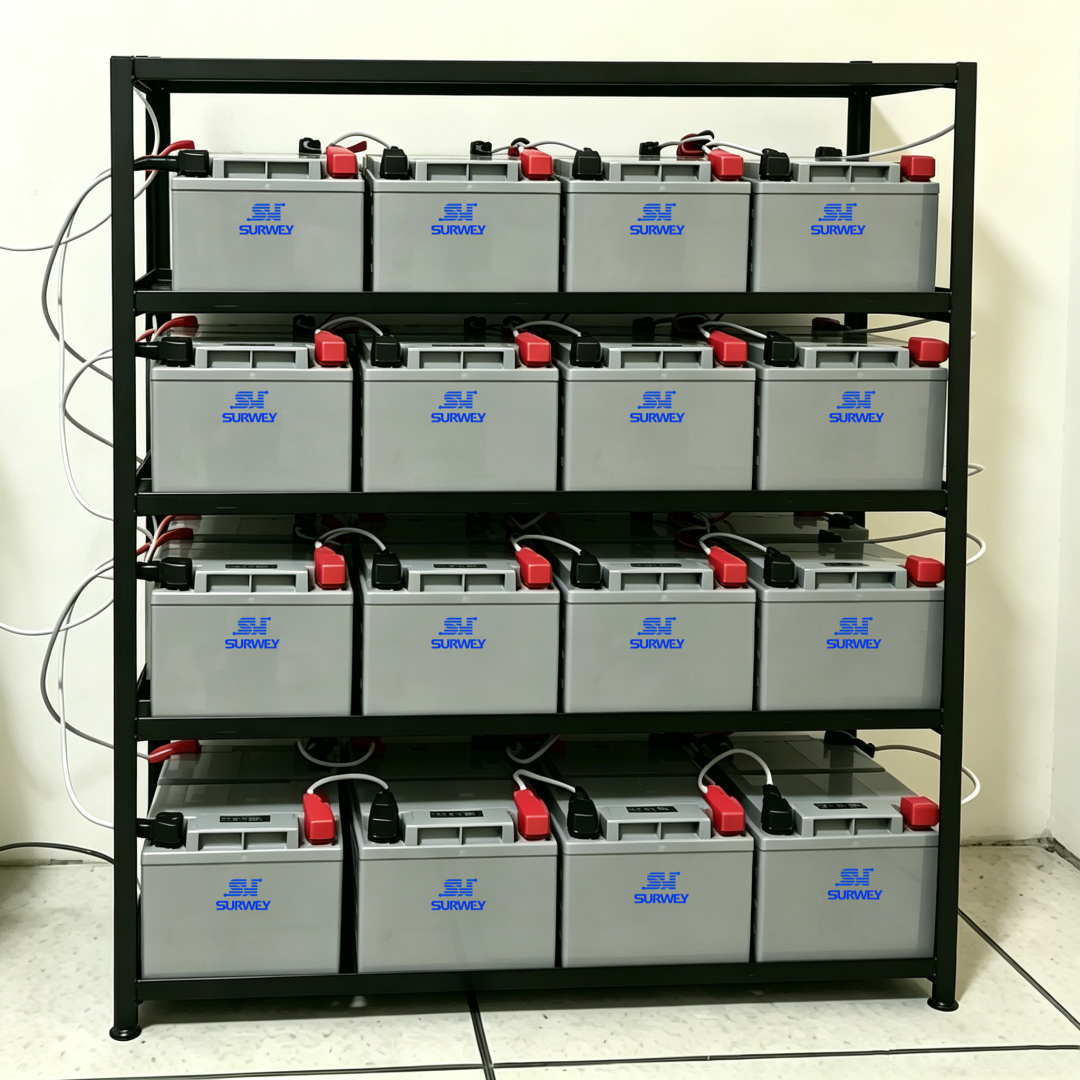
Layout plan for the battery room -
The system is equipped with AC and DC circuit breakers, surge protectors and a comprehensive earthing system to meet the electrical safety requirements for commercial premises.
VII. Summary
This fully off-grid photovoltaic-storage solution utilises all 76 630W modules, with string voltage and current fully calibrated and matched; one MPPT channel has been reserved for future expansion. The 96kWh lead-acid storage system meets the daily storage requirement of 96 kWh, whilst the average daily photovoltaic generation is 240 kWh.
The system’s inverter capacity can cover the shop’s maximum simultaneous load of 13.5 kW; under sunlight, the PV system combined with the storage system can provide a continuous power supply; in the absence of sunlight, relying solely on the storage system, it can supply power at full load for approximately 5.69 hours, and in low-load mode at night for approximately 25.6 hours, providing a degree of resilience against short periods of overcast or rainy weather. The entire system utilises a hybrid inverter operating in pure off-grid mode, providing power to the shop entirely independently of the mains grid. It is tailored to local conditions in Oman, with a well-balanced configuration that accommodates both current power requirements and future expansion and upgrades.


