
An Analysis of Photovoltaic Energy Storage Inverters: Key Differences Between US-Standard Single-Phase, Split-Phase and Three-Phase Inverters, and a Selection Guide
Foreword
“The North American power system features a unique distribution architecture, giving rise to three mainstream inverter product categories: US-standard single-phase inverters, US-standard split-phase inverters (also known as phase-split inverters) and US-standard three-phase inverters. In projects involving grid-connected photovoltaic systems, off-grid energy storage and hybrid photovoltaic-storage systems, many contractors and exporters tend to confuse the definitions of these three types, leading to issues such as failure to connect to the grid, inability to drive loads properly and potential system safety hazards due to the incorrect selection of equipment.”
Starting from the underlying architecture of the North American power grid, this article systematically examines three types of inverters, covering their electrical principles, output characteristics, topological structures, wiring configurations, load compatibility, power ranges, grid connection standards and suitable applications. It compares their key differences and summarises selection criteria, thereby providing a clear technical reference for residential PV, villa energy storage and small-scale commercial and industrial PV-storage projects in the Americas.
I. The Basics of Power Supply in North America: First, let us clarify the three types of power grid systems
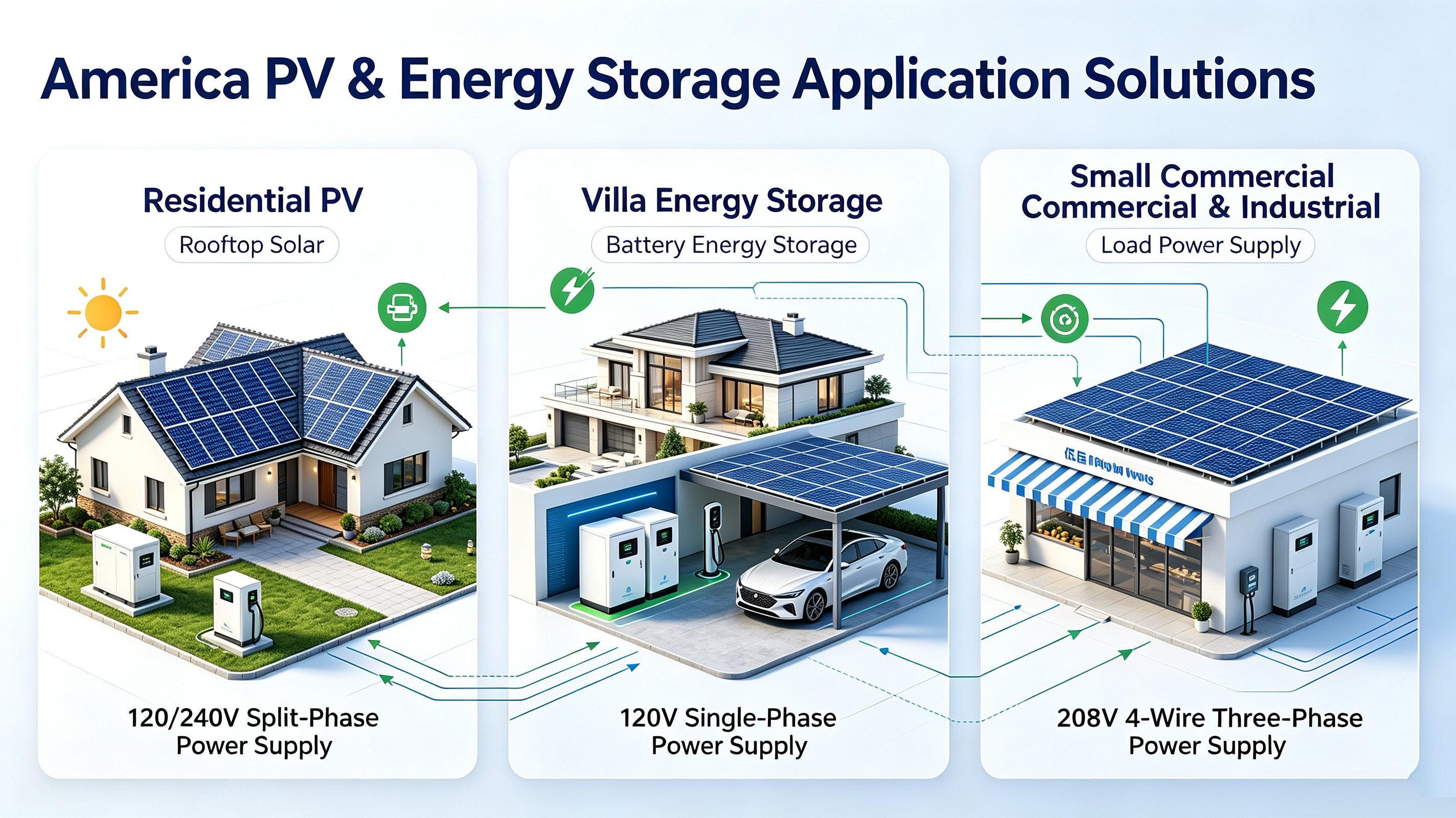
To understand the differences between the three types of inverters, it is first necessary to clarify the three mainstream AC power supply configurations in North America, as inverter designs are tailored to match the local grid architecture. In residential properties across the North American continent, 120/240V split-phase supply is the norm, whilst small retail outlets and some detached cottages utilise a pure 120V single-phase supply; medium-sized shopping centres, factories and large commercial buildings generally employ a 208V three-phase four-wire supply (US standard three-phase). These three types do not belong to the same power system and are not directly compatible.
- Pure 120V single-phase mains supply
Consists of just one live wire (L) and one neutral wire (N), with a voltage of 120V between L and N; it is not capable of supplying 240V and is commonly found in small wooden cottages and simple outbuildings. - 120/240 V split-phase mains supply (North American residential standard)
The secondary winding of the transformer has a centre tap, from which three wires—L1, L2 and N—are drawn off. L1–N = 120 V, L2–N = 120 V, and L1 and L2 are 180° out of phase; the voltage between L1 and L2 is 240 V. The 120V circuit is used for general lighting and small domestic appliances; the 240V two-wire circuit is used for high-power loads such as air conditioners, electric tumble dryers, electric cookers and charging points. This is also the most common form of domestic power supply in North America.
Key concept: Split-phase power supply is essentially a single-phase power system; it is not two-phase power, and this is a common source of confusion within the industry.
- American standard 208V three-phase, four-wire mains supply
Three live wires, A, B and C, with a phase difference of 120°, together with a neutral wire, N. The line voltage (A–B, B–C, A–C) is 208 V; the phase-to-neutral voltage (A–N, B–N, C–N) is 120 V. This system is widely used in commercial and industrial settings in North America, and differs from the 400 V three-phase systems found in Europe and Asia.
✅The AC output configuration of the inverter must be strictly matched to the aforementioned grid; this is the fundamental criterion distinguishing the three types of inverters.
II. Basic Definitions and Electrical Principles of Class II and Class III Inverters
Introduction to and Operating Principles of American Standard Single-Phase, Split-Phase and Three-Phase Inverters
1. US-standard single-phase inverter (Single-phase 120V Inverter)
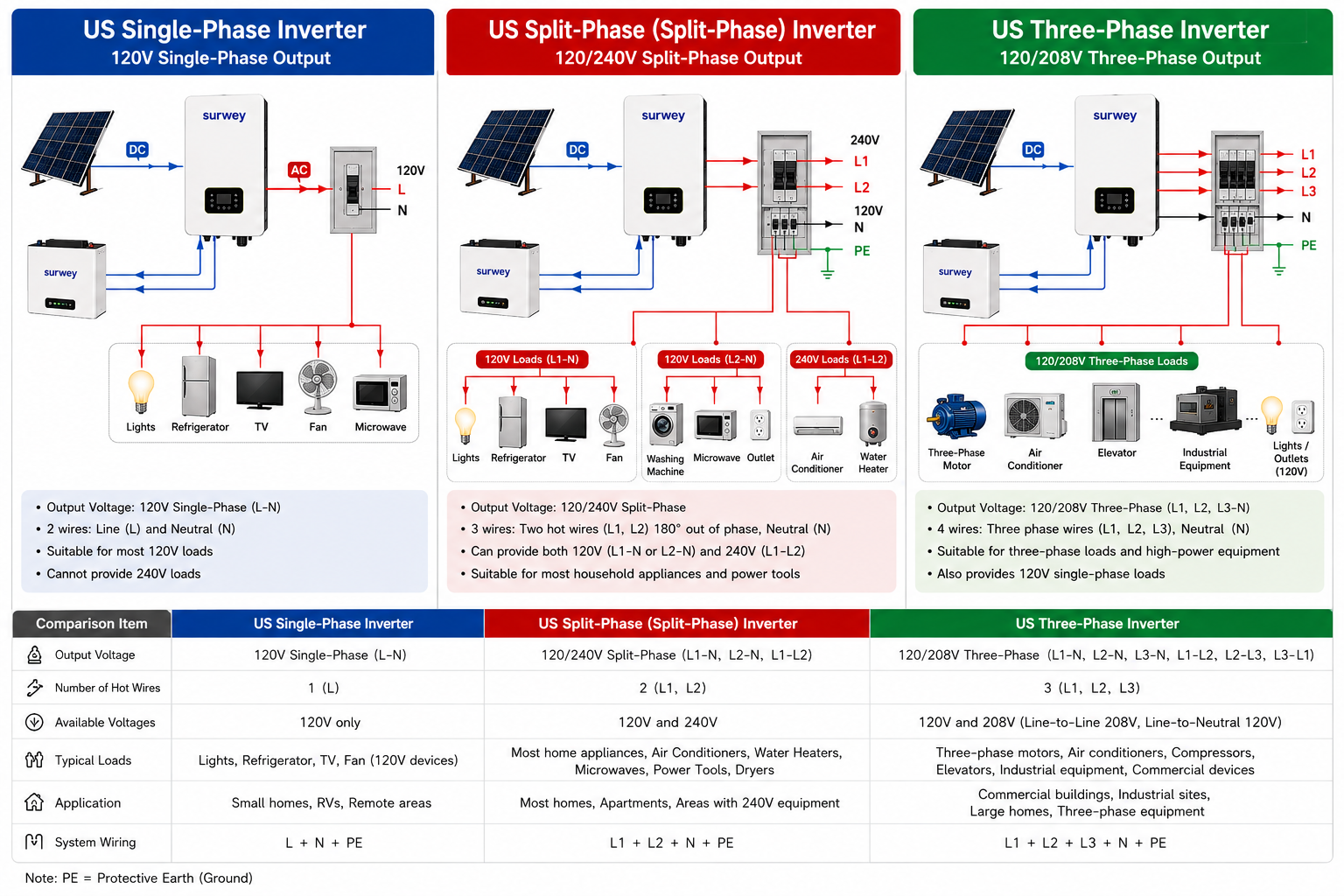
This US-standard single-phase inverter has an AC output terminal comprising only L, N and earth (G), and outputs a single AC voltage: 120V (L-N).
The circuit topology employs a standard single-phase full-bridge inverter architecture, converting DC power into a single-phase sinusoidal AC output; there are no two phase-reversed outputs.
Key limitation: It does not have a 240V output capability. It can only power 120V electrical appliances and cannot directly supply power to high-power 240V loads found in North American homes. Even if some models are rated for 240V output, this refers to 240V between the L and N terminals of a single circuit; it is not a split-phase configuration. As such, it cannot be connected to a standard North American residential distribution board; forcing a connection may result in damage to the equipment and pose electrical safety risks.
Power range: Mainstream models range from 1 kW to 6 kW, primarily used for small off-grid systems and simple backup power supplies; they are very rarely used in complete residential grid-connected systems.
2. American-standard split-phase inverter (120/240V)
In mainstream technical documentation and specifications, it is referred to as a ‘split-phase inverter’, whilst in factory sales and colloquial usage it is commonly known as a ‘phase-split inverter’; it is a product specifically designed for the North American residential 120/240V centre-tapped split-phase mains supply, with AC output terminals labelled L1, L2, N and earth.
Internally, they typically utilise either a centre-tapped power-frequency isolation transformer or an active bidirectional inverter circuit to simultaneously generate two 120V AC outputs with a phase difference of 180°: L1-N = 120V, L2-N = 120V, L1-L2 = 240V.
The system can simultaneously supply both 120V single-phase loads and 240V two-wire loads, perfectly matching all electrical circuits in a North American detached house. Some hybrid energy storage models support mode switching, allowing temporary switching to pure 120V single-phase output; however, the original design objective was to cater for split-phase grids.
Power range: 3 kW–18 kW; these are the most popular models for residential solar-plus-storage systems and backup power supplies for detached houses in North America.
Common misconception clarified: Two standard single-phase inverters must not simply be connected in parallel to function as a split-phase inverter. Two independent single-phase inverters cannot achieve precise 180° phase synchronisation; this results in uncontrolled neutral current and poses a serious risk of burnout. Products with a native split-phase architecture must be used.
3. US-standard three-phase inverter (208V three-phase inverter)
A US-standard three-phase inverter outputs three live wires (A, B and C), together with a neutral wire (N), to produce three-phase sinusoidal AC power, with the three phases phase-shifted by 120°. The line voltage is 208 V and the phase voltage is 120 V, making it compatible with North American 208 V three-phase commercial and industrial power distribution systems.
The topology utilises a three-phase full-bridge inverter, supporting multiple independent MPPT channels, making it suitable for larger-capacity photovoltaic arrays.
The advantage of a three-phase system lies in load balancing: power is distributed across the three-phase circuits, resulting in lower unbalanced current in the neutral conductor and reduced line losses, making it suitable for applications requiring continuous high-power consumption.
Power range: starting from 15 kW, with a focus on industrial and commercial models in the hundreds of kilowatts range; rarely used in ordinary residential properties.
III. Multi-dimensional Comparative Analysis: Key Differences Between the Three Major Inverters
▶Differences in AC Output, Voltage and Wiring
- US-standard single-phase inverter
Terminals: L, N, G; Output: 120V only (L-N); no distinction between L1 and L2; no 240V port. - American Standard Phase-Split Inverter
Terminals: L1, L2, N, G; dual voltage output: 120 V (L1–N / L2–N) + 240 V (L1–L2); the phase difference between the two voltage outputs is 180°. - American Standard Three-Phase Inverter
Terminals: A, B, C, N, G; line voltage 208 V, phase voltage 120 V; phase difference between the three phases 120°.
▶ Load-adaptive capability
- US-standard single-phase inverter
It only supports 120V small appliances and lighting; it cannot power 240V high-power appliances such as electric ovens, tumble dryers and central air-conditioning systems, and is not suitable for supplying power to the entire house. - American Standard Phase-Split Inverter
Compatible with all domestic loads; 120V standard loads and 240V high-power loads can operate simultaneously. The design requires that the loads on phases L1 and L2 be balanced as far as possible; prolonged severe imbalance will increase the neutral current, affecting the service life of the equipment. - American Standard Three-Phase Inverter
Suitable for three-phase motors, large-scale HVAC systems and commercial equipment; it is also possible to draw a single 120V phase to power a single-phase load, but a balanced three-phase configuration is required for engineering purposes, and it is not recommended to operate a single-phase load on a single phase for extended periods.
▶ Topological Structure, Hardware and Efficiency Characteristics
- US-standard single-phase inverter
Single-phase H-bridge inverters feature the simplest circuitry, the fewest components and the lowest cost; most are high-frequency models, with low no-load losses at low power levels. Drawbacks: limited upper limit for power scaling and inability to provide dual voltages. - American Standard Phase-Split Inverter
These are divided into two categories: high-frequency transformerless split-phase systems and power-frequency systems with isolation transformers. Power-frequency models incorporate a centre-tapped transformer, resulting in greater size and weight, as well as transformer losses; their advantages include strong resistance to impact loads, stable off-grid black start performance, and widespread adoption in energy storage backup applications. High-frequency models are more compact, but their control algorithms are more complex than those of standard single-phase inverters. The system requires real-time monitoring of the currents in phases L1 and L2, necessitating the addition of balance control logic. - American Standard Three-Phase Inverter
The three-phase full-bridge topology is typically equipped with multiple MPPT channels, making it suitable for large-area photovoltaic rooftops with multiple orientations and shading issues; it utilises SVPWM (Space Vector Pulse Width Modulation), resulting in higher DC voltage utilisation. High-power models feature a sophisticated thermal management design, ensuring strong stability during continuous heavy-load operation; however, their complex structure leads to higher equipment procurement costs.
▶ Grid Connection Specifications and North American Standards
All three types of inverters must comply with North American grid connection standards, but their methods of grid connection differ entirely:
-
US-standard single-phase inverter:May only be connected to a pure 120V single-phase mains supply; direct connection to a standard 120/240V residential split-phase main distribution board is prohibited; -
American Standard Phase-Split Inverter:It is compatible with mainstream 120/240V split-phase residential electricity networks in North America, making it the preferred choice for residential energy storage systems connected to the grid or used as a backup power source; -
American Standard Three-Phase Inverter:Connection is permitted only to a 208V three-phase commercial and industrial electricity supply network; direct connection to a single-phase split-phase domestic electricity supply network is not permitted.
The electricity supplier strictly distinguishes between different supply systems; incorrect equipment selection will result in the grid connection application being rejected outright.
▶ Classification of Typical Application Scenarios
-
Applications for US-standard single-phase inverters
Small off-grid cabins, camping power supplies, power for small water pumps, and simple backup power sources; all loads are 120V appliances, with no high-power 240V appliances. Not recommended for use with full-scale residential solar power systems.
-
Applications for US-standard phase-split inverters
Detached houses, residential properties and small guesthouses; requiring the simultaneous powering of lighting, a fridge (120V), central air conditioning, an electric tumble dryer and a charging point (240V); grid-connected solar, off-grid energy storage and hybrid solar-storage backup power supply. This is the product category with the highest demand in the residential market across numerous regions, including North America, Central America, South America, Canada, Latin America and the Caribbean.
-
Applications for US-standard Three-Phase Inverters
Supermarkets, processing plants, office blocks, large commercial buildings and farms with high-power equipment; facilities with high installed capacity and three-phase power loads; buildings with large roof areas and large-scale photovoltaic arrays.
IV. An In-Depth Analysis of Common Pitfalls in Project Selection
✖ Misconception 1: “A single-phase inverter paired with a step-up module can replace a split-phase inverter”
A standard 120V single-phase inverter outputs a single AC circuit and is unable to generate two power sources (L1 and L2) with a phase difference of 180°. Even if a step-up converter is used to achieve 240V, this is merely 240V between L and N, which does not comply with North American 240V load wiring standards requiring power to be drawn ‘across L1 and L2’. Connecting such a system to a domestic distribution board will cause circuit anomalies and trip the circuit breakers, posing a risk of electric shock. A native split-phase inverter must be used for whole-house power supply.
✖ Misconception 2: “A split-phase inverter is a two-phase inverter that can be used as a three-phase inverter”
Split-phase is a single-phase power configuration, with only two output phases that are 180° out of phase with each other. It does not feature a three-phase architecture with three phases at 120° intervals; therefore, it cannot drive three-phase motors and cannot be connected to a 208V three-phase grid.
✖ Misconception 3: Split-phase inverters can be used directly for low-power commercial and industrial applications
Where a building is supplied with 208V three-phase power from the electricity supplier, a US-standard three-phase inverter must be selected regardless of load size. If a split-phase inverter is used despite this, an additional three-phase-to-split-phase isolation transformer must be installed, which increases the overall system cost and power losses; this is generally not economically viable.
✖ Misconception 4: Grid-connected and off-grid models can be interchanged at will
Although they are all split-phase inverters, grid-connected models, hybrid energy storage models and pure off-grid models have different control logic. Pure off-grid models lack anti-islanding protection and cannot pass the grid operator’s grid connection inspection; grid-connected models do not support off-grid backup power supply following a power cut, so the operating mode must be confirmed when selecting a model.
V. Summary of the Product Selection Decision-Making Process
When undertaking photovoltaic and energy storage projects in North America, determine the inverter type in the following order:
1. Confirm the on-site grid system: the electricity supplier provides 120V single-phase / 120/240V split-phase / 208V three-phase;
2. Compile a list of all load voltage specifications: check whether there are any high-power 240V domestic appliances;
3. Determine the system configuration: pure grid-connected PV, off-grid storage, or grid-connected hybrid PV-storage with backup;
4. Match the power rating to the installed capacity, whilst ensuring load balancing is taken into account;
5. Confirm that the equipment supports local grid voltage and frequency standards (60 Hz).
Simple mnemonic: A standard small log cabin with only 120V loads → US-standard single-phase inverter; a detached house requiring both 120V and 240V appliances → US-standard split-phase inverter; shops, factories, or three-phase buildings with high-capacity PV systems → US-standard three-phase inverter.
VI. Conclusion
The North American electricity distribution system differs significantly from the mainstream power grids in Europe and Asia; the phase configuration and voltage output format of inverters are the primary criteria for equipment selection. Whilst US-standard single-phase inverters, split-phase inverters and three-phase inverters all appear to output 120V AC, their underlying electrical principles, wiring logic and load compatibility are not interchangeable.
As Chinese photovoltaic and energy storage products continue to be exported to the North American market, engineering designers and international trade sales personnel must clearly understand the core differences between these three types to prevent project rework, grid connection failures and after-sales disputes caused by incorrect equipment selection. In the residential PV-storage sector, split-phase inverters remain the long-term mainstream choice; in commercial and industrial applications, 208V three-phase inverters predominate; whilst single-phase inverters are positioned for the niche small-scale off-grid market. Accurately distinguishing between these three product categories is a fundamental prerequisite for ensuring the stable and reliable operation of PV-storage projects in North America.


