
Off-Grid Solar Systems Support Rural Wastewater Treatment: An In-Depth Technical Analysis of a Project in Rural Jiangxi
In the field of rural wastewater treatment, a stable and reliable energy supply is essential for ensuring the continuous operation of equipment. In a wastewater treatment project covering four administrative villages in a town in Jiangxi Province, Shangwei Technology was fully responsible for the design, equipment selection, and project implementation. The company innovatively adopted a 10 kW off-grid solar energy storage system to power the wastewater treatment equipment. Through precise technical calculations and equipment configuration, the project achieved multiple objectives—including energy self-sufficiency, stable operation, and low-carbon environmental protection—providing a replicable technical model for decentralized rural wastewater treatment.
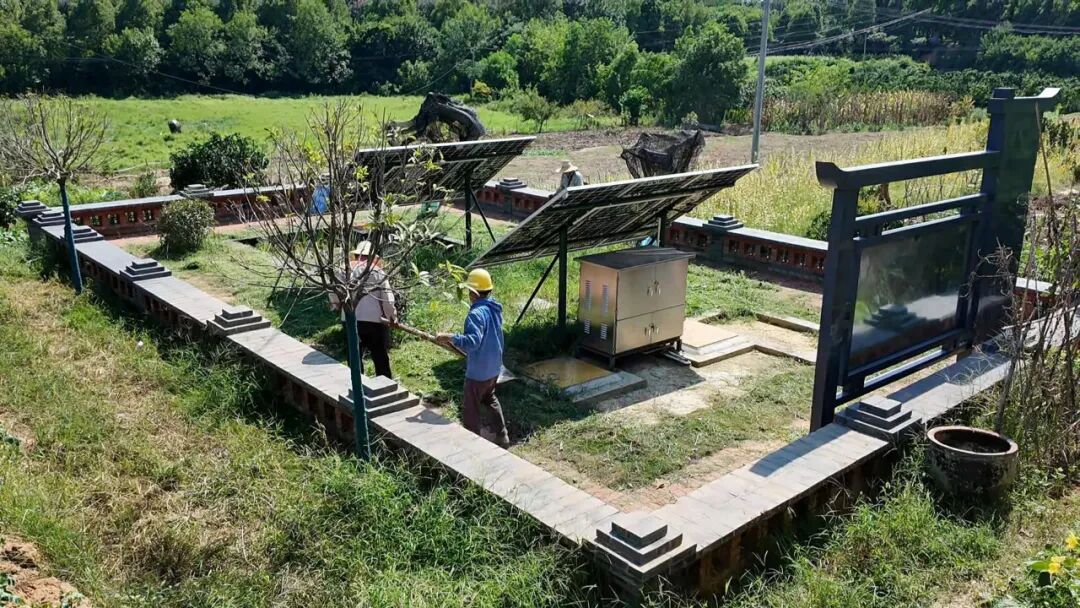
Load Characteristics Analysis: Laying the Foundation for System Design
The primary prerequisite for system design is a precise understanding of the technical parameters of the electrical load, as this directly determines the configuration logic for photovoltaic modules, energy storage equipment, and inverters. Through on-site surveys and process analysis, the Shangwei Technology team identified that the project’s load characteristics are characterized by “multiple devices, intermittent operation, and stable total power”:
Power and Quantity Matching: 4 × 550W feed pumps (total power 2.2 kW), 4 × 550W return pumps (total power 2.2 kW), and 4 × 740W fans (total power 2.96 kW), with a combined total power of 7.36 kW (rounded to 7.4 kW for design purposes). This represents a typical low-to-medium power load that does not require handling of instantaneous high-power surges, providing a clear power basis for inverter selection.
Operating Duration and Energy Consumption Calculation: Based on the requirements of rural wastewater treatment processes (such as staged aeration and timed recirculation), the equipment does not operate 24 hours a day; the average daily operating time is 5 hours. Calculated based on a total power of 7.4 kW, the average daily electricity consumption is 7.4 kW × 5 h = 37 kWh. This precise calculation serves as the core benchmark for the Shangwei Technology team in designing the PV power generation capacity and energy storage capacity, ensuring that the energy configuration meets demand while avoiding waste.
System Configuration Logic: End-to-End Technical Parameter Alignment
Based on load characteristics, Shangwei Technology has built a 10 kW off-grid system featuring end-to-end compatibility across the entire chain—“solar panels – combiner box – controller – energy storage batteries – inverter.” The selection of each piece of equipment is centered on “meeting load requirements, improving energy utilization, and ensuring operational stability”:

PV Module Selection: The system uses 24 monocrystalline silicon PV panels, each rated at 590W, for a total installed capacity of 24 × 590W = 14.16 kW. The system will operate at an actual capacity of 10 kW (with 4.16 kW reserved as redundancy). Monocrystalline silicon modules achieve a conversion efficiency of over 23%. In an open rural environment, with an average daily effective sunlight duration of 5 hours, the theoretical daily power generation is 14.16 kW × 5 h = 70.8 kWh. This exceeds the average daily electricity consumption of 37 kWh by 33.8 kWh, thereby not only meeting the day’s power load but also providing ample excess power to charge the energy storage batteries.
Energy Storage System Design: The system is configured with three sets of 51.2V 300Ah lithium iron phosphate battery packs. Each pack has a capacity of 51.2V × 300Ah = 15.36 kWh, with a total capacity of 46.08 kWh across all three sets, providing an average daily storage capacity of approximately 45 kWh. Through technical analysis, the Shangwei Technology team determined that a 45 kWh energy storage capacity paired with an average daily power consumption of 37 kWh creates a “1.2:1” ratio. This ratio prevents power outages caused by insufficient storage capacity (especially during prolonged periods of cloudy weather) while avoiding cost wastage resulting from excess capacity; Additionally, lithium iron phosphate batteries have a cycle life exceeding 6,000 cycles and a charge/discharge efficiency of over 90%, making them suitable for the long-term, stable operation of rural wastewater treatment stations. They also support deep charge and discharge cycles, eliminating concerns about the “memory effect” affecting their service life.
Energy Management Equipment Selection: Three 48V 100A solar controllers are precisely matched with the photovoltaic modules and energy storage batteries — each controller corresponds to 8 590W photovoltaic panels (total power 4.72 kW), The 100A rated current meets the maximum output current requirements of the solar panels, and the MPPT (Maximum Power Point Tracking) function enables real-time tracking of the solar array’s maximum power output, boosting energy conversion efficiency to over 98%; Three dedicated solar combiner boxes aggregate the current from multiple solar panels and deliver it to the controllers. They feature built-in surge protection modules and overload protection, making them suitable for the frequent thunderstorms typical of rural areas; The 10 kW inverter features a pure sine wave output. With a rated power slightly higher than the total load power of 7.4 kW, it ensures stable voltage when multiple water pumps and fans are started simultaneously, preventing equipment shutdowns caused by load surges. It also supports seamless switching to off-grid mode, ensuring that the output voltage and frequency from the energy storage batteries meet equipment power standards (220 V/50 Hz).
Technological Innovation and Low-Carbon Value: Shangwei Technology’s Practical Achievements
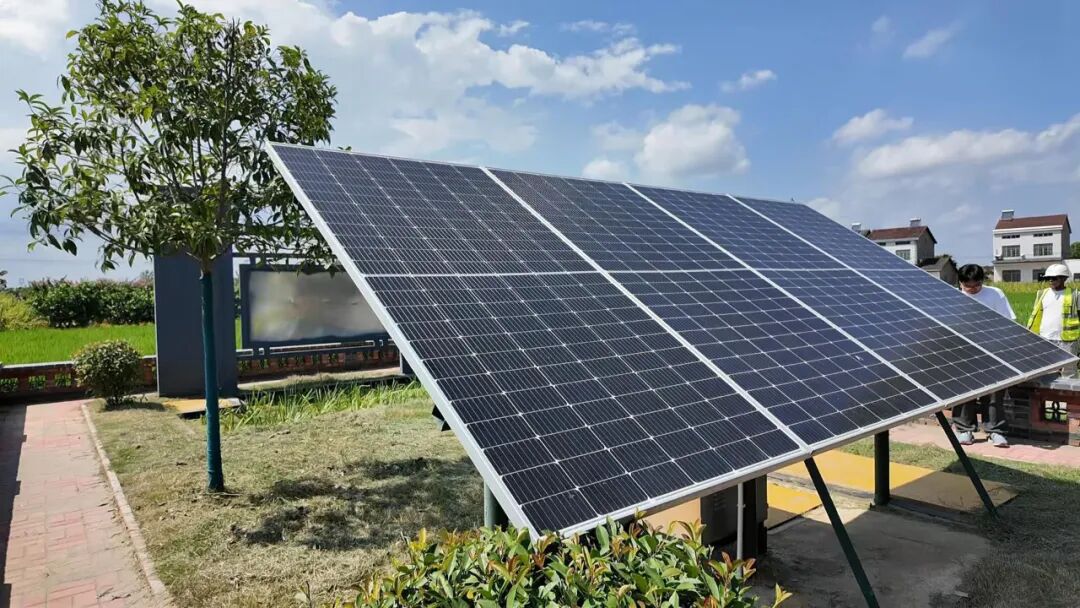
The technical feasibility of this solution ultimately hinges on the dual objectives of “green and low-carbon” operations and “stable performance,” while Shangwei Technology’s end-to-end implementation ensures consistency from design through deployment:
From a technical perspective, the off-grid photovoltaic system completely eliminates the impact of unstable rural power grids on wastewater treatment equipment. In remote villages with limited grid coverage, traditional wastewater treatment stations that rely on the municipal power grid often experience pump shutdowns and insufficient aeration due to voltage fluctuations, which in turn affects treatment efficiency; The “daytime direct PV supply + nighttime energy storage discharge” model designed by Shangwei Technology achieves 24-hour energy self-sufficiency with a power supply reliability of over 99%, ensuring the continuous operation of the wastewater treatment process.
In terms of low-carbon benefits, the system’s annual power generation is approximately 70.8 kWh/day × 365 days = 25,842 kWh, equivalent to reducing standard coal consumption by 8.27 tons (calculated at 0.32 kg of coal per 1 kWh of electricity), reducing carbon dioxide emissions by 20.6 tons, and nitrogen oxide emissions by 0.06 tons. More importantly, Shangwei Technology’s design philosophy of “precise matching and moderate redundancy” prevents energy waste—the redundant power capacity of the photovoltaic modules ensures that power generation on cloudy days meets or exceeds load demand, while the appropriately sized energy storage batteries efficiently store excess electricity, forming a closed-loop system of “power generation – power consumption – energy storage” that fully utilizes every kilowatt-hour of solar energy.
For the rural wastewater treatment sector, Shangwei Technology’s implementation not only provides a viable energy solution but also pioneers a path toward integrating “environmental protection facilities with renewable energy.” This solution can be further optimized in the future, such as by introducing a smart monitoring system to track PV panel output, battery SOC (state of charge), and load status in real time. By using algorithms to dynamically adjust equipment operating modes, energy efficiency can be further enhanced, opening up more possibilities for “technological upgrades” and “low-carbon transitions” in rural ecological governance.


