Project Proposal for a 20 kW Hybrid Solar-Storage Power System for a 40-Foot High-Cube Refrigerated Container

Ground-mounted 20 kW photovoltaic array
I. Project Overview
1.1 Project Background and Application Scenarios
A 40-foot high-cube refrigerated container has a volume of 76.4 square meters, requires significant cooling capacity, and demands a highly stable power supply. Traditional power supply solutions face three major challenges: high costs and substantial carbon emissions from diesel generators; weak power grids at remote locations that are prone to outages; and the risk of cargo spoilage and loss due to grid failures. This project features a 20 kW hybrid solar-storage power supply system, integrating 645 W high-efficiency monocrystalline photovoltaic modules (36 panels), a 64 kWh all-in-one energy storage unit, and a smart inverter. It establishes a triple-layered protection system tailored for ports, logistics parks, and similar environments, meeting 24-hour refrigeration needs while reducing costs and carbon emissions.
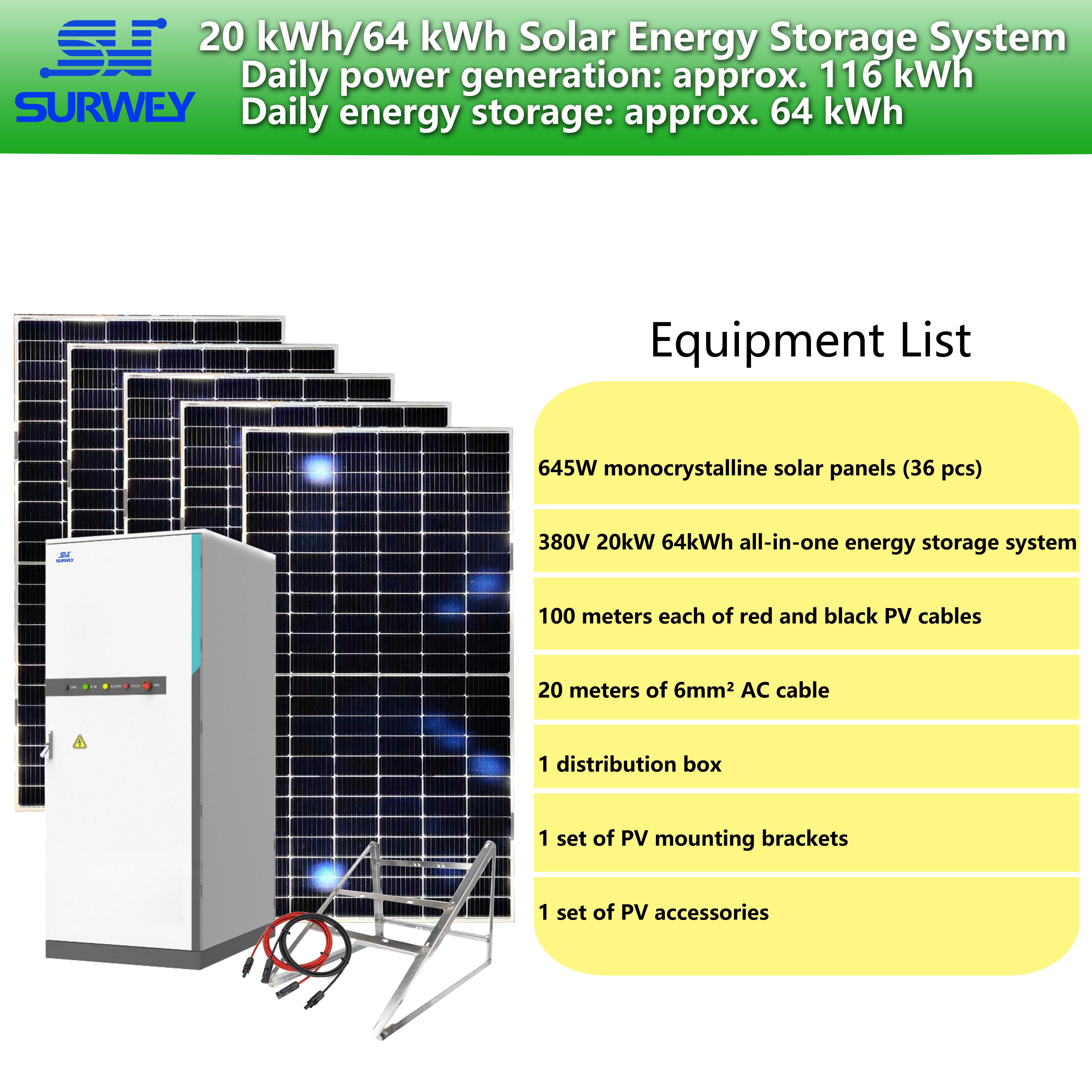
Configuration Diagram of a 20 kW Hybrid Solar-Storage Power Supply System
1.2 Core Objectives of the Project
| Target Type | Specific indicators |
| Power Supply Reliability | Power supply reliability ≥99.9%, continuous off-grid power supply ≥18 hours |
| Energy Efficiency | System overall efficiency ≥95%, photovoltaic utilization rate ≥90%, power matching rate ≥98% |
| Cost-effectiveness | Diesel power generation costs reduced by over 60%, with a payback period of 5 years or less |
II. Overall System Design
2.1 System Architecture and Operating Principles
The system employs a “PV + energy storage + grid” hybrid architecture, with intelligent scheduling via the EMS energy management system. The core modules are configured as follows:
| Module Name | Core Equipment | Functional Positioning |
| Photovoltaic module | 645W High-Efficiency Monocrystalline Module (36 Cells) | Clean energy supply, covering 40% to 60% of daily demand |
| Energy Storage Module | SW20KW-64KWH-HP3-H8 All-in-One Energy Storage System | Energy Storage and Emergency Power Supply, Smoothing Load Fluctuations |
| Inverter Module | SW-20KW-HP3 Grid-Tied Inverter | AC-DC conversion with seamless switching between grid-connected and off-grid modes in ≤50 ms |
| Power Distribution Protection Module | 40-foot High Cube Container Dedicated Distribution Panel | Overload, short-circuit, and ground fault protection; compatible with 380V input |
| Monitoring and Dispatch Module | EMS Energy Management System | Real-time monitoring and intelligent energy management |

Wiring Diagram for a 20 kW Hybrid Solar-Storage Power System
Animation Video Demonstrating Current Flow in a 20 kW/64 kWh Solar Power System
Three operating modes (auto-switch)
Grid-Connected Priority Mode: During the day, power is supplied by solar panels, with excess electricity stored in the energy storage system; when solar power is insufficient, the grid supplements the supply, and the energy storage system is charged during off-peak hours at night.
Off-Grid Backup Mode: In the event of a grid failure, the system switches to off-grid mode within 50 ms, with power supplied by solar panels and the energy storage system to maintain a stable cabinet temperature (-18°C ± 2°C).
Emergency Reserve Mode: Prior to extreme weather conditions, the energy storage system is charged to 85% or higher to reserve capacity for emergency power supply.

64 kWh Outdoor All-in-One Energy Storage Cabinet
2.2 Core Technological Advantages
Precise Load Matching: The energy storage system supports stepless regulation from 0.5 to 20 kW, matching the 2–5 kW load fluctuations of the compressor to prevent waste.
High-Efficiency Energy Utilization: 645W modules with a conversion efficiency of ≥23%; a 4-string, 9-cell string design optimized for the inverter; and 2 MPPT channels that boost PV utilization by over 18%, with an average daily power generation of 116 kWh.
Wide Temperature Adaptability: The energy storage system includes a built-in 1.2 kW inverter-controlled air conditioner with a cooling capacity of 1.0 kW/h and a heating capacity of 1.1 kW/h.
With an average daily power consumption of 7.2 kWh, the system is backed by solar power to ensure stable operation between -20°C and +50°C.
III. Technical Specifications of Core Equipmen
3.1 Photovoltaic Power Generation System (645W High-Efficiency Monocrystalline Modules)
| Technical Specifications | Specification values | Core Strengths |
| Peak power |
645W |
36 panels with a total power output of 23.22 kW, compatible with a 20 kW inverter |
| Photovoltaic conversion efficiency |
≥23.0% |
TOPCon technology offers superior low-light performance |
| Operating temperature range |
-40℃~+85℃ |
Withstands extreme temperatures and is suitable for complex outdoor weather conditions |
| Attenuation rate | ≤1.5% in the first year, ≤18% over 25 years | Long service life, compatible with energy storage systems, and reduced maintenance costs |
| Protection Rating |
IP68 |
Resistant to salt spray and heavy rain; suitable for port environments |
3.2 All-in-One Energy Storage System (SW20KW-64KWH-HP3-H8)
| Category | Parameter value | Note |
| Rated output power |
20KW |
Match the maximum cooling load of the refrigerated cabinet |
| Peak output power |
24KW(10minutes) |
Handling the Inrush Load During Compressor Startup |
| Energy storage capacity |
64KWH |
Available capacity ≥ 51.2 kWh (80% depth of discharge) |
| Battery Type | lithium iron phosphate | No thermal runaway; service life of ≥25 years |

64 kWh Outdoor All-in-One Energy Storage Cabinet
3.3 Grid-Tied Inverter (SW-20KW-HP3)
| Technical Specifications | Specification values | Functional Value |
| Rated power |
20KW |
Match the total system load |
| Maximum efficiency |
≥97.5% |
Reduce energy conversion losses |
| Grid-connection switching time |
≤50ms |
Ensure seamless switching of the refrigerated cabinet |
IV. Power Consumption Calculation and System Compatibility Analysis
4.1 Calculation of Refrigerated Container Power Consumption
4.2 System Compatibility Verification

Refrigerated container