
Technical Solution for a 600W Off-Grid Residential Solar Power System (Designed for Small and Medium-Sized Households in Africa)
 Solar panels on the roof of a home in Niger, West Africa
Video of a 600W Solar Power System
I. System Overview
This solution is a 600W off-grid solar-storage integrated power supply system designed specifically for small and medium-sized households in Africa where grid coverage is limited and power supply is unstable. It employs a proven architecture consisting of high-efficiency monocrystalline photovoltaic modules, a utility-frequency pure sine wave inverter-controller combo, and lithium iron phosphate (LiFePO₄) storage batteries. The system provides stable, round-the-clock power supply through daytime solar generation, stored energy backup, and grid-tied operation (optional), meeting core power needs such as lighting, mobile phone charging, fans, televisions, and small appliances. With a peak power output of 600W, the system generates an average of approximately 3.2 kWh of electricity per day, providing an average of about 0.64 kWh of usable pure electricity daily. It features simple installation, reliable operation, low maintenance costs, and the ability to withstand high-temperature and dusty environments, making it a cost-effective solution for household electrification and the widespread adoption of green energy in Africa.
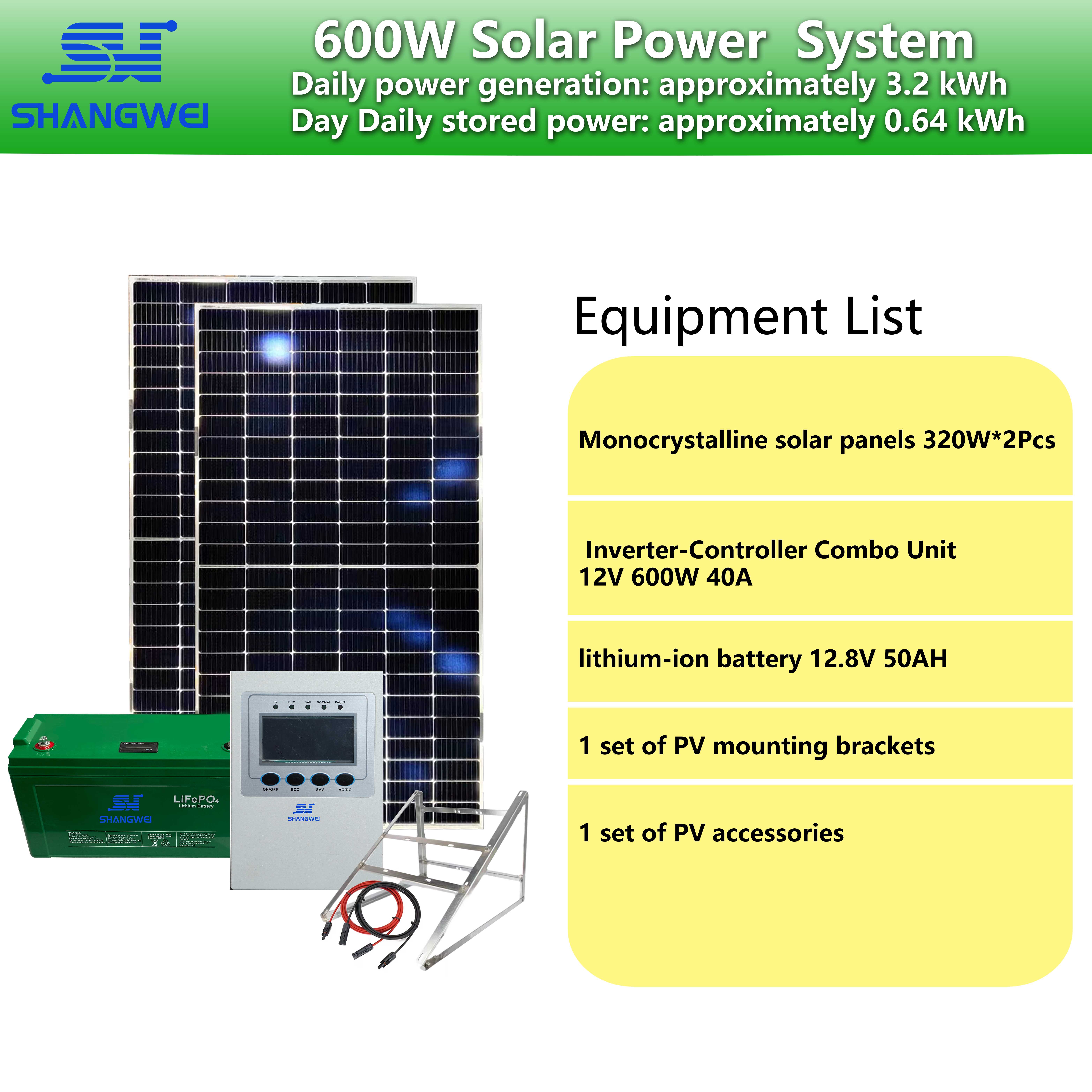
600W Solar Power System Configuration Diagram
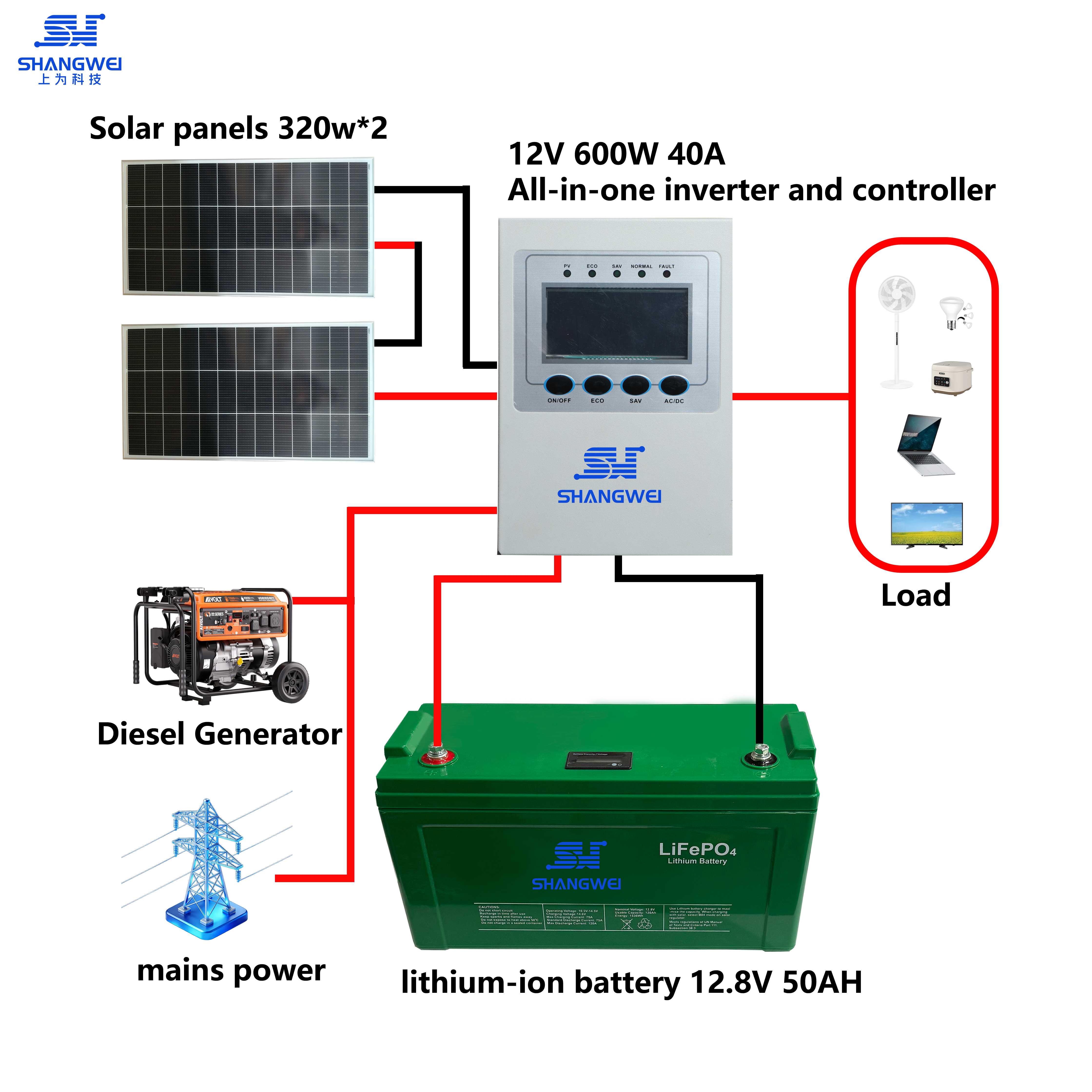
Topology Diagram of a 600W Solar Power System
II. Key Specifications and Technical Parameters
(1) Photovoltaic power generation units: 2 × 320W monocrystalline high-efficiency modules
Module Model: 320W Monocrystalline PV Module
Total Installed Power: 640W (Standard Test Conditions)
Key Parameters
Maximum Power (Pmax): 320W (Under standard test conditions: irradiance 1000 W/m², cell temperature 25°C, AM1.5 spectrum)
Maximum Power Point Voltage (Vmpp): 34.92V (Voltage at which the module delivers maximum power)
Maximum Power Point Current (Impp): 8.59A (Current at which the module delivers maximum power)
Open-Circuit Voltage (Voc): 41.04V (Maximum output voltage when the module is unloaded)
Short-Circuit Current (Isc): 9.02A (Maximum current when the module’s positive and negative terminals are directly short-circuited)
Conversion Efficiency: 23% (Efficiency of converting solar energy into electrical energy; at the high-efficiency level for monocrystalline modules)
Power Tolerance: ±3% (Deviation range between actual power and rated power; ensures output stability)
Dimensions: 1640 mm (L) × 992 mm (W) × 35 mm (H) (Standard dimensions, facilitating installation and transportation)
Module Weight: 18.0 kg per module (moderate weight, placing lower demands on building load-bearing capacity during rooftop installation)
Technical Advantages: The monocrystalline structure offers excellent low-light performance, high-temperature resistance, and resistance to wind and sand, making it well-suited for Africa’s intense sunlight conditions. It provides superior long-term power generation stability compared to polycrystalline modules and achieves higher overall system utilization.

320W monocrystalline solar module
(2) Inverter Control Unit: SW-ST-152 12V/600W/40A Integrated Inverter and Controller
Product Description: A standard vertical, utility-frequency pure sine wave inverter-charger combo that integrates inverter, solar charging, grid charging, switching control, and multiple protection features into a single unit. Designed for 12V low-voltage energy storage systems and optimized for residential off-grid applications.
Key electrical specifications:
Key Advantages: Pure sine wave output, strong interference resistance, automatic adaptation to lithium-ion or lead-acid batteries, and unattended automatic recovery, ensuring long-term stable operation.

SW-ST-152 12V/600W/40A Inverter-Controller Combo
(3) Energy Storage Unit: SW-LH-1250 12.8V/50Ah lithium iron phosphate battery pack
Product Description: A specialized lithium-ion energy storage battery designed to replace traditional lead-acid batteries in home storage applications. It offers a long service life, high safety, and maintenance-free operation, and is compatible with 12V low-voltage systems to provide power during nighttime and on cloudy or rainy days.
Key Specifications:
Technical Advantages: Lithium iron phosphate battery cells offer high thermal stability and are resistant to thermal runaway. They are maintenance-free, compact, and lightweight, making them significantly superior to traditional lead-acid batteries and reducing total lifecycle costs.
III. System Operating Principles and Energy Management
Daytime Solar Power Generation Mode
When sunlight is abundant, the solar panels convert solar energy into direct current (DC). After being optimized by the MPPT inverter-controller, this power is first supplied to the home’s alternating current (AC) loads, with any excess energy stored in lithium-ion batteries, enabling self-generation for self-consumption and the storage of surplus electricity.
Energy Storage Discharge Mode
At night or in the absence of sunlight, the lithium-ion battery releases direct current, which is converted by the inverter-controller combo into 220V pure sine wave alternating current, continuously supplying power to the load and ensuring uninterrupted basic power supply.
Grid-tied mode (optional)
When mains power is available, the system automatically monitors the mains power status and switches to battery or PV power within 10 ms in the event of an abnormality; when mains power is normal, the system can use it to charge the battery, thereby enhancing power supply redundancy.
Smart Protection and Management
Both the inverter-controller combo unit and the battery are equipped with multiple layers of protection. The system automatically shuts down in the event of abnormal battery voltage, overload, short circuit, or overheating, and automatically resumes operation once the issue is resolved. It supports unattended operation, making it ideal for scenarios in Africa where maintenance capabilities are limited.
IV. Power Generation Performance and Electricity Demand Matching
Average daily total power generation: Approximately 3.2 kWh (calculated based on typical daily effective sunlight hours in Africa of 4–5 hours)
Average daily usable net electricity: Approximately 0.64 kWh (after deducting system losses, energy storage cycle losses, and reserve capacity)
Typical load compatibility (simultaneous operation):
The system can reliably support the basic electrification needs of small and medium-sized households in Africa, replacing kerosene lamps and diesel generators while reducing electricity costs and safety risks.

Solar Lighting Equipment in West Africa
V. Environmental Adaptability and Reliability Design
High-temperature resistance
Battery operating temperature: -20°C to 60°C; integrated inverter-controller: 0°C to 40°C; suitable for the high-temperature environments of tropical and subtropical regions in Africa.
Dust-proof and interference-resistant
Industrial-grade structural design, suitable for dusty and high-humidity environments, reducing failure rates.
Low-voltage stability
12V low-voltage system, safe to install and maintain, reducing the risk of electric shock, and suitable for use by non-professionals in the home.
Long-life design
Photovoltaic modules come with a 20-year warranty, cells with ≥3,000 charge-discharge cycles, and a combined inverter-controller unit featuring highly reliable components, significantly extending the overall system lifespan.
Maintenance-free operation
Lithium-ion batteries require no topping up or equalization maintenance; the integrated inverter-controller manages them automatically, reducing the need for manual intervention.
VI. Key Points for Installation and Deployment
Installation Requirements: Roof or open area facing the equator with no obstructions to ensure optimal sunlight exposure.
Wiring Specifications: Clearly distinguish between positive and negative terminals for PV modules, batteries, loads, and utility power. Use compliant copper cables, ensure secure crimping, and implement proper insulation and lightning protection.
Layout Recommendations: Mount PV modules outdoors. Place the inverter-controller combo and batteries indoors in a well-ventilated, dry, and cool location to avoid direct sunlight and rain.
System Expansion: Supports parallel connection of batteries of the same specification to extend backup runtime; PV modules can be added to increase power generation and accommodate more loads.
VII. Application Value and Market Positioning
This system is precisely tailored to meet the electricity needs of small and medium-sized households in Africa, addressing pain points such as lack of electricity, power shortages, high electricity prices, and unstable power supply. Its core value:
Improvements in People's Livelihoods
Provide reliable lighting, communication, and charging services, as well as power for small appliances, to improve quality of life and support children’s nighttime study.
Cost-effective
Zero fuel costs and low operating and maintenance expenses; replaces kerosene and diesel, significantly reducing household energy expenses over the long term.
Green and Safe
Clean energy produces zero emissions, is silent, and generates no exhaust fumes, eliminating the risk of fires and poisoning associated with kerosene lamps.
Inclusive and feasible
Compact in design, easy to install, and offering excellent value for money, this solution is ideal for large-scale deployment and supports rural electrification and green energy development in Africa.
VIII. Conclusion
The 600W off-grid residential solar system is built around two 320W monocrystalline modules, an SW-ST-152 inverter-controller combo, and an SW-LH-1250 lithium iron phosphate battery, delivering a highly efficient, stable, safe, and cost-effective standalone power solution. With an average daily power generation of 3.2 kWh and 0.64 kWh of usable pure electricity, it perfectly meets the basic power needs of small and medium-sized households in Africa. The system integrates key technologies such as pure sine wave inversion, MPPT fast charging, intelligent protection, and long-life energy storage. It features strong environmental adaptability, high reliability, and maintenance-free operation. Serving as both a practical solution to current electricity shortages and a vital pillar for promoting the green energy transition in African households, it can be widely deployed in rural areas, communities, and remote villages, providing a solid technological foundation for Africa’s electrification and sustainable development.


