Technical Proposal for a 25 kW/60 kWh Three-Phase Grid-Connected Photovoltaic Energy Storage System

Three-Phase Grid-Connected Photovoltaic Energy Storage System in Namibia
I. System Overview
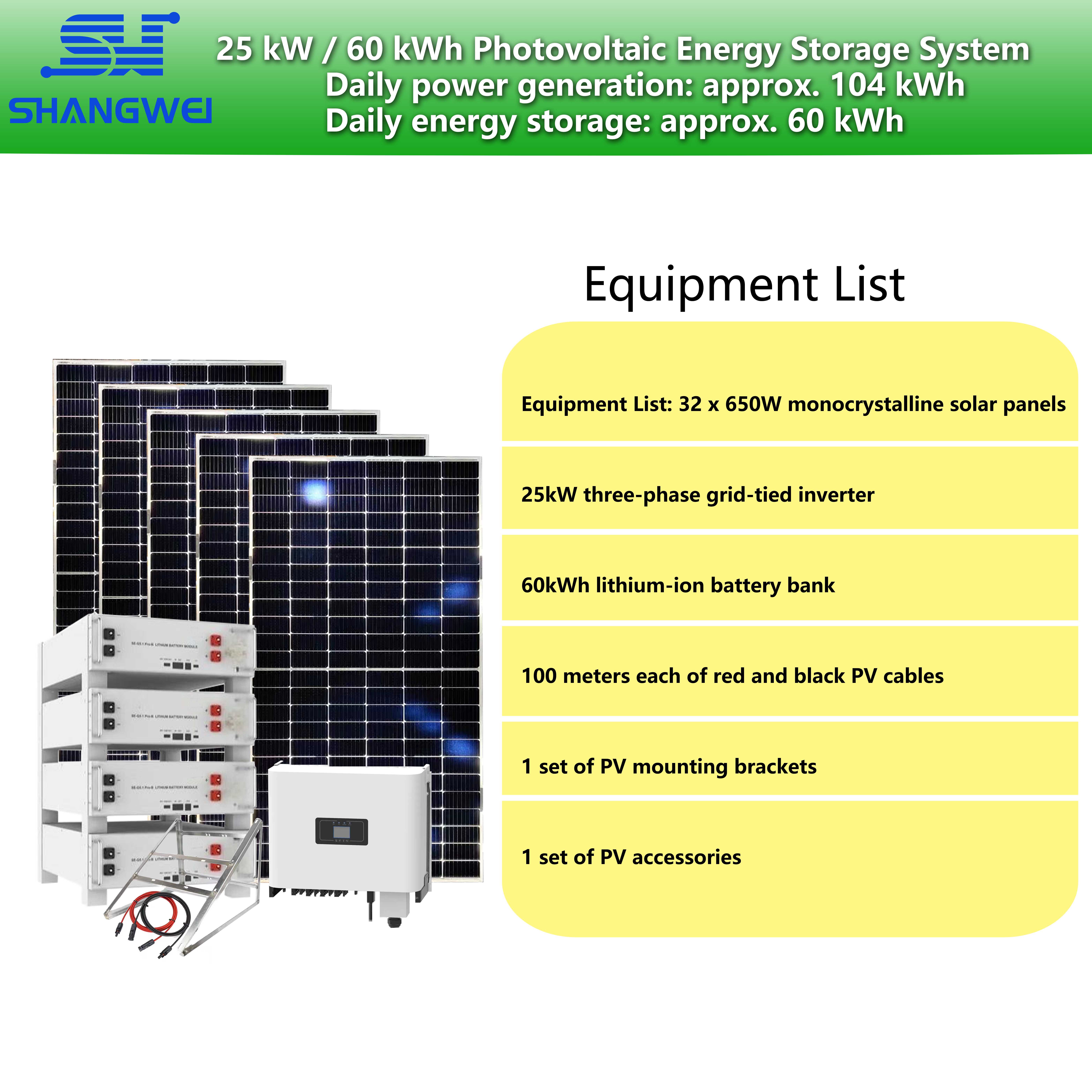
25 kW / 60 kWh Three-Phase Grid-Connected Photovoltaic-Storage System Configuration Diagram
II. Technical Specifications and Performance of Core Equipment

Topology Diagram of a 25 kW/60 kWh Three-Phase Hybrid Grid-Connected Solar-Storage System
(1) Three-phase grid-tied inverter
AC output capacity
With a rated AC output power of 25,000 W (25 kW) and compatibility with 220 V/380 V three-phase AC grids, it can reliably power a wide range of three-phase industrial loads and single-phase residential loads, meeting the daily power needs of commercial, industrial, and residential applications as well as the operational requirements of production equipment. Its rated output current design ensures stable power delivery, with a total harmonic distortion (THD) rate lower than industry standards, effectively preventing harmonic interference with electrical equipment and ensuring the safe operation of loads.
PV Input Performance
The system supports a maximum PV input power of 50,000 W (50 kW) and is equipped with two independent MPPT (Maximum Power Point Tracking) channels, each capable of handling a maximum PV input current of 40 A. It can flexibly adapt to PV module arrays with varying orientations and tilt angles, thereby improving power generation efficiency under complex lighting conditions. The system features a maximum PV-side withstand voltage of 850V, with an MPPT rated operating voltage range of 150–850V and a nominal operating voltage range of 500–850V. This design accommodates both high-voltage PV module series arrays and enables rapid power generation startup under low-light and low-voltage conditions, significantly expanding the flexibility and adaptability of module configurations.
Battery Charge and Discharge Management
The inverter has a maximum charging power of 50.0 kW and is precisely matched with the SW-G12-60WKWH high-voltage lithium-ion battery pack. It supports the connection of lithium iron phosphate (LFP) batteries, with an operating voltage range of 150–800 V, making it compatible with high-voltage lithium-ion battery packs in various series configurations. The rated charging and discharging currents are both 75 A, ensuring efficient charging and discharging of the battery pack within a safe current range. Additionally, it features built-in three-stage charging curve management to optimize the charging process and extend the battery’s cycle life.
Safety and Security Features
The inverter integrates multiple protection mechanisms, including reverse connection protection, overcurrent/overvoltage protection, islanding protection, AC short-circuit protection, earth leakage current detection, ground fault monitoring, and grid monitoring functions. It can respond quickly to scenarios such as grid failures, load abnormalities, and equipment malfunctions, cutting off hazardous circuits to ensure the safety of both the system and personnel. With an IP65 protection rating, the device is resistant to wind, rain, dust, and corrosion, making it suitable for complex outdoor installation environments. It employs a transformerless topology combined with an intelligent fan cooling design, which reduces operational losses while enhancing equipment stability. Efficiency reaches over 98.00%, enabling highly efficient energy conversion.
(2) SW-G12-60WKWH High-Voltage Lithium-Ion Battery Pack

Shangwei 15kWh Lithium-Ion Battery Production Line
Key Performance Specifications
The battery pack has a total capacity of 60.0 kWh and a rated voltage of 614 V. It features a modular stacked design consisting of four 15-kWh lithium-ion battery modules, which facilitates transportation, installation, and capacity expansion. It also allows for the flexible addition of modules at a later stage to increase the system’s energy storage capacity in response to changing power demands.
Advantages of Battery Technology
Utilizing lithium iron phosphate (LiFePO₄) battery technology, this system offers high safety, a long cycle life, a wide operating temperature range, and a low self-discharge rate. It is capable of operating in ambient temperatures ranging from -25°C to 60°C, meeting installation requirements in various regions. The high-voltage platform design effectively reduces charging and discharging currents, minimizing line losses and heat generation. This enhances the system’s overall efficiency while reducing safety risks.
Integrated Management System
Equipped with a built-in intelligent Battery Management System (BMS), it monitors individual cell voltage, current, and temperature in real time, providing multiple layers of protection against overcharging, over-discharging, overcurrent, overheating, and short circuits to ensure the safe and stable operation of the battery pack. It also supports communication with the inverter to enable coordinated control of the charging and discharging processes, thereby optimizing system operation strategies.

SW-G12-60WKWH High-Voltage Lithium-Ion Battery Pack
(3) Photovoltaic Module Array Configuration
Single-cell performance
Each module has a rated power of 650W, an open-circuit voltage (Voc) of 45V, a maximum power voltage (Vmp) of 38V, a maximum power current (Imp) of 17A, and a short-circuit current (Isc) of 18A. It features high conversion efficiency and excellent low-light performance, maintaining high power generation efficiency under low-light conditions such as cloudy or overcast skies. The module measures 2384 × 1303 × 35 mm and weighs 34 kg. It features a high-strength aluminum alloy frame and tempered glass encapsulation, offering excellent resistance to wind, hail, and weathering, making it suitable for long-term outdoor operation.
Array Configuration Options
Based on the module specifications and the inverter’s MPPT voltage range, an array configuration of “16 modules per string, with a total of 2 strings” is adopted. When 16 modules are connected in series per string, the open-circuit voltage is 45V × 16 = 720V, and the maximum power voltage is 38V × 16 = 608V. These values fall entirely within the inverter’s MPPT operating range of 150–850V, enabling precise tracking of the maximum power point and efficient power generation
Estimated Electricity Generation
Based on standard conditions of 5 hours of daily sunlight, the system can generate an average of 104 kWh per day, which is sufficient to meet the daily electricity needs of most commercial, industrial, and residential users. Excess electricity can be stored in battery banks or fed into the grid, enabling an economical operating model of “self-generation for self-consumption, with surplus power fed into the grid.”
III. System Operating Modes and Working Principles
Grid-connected operation mode
When the grid is supplying power normally, the system prioritizes supplying the electrical energy generated by the photovoltaic modules to the loads. Excess energy is first used to charge the SW-G12-60WKWH battery bank; once the battery is fully charged, any remaining energy can be fed back into the grid. When photovoltaic generation is insufficient, the grid supplements the power supply to ensure stable operation of the loads. The inverter dynamically adjusts the PV output and battery charging/discharging strategies based on changes in grid voltage, frequency, and load, thereby achieving “self-generation for self-consumption with surplus power fed into the grid” and reducing the user's electricity costs.
Off-grid operation mode
In the event of a grid failure or power outage, the system automatically switches to off-grid mode, with the photovoltaic modules and battery bank working together to supply power to the load. When sunlight is abundant, the PV modules directly supply power to the loads while simultaneously charging the battery bank; when sunlight is insufficient or at night, the battery bank discharges energy to power the loads, ensuring uninterrupted operation of critical loads and providing independent power supply capability in off-grid conditions. The inverter features a built-in fast-switching mechanism with a switching time of less than 10 ms, preventing load interruptions due to power outages and making it suitable for scenarios with high requirements for power supply continuity.
Intelligent Collaborative Control Strategy
The system features built-in energy management strategies that automatically optimize charging and discharging schedules based on user electricity consumption patterns, grid peak and off-peak rates, and solar irradiance forecasts. For example, during off-peak grid pricing periods, grid power can be used to charge the battery pack; during peak pricing periods, the battery pack discharges to power the load, thereby reducing the user’s electricity costs. Additionally, the system can adjust photovoltaic output and battery charging strategies based on weather forecasts to maximize the utilization of solar power and reduce reliance on the grid.
IV. System Advantages and Application Value
(1) Core Technological Advantages
High-efficiency energy conversion
The inverter employs an advanced MPPT algorithm with a tracking efficiency of over 99%. When combined with high-efficiency solar modules and low-loss high-voltage battery banks, the system achieves an overall conversion efficiency of over 98%, significantly improving the utilization efficiency of solar power generation.
High reliability and safety
The inverter’s IP65 protection rating, multi-level BMS protection for the battery bank, weather-resistant module design, and comprehensive electrical protection mechanisms ensure the system’s long-term stable operation in challenging environments and minimize the risk of failure.
Flexible Configuration and Scalability
Both the solar array and the battery bank feature a modular design, allowing users to flexibly adjust the number of modules or battery modules based on their power needs, making it easy to expand capacity in the future; the inverter supports multiple operating modes and can be adapted to various scenarios, including grid-connected, off-grid, and backup power applications.
Smart Monitoring and Management
The system supports LCD and LED displays, as well as communication interfaces such as RS485, CAN, Wi-Fi, and GPRS/4G, enabling real-time monitoring and remote management of equipment status, power generation, and battery status. Users can view data and adjust operating parameters through the platform to achieve intelligent system operation and maintenance.
(2) Practical Value
Economic benefits
Through the “self-consumption with surplus power fed into the grid” model, users can reduce their reliance on grid electricity and lower their electricity bills; peak-off-peak pricing arbitrage strategies can further reduce electricity costs, while the long-life design of the photovoltaic modules and battery packs ensures stable, long-term returns for the system.
Improved Power Supply Reliability
The off-grid switching function ensures uninterrupted power supply to critical loads during grid failures, preventing production losses or daily inconveniences caused by power outages. It is suitable for commercial and industrial settings, remote areas, and scenarios with high requirements for power supply continuity.
V. Key Points for System Installation and Maintenance
(1) Installation Design Specifications
Installation of Photovoltaic Arrays
Panels should be installed in an unobstructed location with ample sunlight. The tilt angle and orientation should be optimized based on the local latitude to avoid shading. Series and parallel wiring must comply with electrical standards, and proper insulation and waterproofing measures must be implemented. Junction boxes and connectors must be UV-resistant and weatherproof.
Installation of the Inverter and Battery Bank
The inverter must be installed in a well-ventilated location that facilitates heat dissipation, and must be placed at a sufficient distance from walls. The SW-G12-60WKWH battery pack must be installed in a dry, well-ventilated environment with appropriate temperatures, away from heat sources and flammable or explosive materials. During installation, take precautions regarding high-voltage safety to avoid the risk of short circuits.
Electrical System Connections
The wiring on the DC and AC sides must use cables of the appropriate specifications to meet current and voltage carrying capacity requirements, and proper grounding protection must be ensured. Communication cables connecting the inverter to the battery bank, PV array, and utility grid must be connected correctly to ensure stable data transmission.
(2) Daily Operations and Maintenance
Regular inspections
Regularly inspect the surface of the photovoltaic modules for dust or debris that may be obstructing them; check that the inverters and battery banks are operating normally and at appropriate temperatures; and verify that the terminal connections are secure and not overheating. Regularly inspect the grounding system to ensure it is intact and verify that the protective devices are functioning properly.
Data Monitoring and Analysis
Regularly monitor data such as system power generation, battery SOC, and inverter efficiency through the monitoring platform to analyze system performance, promptly identify and address anomalies, and optimize operational strategies.
Maintenance
Regularly clean dust from the surface of the solar panels to improve power generation efficiency; perform equalization charging maintenance based on the operating status of the battery bank; regularly clean the inverter’s cooling fans and vents to prevent dust buildup from obstructing heat dissipation.
VI. Conclusion

Off-grid small-scale solar power systems in Somalia